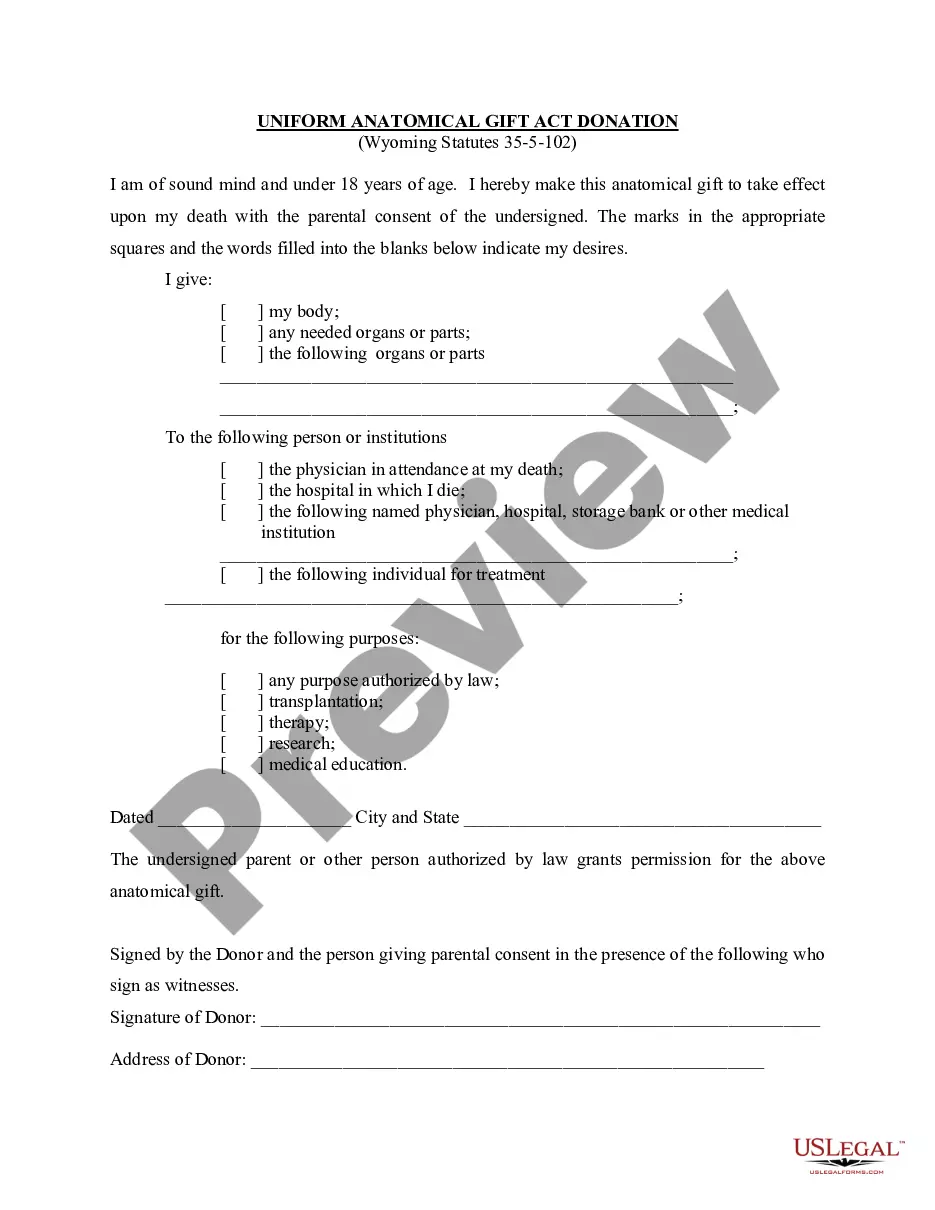
Wyoming Uniform Anatomical Gift Act Donation by Person Under Eighteen Years of Age
Overview of this form
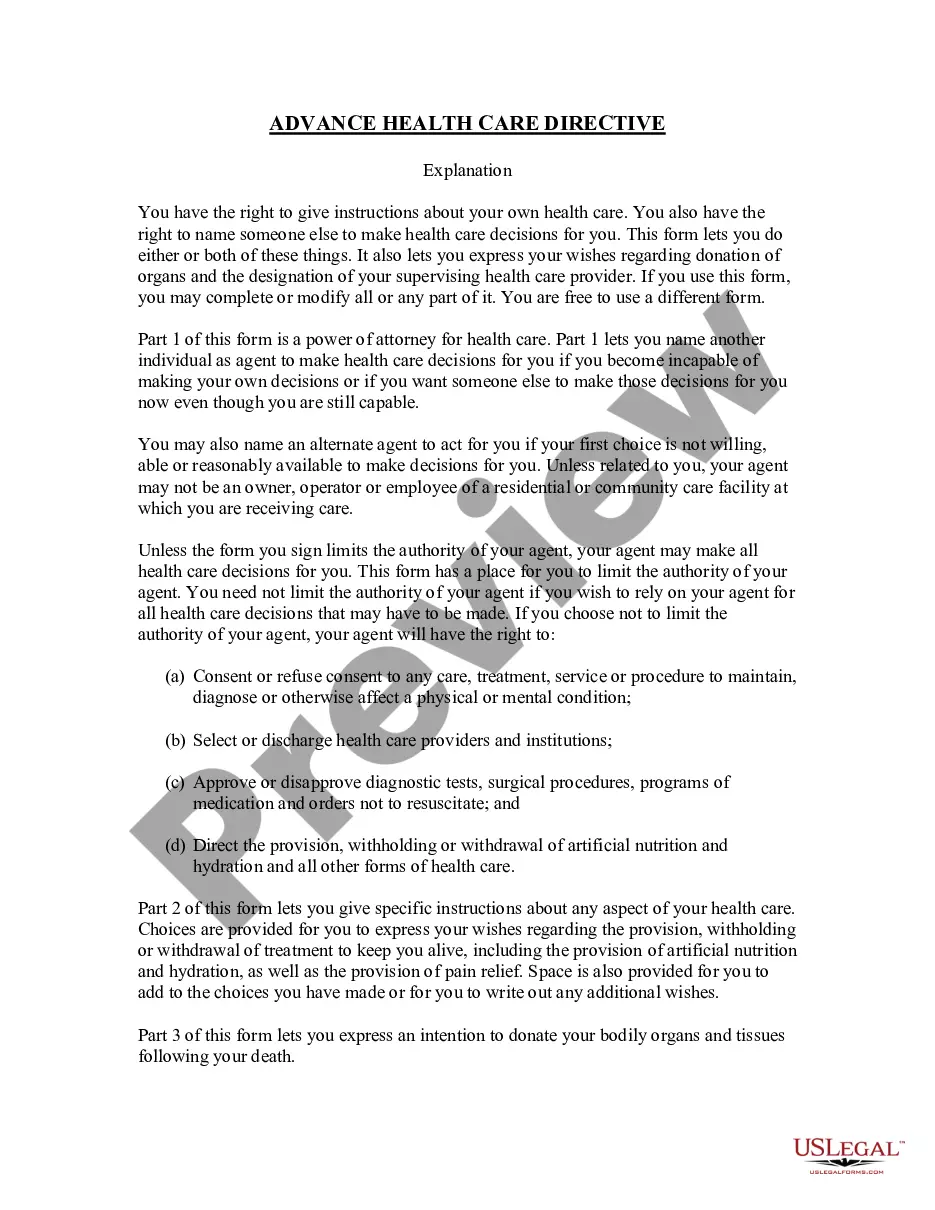
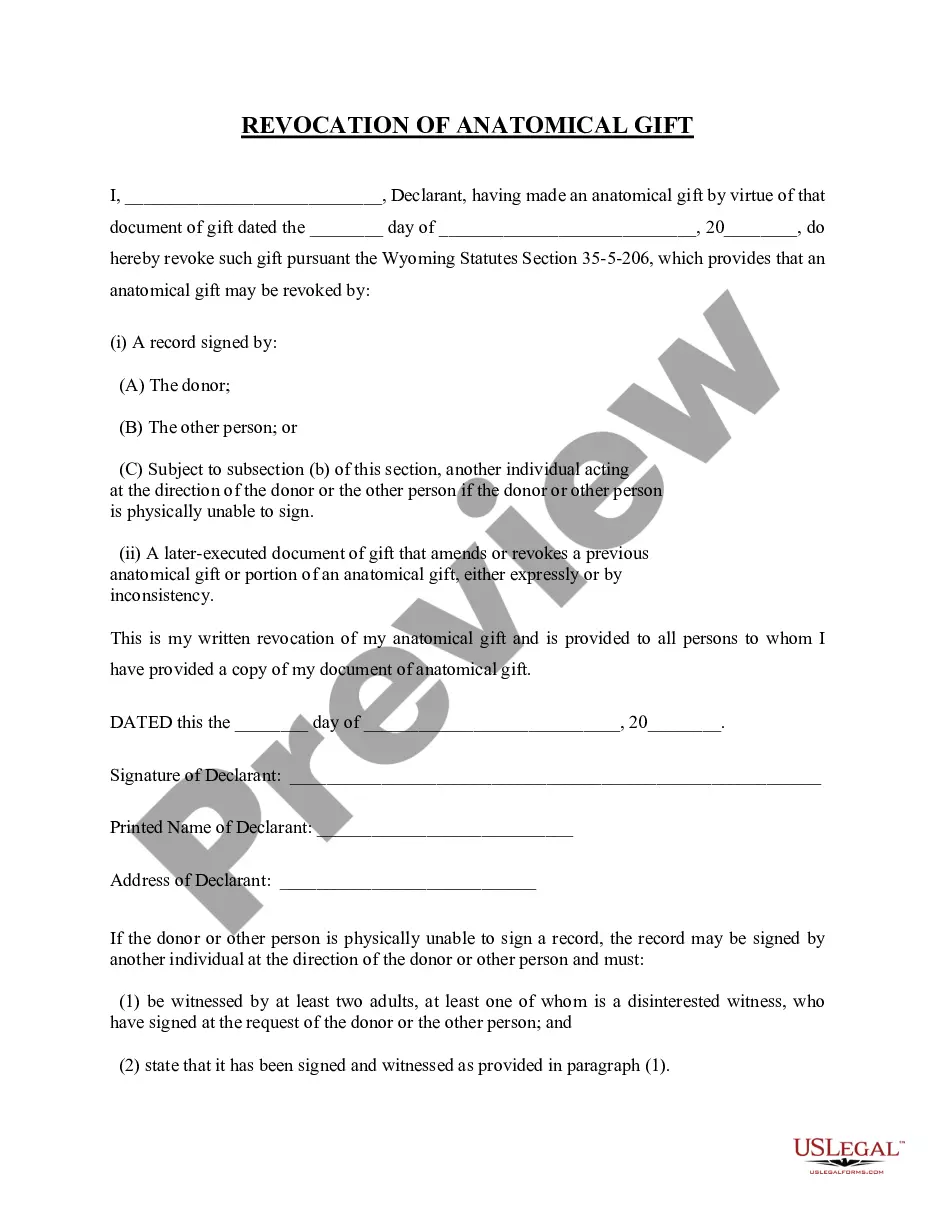
The Uniform Anatomical Gift Act Donation by Person Under Eighteen Years of Age is a legal document that allows individuals under eighteen, with parental consent, to designate specific body parts or organs they wish to donate upon their death. This form ensures that minors can make their wishes known regarding anatomical gifts, distinguishing it from other donation forms that may not accommodate minors without parental approval. It includes signature requirements to validate the document.
Main sections of this form
- Identification of the donor and confirmation of age and mental soundness.
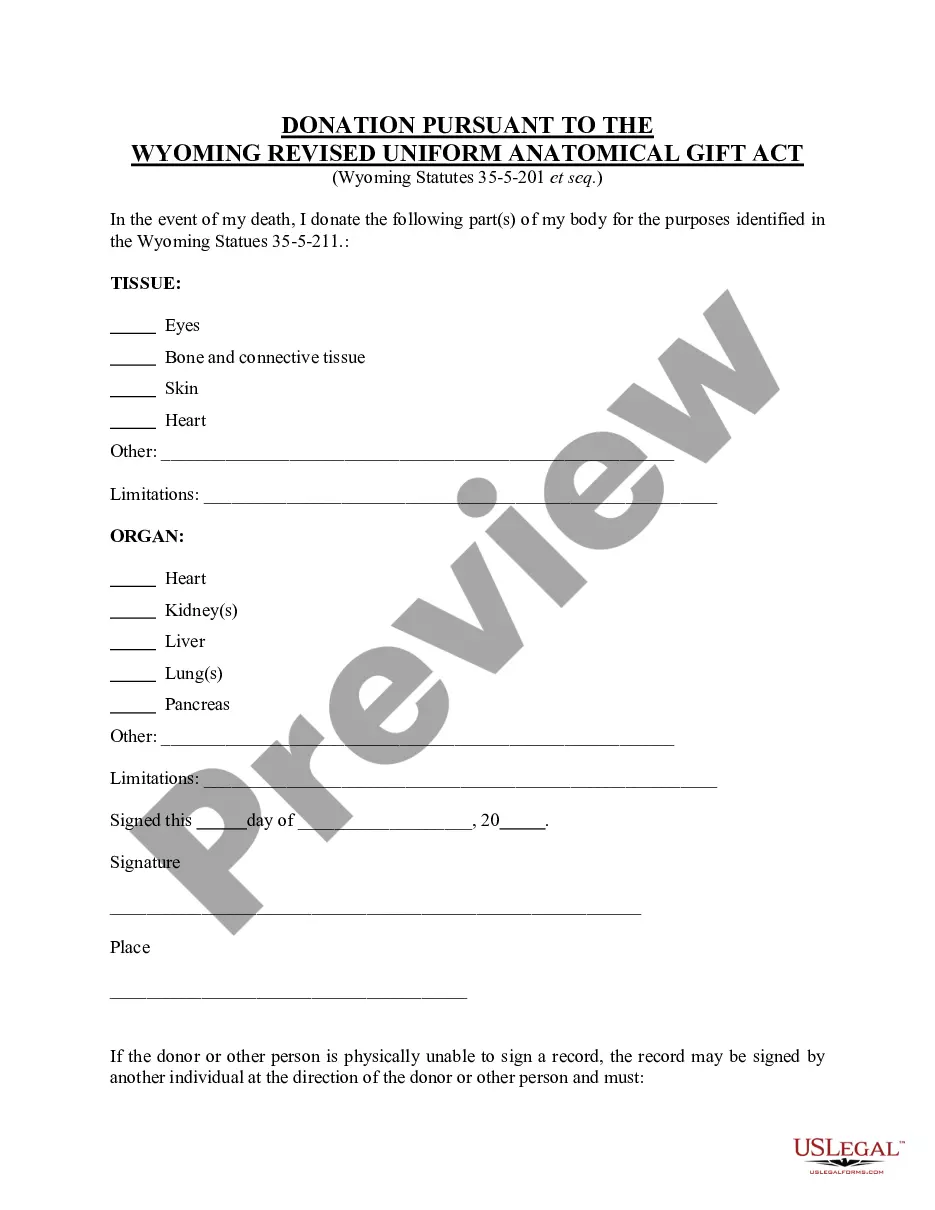
- Specification of which organs or body parts are to be donated.
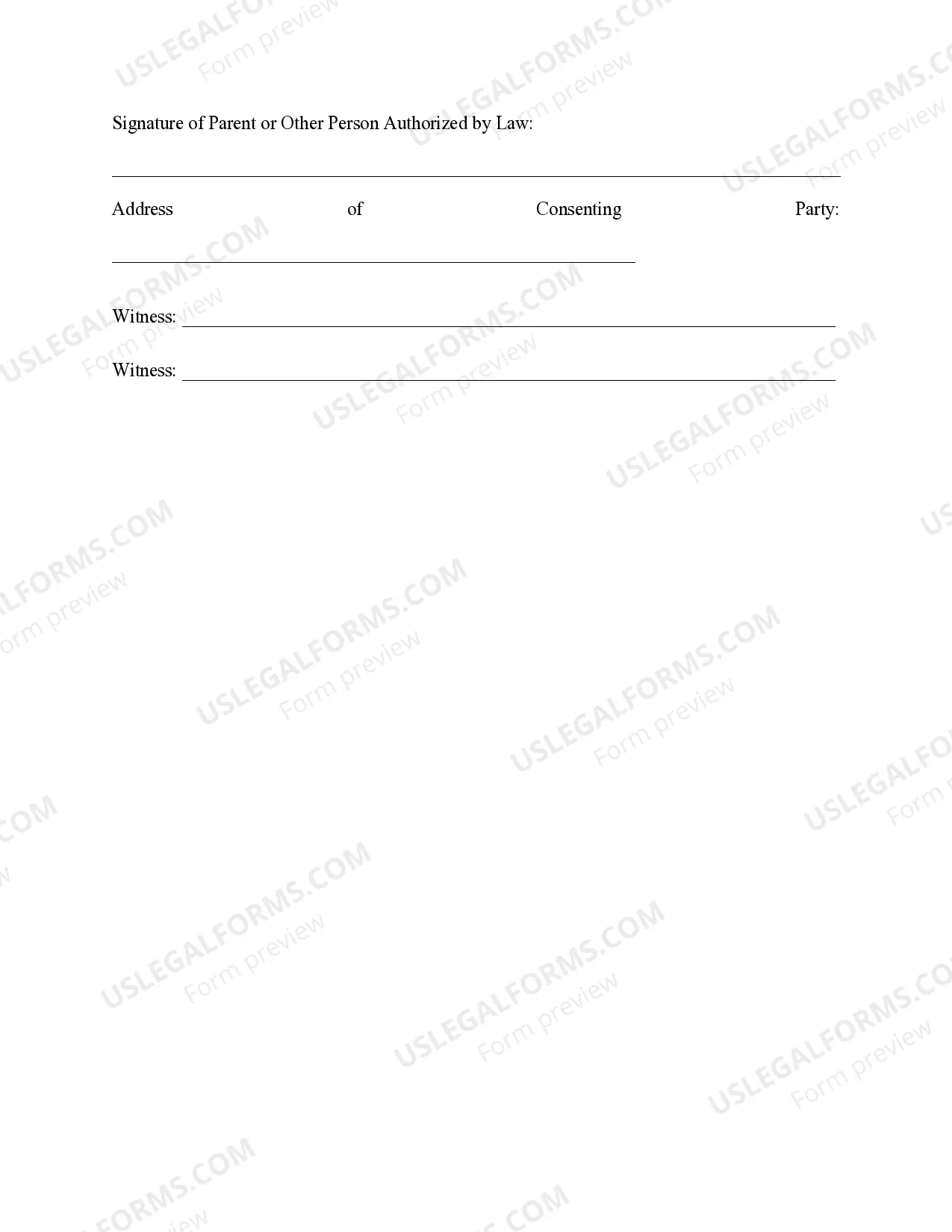
- Parental consent required for the donor under eighteen years of age.
- Witness signatures to validate the document.
- Details of the intended recipient of the donation, such as physicians or medical institutions.
- Purpose of the donation, like transplantation or research.
When to use this document
Use this form when a minor wishes to donate their organs or body parts upon their death, and parental consent is necessary. Situations may include life-threatening medical conditions, a desire to help others after death, or participation in organ donation awareness initiatives.
Who needs this form
- Minors under eighteen years of age who wish to make anatomical gifts.
- Parents or legal guardians providing consent for their childâs donation.
- Individuals involved in discussions about organ donation with minors.
Completing this form step by step
- Complete the donor's information, confirming they are under eighteen and of sound mind.
- Select the specific organs or body parts to be donated.
- Obtain parental consent by having the parent or legal guardian sign the form.
- Gather two witnesses to sign the document in the donor's presence, with one witness being the consenting parent or guardian.
- Fill in the date and location of the signing.
Does this document require notarization?
This form does not typically require notarization unless specified by local law. Ensure all signatures are obtained properly to validate the gift.
Get your form ready online
Our built-in tools help you complete, sign, share, and store your documents in one place.
Make edits, fill in missing information, and update formatting in US Legal Forms—just like you would in MS Word.
Download a copy, print it, send it by email, or mail it via USPS—whatever works best for your next step.
Sign and collect signatures with our SignNow integration. Send to multiple recipients, set reminders, and more. Go Premium to unlock E-Sign.
If this form requires notarization, complete it online through a secure video call—no need to meet a notary in person or wait for an appointment.
We protect your documents and personal data by following strict security and privacy standards.

Make edits, fill in missing information, and update formatting in US Legal Forms—just like you would in MS Word.

Download a copy, print it, send it by email, or mail it via USPS—whatever works best for your next step.

Sign and collect signatures with our SignNow integration. Send to multiple recipients, set reminders, and more. Go Premium to unlock E-Sign.

If this form requires notarization, complete it online through a secure video call—no need to meet a notary in person or wait for an appointment.

We protect your documents and personal data by following strict security and privacy standards.
Mistakes to watch out for
- Failing to have the required number of witnesses during the signing.
- Omitting parental consent or failing to have the consent signed properly.
- Not specifying the organs or parts clearly enough.
- Leaving out the donor's address and other required personal information.
Why use this form online
- Convenience of downloading and completing the form at your own pace.
- Editability allows for corrections and adjustments as necessary.
- Access to legally sound templates drafted by licensed attorneys, ensuring compliance with local laws.
Key takeaways
- The form is essential for minors wishing to donate organs or body parts upon their death.
- Parental consent and witness signatures are critical for the form to be valid.
- Completing the form accurately helps ensure that the donor's wishes are respected and legally enforceable.
Looking for another form?

Form popularity
FAQ
You can record your decision to opt in or out on the Organ Donor Register. Those excluded will be people under 18, people who have lived in England for less than 12 months or who are not living here voluntarily, and people who lack the capacity to understand the change.
The law allows an adult (someone age 18 or older) to donate all or part of his or her body for transplant, therapy, education, or research. The act permits minors to make such donations under certain conditions and parents to do so on behalf of an unemancipated minor.
Are my organs too old to donate? There are no cutoff ages for donating organs. Organs have been successfully transplanted from newborns and people older than 80. It is possible to donate a kidney, heart, liver, lung, pancreas, cornea, skin, bone, bone marrow and intestines.
There's no age limit to donation or to signing up. People in their 50s, 60s, 70s and beyond have been both organ donors and organ transplant recipients.People of all ages can be organ donors. One of the oldest organ donors in the U.S. was age 92.
Important Revisions. The UAGA of 2006 allows for individuals to consent to organ donation by expressing their wish when obtaining a driver's license, through verbal expression, by writing it in a will or other advance directive, or in any other manner, simplifying the consent process.
How Old Is Too Old? At many institutions, donors over the age of 60, 65, or even 70 are considered on a case-by-case basis. Between 1990 and 2010, 219 people over the age of 70 donated kidneys, and researchers say the number of donors in this age group is on the rise.
Kidney transplants performed using organs from live donors over the age of 70 are safe for the donors and lifesaving for the recipients, new Johns Hopkins research suggests.
(3) "Anatomical gift" means a donation of all or part of a human body to take effect after the donor's death for the purpose of transplantation, therapy, research, or education.