West Virginia Revocation of Statutory Medical Power of Attorney and Living Will
What this document covers
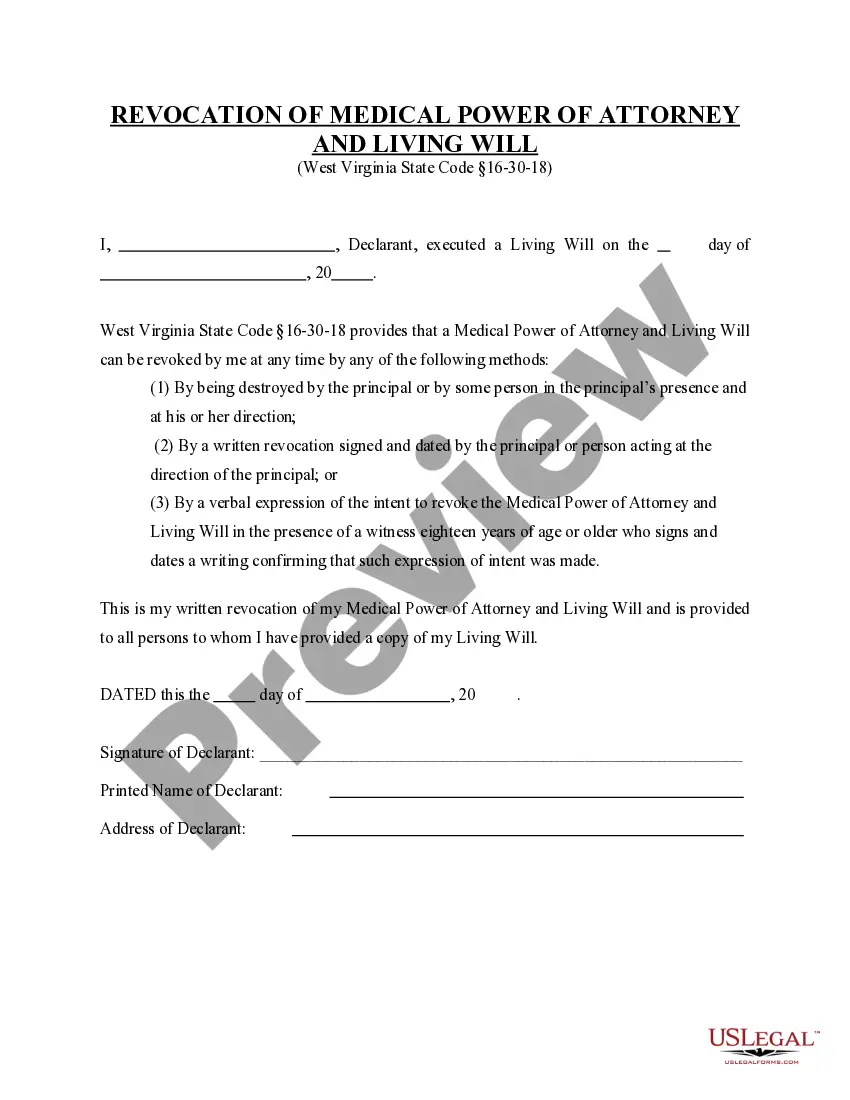
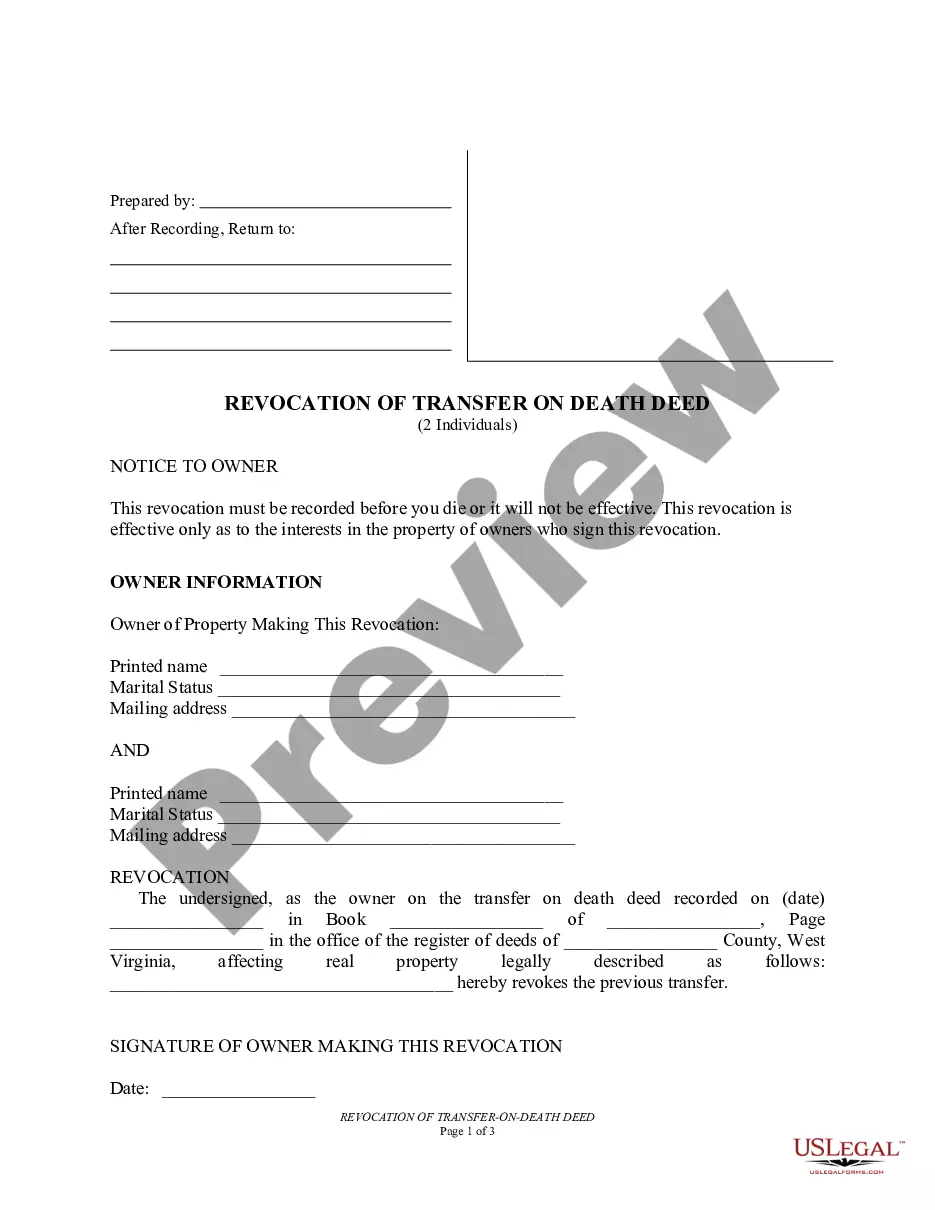
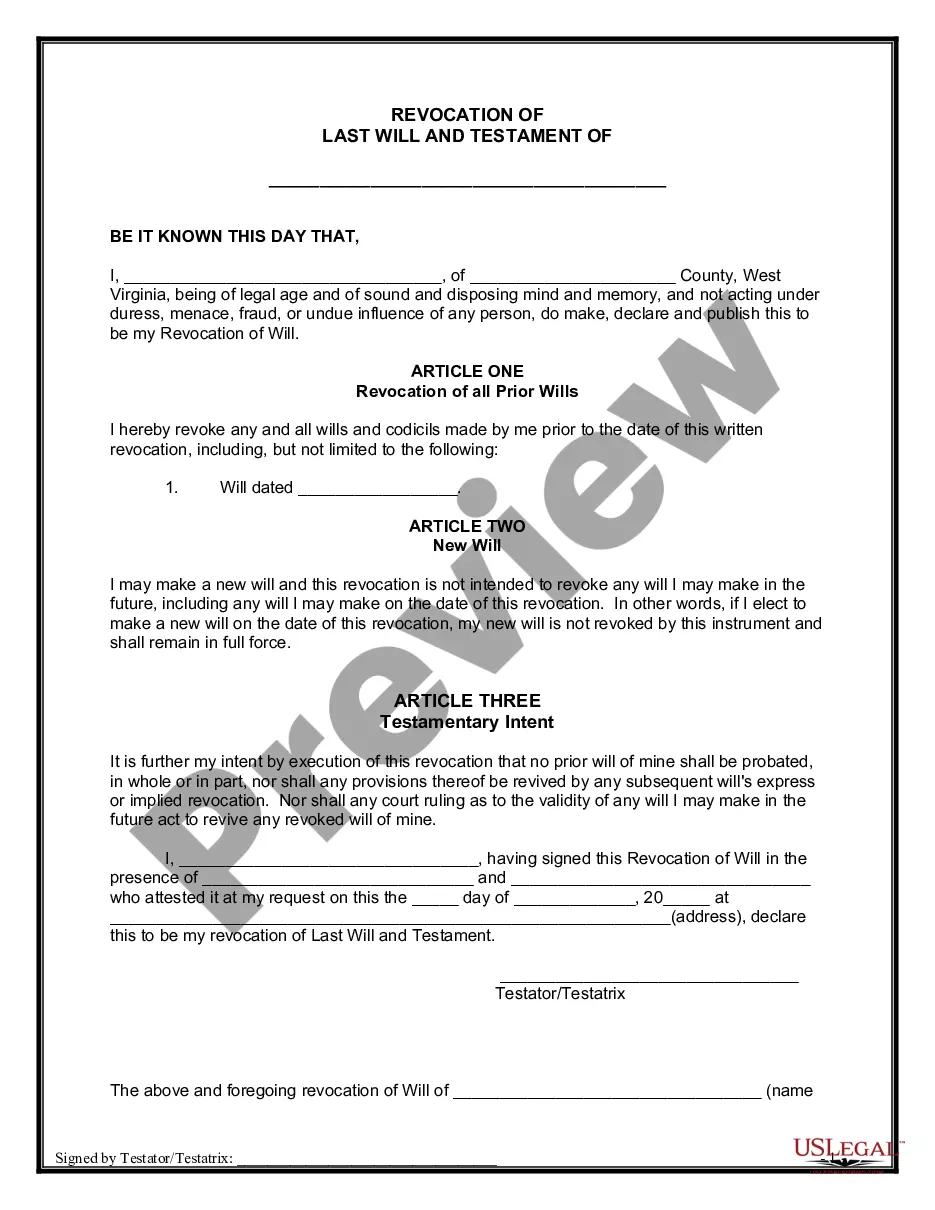
The Revocation of Statutory Medical Power of Attorney and Living Will is a legal document used to cancel a previously established medical power of attorney and living will. This form communicates your decision to revoke the authority granted to your healthcare agent and restates your healthcare preferences. It is essential for ensuring your current wishes regarding medical treatment are upheld, particularly in situations where life-sustaining procedures may be involved.
What’s included in this form
- Identification of the principal: The person revoking the authority.
- Statement of revocation: Explicit declaration that the previous documents are revoked.
- Methods of revocation: Specifies how the revocation can be executed (destruction of documents, written notice, or verbal expression in front of a witness).
- Notification clause: Indicates the need to inform parties who received copies of the original documents.
When this form is needed
You should use this form when you want to revoke your previous wishes about medical treatment and the authority granted to a healthcare agent. Common scenarios include changes in your health status, alteration of personal relationships, or a decision to have a different individual make healthcare decisions on your behalf. This form ensures that healthcare providers and agents are aware of your current preferences.
Intended users of this form
- Individuals who have previously completed a statutory medical power of attorney or living will.
- Anyone wishing to update their healthcare decisions due to changes in life circumstances.
- People looking to appoint a new healthcare agent.
Instructions for completing this form
- Clearly state your name as the principal and provide any necessary identification details.
- Indicate the date when you are completing the revocation.
- Express your intention to revoke the previous documents explicitly.
- Choose one of the methods of revocation (destroying, writing a new notice, or stating verbally in front of a witness).
- Ensure that a witness signs if you opt for verbal revocation, confirming your intent.
- Distribute copies of the completed form to all relevant parties, including the healthcare agent.
Does this document require notarization?
This form usually doesn’t need to be notarized. However, local laws or specific transactions may require it. Our online notarization service, powered by Notarize, lets you complete it remotely through a secure video session, available 24/7.
Get your form ready online
Our built-in tools help you complete, sign, share, and store your documents in one place.
Make edits, fill in missing information, and update formatting in US Legal Forms—just like you would in MS Word.
Download a copy, print it, send it by email, or mail it via USPS—whatever works best for your next step.
Sign and collect signatures with our SignNow integration. Send to multiple recipients, set reminders, and more. Go Premium to unlock E-Sign.
If this form requires notarization, complete it online through a secure video call—no need to meet a notary in person or wait for an appointment.
We protect your documents and personal data by following strict security and privacy standards.

Make edits, fill in missing information, and update formatting in US Legal Forms—just like you would in MS Word.

Download a copy, print it, send it by email, or mail it via USPS—whatever works best for your next step.

Sign and collect signatures with our SignNow integration. Send to multiple recipients, set reminders, and more. Go Premium to unlock E-Sign.

If this form requires notarization, complete it online through a secure video call—no need to meet a notary in person or wait for an appointment.

We protect your documents and personal data by following strict security and privacy standards.
Typical mistakes to avoid
- Failing to notify the healthcare agent and relevant parties about the revocation.
- Not following the correct method of revocation as outlined in the form.
- Inadequate witness verification when revocation is expressed verbally.
Benefits of completing this form online
- Convenient access: Easily download and fill out the form from home.
- Time-saving: Avoid the hassle of visiting a lawyer for standard documents.
- Reliable templates: The forms are drafted by licensed attorneys, ensuring compliance with legal standards.
Looking for another form?
Form popularity
FAQ
You may decide to have both a power of attorney and a living will, called a combined advance directive for health care. Whether you go with one or both, you receive similar benefits. You prevent the matter from having to go to court, where a judge who does not know you would determine what your care would be.
Can you have both a living will and healthcare power of attorney? Yes. Since a living will generally covers very specific issues like DNR (or do not resuscitate), it may not deal with other important medical concerns you might have.
You can give a person complete authority to make all decisions, or limit them significantly to make only specific decisions.If you want specificity, it is better to do that in your living will, which the person with a durable power of attorney cannot override.
Healthcare advance directives should state both what you do want and what you don't want.You retain the right to override the decisions or your representative, change the terms of your living will or POA, or completely revoke an advance directive.
Policies vary, but as a rule a power of attorney may not sign a beneficiary designation form, although some insurance programs allow it.Likewise, a power of attorney cannot designate herself as a beneficiary on the form unless the power of attorney documents clearly state that she has that right.
A power of attorney (POA) is a legal document that allows you to appoint someone to act on your behalf, usually in financial or medical situations.An agent can never transfer their authority to another person unless the POA explicitly permits it.
A living will is a vital part of the estate plan. You can alter it as your preferences and needs change over time.But your family cannot override your living will. They cannot take away your authority to make your own treatment and care plans.
The principal can always override a power of attorney, although it's possible for others to stop an agent from abusing their responsibilities.Medical POA A healthcare or medical power of attorney grants the Agent you appoint the authority to make decisions about your care if you are unable to do so.
You can revoke a Medical Power of Attorney even if you cannot make your own medical decisions. To cancel it, you can: Tell the agent, in person or in writing,Sign a new Medical Power of Attorney.