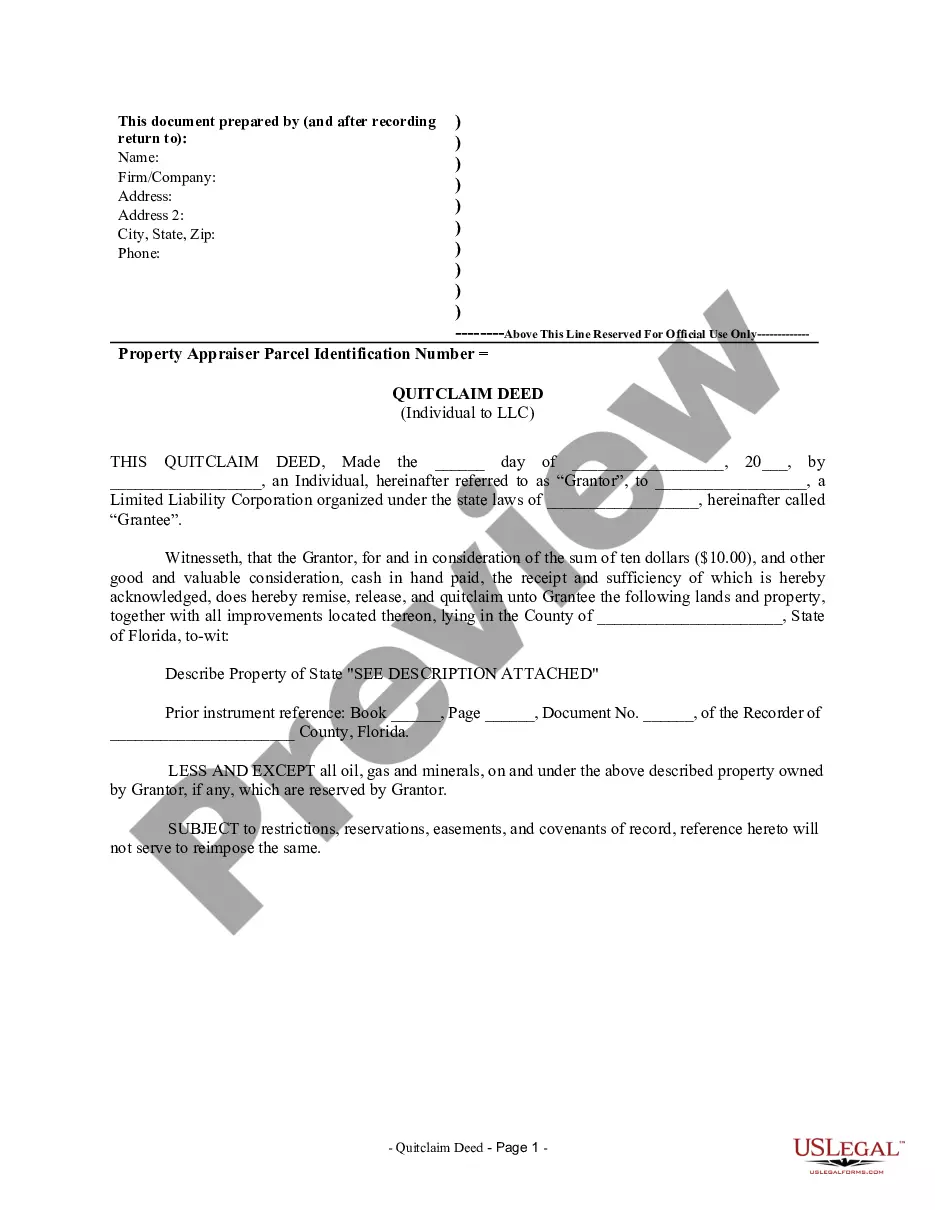
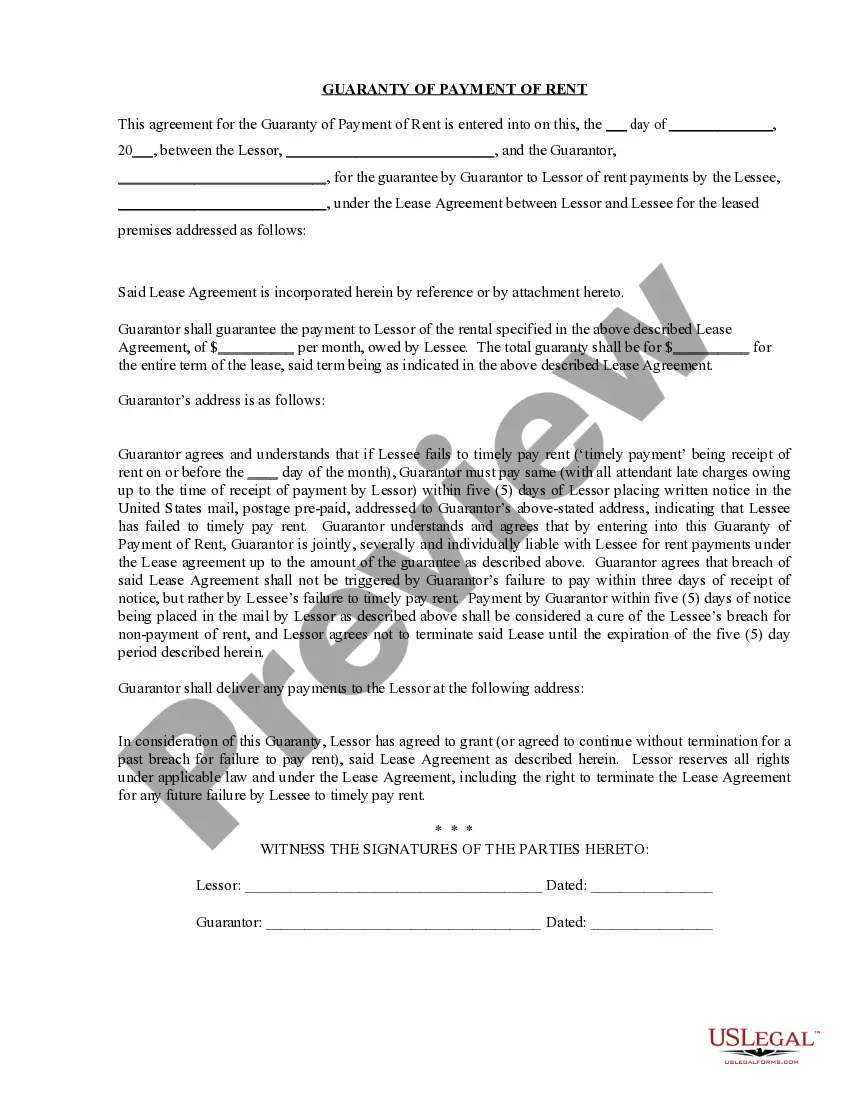
West Virginia Guaranty or Guarantee of Payment of Rent
What this document covers
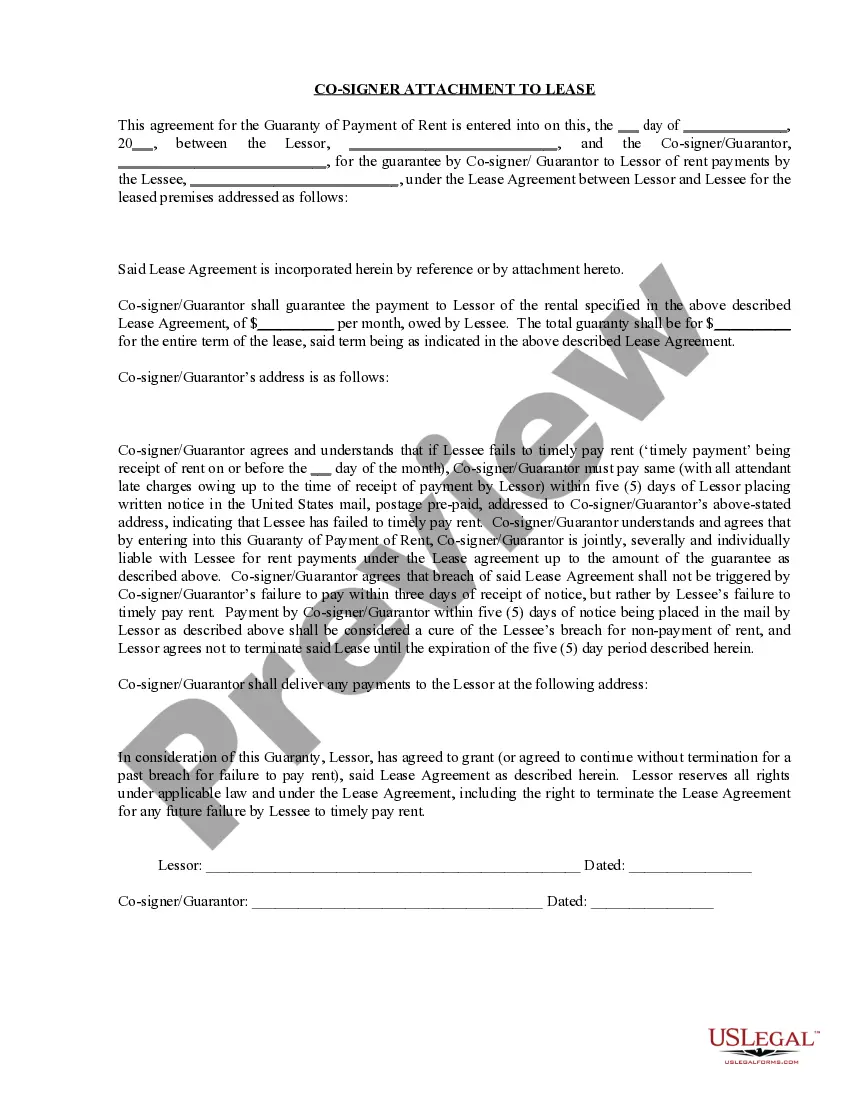
The Guaranty or Guarantee of Payment of Rent is a legal agreement between a tenant's guarantor and the landlord. This contract ensures that the guarantor will cover the rent if the tenant fails to make payments. It is essential for landlords seeking additional security and differs from standard lease agreements by focusing specifically on the guarantor's obligations. This form clarifies the conditions under which the guarantor is liable, providing peace of mind for both parties involved.
Main sections of this form
- Guarantor's details: Includes the name and address of the guarantor.
- Tenant's obligations: Describes the responsibilities of the tenant regarding rent payments.
- Conditions for payment: Specifies the circumstances that will trigger the guarantor's financial responsibility.
- Signatures: Requires signatures from both the landlord and the guarantor to validate the agreement.
- Effective date: Indicates when the agreement becomes enforceable.
Situations where this form applies
This form is useful in various scenarios where a landlord requires assurance that rent payments will be made. It is commonly used when a tenant has insufficient credit history or income to qualify for a lease on their own. By securing a guarantor, landlords reduce the risk of non-payment and create a leasing arrangement that is beneficial for both parties.
Who this form is for
This form is intended for:
- Landlords seeking a financial guarantee for tenant rent payments.
- Tenants who may not qualify for a rental agreement without a guarantor.
- Guarantors looking to understand their obligations before signing.
Instructions for completing this form
- Identify the parties: Provide the names and addresses of both the guarantor and the landlord.
- Specify the tenant: Include the name of the tenant for whom the guarantor is agreeing to pay rent.
- Detail the obligations: Clearly outline the conditions under which the guarantor must pay rent.
- Enter the date and signatures: Both the guarantor and landlord need to sign and date the form to validate the agreement.
Does this document require notarization?
In most cases, this form does not require notarization. However, some jurisdictions or signing circumstances might. US Legal Forms offers online notarization powered by Notarize, accessible 24/7 for a quick, remote process.
Get your form ready online
Our built-in tools help you complete, sign, share, and store your documents in one place.
Make edits, fill in missing information, and update formatting in US Legal Forms—just like you would in MS Word.
Download a copy, print it, send it by email, or mail it via USPS—whatever works best for your next step.
Sign and collect signatures with our SignNow integration. Send to multiple recipients, set reminders, and more. Go Premium to unlock E-Sign.
If this form requires notarization, complete it online through a secure video call—no need to meet a notary in person or wait for an appointment.
We protect your documents and personal data by following strict security and privacy standards.

Make edits, fill in missing information, and update formatting in US Legal Forms—just like you would in MS Word.

Download a copy, print it, send it by email, or mail it via USPS—whatever works best for your next step.

Sign and collect signatures with our SignNow integration. Send to multiple recipients, set reminders, and more. Go Premium to unlock E-Sign.

If this form requires notarization, complete it online through a secure video call—no need to meet a notary in person or wait for an appointment.

We protect your documents and personal data by following strict security and privacy standards.
Mistakes to watch out for
- Failing to include all parties' details accurately.
- Not specifying the conditions that trigger the guarantor's obligations.
- Neglecting to sign and date the contract.
Benefits of completing this form online
- Accessibility: Download and fill out the form anytime and anywhere.
- Customization: Easily edit the template to suit specific needs.
- Security: Protect sensitive information with secure downloads.
Looking for another form?

Form popularity
FAQ
When The Lease Is Up When having a guarantor on the lease, the best way to be able to have him removed as soon as possible is to set a good payment record with the landlord.
What is the deadline to return a security deposit in West Virginia? The security deposit (minus any costs incurred for cleaning or repairs, if applicable) must be returned to the renter no later than 60 days from the date the tenancy is terminated.
State law prohibits landlords from entering rental housing without either the consent of the tenant or providing reasonable notice in advance, unless circumstances require the landlord to perform emergency repairs.
Rolling guaranty: this can be a 12 month, 24 month or some other number of months, rolling guaranty. It means that the total exposure is the number of months regardless of how many months are remaining in the lease (unless the remaining months are less than the rolling months.
When you rent a property from a landlord it becomes your home. They should only enter the property without you being present, if you have given permission for them to do so, or in a genuine emergency.
A guaranty of lease is a covenant by the guarantor to be responsible for the obligations of the tenant.In these examples, a selective landlord would not enter into the lease without the tenant offering a creditworthy guarantor.
While a co-signer is responsible for the rent at the moment it is due, a guarantor only has to pay once the person on the agreement fails to do so. A guarantor won't have any right to live in the apartment "because you are only going to be liable for anything if the tenant stops paying," says Cohen.
It's very common for a guarantee to last as long as the tenancy lasts. So, if the tenant remains in the property for four years, you will continue to be responsible for any arrears or damages during that entire period. Most tenancies will run for a fixed term and will then continue on a month-by-month basis.
The big take-away is that in most circumstances a landlord cannot enter a property without agreement from the tenant. And If the landlord ignores the law and enters the property without permission, the tenant may be able to claim damages or gain an injunction to prevent the landlord doing it again.