Vermont Quitclaim Deed by Two Individuals to Husband and Wife
What this document covers
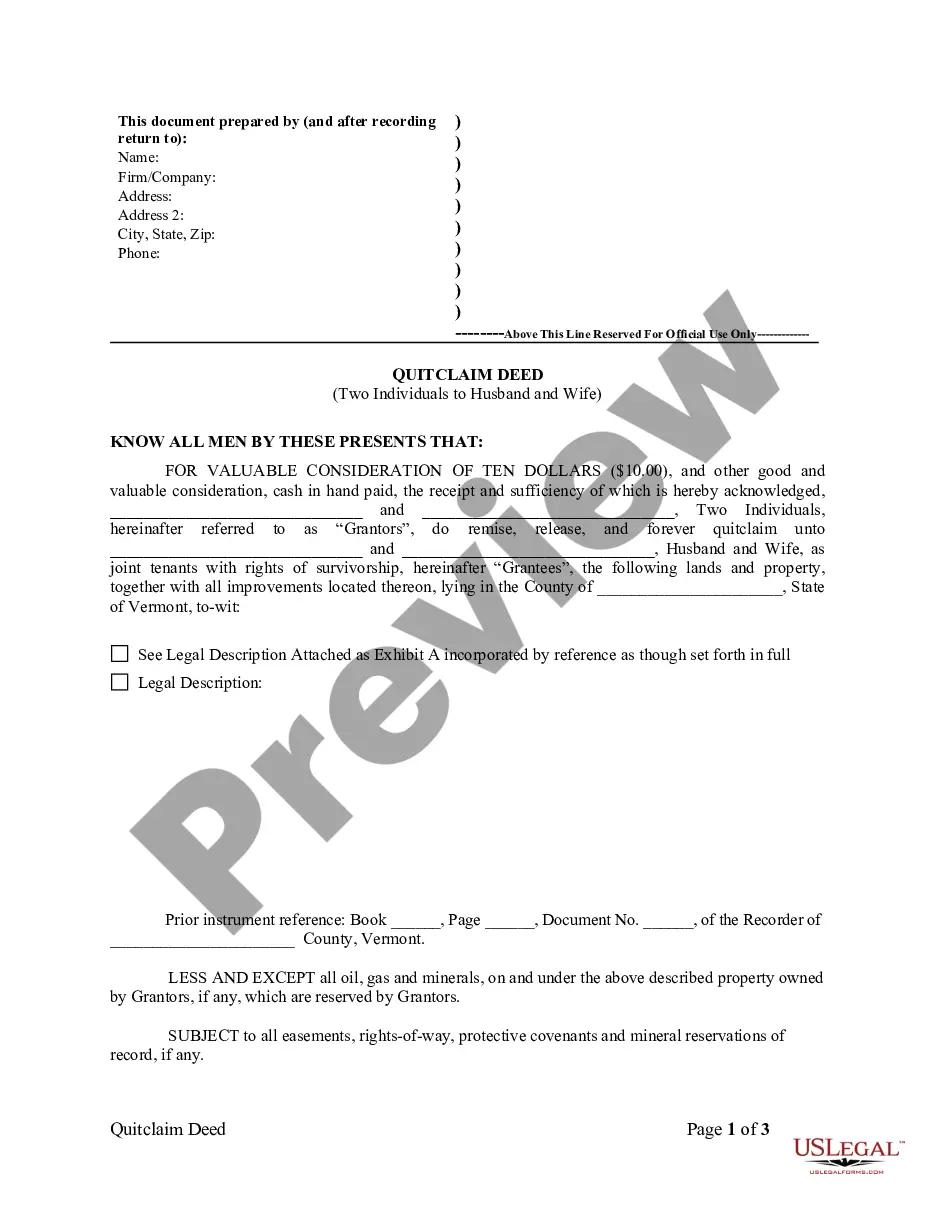
The Quitclaim Deed by Two Individuals to Husband and Wife is a legal document used to transfer ownership of a property from two individuals (grantors) to a married couple (grantees). Unlike other types of deeds, a quitclaim deed does not guarantee that the grantors hold clear title to the property. This form allows for a quick and straightforward transfer of property rights, often used in familial situations or when property ownership needs to be simplified within a marriage.
Key parts of this document
- Identification of grantors (two individuals) and grantees (husband and wife).
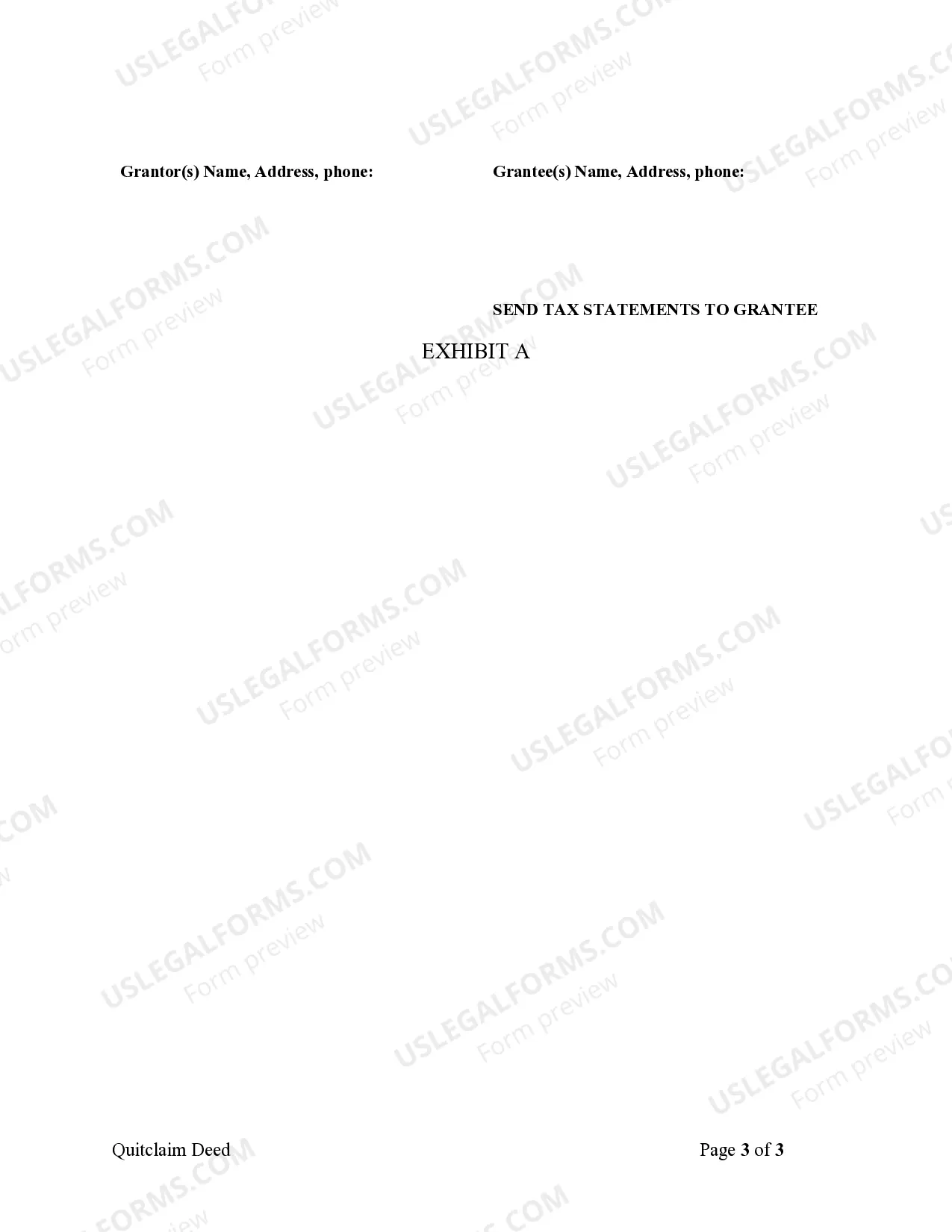
- Description of the property being transferred, including specific legal details.
- Reservation clause stating that oil, gas, and minerals are not included in the transfer.
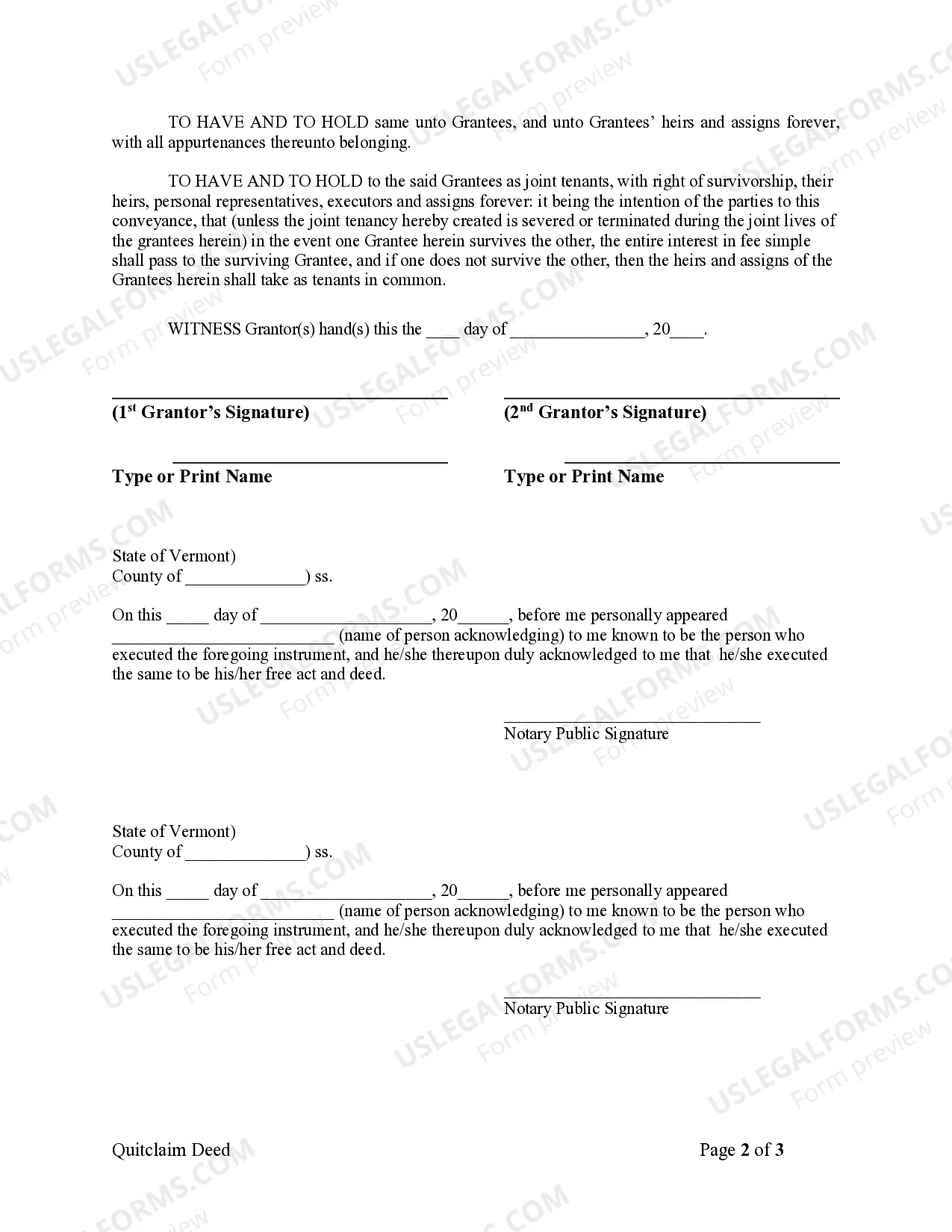
- Joint tenancy clause, which outlines the rights of survivorship for the grantees.
- Notary public section for verification and legal authenticity.






Common use cases
This form is often used in situations where two individuals wish to transfer property to a married couple. Common scenarios include conveying real estate between family members, simplifying the titling of property for spouses, or when one co-owner wishes to transfer their interest in a property to their spouse without the complexities of a sale.
Who should use this form
This quitclaim deed is suitable for:
- Two individuals who currently own a property and wish to transfer it to a husband and wife.
- Married couples who are jointly acquiring property for personal or familial reasons.
- Individuals involved in property matters where a rapid transfer of ownership is beneficial.
How to complete this form
- Identify the parties involved, clearly naming the grantors and grantees.
- Provide a complete legal description of the property to be transferred.
- Review and include any reservations or exceptions related to the property, such as mineral rights.
- Have the grantors sign the deed in front of a notary public.
- Ensure the notarization includes the notary's signature and seal.
Does this document require notarization?
Notarization is required for this form to take effect. Our online notarization service, powered by Notarize, lets you verify and sign documents remotely through an encrypted video session, available 24/7.
Get your form ready online
Our built-in tools help you complete, sign, share, and store your documents in one place.
Make edits, fill in missing information, and update formatting in US Legal Forms—just like you would in MS Word.
Download a copy, print it, send it by email, or mail it via USPS—whatever works best for your next step.
Sign and collect signatures with our SignNow integration. Send to multiple recipients, set reminders, and more. Go Premium to unlock E-Sign.
If this form requires notarization, complete it online through a secure video call—no need to meet a notary in person or wait for an appointment.
We protect your documents and personal data by following strict security and privacy standards.

Make edits, fill in missing information, and update formatting in US Legal Forms—just like you would in MS Word.

Download a copy, print it, send it by email, or mail it via USPS—whatever works best for your next step.

Sign and collect signatures with our SignNow integration. Send to multiple recipients, set reminders, and more. Go Premium to unlock E-Sign.

If this form requires notarization, complete it online through a secure video call—no need to meet a notary in person or wait for an appointment.

We protect your documents and personal data by following strict security and privacy standards.
Common mistakes
- Failing to include a detailed legal description of the property.
- Not having the document notarized, which may invalidate the deed.
- Omitting relevant details about reservations or exceptions.
- Incorrectly identifying grantors and grantees, leading to confusion in ownership.
Why use this form online
- Convenient accessibility to the form at any time.
- Editable fields allow for precise personal and property information input.
- Drafted by licensed attorneys to ensure compliance with legal standards.
Quick recap
- The Quitclaim Deed allows for the transfer of property ownership between two individuals and a married couple.
- Proper notarization is essential for the validity of the deed.
- Understanding the implications of joint tenancy with right of survivorship is crucial for grantees.
- Consult local laws to ensure compliance with specific requirements in your state.
Looking for another form?



Form popularity
FAQ
To use a Quitclaim Deed to add someone to a property deed or title, you would need to create a Quitclaim Deed and list all of the current owners in the grantor section. In the grantee section, you would list all of the current owners as well as the person you would like to add.
If you are married and your name is not on the title deed, you may have relinquished your ownership right.
The easiest way to grant your spouse title to your home is via a quitclaim deed (Californians generally use an interspousal grant deed). With a quitclaim deed, you can name your spouse as the property's joint owner. The quitclaim deed must include the property's description, including its boundary lines.
A person who signs a quitclaim deed to transfer property they do not own results in no title at all being transferred since there is no actual ownership interest. The quitclaim deed only transfers the type of title you own.
If you own your own home, you are free to gift or sell an interest in the real property to someone else.You'll need to transfer an interest by writing up another deed with the person's name on it. In California, you can use either a grant deed, a quitclaim deed or an interspousal deed, depending on your circumstances.
Vermont Quit Claim Deed Form Before a quit claim deed can be filed with the County Clerk's Office, Form PT-172 must be filled out and filed with the Department of Taxes in order to prove that the property tax has been paid.
When it comes to reasons why you shouldn't add your new spouse to the Deed, the answer is simple divorce and equitable distribution. If you choose not to put your spouse on the Deed and the two of you divorce, the entire value of the home is not subject to equitable distribution.
Two of the most common ways to transfer property in a divorce are through an interspousal transfer deed or quitclaim deed. When spouses own property together, but then one spouse executes an interspousal transfer or a quitclaim deed, this is known as transmutation.
Yes you can. This is called a transfer of equity but you will need the permission of your lender. If you are not married or in a civil partnership you may wish to consider creating a deed of trust and a living together agreement which we can explain to you.