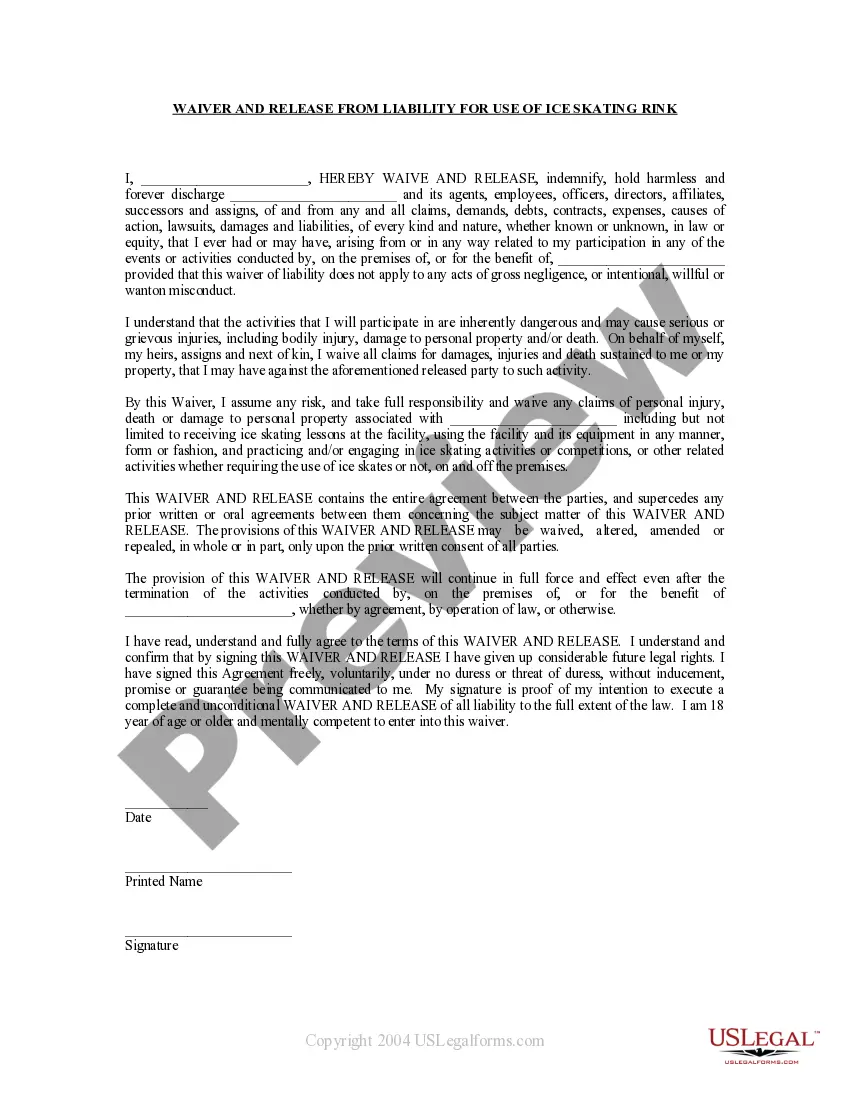
Waiver and Release From Liability For Adult for Ice Skating Rink
What this document covers
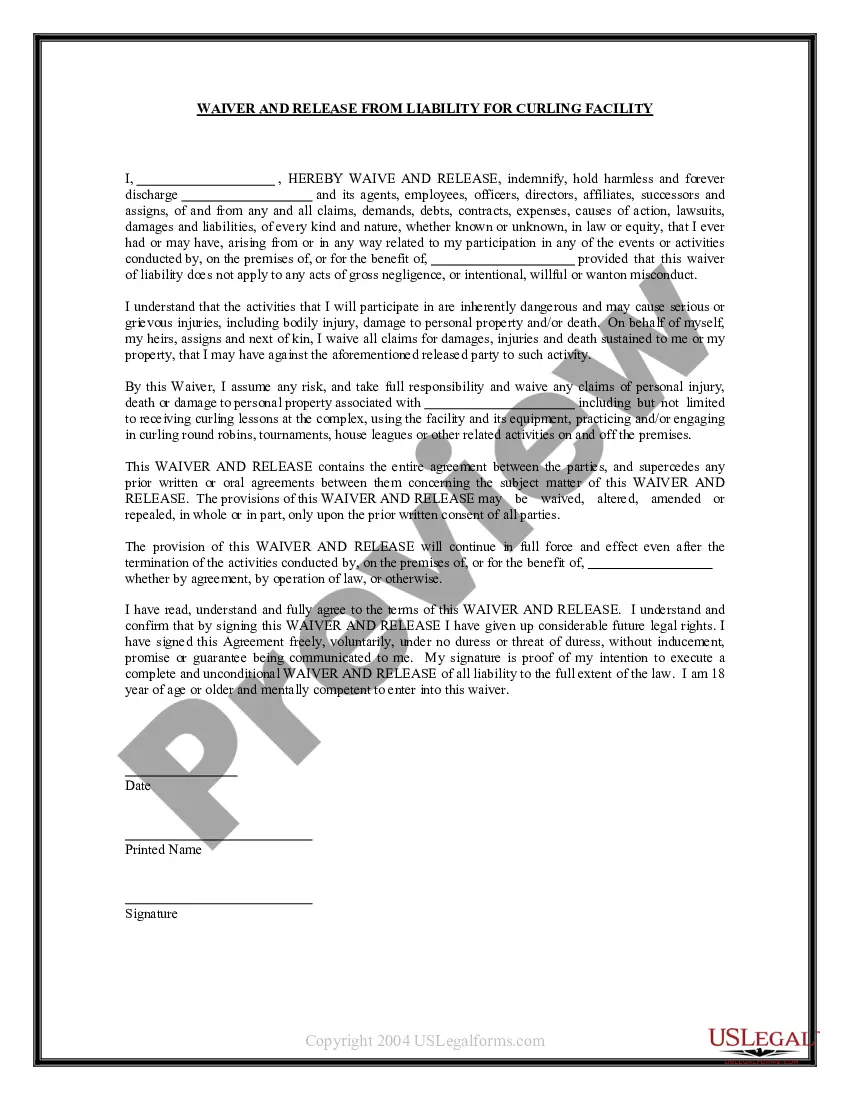
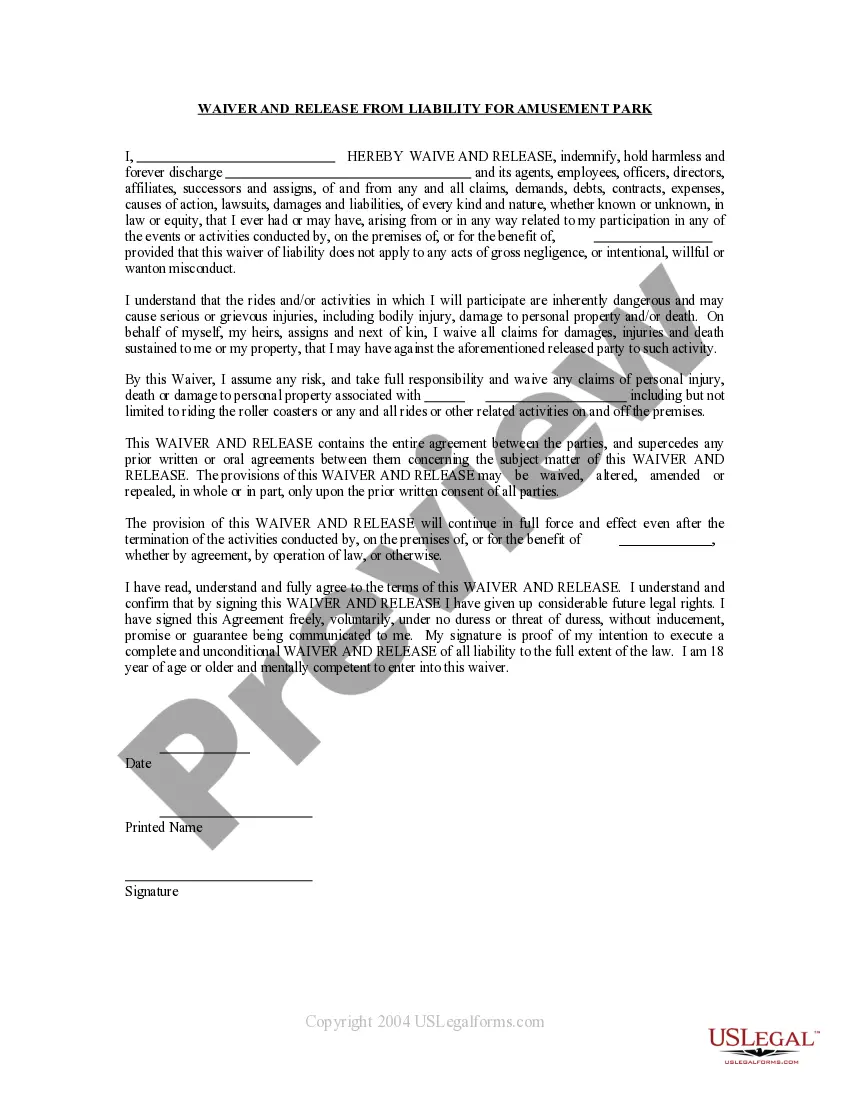
The Waiver and Release From Liability For Adult for Ice Skating Rink is a legal document that allows an adult to release an ice skating rink from liability for any injuries sustained while participating in activities at the facility. This form differs from other liability waivers as it specifically addresses the inherent risks associated with ice skating and provides a clear framework for limiting the rink's legal obligations towards participants.
What’s included in this form
- Personal identification section for the adult participant.
- Release of liability clause protecting the ice skating rink and its personnel.
- Assumption of risk acknowledgment related to ice skating activities.
- Statement regarding the waiver's enforceability and modification conditions.
- Signature section confirming the participant's understanding and agreement.
When to use this form
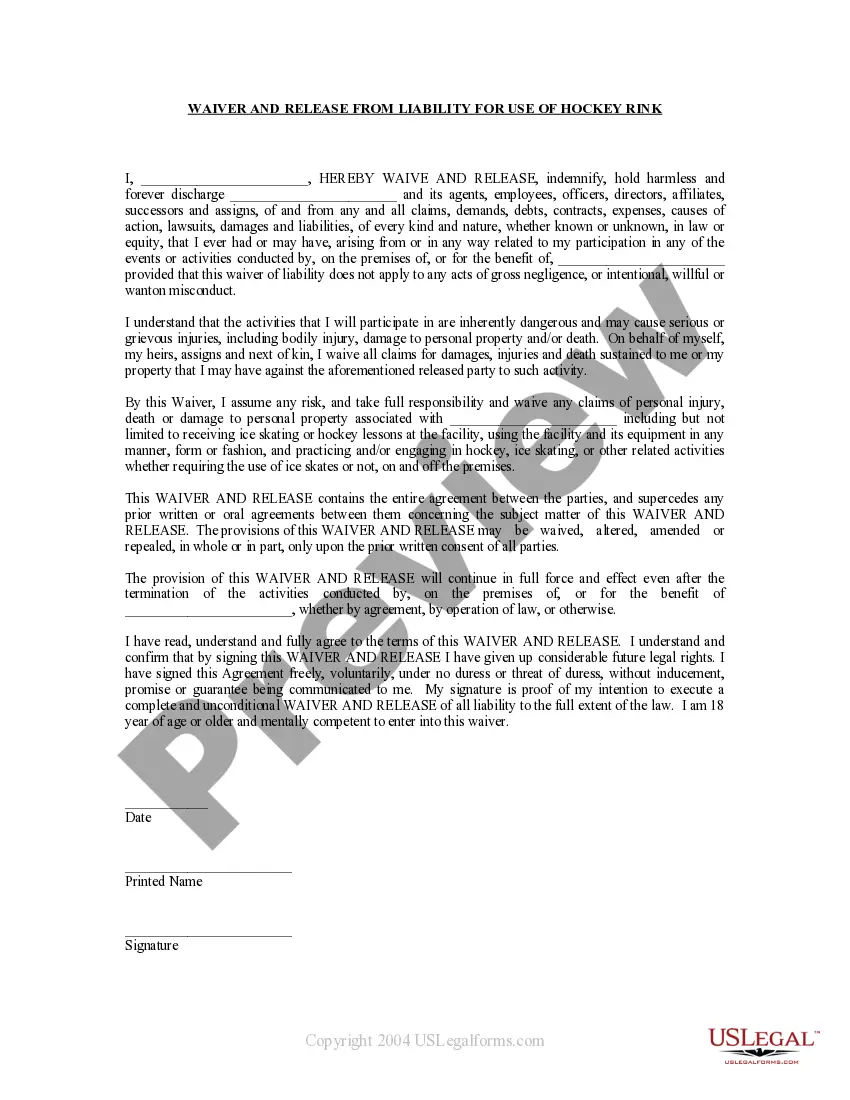
This form should be used when an adult intends to participate in ice skating activities at a rink and must acknowledge the risks involved. It is essential for any adult skater, especially when the rink requires a waiver for participation in group lessons, competitions, or open skating sessions.
Who can use this document
- Adults aged eighteen years or older seeking to engage in ice skating activities.
- Individuals participating in organized ice skating events at a rink.
- Parents or guardians seeking a release on behalf of an adult participant with limited capacity for understanding.
Steps to complete this form
- Identify yourself by entering your full name in the designated space.
- Clearly state the name of the ice skating rink where you will participate.
- Read through the waiver clauses to ensure you understand your rights and responsibilities.
- Sign and date the form after confirming your agreement to the terms.
- Keep a copy of the completed waiver for your records.
Does this form need to be notarized?
This form does not typically require notarization to be legally valid. However, some jurisdictions or document types may still require it. US Legal Forms provides secure online notarization powered by Notarize, available 24/7 for added convenience.
Get your form ready online
Our built-in tools help you complete, sign, share, and store your documents in one place.
Make edits, fill in missing information, and update formatting in US Legal Forms—just like you would in MS Word.
Download a copy, print it, send it by email, or mail it via USPS—whatever works best for your next step.
Sign and collect signatures with our SignNow integration. Send to multiple recipients, set reminders, and more. Go Premium to unlock E-Sign.
If this form requires notarization, complete it online through a secure video call—no need to meet a notary in person or wait for an appointment.
We protect your documents and personal data by following strict security and privacy standards.

Make edits, fill in missing information, and update formatting in US Legal Forms—just like you would in MS Word.

Download a copy, print it, send it by email, or mail it via USPS—whatever works best for your next step.

Sign and collect signatures with our SignNow integration. Send to multiple recipients, set reminders, and more. Go Premium to unlock E-Sign.

If this form requires notarization, complete it online through a secure video call—no need to meet a notary in person or wait for an appointment.

We protect your documents and personal data by following strict security and privacy standards.
Mistakes to watch out for
- Failing to read the entire waiver before signing, leading to misunderstandings.
- Not providing accurate personal information, which can invalidate the waiver.
- Signing under pressure or without understanding the legal implications.
Benefits of completing this form online
- Convenient access to the waiver, allowing for quick completion before participating.
- Editability features ensure all information can be accurately filled in.
- Reliable legal format drafted by licensed attorneys, offering peace of mind.
Looking for another form?
Form popularity
FAQ
To prevent this, you can either run your hose along the edges to melt the ice from the edges or break the ice 12-18 from the edge of the rink and REMOVE the broken ice. Then you can fill at will to get more water into the rink with a much less chance of creating additional problems.
The best scenario is for the weight of the snow to push the ice down enough to force enough water onto the top of the ice so it ALL turns to slush. Let the slush freeze, and then you can skate on that base if it's smooth enough or resurface a few times to get it back to smooth.
On average, a roller rink needs a monthly income of $35,000 to be able to break even. That means that you will need more than $35,000 a month to make money. This means that, on average, you will need to bring in at least $1,166 per day.
Roller skaters injured at roller skating rinks may be able to sue the owner and/or operator of the rink for personal injuries that arise from skating accidents.However, even rink operators that take these measures and other precautions cannot always avoid claims for every personal injury.
The ideal temperature to flood your ice is between -7 and -20 degrees Celsius. If you try to flood your rink when it's below -20 degrees, the ice will be brittle and freeze before it has a chance to level out. Before you flood, be sure to clear off any debris such as leaves or sticks to avoid creating bumps.
While injuries from roller-skating are not uncommon, death is extremely rare, according to the U.S. Consumer Product Safety Commission. The last death while roller-skating came in 1999, when a 66-year-old Pennsylvania man fell and hit his head, according to the commission's data.
In comparison Glice rinks cost $80,000 to $150,000 for a 2,000 to 4,000-square-foot rink, the range of sizes most shopping malls use.
The average Roller Skating Business in America spends between $300-$800 per year for $1 million in general liability coverage. You may be able to acquire general liability insurance at a discounted rate by purchasing it as part of a business owner's policy (BOP) rather than as a standalone policy.
Most inline skating injuries are musculoskeletal in nature, including fractures and sprains. The wrist is the most frequently injured body part, making up 37 percent of all injuries, and two-thirds of wrist injuries are fractures. Head injuries comprise about 5 percent of inline skating injuries.