Application For Expedited Discovery
What this document covers
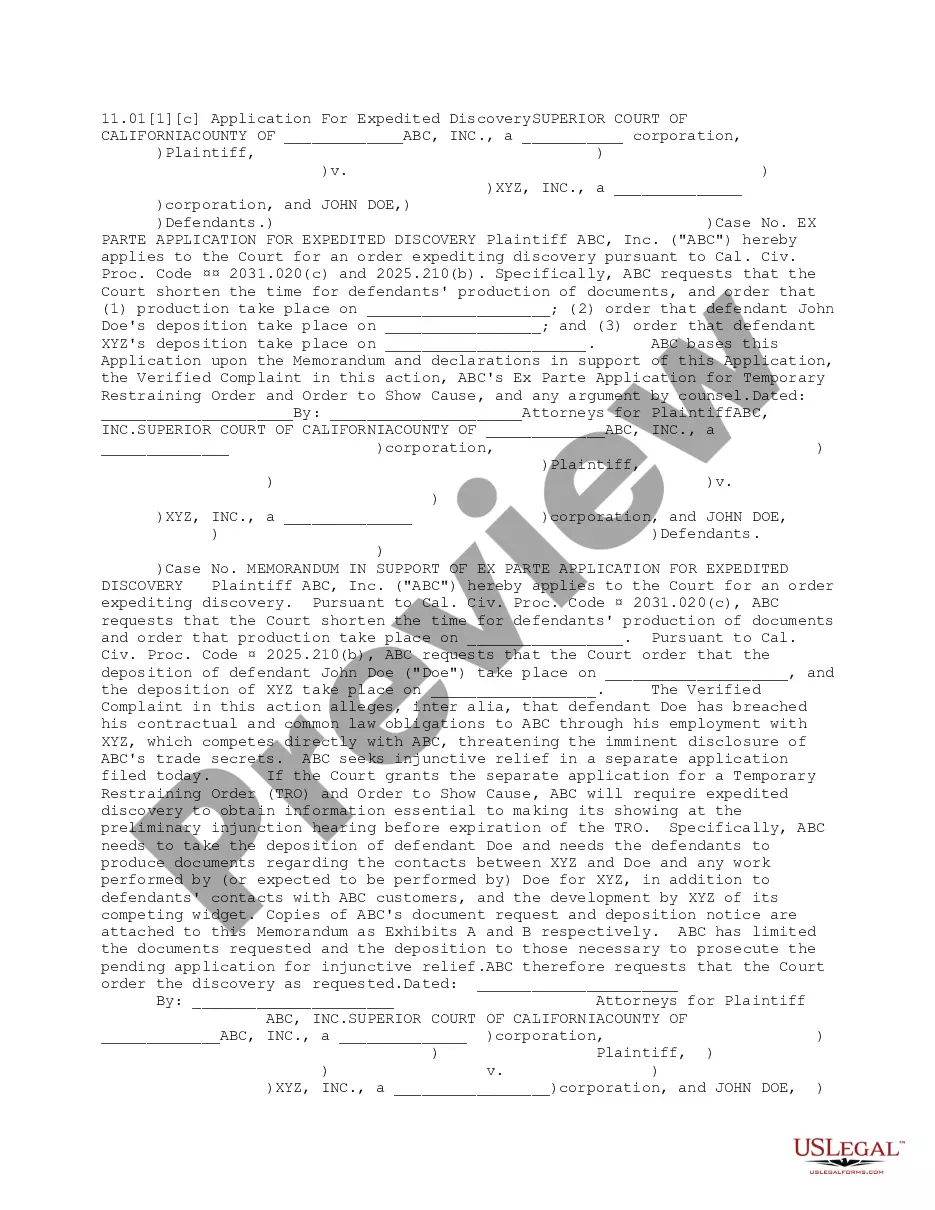
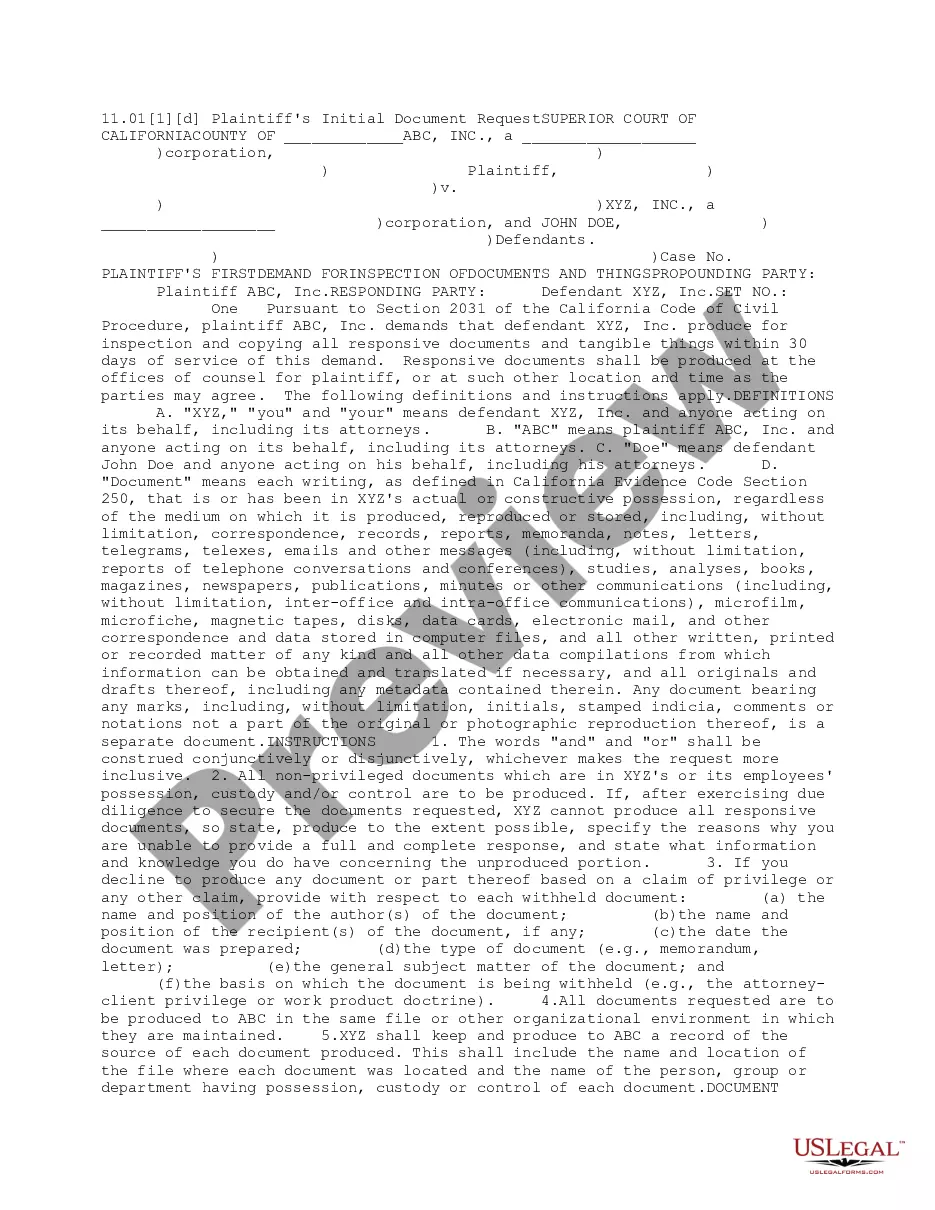
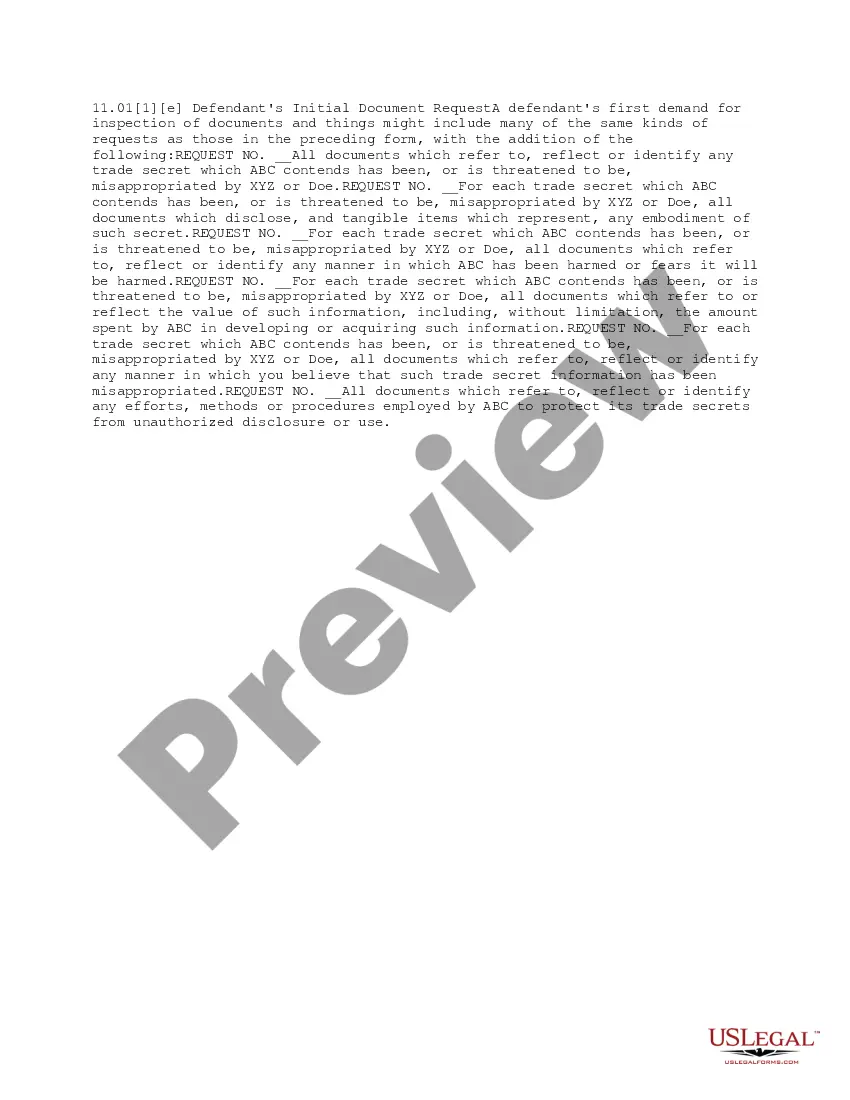
The Application for Expedited Discovery is a legal document used in California to request a faster discovery process in cases involving licensing, patents, or commercial trade secrets. This form allows a party to expedite essential information gathering that may be critical for legal proceedings, differentiating it from regular discovery requests by its urgency and specific nature.
Form components explained
- Identification of parties involved in the case.
- Specific requests for expedited production of documents and depositions.
- A memorandum outlining the reasons for the expedited discovery request.
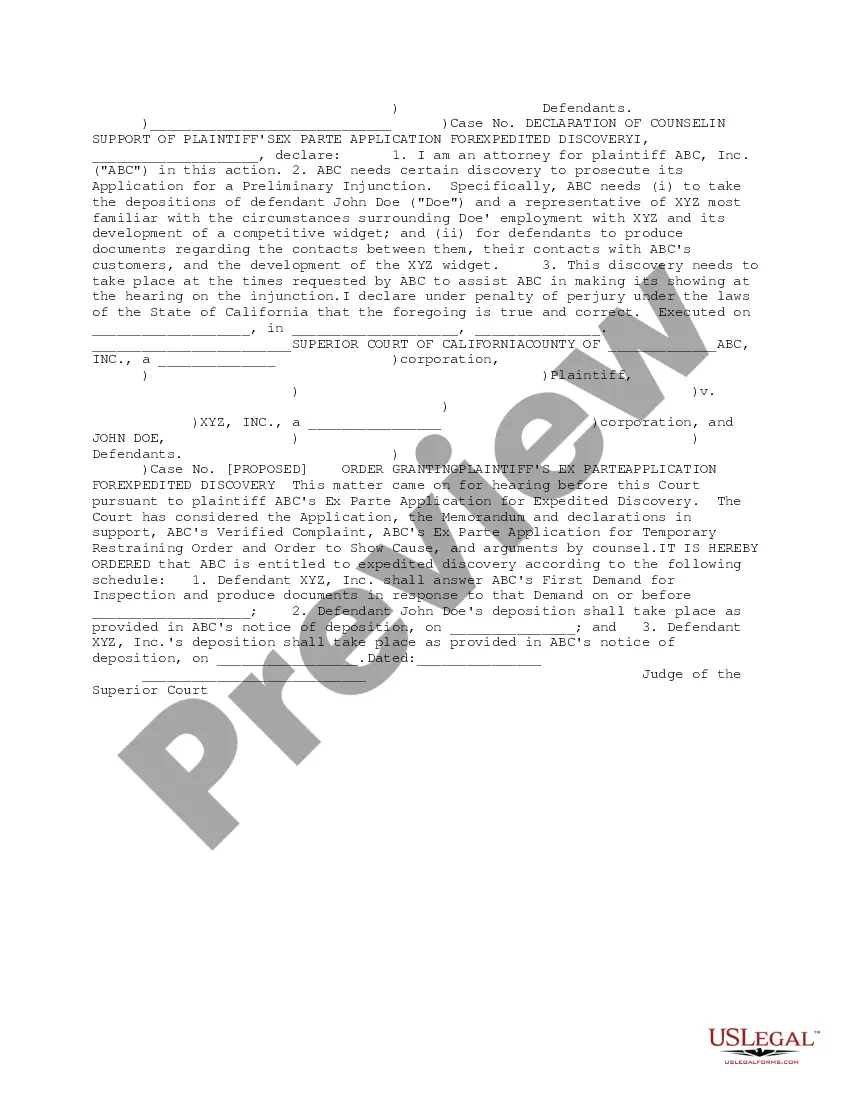
- Declarations from counsel supporting the urgency of the request.
- A proposed order detailing the timeline for compliance by the defendants.
Situations where this form applies
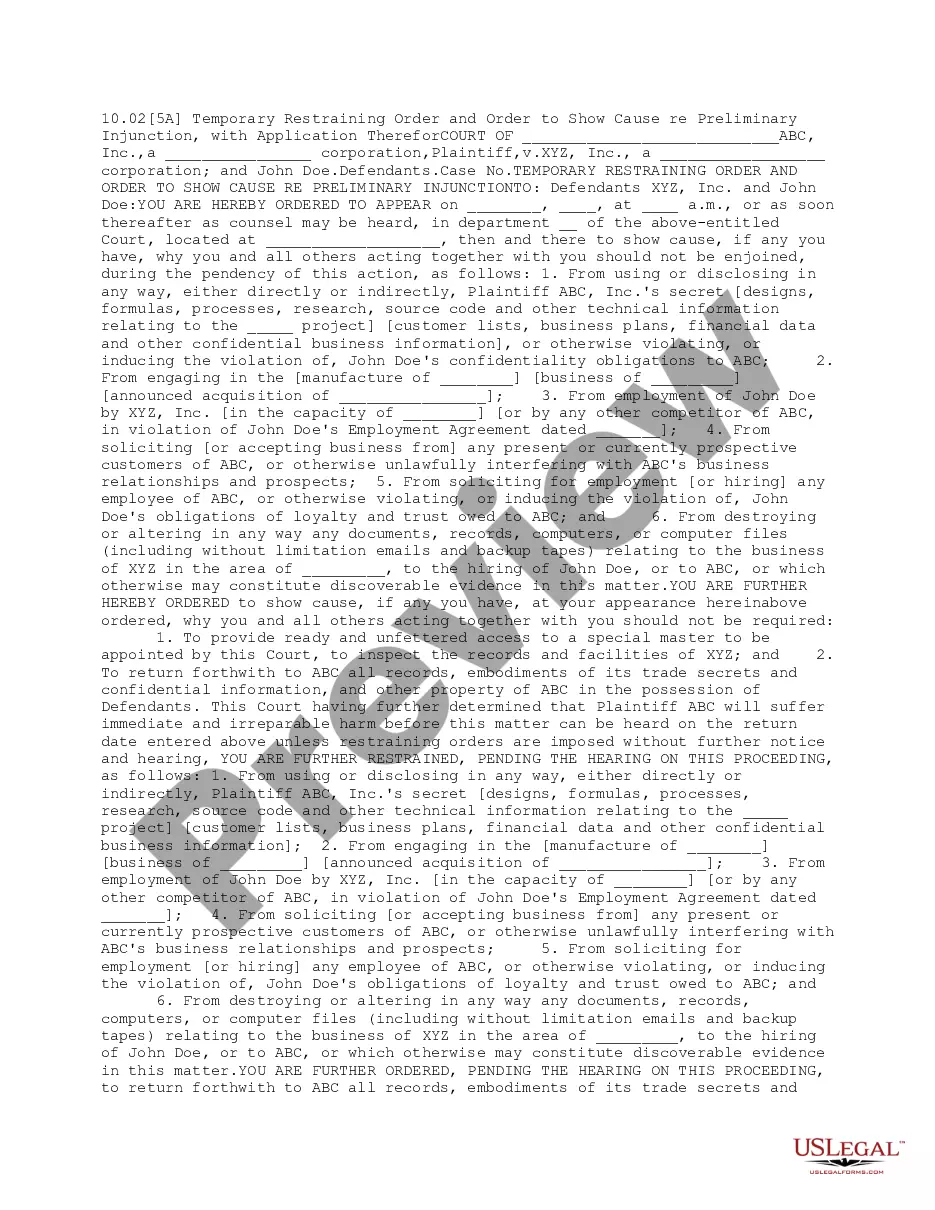
This form should be used when a party in a legal case needs to expedite discovery due to time-sensitive issues, such as potential threats to trade secrets or imminent harm from the actions of the opposing party. Common scenarios may include competitive business disputes or situations involving the breach of confidentiality agreements where immediate evidence is required to support legal claims.
Who should use this form
- Plaintiffs in legal actions seeking a faster discovery process.
- Businesses concerned about imminent disclosure of trade secrets or proprietary information.
- Attorneys representing clients involved in licensing or patent disputes.
- Individuals requiring time-sensitive evidence in support of injunctive relief applications.
Completing this form step by step
- Identify the parties involved by filling in the names of the plaintiff and defendants.
- Specify the dates for document production and depositions required from the defendants.
- Prepare the supporting memorandum that explains the urgency of the request.
- Include any necessary declarations from counsel to support the application.
- File the completed application with the appropriate court and serve it on all parties involved.
Is notarization required?
This form does not typically require notarization unless specified by local law. However, it is essential to ensure that all signatures are properly executed and witnessed as required by the court.
Get your form ready online
Our built-in tools help you complete, sign, share, and store your documents in one place.
Make edits, fill in missing information, and update formatting in US Legal Forms—just like you would in MS Word.
Download a copy, print it, send it by email, or mail it via USPS—whatever works best for your next step.
Sign and collect signatures with our SignNow integration. Send to multiple recipients, set reminders, and more. Go Premium to unlock E-Sign.
If this form requires notarization, complete it online through a secure video call—no need to meet a notary in person or wait for an appointment.
We protect your documents and personal data by following strict security and privacy standards.

Make edits, fill in missing information, and update formatting in US Legal Forms—just like you would in MS Word.

Download a copy, print it, send it by email, or mail it via USPS—whatever works best for your next step.

Sign and collect signatures with our SignNow integration. Send to multiple recipients, set reminders, and more. Go Premium to unlock E-Sign.

If this form requires notarization, complete it online through a secure video call—no need to meet a notary in person or wait for an appointment.

We protect your documents and personal data by following strict security and privacy standards.
Common mistakes
- Failing to include necessary deadlines for document production and depositions.
- Not providing sufficient justification for the need for expedited discovery.
- Omitting signatures or necessary supporting documents from the filing.
Benefits of using this form online
- Immediate access to the most current legal language and formats.
- Ability to easily edit and customize the form based on specific case details.
- Convenient downloading options, allowing for quick filing and submission.
Legal use & context
- This form is used within the framework of California civil procedures for expedited discovery.
- It is enforceable in legal disputes involving trade secrets and other sensitive information.
- Usage of this form should align with local court requirements and timelines for submission.
What to keep in mind
- The Application for Expedited Discovery is crucial in urgent legal scenarios.
- Proper filling, editing, and timely submission can significantly impact the outcome of a case.
- Understanding and complying with California state-specific requirements is essential for effective use.
Looking for another form?
Form popularity
FAQ
Step 1: Research and Write Your Complaint and Accompanying Papers. Step 3: File the Lawsuit (if Needed) and Motion, and Pay the Filing Fee. Step 4: Have the Motion and Related Papers Served on All Parties. Step 5: Review Any Opposition to the Preliminary Injunction.
An injunction begins with a petition requesting the court to grant injunctive relief. Because the petition is usually the beginning of a lawsuit, you will be required to pay a filing fee. Depending on the extent of the legal remedy you are requesting, the court may also require you to post a bond.
Courts are used to parties making requests for "expedited" discovery in advance of the normal timeframes during which discovery usually is permitted. Discovery is necessary, because in competition cases, it is very hard for a plaintiff to prove a case without seeing what the defense has.
A preliminary injunction is an injunction that may be granted before or during trial, with the goal of preserving the status quo before final judgment.
How Much Does an Injunction Bond Cost? The cost of an injunction bond that does NOT require collateral is typically is 2-3% of the bond amount. There is a sliding scale for larger bonds (those in excess of $500,000) and your cost may be lower than 2-3%.
Even if the court does not issue a restraining order (or if there has not been a criminal trial at all) you can make an application for a protective injunction.
Preliminary Injunctions: A preliminary injunction is an order prohibiting an action, to preserve the status quo while the underlying court case is decided.
Temporary Restraining Orders: A temporary restraining order (TRO) is an order by the court immediately prohibiting a threatened action.Preliminary Injunctions: A preliminary injunction is an order prohibiting an action, to preserve the status quo while the underlying court case is decided.
You can apply for an injunction against any person who has harassed or stalked you or put you in fear of violence by deliberately causing you distress on two or more occasions. This is different from restraining orders which can be made in the criminal courts.