Agreement for Non Assertion of Intellectual Property Rights
Overview of this form
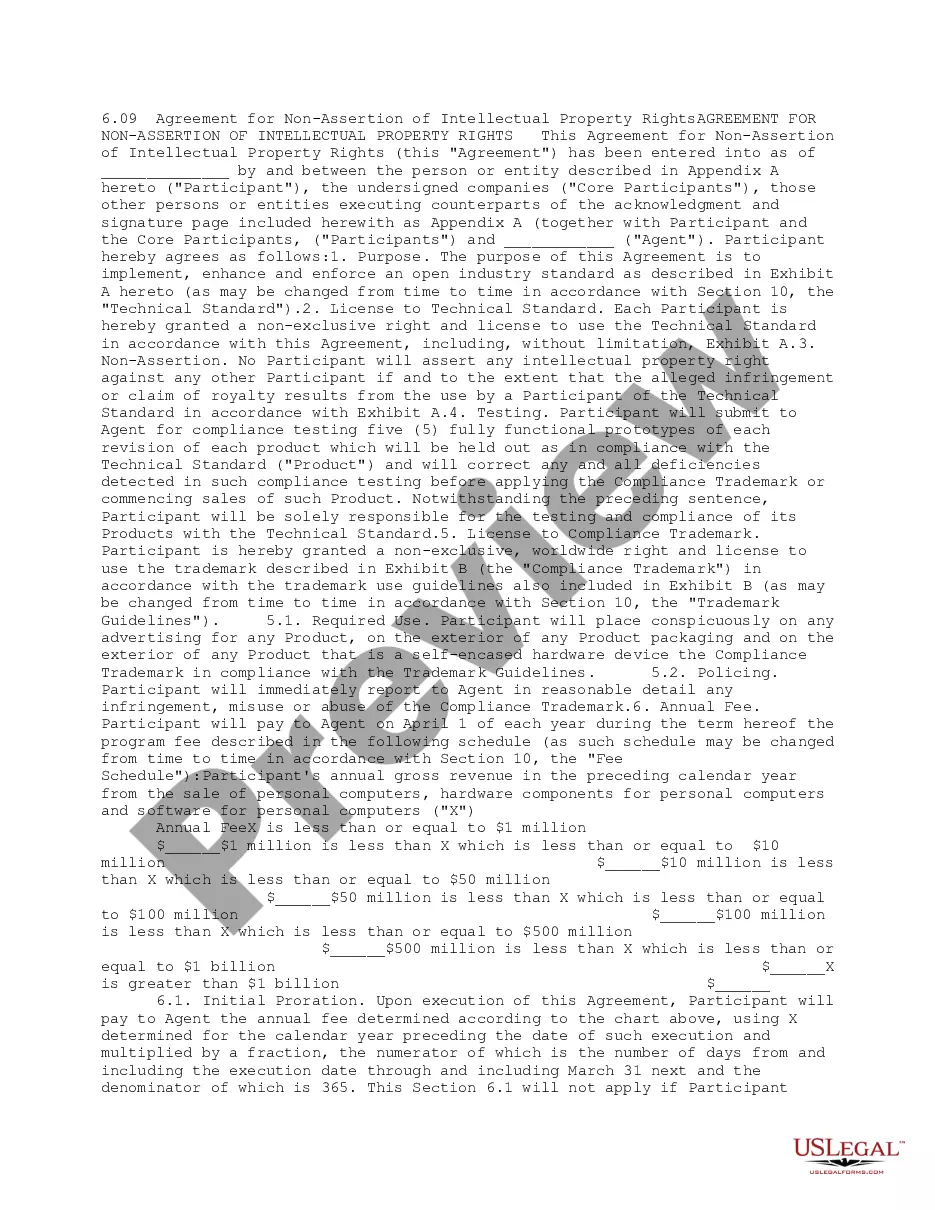
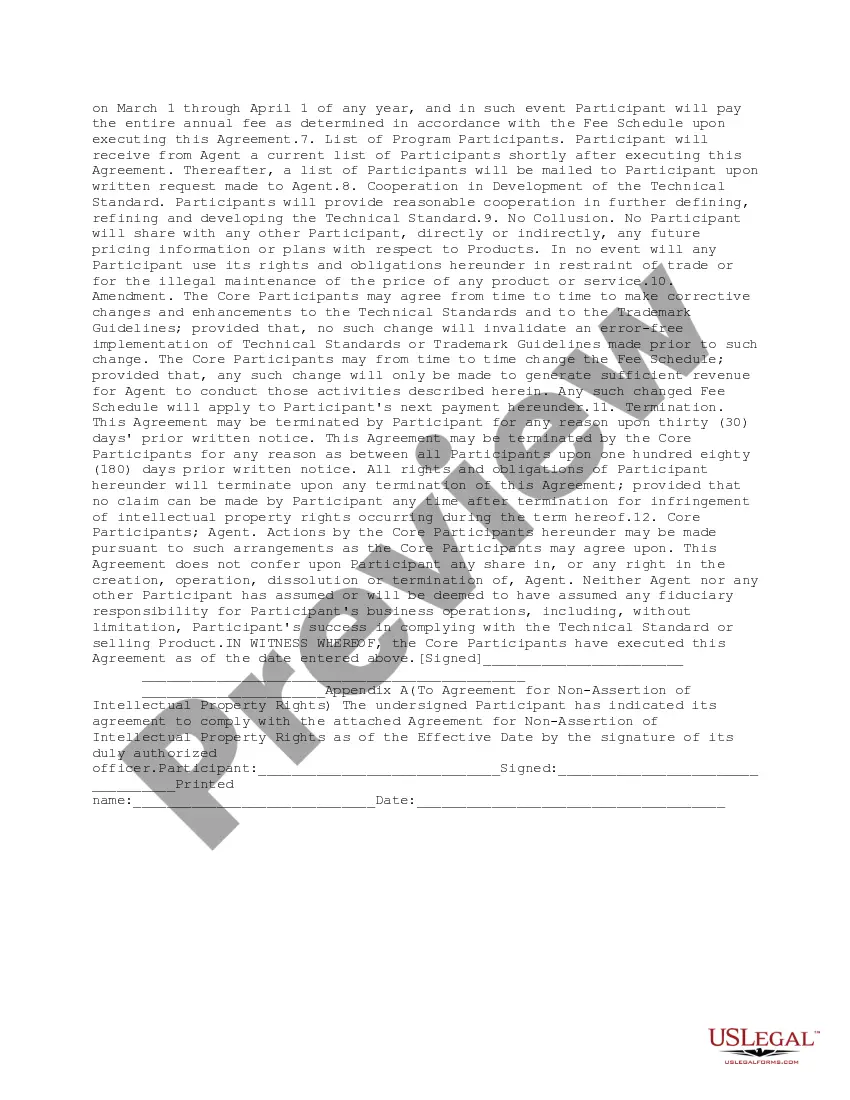
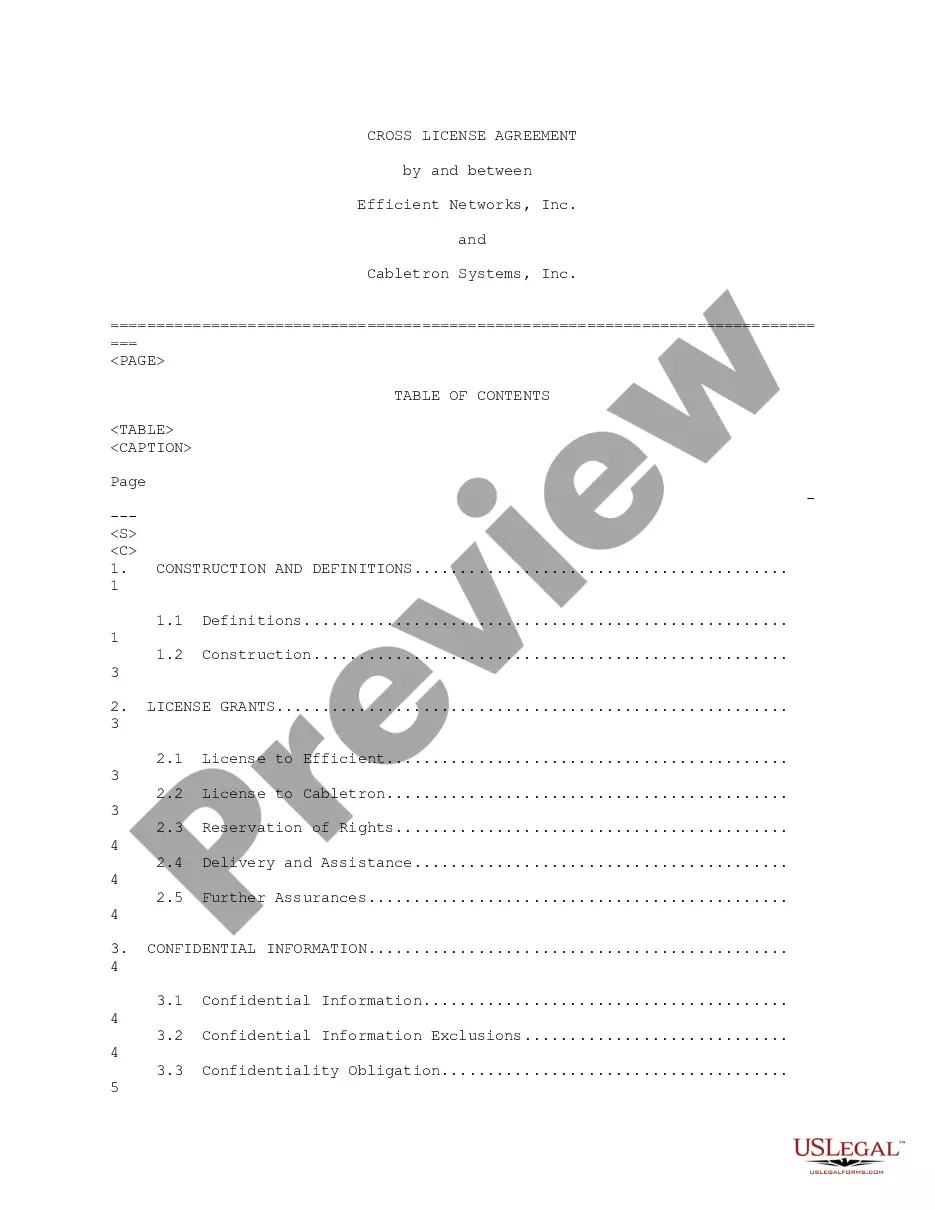
The Agreement for Non-Assertion of Intellectual Property Rights is a legal document that establishes mutual agreements among participants to refrain from asserting intellectual property claims against each other when using a shared technical standard. This form is designed to foster cooperation and ensure that all parties can benefit from innovations without the fear of legal repercussions. It differs from other agreements, like licensing or assignment agreements, by specifically focusing on non-assertion, promoting an open industry standard instead of restricting usage rights.
Key parts of this document
- Purpose: Outlines the intent to implement and enhance an open industry standard.
- License: Grants a non-exclusive right to use the established technical standard.
- Non-Assertion Clause: Prevents participants from asserting intellectual property rights against each other concerning compliance with the technical standard.
- Testing Requirements: Specifies responsibilities for compliance testing of products.
- Compliance Trademark License: Details the right to use a trademark in connection with compliant products.
- Annual Fee: Describes the fee structure based on gross revenue from product sales.
When this form is needed
Who this form is for
- Companies or entities involved in technology development and standardization.
- Organizations looking to collaborate on shared technical projects.
- Businesses that want clear guidelines on intellectual property rights amidst cooperation.
- Participants who wish to protect their interests while promoting an open standard.
Steps to complete this form
- Identify the parties involved: List the Participant and the Core Participants in the agreement.
- Specify the effective date: Fill in the date when the agreement becomes active.
- Detail the technical standard: Provide clear descriptions in Exhibit A.
- Enter obligations: Complete details regarding compliance testing and trademark usage.
- Sign the agreement: Ensure that authorized representatives from all parties sign and date the agreement.
Does this document require notarization?
In most cases, this form does not require notarization. However, some jurisdictions or signing circumstances might. US Legal Forms offers online notarization powered by Notarize, accessible 24/7 for a quick, remote process.
Get your form ready online
Our built-in tools help you complete, sign, share, and store your documents in one place.
Make edits, fill in missing information, and update formatting in US Legal Forms—just like you would in MS Word.
Download a copy, print it, send it by email, or mail it via USPS—whatever works best for your next step.
Sign and collect signatures with our SignNow integration. Send to multiple recipients, set reminders, and more. Go Premium to unlock E-Sign.
If this form requires notarization, complete it online through a secure video call—no need to meet a notary in person or wait for an appointment.
We protect your documents and personal data by following strict security and privacy standards.

Make edits, fill in missing information, and update formatting in US Legal Forms—just like you would in MS Word.

Download a copy, print it, send it by email, or mail it via USPS—whatever works best for your next step.

Sign and collect signatures with our SignNow integration. Send to multiple recipients, set reminders, and more. Go Premium to unlock E-Sign.

If this form requires notarization, complete it online through a secure video call—no need to meet a notary in person or wait for an appointment.

We protect your documents and personal data by following strict security and privacy standards.
Typical mistakes to avoid
- Failing to identify all participating entities accurately.
- Omitting crucial details about the technical standard.
- Not keeping track of compliance testing requirements and timelines.
- Missing signatures from all necessary representatives.
- Neglecting to update the agreement with changes in standards or fees.
Advantages of online completion
- Convenience of downloading and completing at your own pace.
- Editable templates that can be tailored to specific agreements and needs.
- Access to reliable forms drafted by licensed attorneys.
- Secure storage of completed forms for future reference.
- Streamlined process helps in maintaining compliance with legal requirements.
Legal use & context
- This agreement facilitates collaboration while protecting intellectual property rights.
- It is enforceable and useful for clearly defining the roles and responsibilities of participants.
- Proper completion and retention of this document help mitigate legal disputes in the future.
Key takeaways
- The Agreement for Non-Assertion of Intellectual Property Rights promotes collaboration by preventing infringement disputes.
- Key sections include licensing rights, testing obligations, and fee structures based on revenue.
- Proper completion involves accurately identifying parties and ensuring compliance with testing and trademark usage.
Looking for another form?
Form popularity
FAQ
Trade Secrets. Trade secrets refer to specific, private information that is important to a business because it gives the business a competitive advantage in its marketplace. Patents. Copyrights. Trademarks.
: the act of asserting or something that is asserted: such as. a : insistent and positive affirming, maintaining, or defending (as of a right or attribute) an assertion of ownership/innocence. b : a declaration that something is the case He presented no evidence to support his assertions.
A non-assertion covenant (nonassert for short) is an agreement by a party not to seek to enforce patent or other intellectual property rights it may have against another party or parties.
The definition of an assertion is an allegation or proclamation of something, often as the result of opinion as opposed to fact. An example of someone making an assertion is a person who stands up boldly in a meeting with a point in opposition to the presenter, despite having valid evidence to support his statement.
Some of the most common violations are: Infringement of patent, trademark or copyright rights. Counterfeiting of copyrights or trademarks. Misappropriating trade secrets.
Non-Assertiveness. A non-assertive person is one who is often taken advantage of, feels helpless, takes on everyone's problems, says yes to inappropriate demands and thoughtless requests, and allow others to choose for him or her. The basic message he/she sends is I'm not OK.
An intellectual property (IP) infringement is the infringement or violation of an intellectual property right. There are several types of intellectual property rights, such as copyrights, patents, trademarks, industrial designs, and trade secrets.
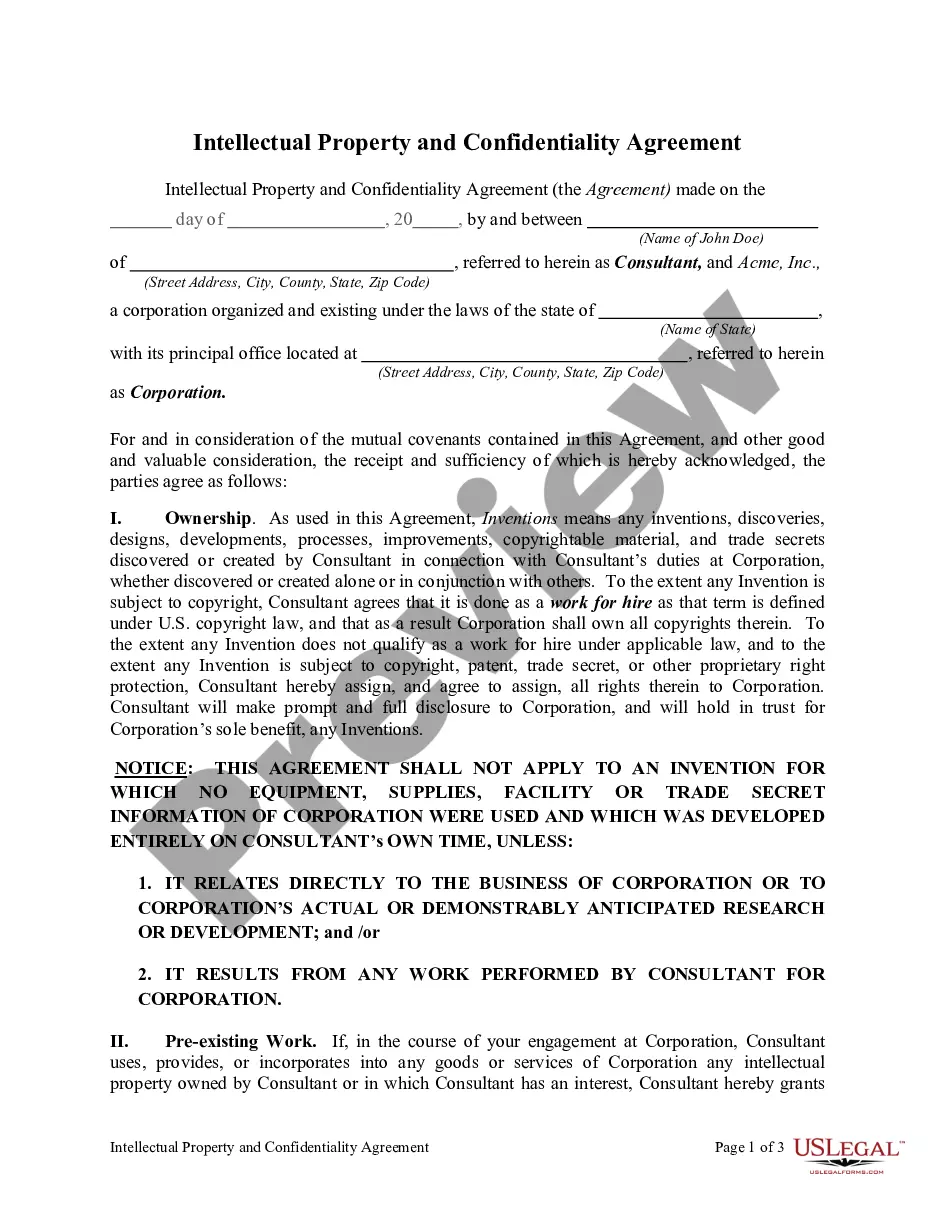
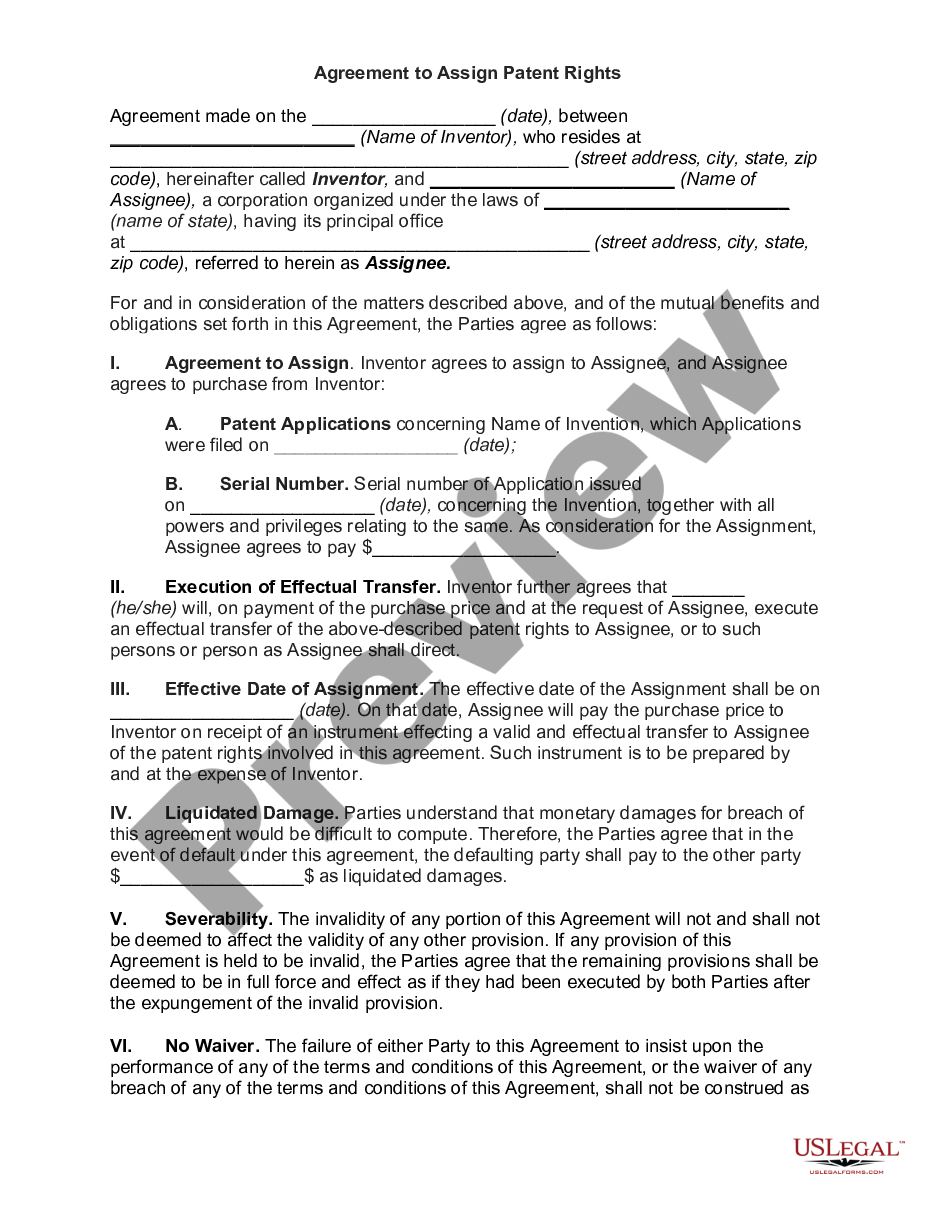
Intellectual property Assignment Agreement By this kind of an agreement the original owner transfer his right to develop or sell the said intellectual property to another person or legal entity.
1 : disposed to or characterized by bold or confident statements and behavior an assertive leader. 2 : having a strong or distinctive flavor or aroma assertive wines.