Action by Written Consent of Board of Directors - Upon Incorporation
About this form
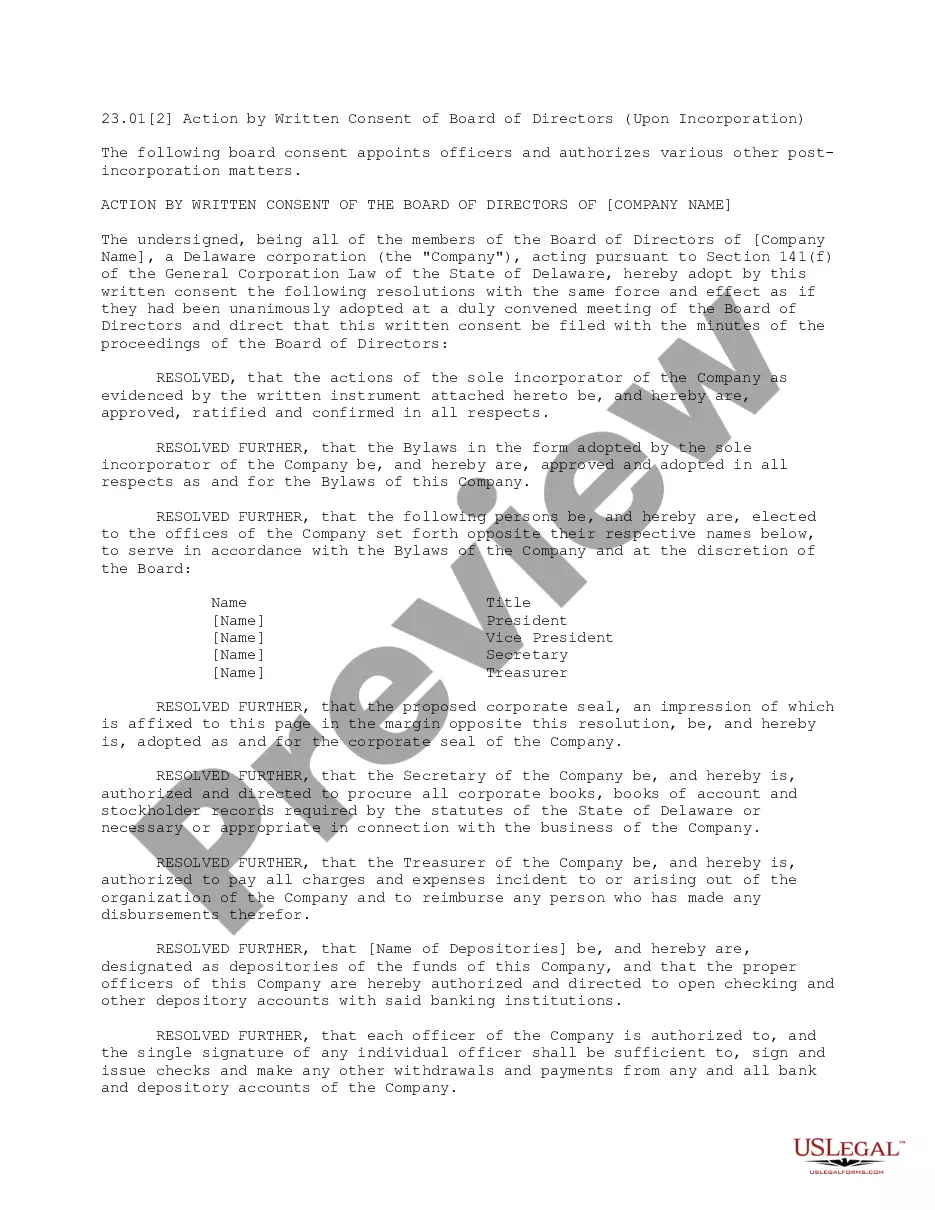
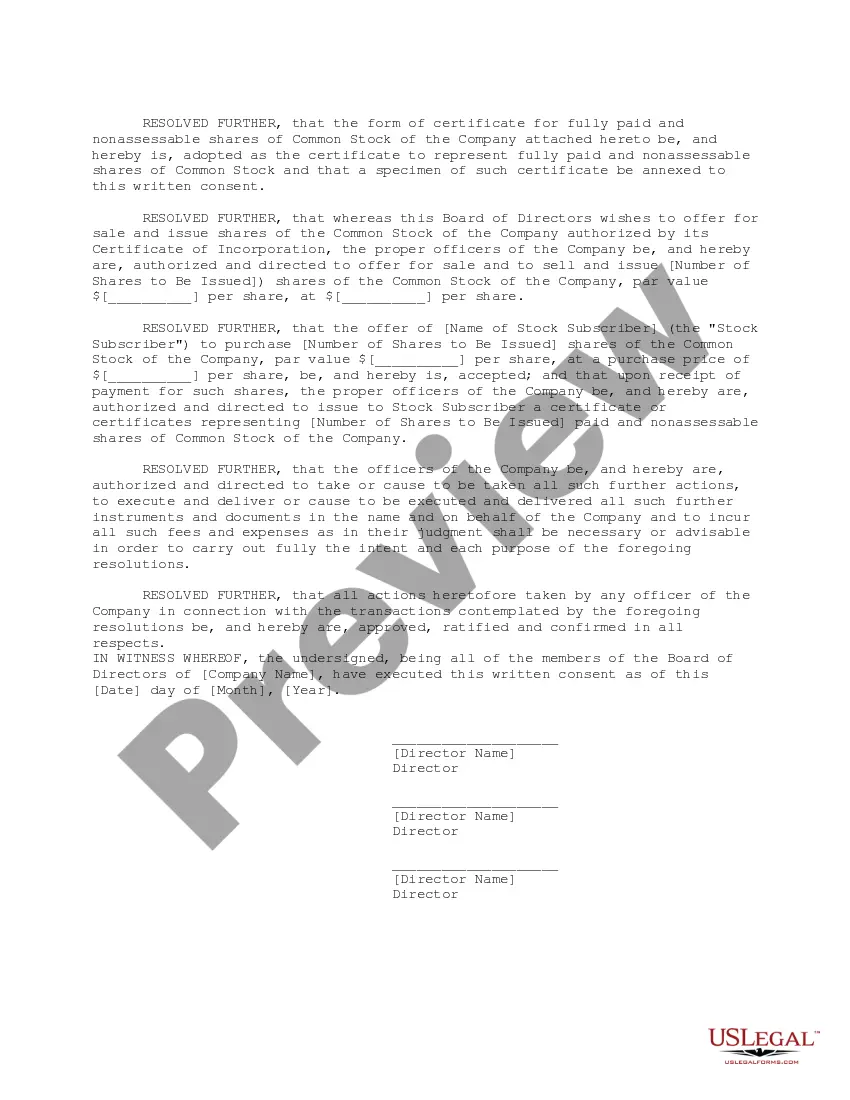
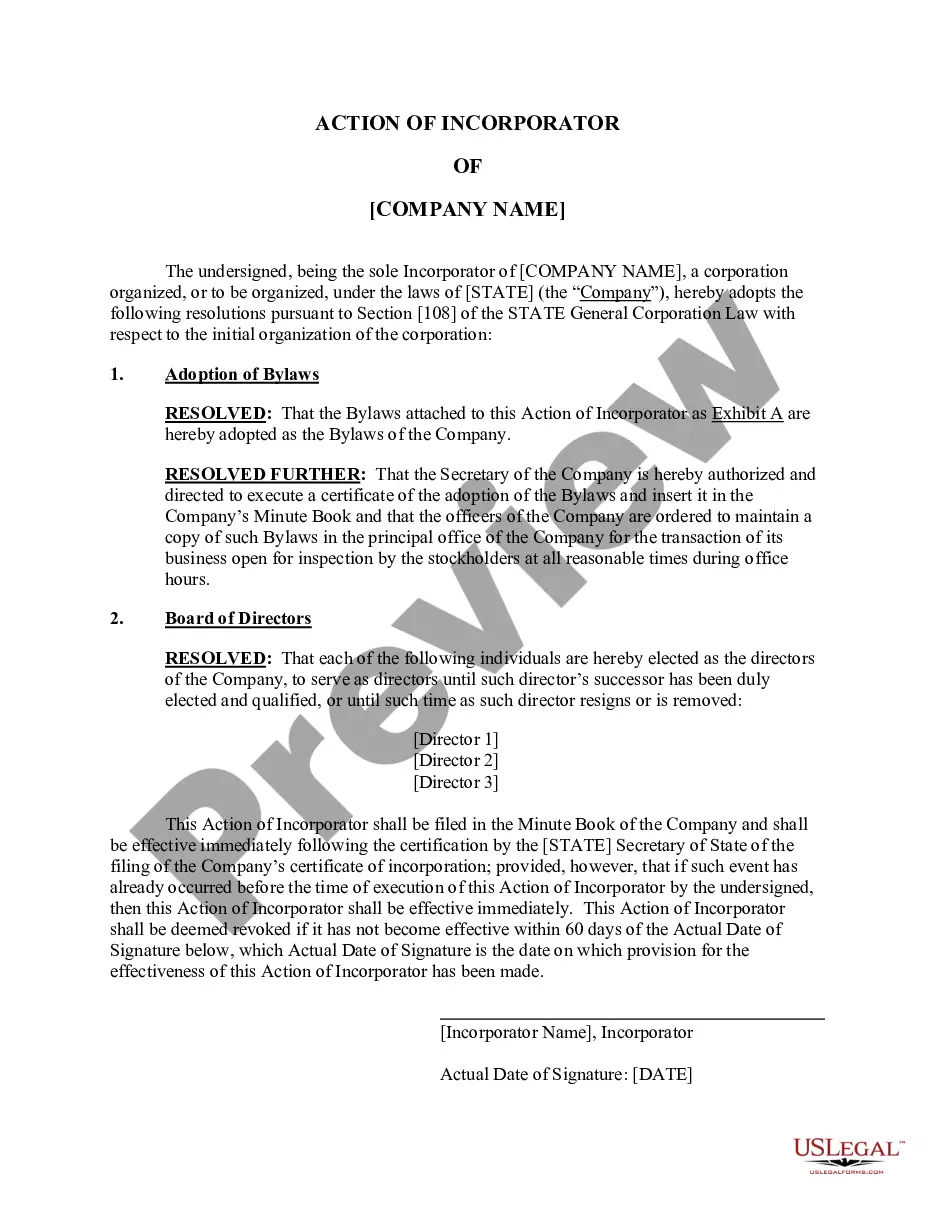
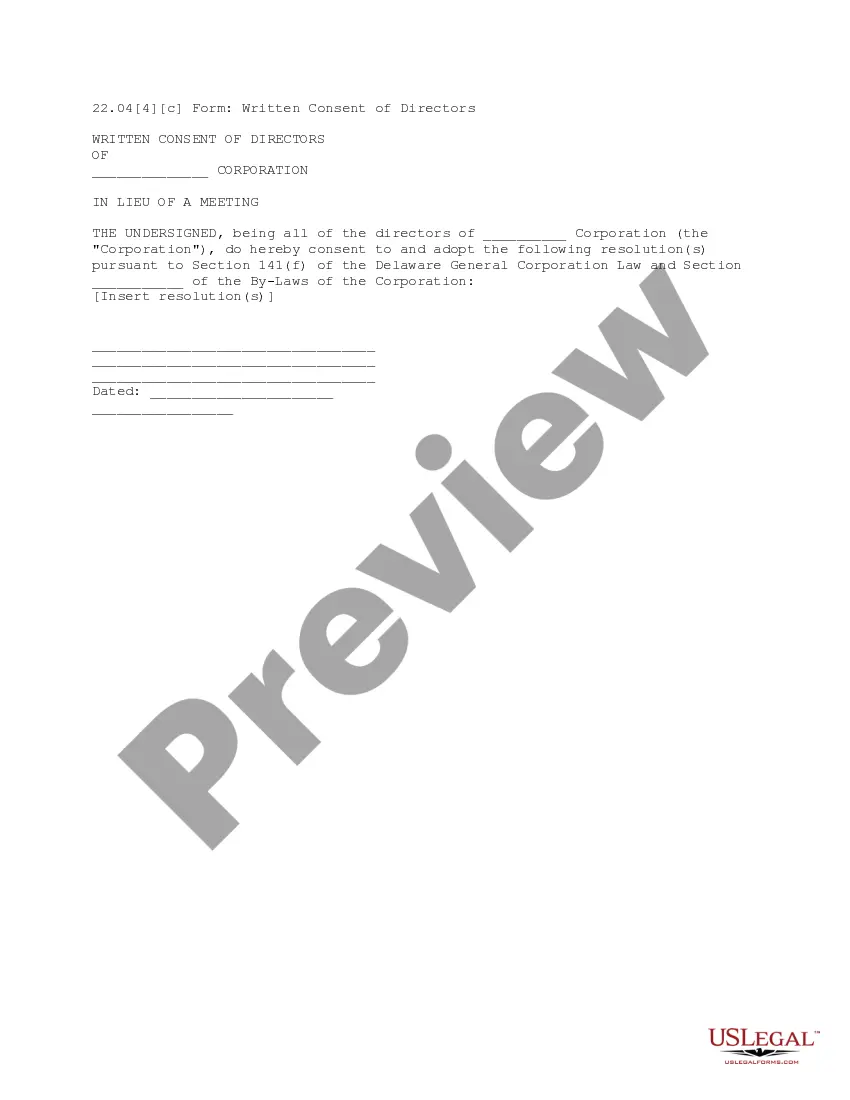
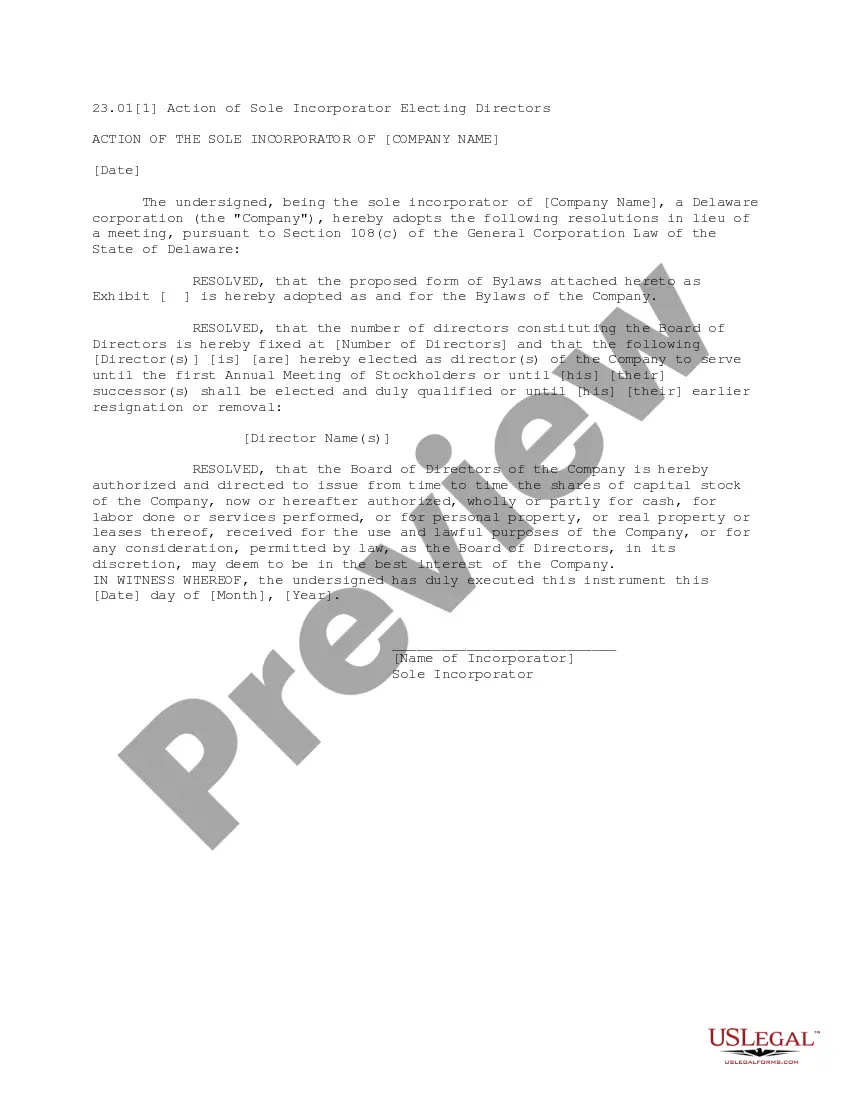
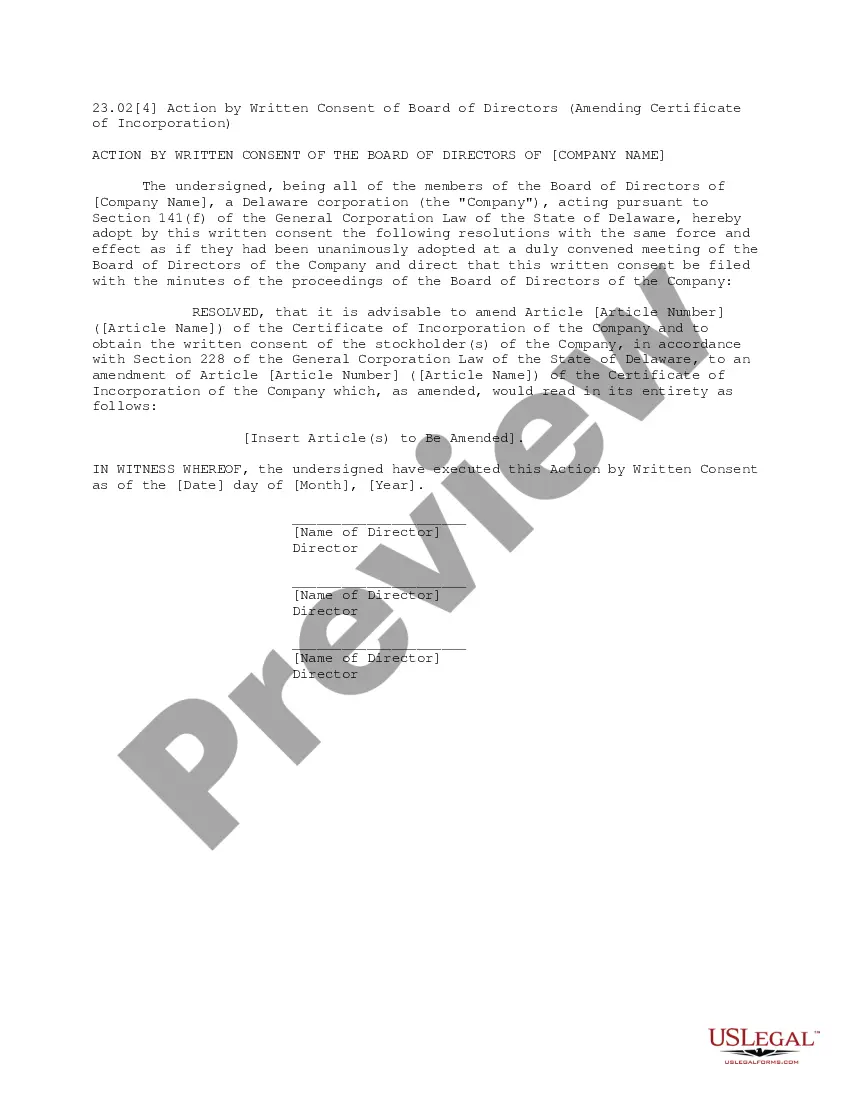
This Action by Written Consent of the Board of Directors document is a legal form used by newly incorporated companies to formalize important decisions and appointments in writing, without the need for a physical meeting. This form allows the board to approve bylaws, appoint officers, and authorize the opening of bank accounts, ensuring compliance with state laws, particularly in Delaware. Using this template helps streamline the incorporation process and provides clear documentation of board actions from the outset.
Key components of this form
- Identification of the company and its incorporation details.
- Resolutions regarding the approval of the sole incorporator's actions.
- Adoption of company bylaws.
- Election of corporate officers, including President, Vice President, Secretary, and Treasurer.
- Authorization for the procurement of corporate records and funds management.
- Approval for issuing shares and accepting payments for those shares.
Common use cases
This form should be used immediately after the incorporation of your business. It is essential when the Board of Directors wishes to take formal actions such as appointing officers, approving bylaws, managing finances, and complying with state requirements. Essentially, it serves as an official record of key decisions made by the board that are necessary for the proper functioning of the corporation.
Who needs this form
- Corporations that have just been incorporated in Delaware.
- Members of the Board of Directors looking to formalize their initial corporate decisions.
- Business owners who want to ensure compliance with state laws regarding corporate governance.
- Legal representatives or attorneys acting on behalf of a newly formed corporation.
Instructions for completing this form
- Identify the company name and include the date of the consent.
- List the names of all Board members who will be signing the document.
- Fill in the resolution sections with specific officer names and titles.
- Specify details regarding share issuance, including the number of shares and the purchase price.
- Ensure all Board members sign and date the document to validate the consent.
Does this document require notarization?
Notarization is not commonly needed for this form. However, certain documents or local rules may make it necessary. Our notarization service, powered by Notarize, allows you to finalize it securely online anytime, day or night.
Get your form ready online
Our built-in tools help you complete, sign, share, and store your documents in one place.
Make edits, fill in missing information, and update formatting in US Legal Forms—just like you would in MS Word.
Download a copy, print it, send it by email, or mail it via USPS—whatever works best for your next step.
Sign and collect signatures with our SignNow integration. Send to multiple recipients, set reminders, and more. Go Premium to unlock E-Sign.
If this form requires notarization, complete it online through a secure video call—no need to meet a notary in person or wait for an appointment.
We protect your documents and personal data by following strict security and privacy standards.

Make edits, fill in missing information, and update formatting in US Legal Forms—just like you would in MS Word.

Download a copy, print it, send it by email, or mail it via USPS—whatever works best for your next step.

Sign and collect signatures with our SignNow integration. Send to multiple recipients, set reminders, and more. Go Premium to unlock E-Sign.

If this form requires notarization, complete it online through a secure video call—no need to meet a notary in person or wait for an appointment.

We protect your documents and personal data by following strict security and privacy standards.
Avoid these common issues
- Failing to include all Board members for signatures, which could invalidate the consent.
- Not specifying the details of share issuance accurately, leading to potential legal issues.
- Neglecting to retain a copy of the signed consent with the company minutes.
- Forgetting to check state-specific requirements that may affect the document's validity.
Advantages of online completion
- Convenience of immediate access and downloadable format.
- Customizable language to fit specific corporate situations.
- Time-saving in comparison to scheduling a formal board meeting.
- Affordability with no need for legal counsel for straightforward cases.
Looking for another form?
Form popularity
FAQ
Shareholder action by written consent refers to corporate shareholders' right to act by written consent instead of a meeting. This type of consent avoids some of the negative characteristics of shareholder meetings.Shareholder action by written consent is also known as: Shareholders' Consent to Action Without Meeting.
Actions Requiring Board and Stockholder Approval Enter into fundamental corporate transactions (sale of company, merger, sale of substantially all assets of corporation, etc.) Appoint officers. Issue securities that will affect the capitalization of the corporation (issuing shares, issuing stock options, etc.)
Following definition of Board actions, in ascending order of degree or intensity: Discipline as Warning. Counsel or advice to be careful or to stop doing something. Discipline as Reprimand. A rebuke give for having done something wrong; scolding, reproof.
The Unanimous in Unanimous Written Consent reflects the fact that board of director consents typically must be approved by all board members. See, e.g., California Corporations Code Section 307(b) and Delaware General Corporation Law Section 141(f).
Consent request: A request for a bondholder's permission to change the bond agreement. The company may usually offer to compensate you for your consent. Rights offer: An offer to current shareholders to purchase new shares that are typically below the market price before the company offers them publicly.
Board Consent refers to the approval of a startup's board of directors. The Board Consent can take written form or can be effected at a meeting of the Board of Directors. Board Consent is needed to approve certain startup transactions, such as option grants.