Resume for Theatrical Costume Designer
What this document covers
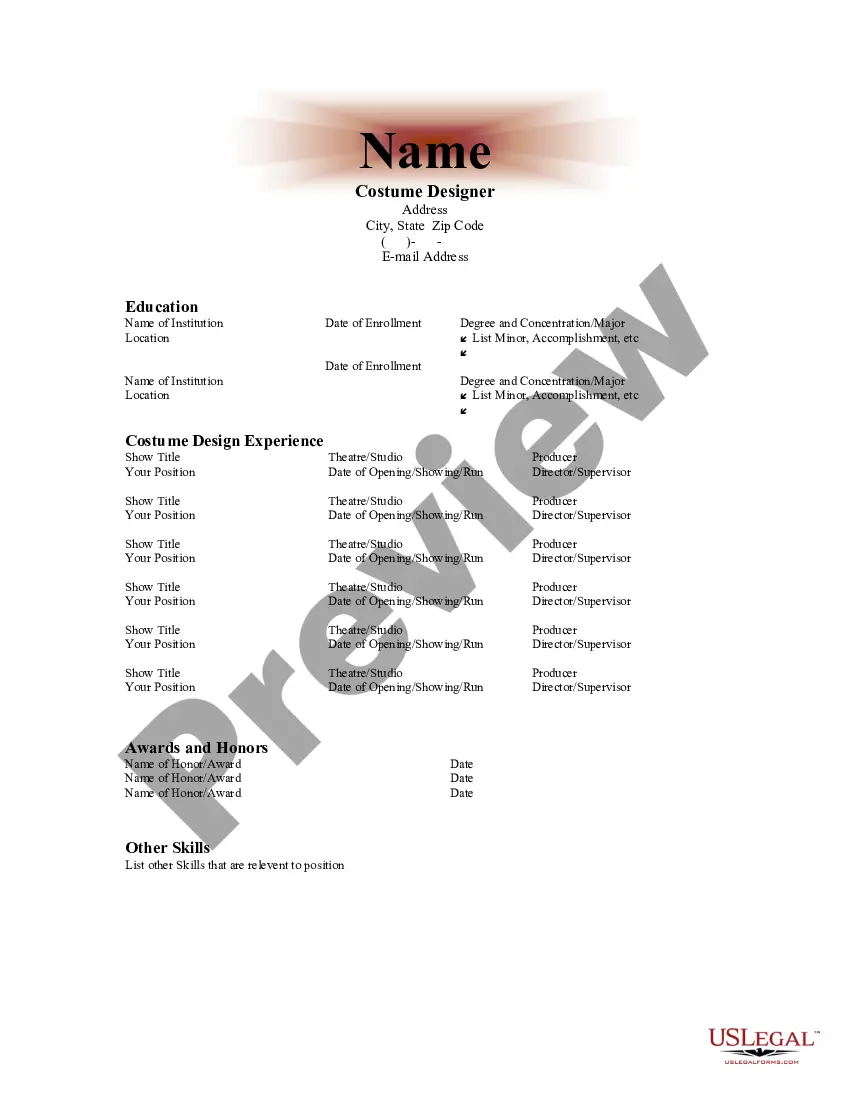
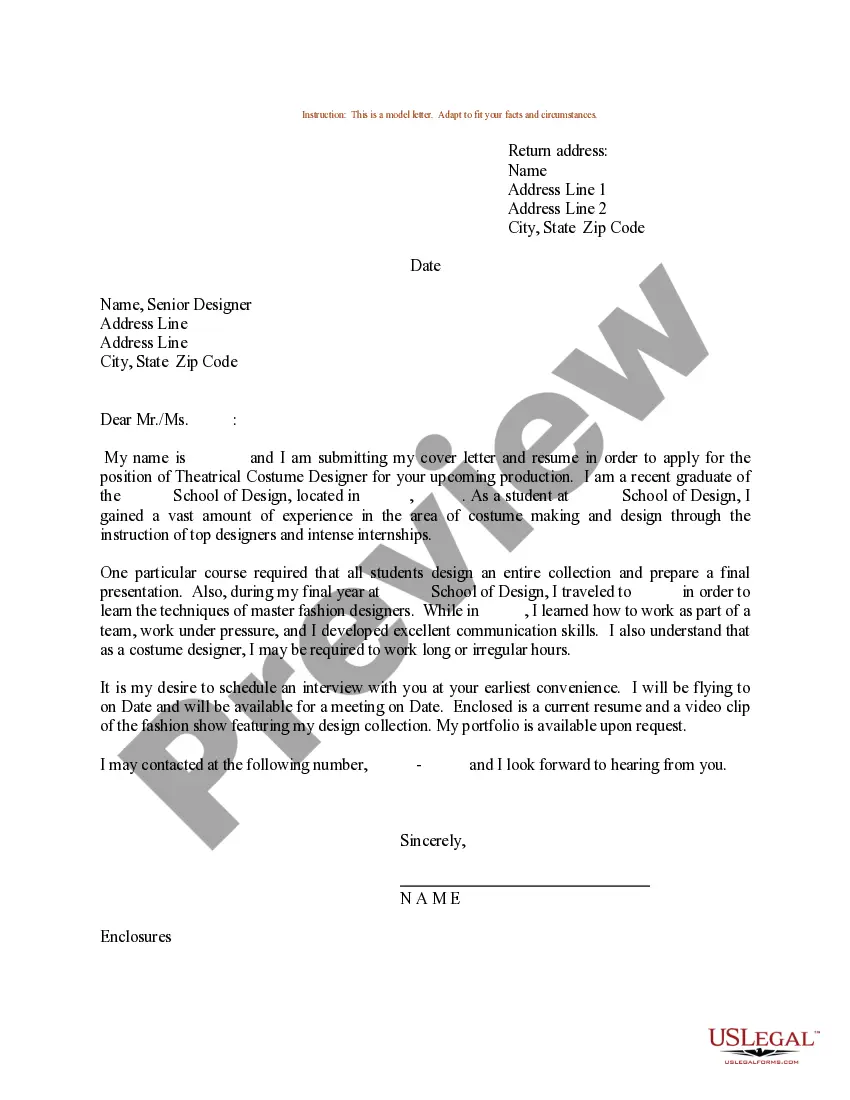
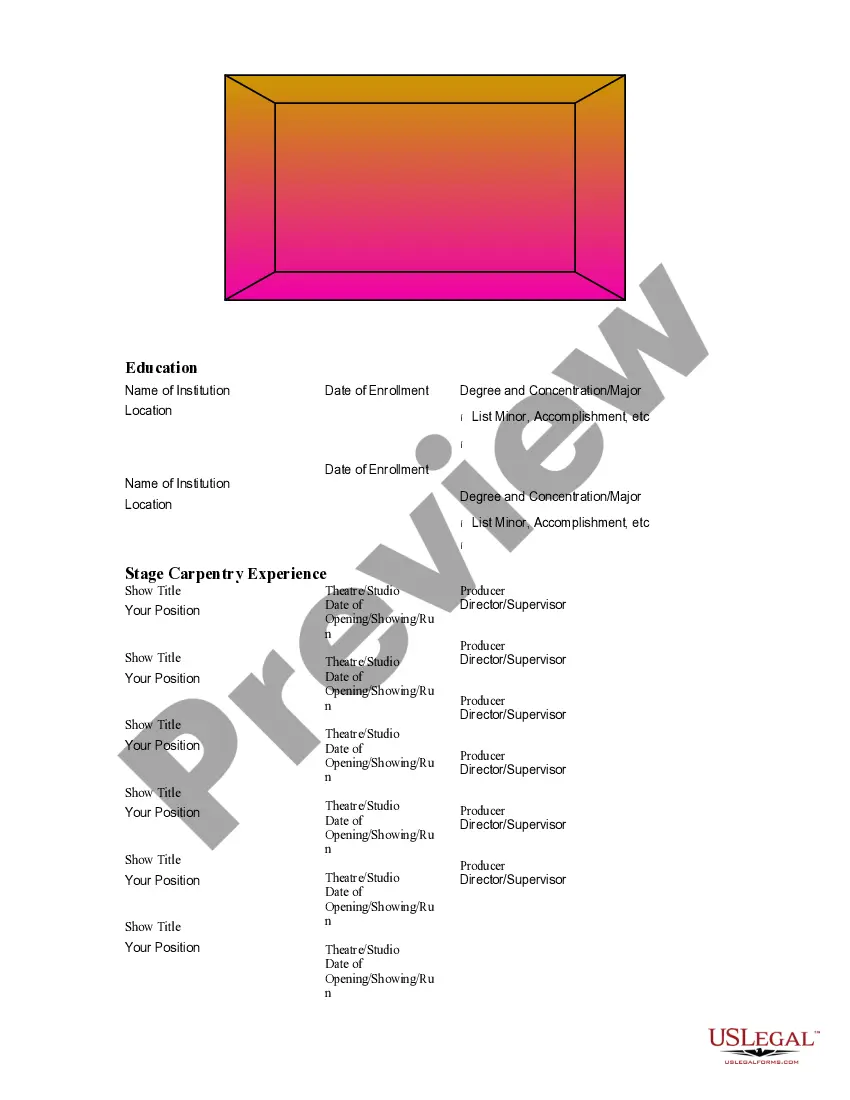
The resume for theatrical costume designer is a specialized document tailored for individuals seeking employment in the theatre industry as costume designers. Unlike conventional resumes, this form emphasizes theatre-specific experience and skills, making it an essential tool for applicants looking to showcase their unique talents and background in costume design.
Main sections of this form
- Name of institution and location
- Dates of enrollment and degree concentration/major
- List of relevant minors or accomplishments
- Your positions on various productions
- Show titles and dates of openings or runs
- Details about the theatre or studio locations
When to use this form
This resume should be used when applying for positions as a theatrical costume designer, whether in regional, national, or local theatre productions. It is particularly useful when you want to highlight your creative skills and experiences related to costume design.
Who this form is for
- Individuals seeking a career as a theatrical costume designer
- Costume designers with various levels of experience, from beginners to seasoned professionals
- Students in costume design programs who are preparing to enter the job market
- Freelancers looking to showcase their portfolio and relevant experience for potential projects
Steps to complete this form
- Fill in your personal details, including your name and contact information.
- List the institutions where you studied, including locations and dates.
- Specify your degree and any minors or relevant accomplishments.
- Document your positions in theatre productions, including show titles and dates.
- Include the names and locations of theatres or studios where you worked.
Notarization requirements for this form
This form does not typically require notarization to be legally valid. However, some jurisdictions or document types may still require it. US Legal Forms provides secure online notarization powered by Notarize, available 24/7 for added convenience.
Get your form ready online
Our built-in tools help you complete, sign, share, and store your documents in one place.
Make edits, fill in missing information, and update formatting in US Legal Forms—just like you would in MS Word.
Download a copy, print it, send it by email, or mail it via USPS—whatever works best for your next step.
Sign and collect signatures with our SignNow integration. Send to multiple recipients, set reminders, and more. Go Premium to unlock E-Sign.
If this form requires notarization, complete it online through a secure video call—no need to meet a notary in person or wait for an appointment.
We protect your documents and personal data by following strict security and privacy standards.

Make edits, fill in missing information, and update formatting in US Legal Forms—just like you would in MS Word.

Download a copy, print it, send it by email, or mail it via USPS—whatever works best for your next step.

Sign and collect signatures with our SignNow integration. Send to multiple recipients, set reminders, and more. Go Premium to unlock E-Sign.

If this form requires notarization, complete it online through a secure video call—no need to meet a notary in person or wait for an appointment.

We protect your documents and personal data by following strict security and privacy standards.
Common mistakes
- Failing to tailor the resume for specific employment opportunities.
- Omitting important details such as dates and outcomes of productions.
- Using overly complex language or industry jargon that may not be clear to all employers.
- Neglecting to proofread for spelling and grammatical errors.
Benefits of completing this form online
- Easy to download and print, making it convenient for use at auditions and interviews.
- Editable fields allow for customization to highlight your specific skills and experiences.
- Access to professional templates created by licensed attorneys ensures conformity with industry standards.
Legal use & context
- A resume is a vital document for job applications and should accurately represent your skills.
- This resume form is designed to help you highlight theatrical work effectively.
Quick recap
- A resume for theatrical costume designer is crucial for showcasing relevant experience in a vibrant field.
- This form is customizable, catering specifically to the needs of applicants in theatre.
- Completing the form accurately and persuasively increases chances of obtaining desired positions.
Looking for another form?
Form popularity
FAQ
Study the script to understand costume requirements. discuss ideas with the director, and production, make-up, lighting and set designers. research suitable costume styles and fabrics. sketch costume designs. create costumes to fit the production's design concept and budget.
The Costume Designer is responsible for the visual appearance of the actors. These responsibilities include what is seen (clothes, shoes, hats, purses, canes, parasols, jewelry, wigs, makeup, etc.) as well as what isn't (corsets, hoops, boning, character elements such as padded stomachs, etc.).
Costume designers assemble their ideas sometimes via sketches, photographs, mood boards or rough designs. Usually, they will create a timeline for major character's storylines which evolves as the story goes on. They also develop costumes for secondary and supporting characters.
Fashion Designer Resume Example. Choose the Best Format for Your Fashion Designer Resume. Write a Fashion Designer Resume Objective or Summary. Create the Perfect Job Description for a Fashion Designer Resume. Make Your Fashion Designer Resume Education Section Shine. Highlight Your Fashion Designer Skills.
The role of the costume designer is to create the characters' outfits/costumes and balance the scenes with texture and colour, etc. The costume designer works alongside the director, scenic, lighting designer, sound designer, and other creative personnel.
Costume Designer's Tools Like the set designer, the costume designer has two sets of tools: the elements of visual design and the practical material needed to create costumes. As discussed in the last chapter, the elements of visual design are line, mass, composition, space, color, and texture.
Passion for design. A costume designer must have a deep knowledge and appreciation of clothing and fashion across history and locale. Artistic ability. Software capabilities. Rudimentary construction knowledge.
You must have good communication and research skills, be creative and imaginative, and be a great designer. Also, you must have the confidence to motivate a team, break down a script in terms of costume or scene changes, sewing skills, and knowledge of textiles; how they move and feel.
A Costume Designer resume should focus heavily on your training and experience in the field of Costume Design. Your resume should highlight important skills like communication skills, attention to detail, knowledge of fabric and patterns, fashion sketching, sewing skills, and more.