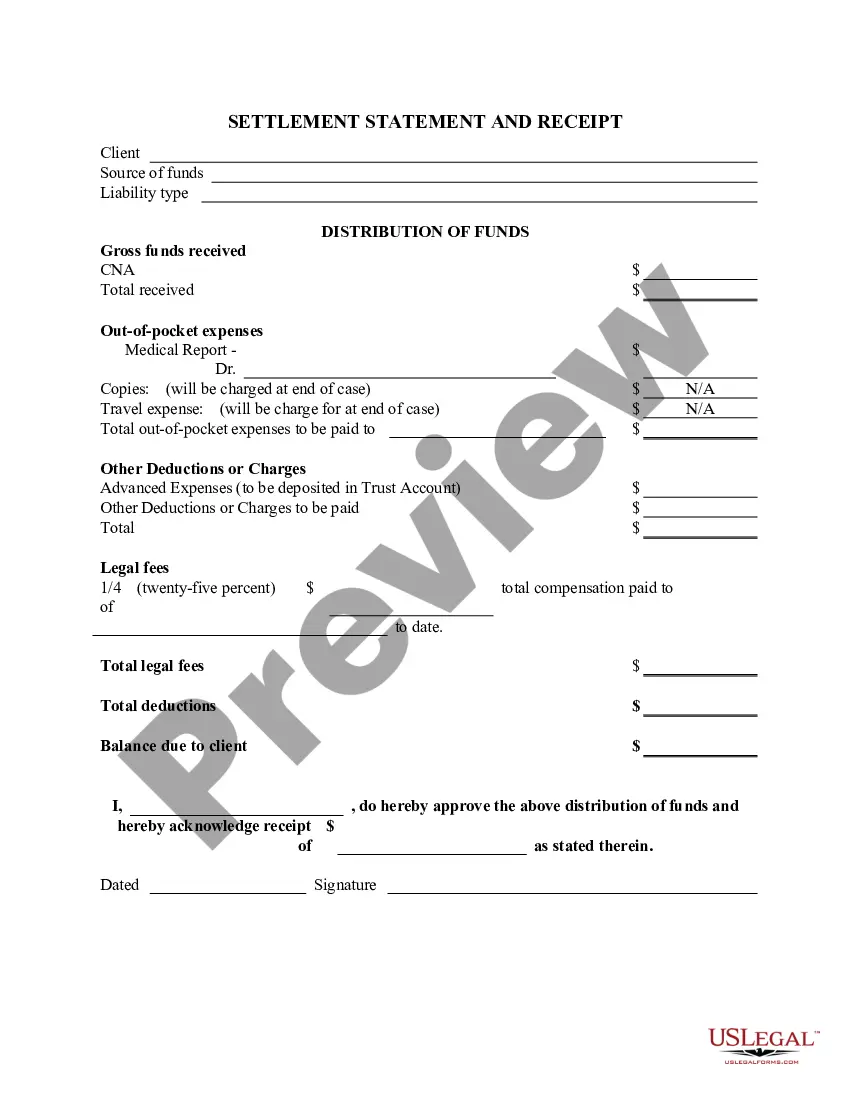
Settlement Statement of Personal Injury Case and Receipt
Understanding this form
The Settlement Statement of Personal Injury Case and Receipt is a legal document that serves two main purposes: it confirms the acknowledgment of the settlement of a personal injury claim by the client and acts as a receipt for the distribution of settlement funds. This form is essential for ensuring that all parties understand the terms of the settlement and provides a clear record of the funds exchanged, distinct from other legal forms that may address settlements without specifying fund distribution details.
Form components explained
- Client's acknowledgment of the settlement agreement.
- Details of the settlement funds distributed to the client.
- Signatures of all relevant parties to confirm receipt.
- Identification of any deductions or fees from the settlement amount.

When this form is needed
This form should be used when a client has reached a settlement in a personal injury case. It is important to complete this document before releasing any settlement funds to ensure all parties are in agreement about the terms and amounts being distributed. This form may be particularly relevant during the conclusion of negotiations between the client and the insurer or other responsible parties.
Intended users of this form
This form is intended for:
- Clients who have settled their personal injury claims.
- Attorneys representing clients in personal injury cases.
- Insurers or responsible parties facilitating settlement payments.
Completing this form step by step
- Identify the parties involved in the settlement, including the client and the insurer.
- Specify the total amount of the settlement agreed upon.
- Outline any deductions or fees that will be applied to the settlement funds.
- Include the distribution details, including the amount the client will receive.
- Ensure all relevant parties sign the document to confirm their agreement and acknowledgment.
Is notarization required?
This form usually doesn’t need to be notarized. However, local laws or specific transactions may require it. Our online notarization service, powered by Notarize, lets you complete it remotely through a secure video session, available 24/7.
Get your form ready online
Our built-in tools help you complete, sign, share, and store your documents in one place.
Make edits, fill in missing information, and update formatting in US Legal Forms—just like you would in MS Word.
Download a copy, print it, send it by email, or mail it via USPS—whatever works best for your next step.
Sign and collect signatures with our SignNow integration. Send to multiple recipients, set reminders, and more. Go Premium to unlock E-Sign.
If this form requires notarization, complete it online through a secure video call—no need to meet a notary in person or wait for an appointment.
We protect your documents and personal data by following strict security and privacy standards.

Make edits, fill in missing information, and update formatting in US Legal Forms—just like you would in MS Word.

Download a copy, print it, send it by email, or mail it via USPS—whatever works best for your next step.

Sign and collect signatures with our SignNow integration. Send to multiple recipients, set reminders, and more. Go Premium to unlock E-Sign.

If this form requires notarization, complete it online through a secure video call—no need to meet a notary in person or wait for an appointment.

We protect your documents and personal data by following strict security and privacy standards.
Common mistakes
- Failing to include all relevant parties' signatures.
- Omitting crucial details about deductions or fees.
- Not providing a copy to all parties involved after it is completed.
Why use this form online
- Easy access to the form allows for quick completion and distribution.
- Digital formats ensure you can edit and customize the document as needed.
- Provides a reliable record of the settlement agreement and funds distribution.
Looking for another form?


Form popularity
FAQ
The Settlement Statement of Personal Injury Case and Receipt is a dual-purpose document used to confirm the client’s agreement to a settlement and to document how funds are distributed. It records the settlement terms, identifies any deductions or fees, and provides a receipt for the funds paid to the client, ensuring all parties understand and agree to the financial details before funds are released.
The form requires signatures from all relevant parties to confirm receipt and agreement. Typically, the client signs to acknowledge the settlement and the funds received, with signatures from the attorney and the insurer or responsible party to confirm the terms and distribution of funds. These signatures finalize acknowledgment and receipt.
Use this form once a personal injury settlement has been reached, and before any settlement funds are released. It ensures all parties agree on the terms and the exact funds distributed to the client, providing a clear, documented record during the conclusion of negotiations with the insurer or responsible party.
Details include the total settlement amount allocated to the client, any deductions or fees taken from that amount, and the net funds actually paid to the client. The form also records the fund distribution and the client’s acknowledgment of receipt.
The form identifies any deductions or fees from the settlement amount, providing a clear line of how the gross settlement is reduced to the net amount paid to the client. This transparency helps avoid disputes about how funds were allocated.
This form is focused on documenting the actual funds distribution and providing a receipt for the client, including the specific deductions, in addition to confirming settlement terms. A standard settlement agreement may outline terms but might not separately itemize fund distribution or serve as a recipient receipt.