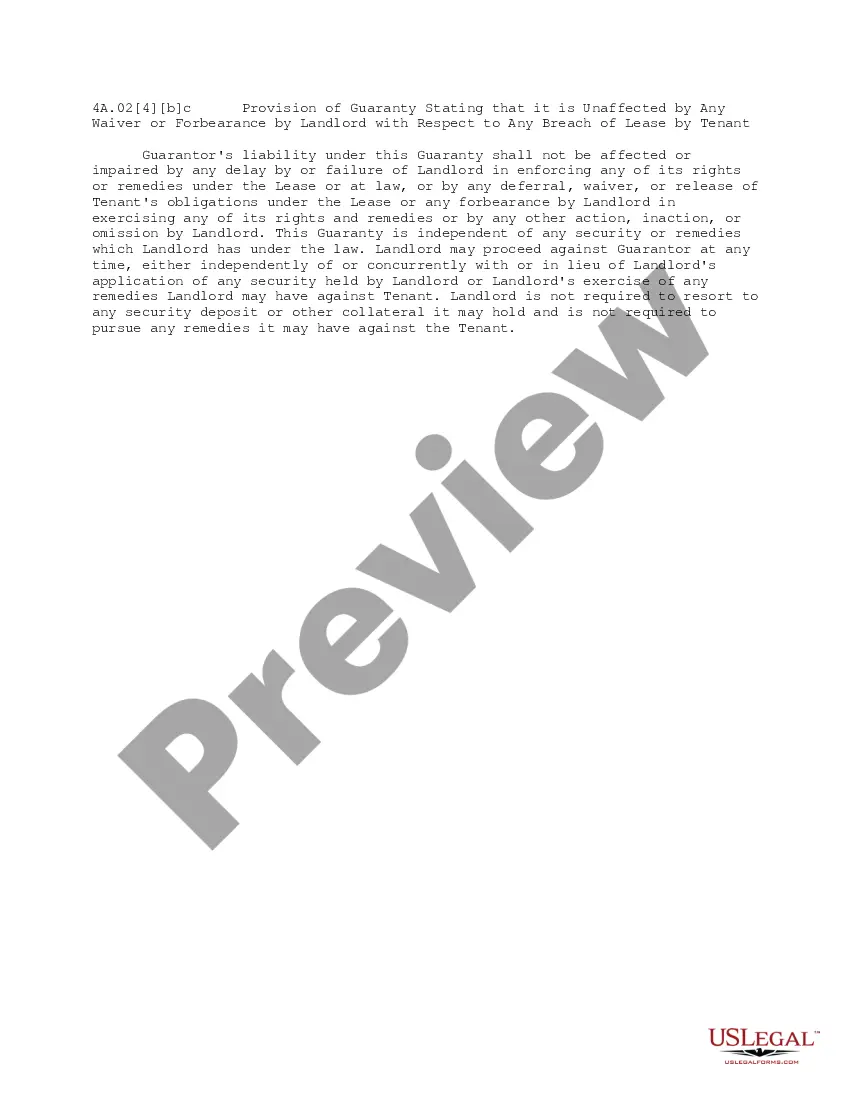
Provision of Guaranty Stating that it is Unaffected by Any Waiver or Forbearance by Landlord
Overview of this form
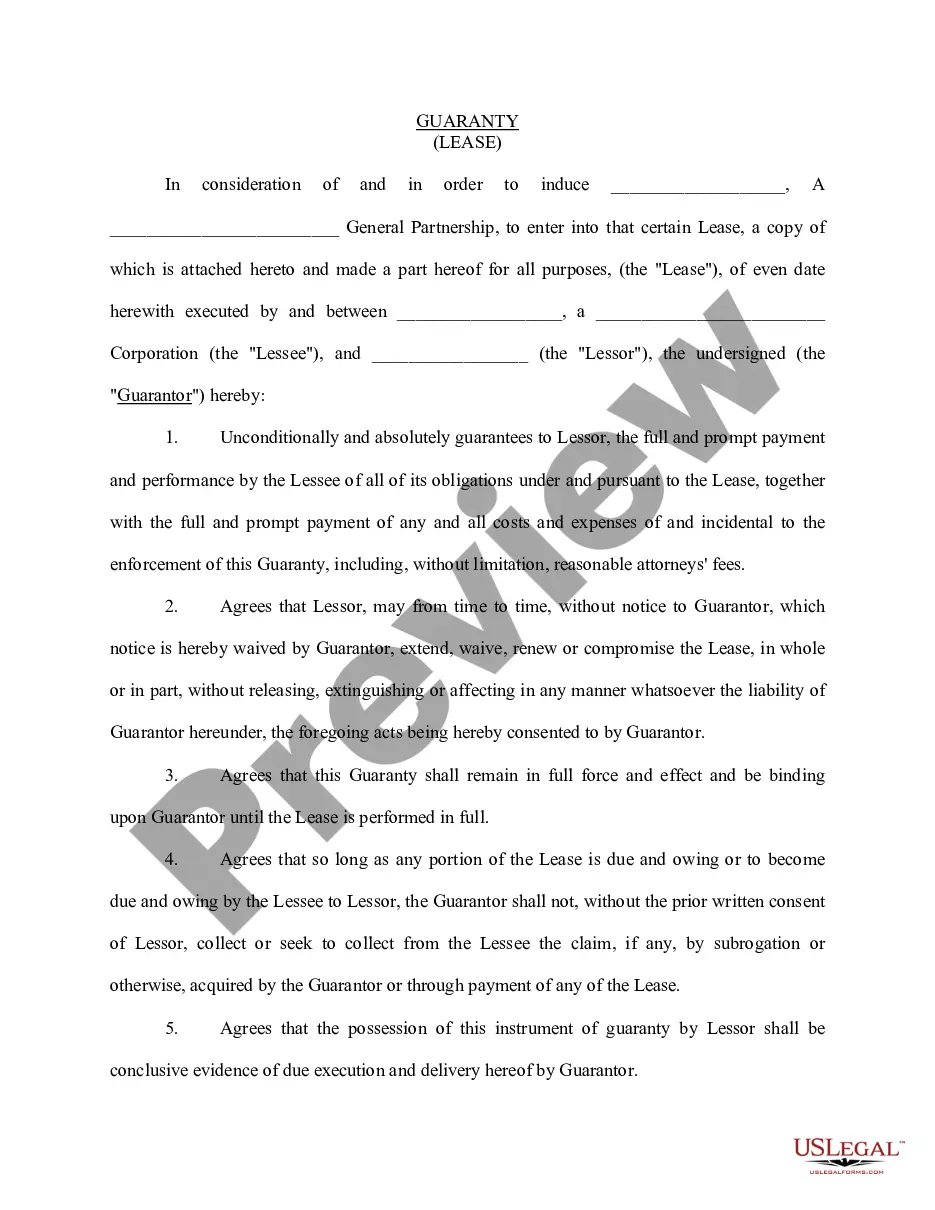
This form is a Provision of Guaranty, specifying that the guarantor's liability remains intact regardless of any delay or forbearance by the landlord. This ensures that the landlord can pursue the guarantor for obligations without needing to first exhaust remedies against the tenant. Unlike a standard lease agreement, this provision explicitly states the independence of the guarantor's obligations from the landlord's actions or inactions.
Key components of this form
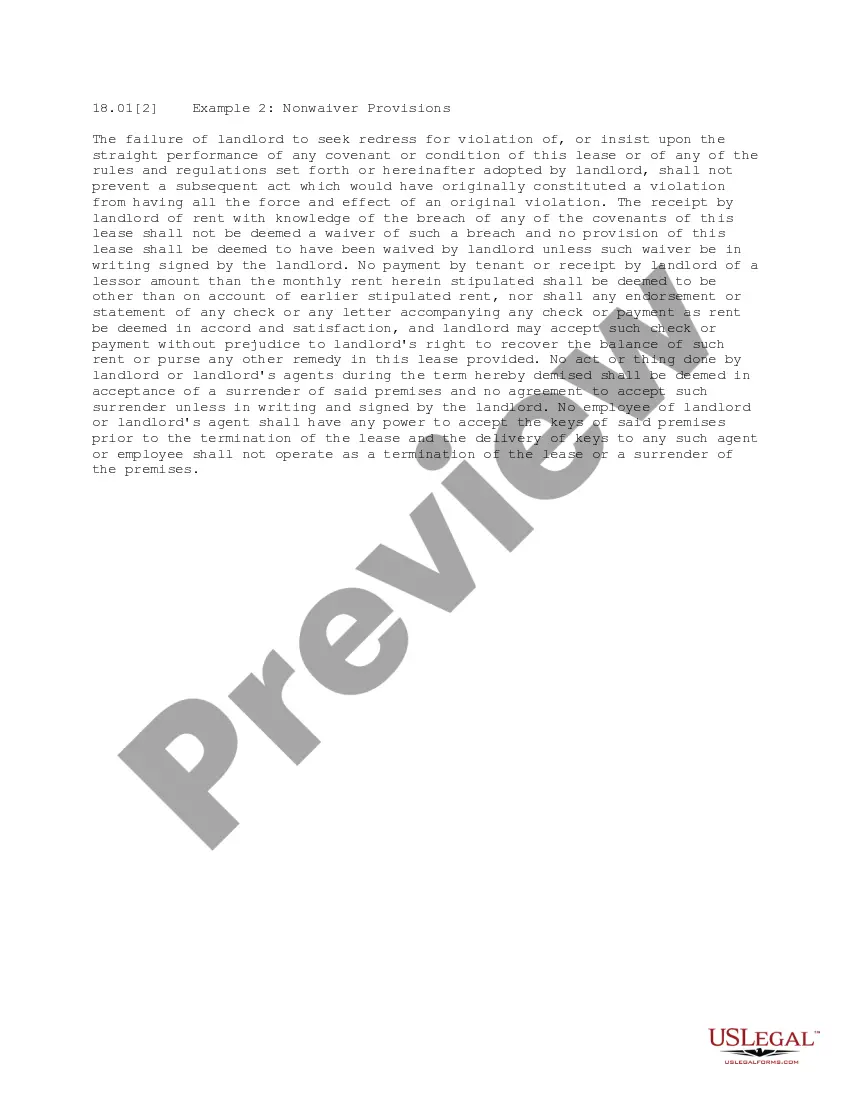
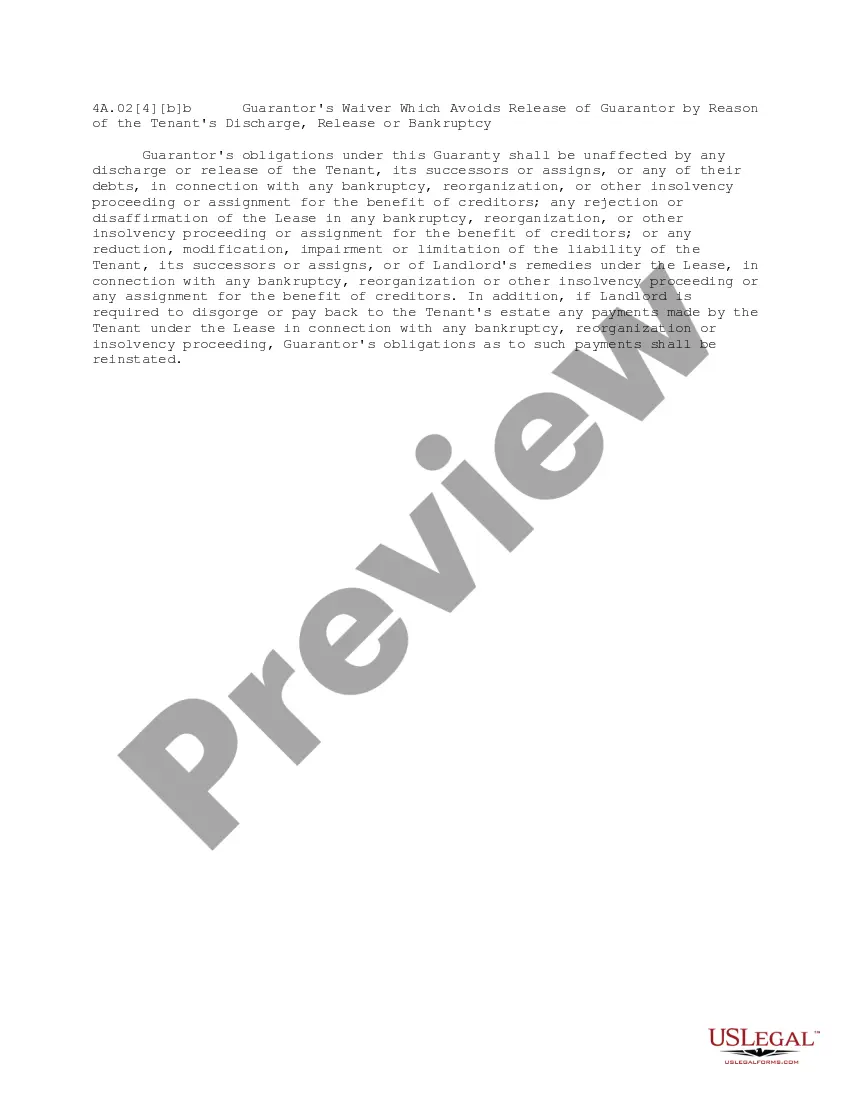
- Guarantor's liability clause: Confirms that the guarantor's obligations are unaffected by landlord's delay or waiver.
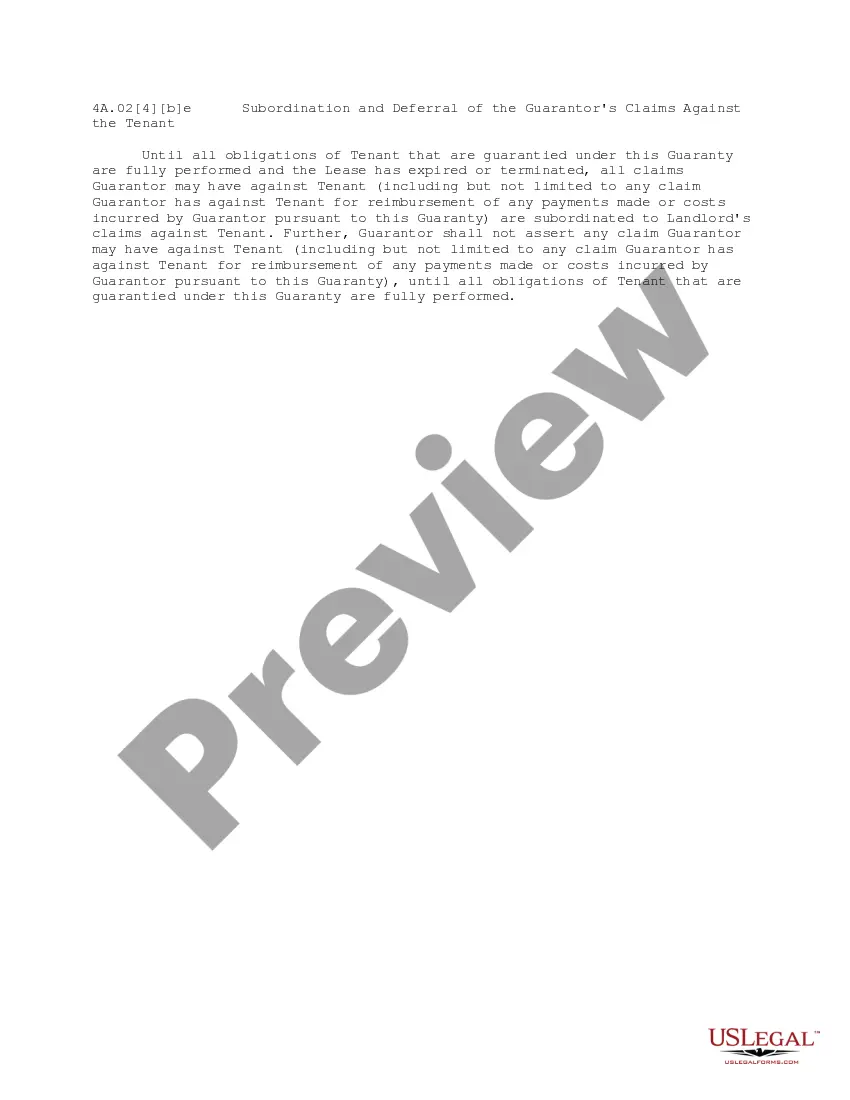
- Independence declaration: Affirms that the guaranty stands alone apart from any security or remedies held by the landlord.
- Enforcement rights: Allows landlords to pursue the guarantor at any time, alongside or instead of actions against the tenant.
- Non-requirement of security: States that landlords do not need to use any security deposit before pursuing the guarantor.

When this form is needed
This form should be used in situations where a landlord requires a guarantor to back a lease. It is especially relevant when the landlord wants assurance that they can enforce the guaranty without being impacted by any potential issues that may arise from their management of the lease, such as delays in enforcing tenant obligations or giving waivers.
Who this form is for
This form is appropriate for:
- Landlords who need to secure a lease through a guarantor.
- Guarantors who agree to take on liability for a tenantâs obligations under a lease.
- Real estate professionals managing leasing agreements.
How to prepare this document
To complete this form, follow these steps:
- Identify the parties involved: Clearly state the landlord, tenant, and guarantor.
- Specify the lease details: Include relevant information about the lease related to the tenancy.
- Review the terms and conditions: Ensure all parties understand their responsibilities under the guaranty.
- Enter dates: Clearly indicate the effective date of the guaranty.
- Collect signatures: Have all necessary parties sign the provision to establish agreement.
Notarization guidance
This form does not typically require notarization unless specified by local law.
Get your form ready online
Our built-in tools help you complete, sign, share, and store your documents in one place.
Make edits, fill in missing information, and update formatting in US Legal Forms—just like you would in MS Word.
Download a copy, print it, send it by email, or mail it via USPS—whatever works best for your next step.
Sign and collect signatures with our SignNow integration. Send to multiple recipients, set reminders, and more. Go Premium to unlock E-Sign.
If this form requires notarization, complete it online through a secure video call—no need to meet a notary in person or wait for an appointment.
We protect your documents and personal data by following strict security and privacy standards.

Make edits, fill in missing information, and update formatting in US Legal Forms—just like you would in MS Word.

Download a copy, print it, send it by email, or mail it via USPS—whatever works best for your next step.

Sign and collect signatures with our SignNow integration. Send to multiple recipients, set reminders, and more. Go Premium to unlock E-Sign.

If this form requires notarization, complete it online through a secure video call—no need to meet a notary in person or wait for an appointment.

We protect your documents and personal data by following strict security and privacy standards.
Common mistakes
- Failing to include all parties' names correctly, which can complicate enforcement.
- Not specifying the lease details, leading to ambiguity about the obligations covered.
- Omitting signatures, rendering the form ineffective.
Benefits of completing this form online
- Convenience: Easily download and complete the form from your computer or device.
- Editability: Modify the form to meet your specific situation before finalizing.
- Reliability: Obtain documents legally reviewed by licensed attorneys to ensure accuracy.
- This provision helps landlords enforce tenant obligations effectively by securing guarantor liability.
- It clarifies that the guarantor's obligations are not contingent on the landlordâs actions, making them more enforceable.
Summary of main points
- The Provision of Guaranty ensures the guarantee is upheld regardless of the landlordâs actions.
- It provides landlords the option to pursue the guarantor without needing to apply security deposits first.
- This form is essential for landlords seeking strong financial assurances from guarantors.
Looking for another form?
Form popularity
FAQ
Even if you qualify for forbearance, you won't automatically be granted that protection. You must apply for it, and stopping payments before you've officially been granted forbearance on your loan may make you delinquent on your mortgage and have a serious negative impact on your credit score.
Forbearance is when your mortgage servicer or lender allows you to temporarily pay your mortgage at a lower payment or pause paying your mortgage. You will have to pay the payment reduction or the paused payments back later.Forbearance does not erase the amount you owe on your mortgage.
Forbearance lets you skip some or all of your monthly mortgage payments for as much as a year. But forbearance should be a last resort, something to avoid if at all possible. While it can be a lifeline in the short-term, forbearance will undoubtedly lead to credit issues for many down the road.
The major difference is that forbearance always increases the amount you owe, while deferment can be interest-free for certain types of federal loans.Deferment: Generally better if you have subsidized federal student loans or Perkins loans and you are unemployed or dealing with significant financial hardship.
With a forbearance, the lender agrees to reduce or suspend mortgage payments for a while. During the forbearance period, the servicer (on behalf of the lender) won't initiate a foreclosure.pay the amount in a lump sum. add an extra amount to your regular payments each month until the entire skipped amount is repaid,
Loan forbearance should not have any impact on your credit. Your lender may report your forbearance, but so long as you fulfill your part of the agreement, no missed payments will be recorded and your score will be unaffected by your choice to participate in a forbearance.
Forbearance lets you skip some or all of your monthly mortgage payments for as much as a year. But forbearance should be a last resort, something to avoid if at all possible. While it can be a lifeline in the short-term, forbearance will undoubtedly lead to credit issues for many down the road.
Forbearance is when your mortgage servicer, that's the company that sends your mortgage statement and manages your loan, or lender allows you to pause or reduce your payments for a limited period of time. Forbearance does not erase what you owe. You'll have to repay any missed or reduced payments in the future.