Release of Right of Way / Easement
Understanding this form
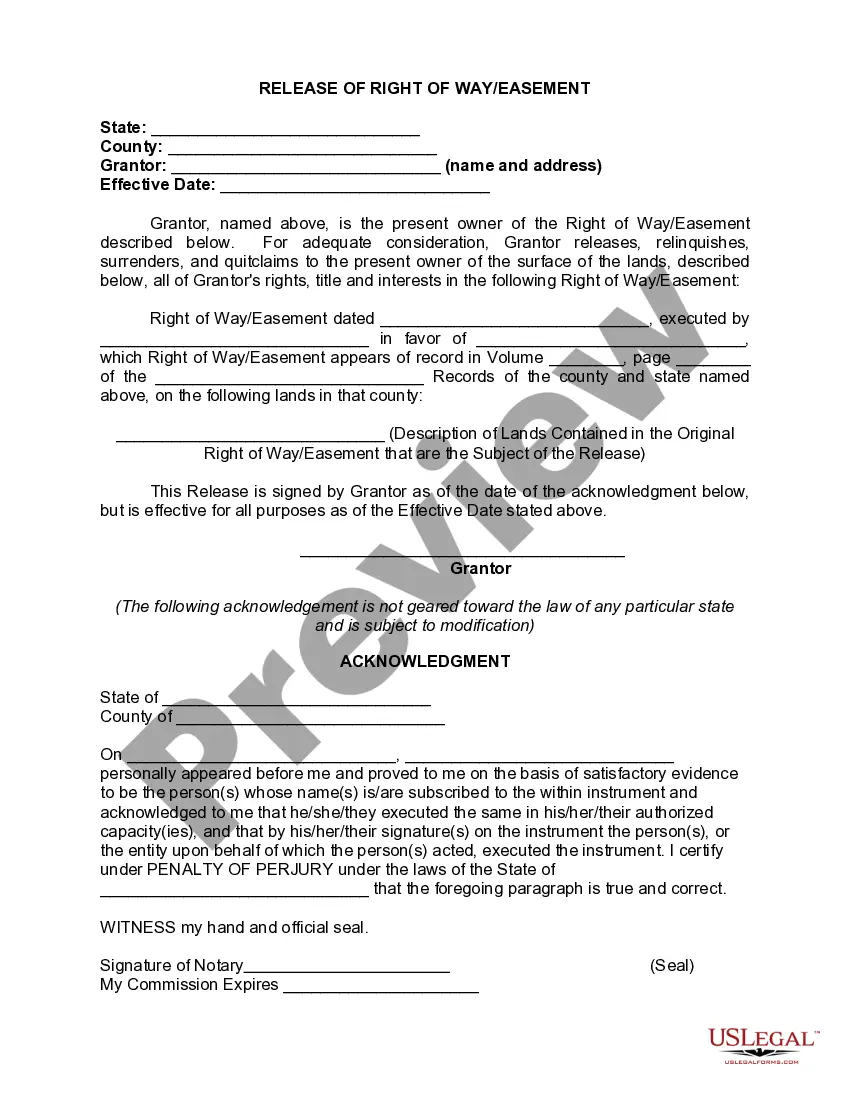
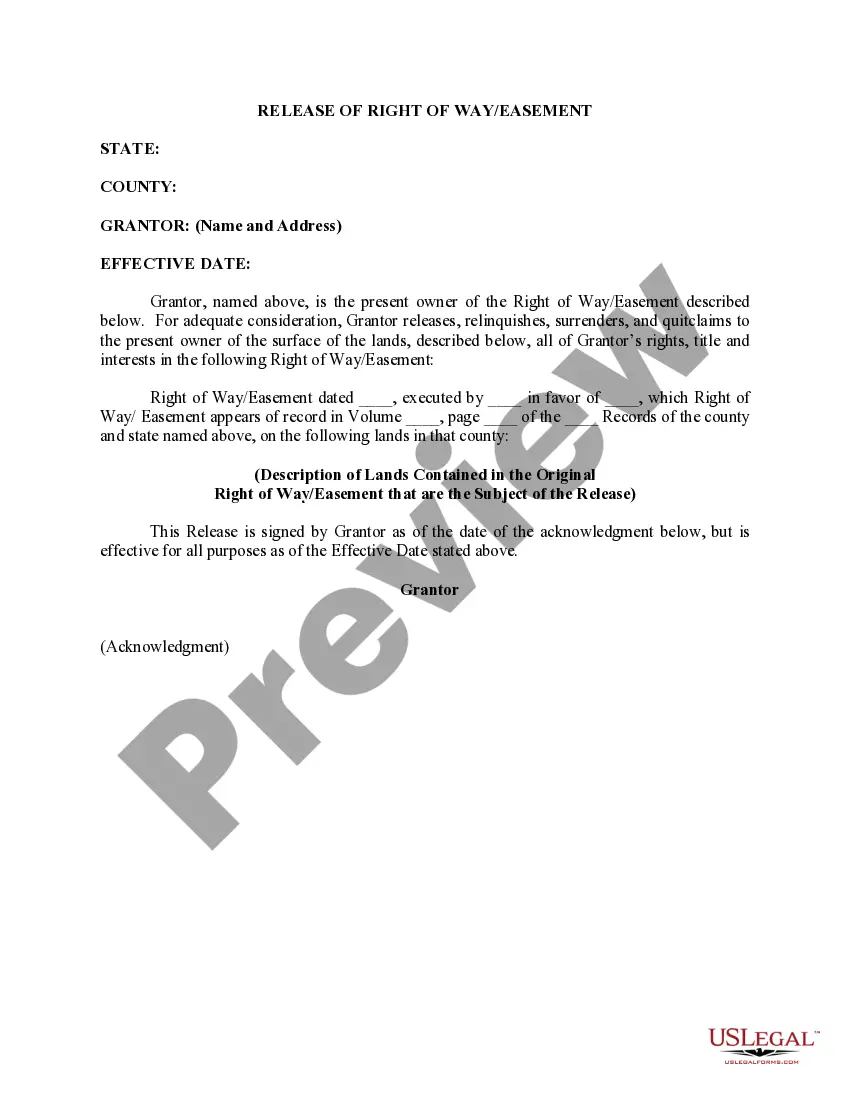
The Release of Right of Way / Easement form is a legal document that officially terminates an existing right of way or easement, allowing the property owner to reclaim full control of their land. Unlike similar forms that may create or modify easements, this form specifically provides for their release, ensuring that the right of way no longer exists.
Main sections of this form
- Identification of the Grantor (owner of the right of way)
- Effective date of the release
- Description of the Right of Way/Easement being released
- Details about the original Right of Way/Easement, including execution date and record location
- Signature of the Grantor and acknowledgment section for notarization

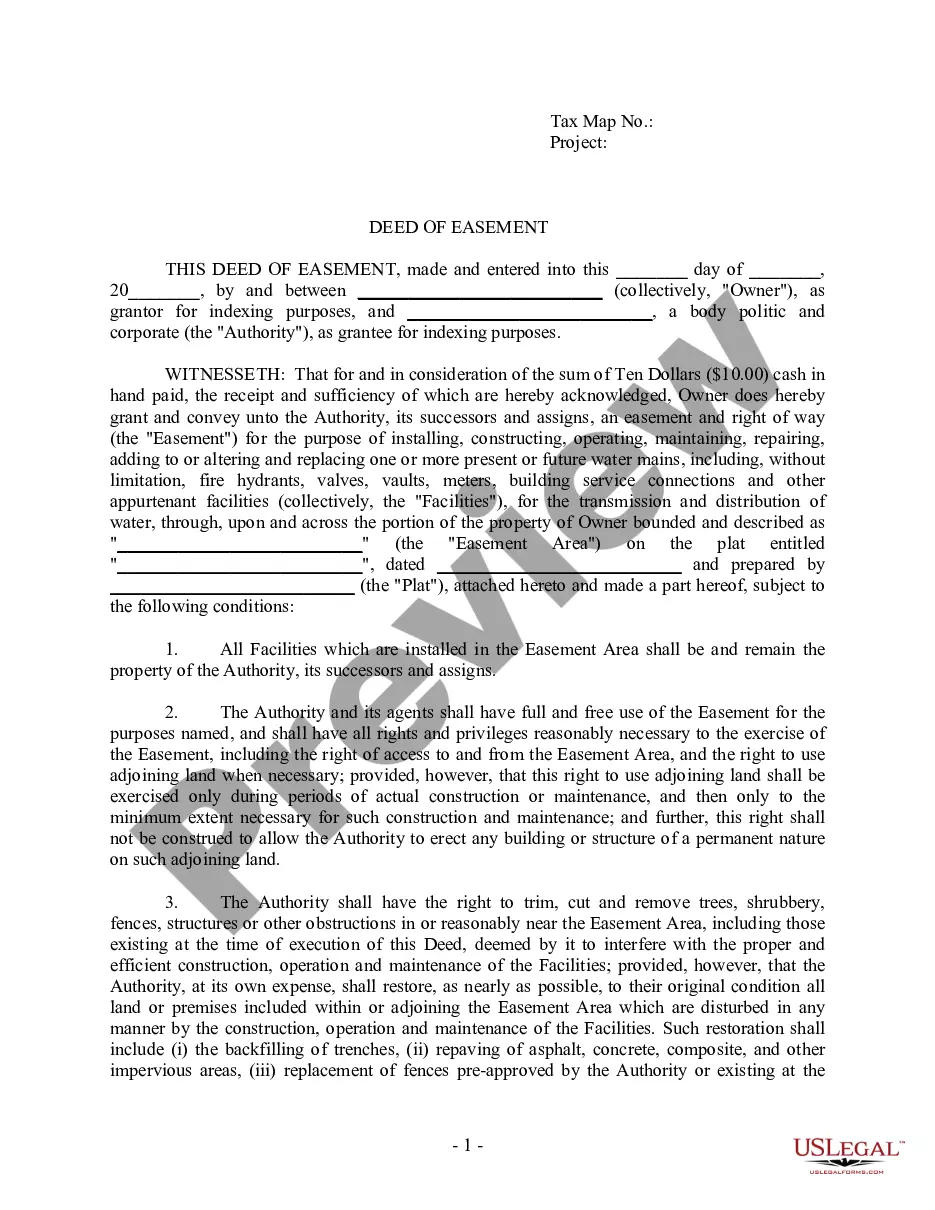
When to use this form
This form is typically used when a property owner wishes to formally relinquish a right of way or easement that no longer serves a purpose. Scenarios may include where a path or access is no longer needed, or when property redevelopment is occurring that does not require the easement to remain in effect.
Who this form is for
- Property owners looking to terminate a right of way or easement on their land.
- Individuals involved in real estate transactions where easements are being released.
- Attorneys representing clients in land use or property disputes related to easements.
Completing this form step by step
- Enter the state and county where the right of way is located.
- Provide the name and address of the Grantor releasing the easement.
- Specify the effective date of the release.
- Describe the Right of Way/Easement being released, including details of the original document.
- Have the Grantor sign the form and complete the acknowledgment section in the presence of a notary.
Does this document require notarization?
To make this form legally binding, it must be notarized. Our online notarization service, powered by Notarize, lets you verify and sign documents remotely through an encrypted video session.
Get your form ready online
Our built-in tools help you complete, sign, share, and store your documents in one place.
Make edits, fill in missing information, and update formatting in US Legal Forms—just like you would in MS Word.
Download a copy, print it, send it by email, or mail it via USPS—whatever works best for your next step.
Sign and collect signatures with our SignNow integration. Send to multiple recipients, set reminders, and more. Go Premium to unlock E-Sign.
If this form requires notarization, complete it online through a secure video call—no need to meet a notary in person or wait for an appointment.
We protect your documents and personal data by following strict security and privacy standards.

Make edits, fill in missing information, and update formatting in US Legal Forms—just like you would in MS Word.

Download a copy, print it, send it by email, or mail it via USPS—whatever works best for your next step.

Sign and collect signatures with our SignNow integration. Send to multiple recipients, set reminders, and more. Go Premium to unlock E-Sign.

If this form requires notarization, complete it online through a secure video call—no need to meet a notary in person or wait for an appointment.

We protect your documents and personal data by following strict security and privacy standards.
Avoid these common issues
- Failing to accurately describe the right of way or easement being released.
- Omitting the effective date or other crucial information.
- Not obtaining the necessary notarization for the document.
Advantages of online completion
- Convenient access to professionally drafted legal forms.
- Instant download allows for immediate use and completion.
- User-friendly format that simplifies the understanding and filling process.
Looking for another form?


Form popularity
FAQ
Give the document a simple title: Grant of Easement is sufficient. Identify the parties. You need to explain who the parties are to the agreement. The person granting the easement to his property is the Grantor and the person gaining access to the property is the Grantee.
An easement is a limited right to use another person's land for a stated purpose. Examples of easements include the use of private roads and paths, or the use of a landowner's property to lay railroad tracks or electrical wires.
Generally speaking, an easement is a more serious property right; it is the legal right to use someone else's land for a particular purpose. Easements are often recorded at the county clerk's office and encumber your property's title.Here, however, you probably do not need to take the step of granting an easement.
There are eight ways to terminate an easement: abandonment, merger, end of necessity, demolition, recording act, condemnation, adverse possession, and release.
What are Easements and Rights-of-Way? Easements are nonpossessory interests in real property. More simply, an easement is the right to use another's property for a specific purpose. Rights-of-way are easements that specifically grant the holder the right to travel over another's property.
An easement is a nonpossessory right to use and/or enter onto the real property of another without possessing it. It is "best typified in the right of way which one landowner, A, may enjoy over the land of another, B".
Thus, the simplest method by which an owner can prevent an easement from being acquired on his or her property is by giving his consent to the other person's use. Once permission is given, the use by the neighbor (or the neighbor's tenant) is not adverse.
You can terminate an easement by release. A release is a surrender of a right or interest, such as an easement. Only the person holding the right can release it, such as the owner of the dominant estate in an easement appurtenant or the holder of an easement in gross.
An easement deed allows a party that is not the owner to use a portion of the land. It is a written agreement between two parties that spells out what part of the property is available for access and how it may be used. Since you are granting an easement to your land, you can set any terms and conditions you like.