Forester Agreement - Self-Employed Independent Contractor
Overview of this form
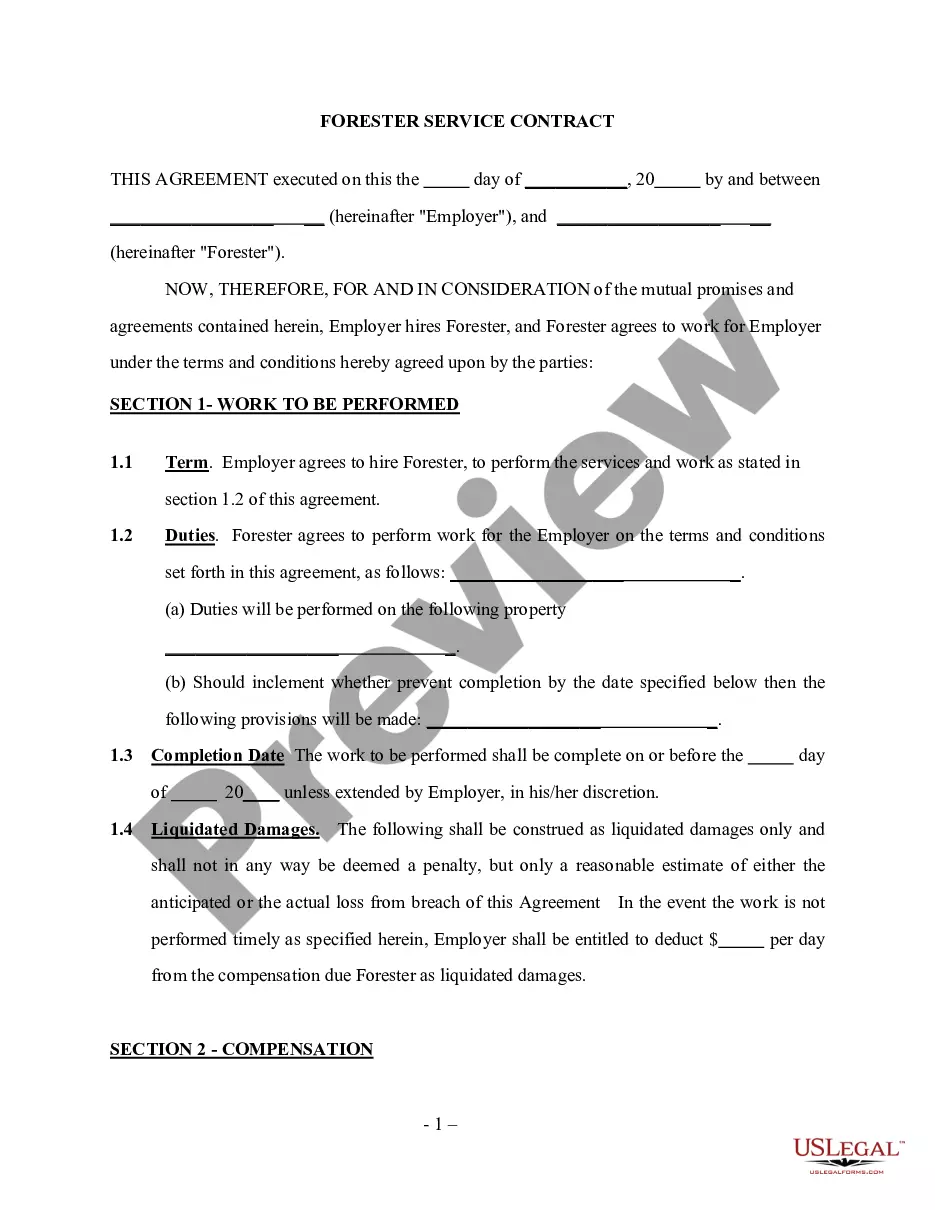
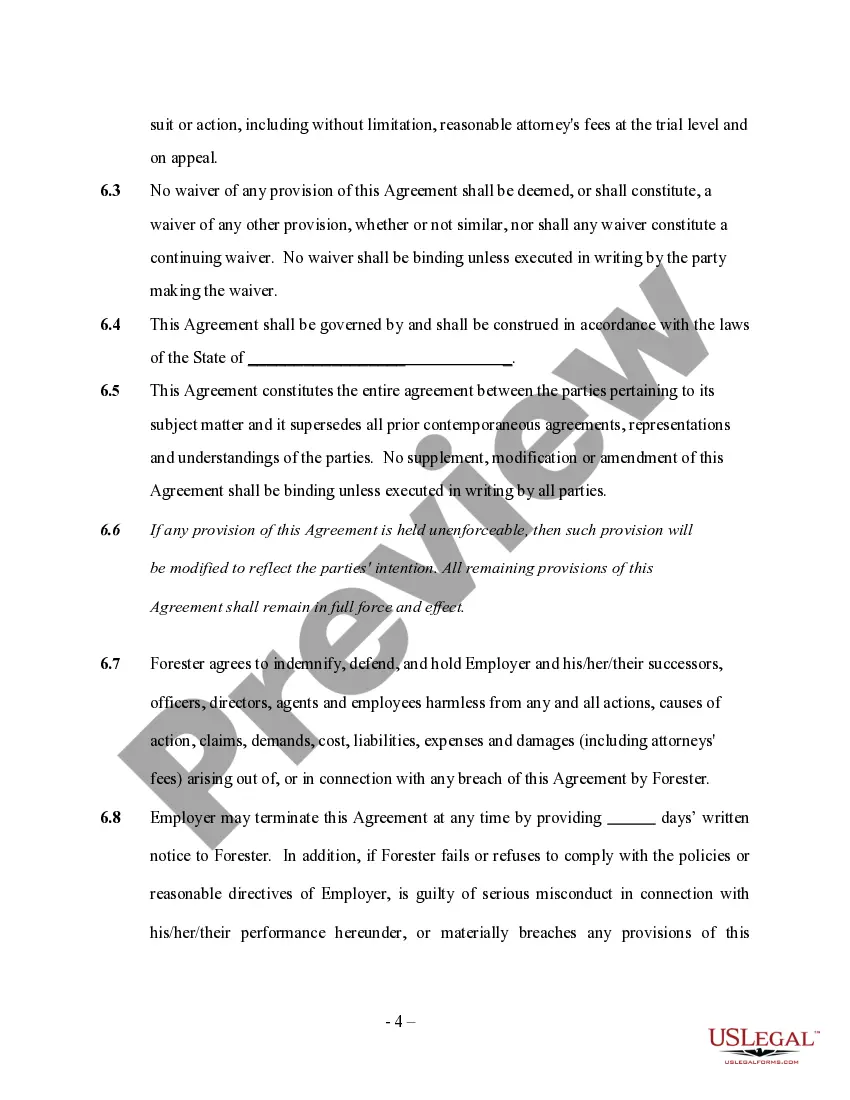
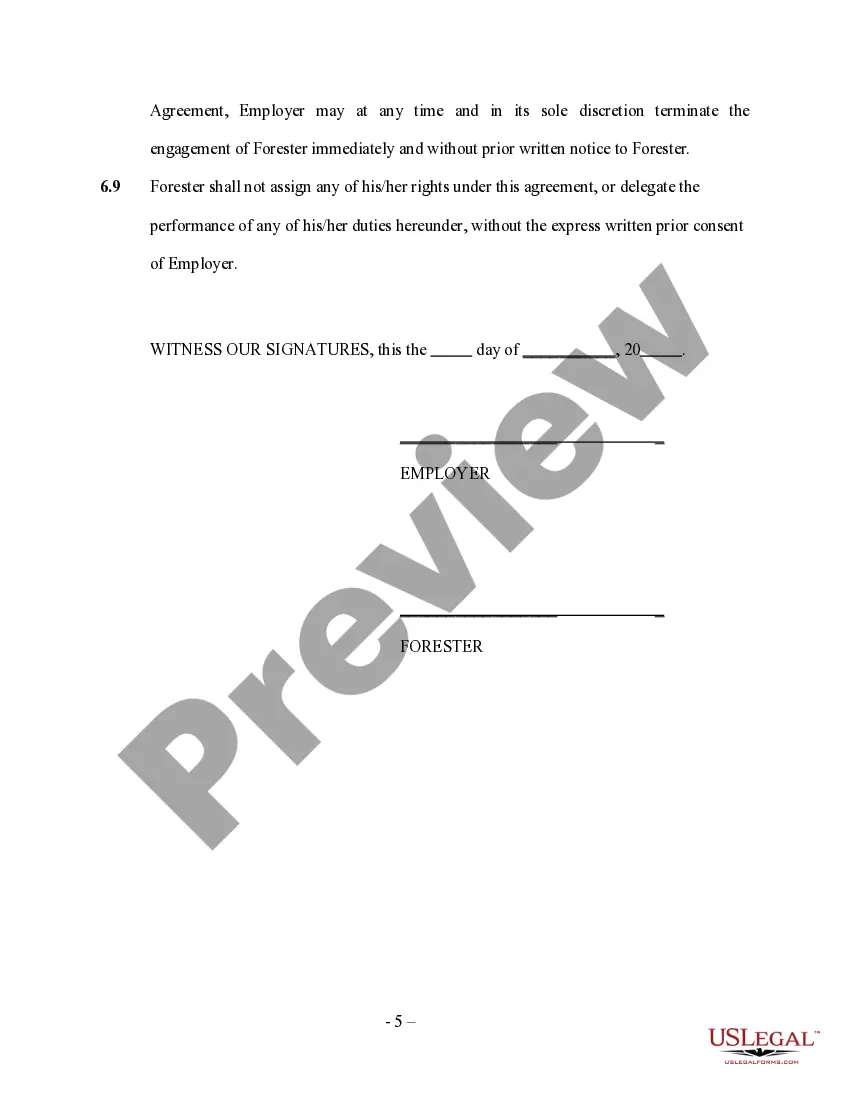
The Forester Agreement - Self-Employed Independent Contractor is a legal document that outlines the terms and conditions between a property owner (Employer) and a forester acting as an independent contractor. This agreement specifies the services to be performed by the forester and differentiates their relationship from that of an employee, establishing clear responsibilities and expectations for both parties. Unlike employment contracts, this form emphasizes the independent nature of the contractor's work and their accountability for taxes and insurance.
Key parts of this document
- Work to be performed: Defines the specific duties and any relevant timelines for the performance of services.
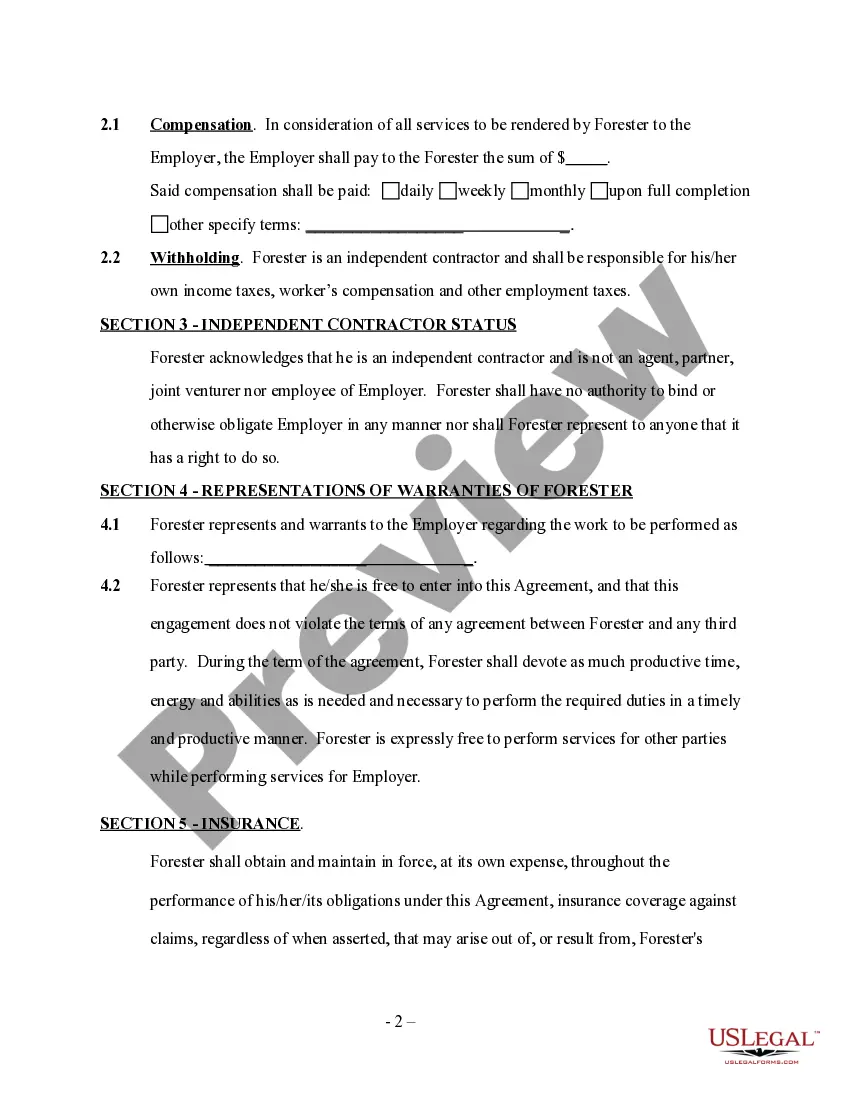
- Independent contractor status: Clarifies that the forester is not an employee and outlines the legal implications of this status.
- Insurance requirements: Details the obligation of the forester to obtain insurance coverage for their services.
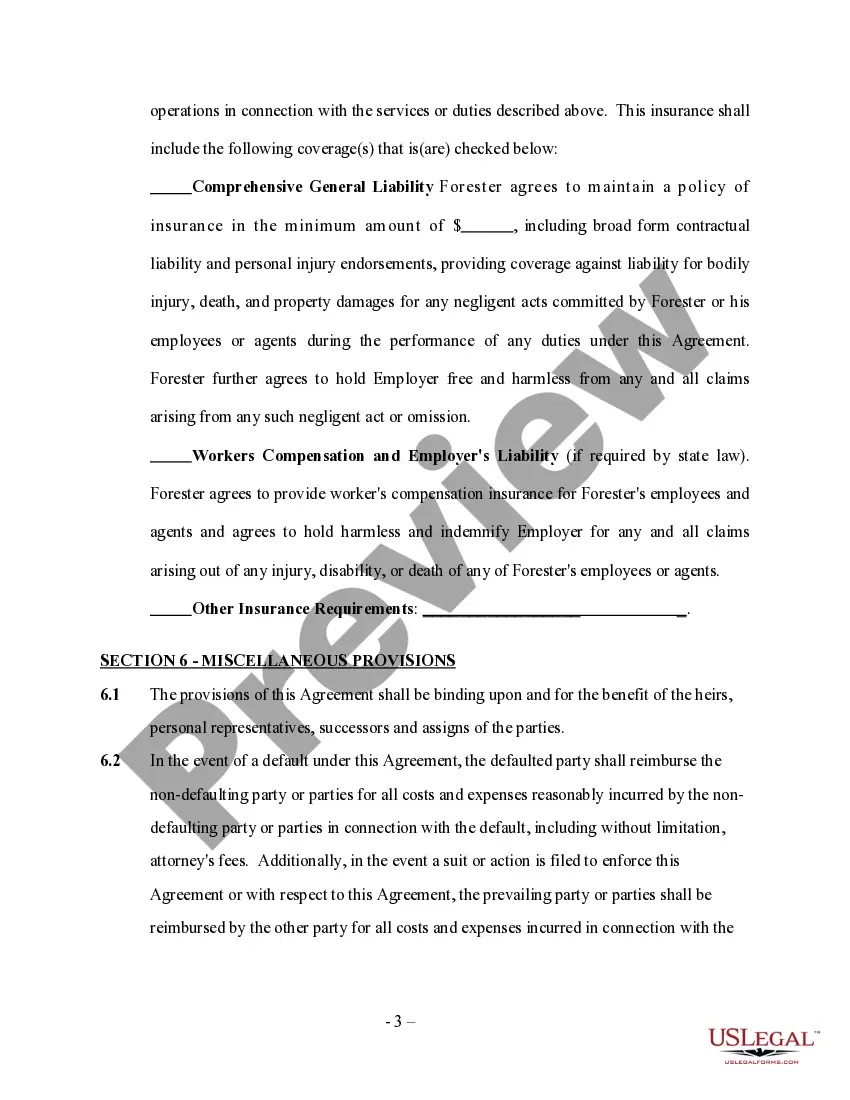
- Default and reimbursement clauses: Specifies the actions in case of default by either party and responsibilities regarding legal fees.
- Governing law: Identifies the state laws that will govern the agreement.
When this form is needed
This form is essential when a property owner requires forestry services from a self-employed forester. It is applicable in situations where the employer needs to outline the expectations and responsibilities related to tasks like timber valuation, forest management, or consulting on land use. Additionally, this agreement is used to formalize the independent status of the forester, ensuring compliance with local and state regulations.
Who this form is for
- Property owners looking to engage a forester as an independent contractor.
- Foresters seeking to clarify their working relationship and responsibilities to avoid potential legal issues.
- Businesses or organizations that require forestry-related services on their properties.
Completing this form step by step
- Identify the parties involved: Full names and addresses of the Employer and Forester.
- Specify the services to be performed: Clearly outline the duties and tasks expected from the Forester.
- Designate the property: Indicate the location where the forestry services will be rendered.
- Determine and enter any relevant dates: Include start dates and completion deadlines.
- Include signatures: Ensure both parties sign and date the agreement to validate the contract.
Is notarization required?
Notarization is not commonly needed for this form. However, certain documents or local rules may make it necessary. Our notarization service, powered by Notarize, allows you to finalize it securely online anytime, day or night.
Get your form ready online
Our built-in tools help you complete, sign, share, and store your documents in one place.
Make edits, fill in missing information, and update formatting in US Legal Forms—just like you would in MS Word.
Download a copy, print it, send it by email, or mail it via USPS—whatever works best for your next step.
Sign and collect signatures with our SignNow integration. Send to multiple recipients, set reminders, and more. Go Premium to unlock E-Sign.
If this form requires notarization, complete it online through a secure video call—no need to meet a notary in person or wait for an appointment.
We protect your documents and personal data by following strict security and privacy standards.

Make edits, fill in missing information, and update formatting in US Legal Forms—just like you would in MS Word.

Download a copy, print it, send it by email, or mail it via USPS—whatever works best for your next step.

Sign and collect signatures with our SignNow integration. Send to multiple recipients, set reminders, and more. Go Premium to unlock E-Sign.

If this form requires notarization, complete it online through a secure video call—no need to meet a notary in person or wait for an appointment.

We protect your documents and personal data by following strict security and privacy standards.
Common mistakes
- Not specifying the exact duties of the forester, leading to misunderstandings.
- Failing to clarify the independent contractor status, which may result in misclassification issues.
- Neglecting to address insurance and liability concerns, exposing both parties to risk.
- Overlooking to include a governing law provision, which may complicate enforcement in disputes.
Benefits of using this form online
- Convenience: Downloadable format allows quick access and completion.
- Editability: Forms can be tailored to specific needs before printing.
- Reliability: Templates are drafted by licensed attorneys to ensure legal compliance.
Legal use & context
- This agreement is legally enforceable as long as it adheres to the contract law applicable in the jurisdiction.
- It protects both parties by clearly outlining expectations and responsibilities.
- Understanding the independent contractor status helps mitigate exposure to liability issues for the employer.
Summary of main points
- The Forester Agreement helps clarify the relationship between a property owner and a forester.
- Independent contractor status impacts tax and legal responsibilities for the forester.
- Specific terms and conditions should be defined in the agreement to avoid misunderstandings.
Looking for another form?







Form popularity
FAQ
Get it in writing. Keep it simple. Deal with the right person. Identify each party correctly. Spell out all of the details. Specify payment obligations. Agree on circumstances that terminate the contract. Agree on a way to resolve disputes.
If you received a 1099 form instead of a W-2 , then the payer of your income did not consider you an employee and did not withhold federal income tax or Social Security and Medicare tax. A 1099-MISC or NEC means that you are classified as an independent contractor and independent contractors are self-employed.
Name of contractor and contact information. Name of homeowner and contact information. Describe property in legal terms. List attachments to the contract. The cost. Failure of homeowner to obtain financing. Description of the work and the completion date. Right to stop the project.
Self-employed persons, including direct sellers, report their income on Schedule C (Form 1040), Profit or Loss from Business (Sole Proprietorship). Use Schedule SE (Form 1040), Self-Employment Tax if the net earnings from self-employment are $400 or more.
An independent contractor is a self-employed person or entity contracted to perform work foror provide services toanother entity as a nonemployee. As a result, independent contractors must pay their own Social Security and Medicare taxes.
Terms. This is the first section of any agreement or contract and states the names and locations of the parties involved. Responsibilities & Deliverables. Payment-Related Details. Confidentiality Clause. Contract Termination. Choice of Law.
Form W-9. The IRS requires contractors to fill out a Form W-9, request for Taxpayer Identification Number and Certification, which you should keep on file for at least four years after the hiring. This form is used to request the correct name and Taxpayer Identification Number, or TIN, of the worker or their entity.
Simply put, being an independent contractor is one way to be self-employed. Being self-employed means that you earn money but don't work as an employee for someone else. An independent contractor is someone who provides a service on a contractual basis.
IRS Form W-9 is most commonly used by individuals when they are working as a freelancer or independent contractor. If you ever find yourself filling out a Form W-9, it generally means that a business or person who is paying you money needs your Social Security number so it can notify the IRS of the amount.