Plan of Merger between The TriZetto Group, Inc., Finserv Acquisition Corp., Finserv Health Care Sys., Inc
Overview of this form
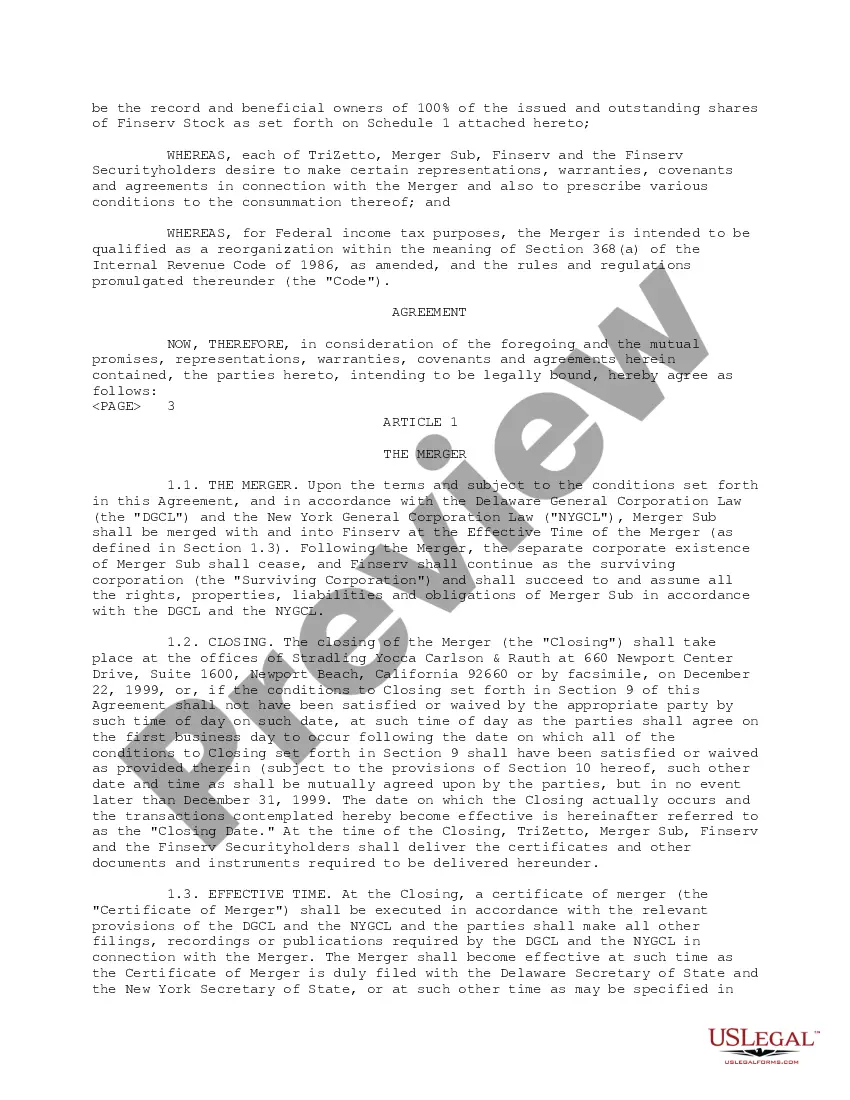
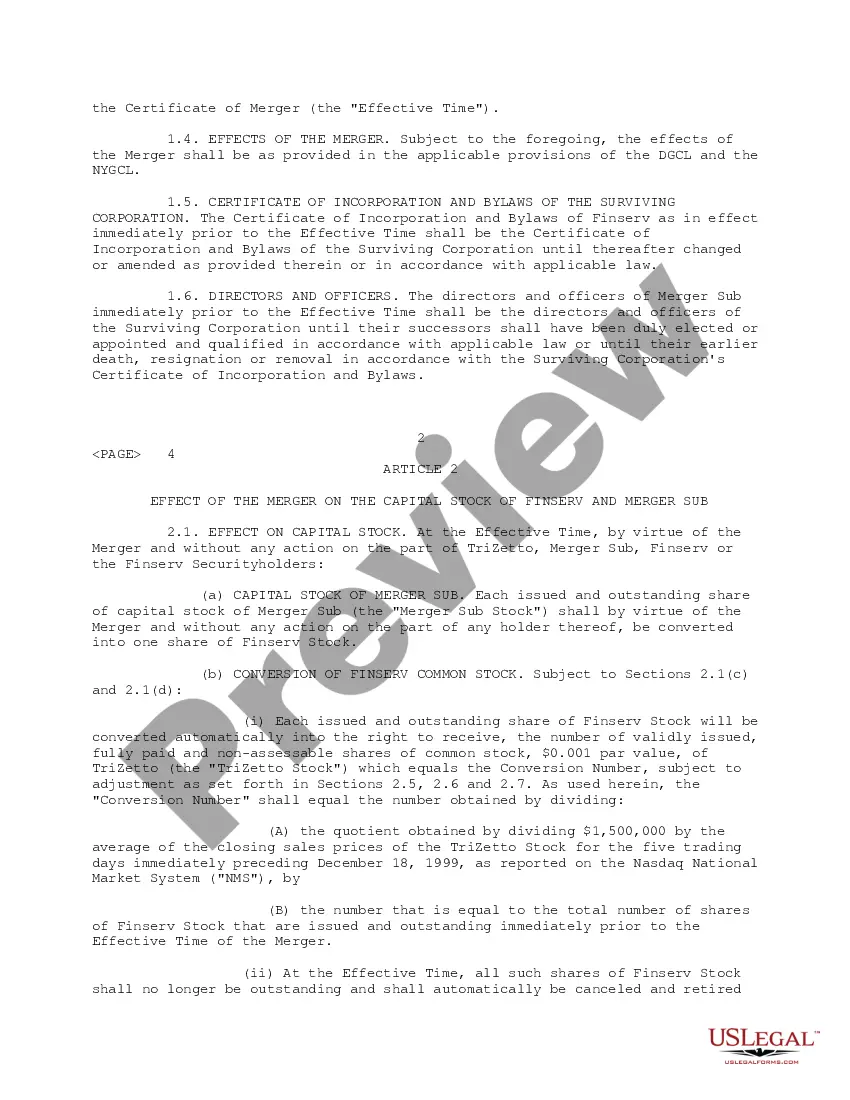
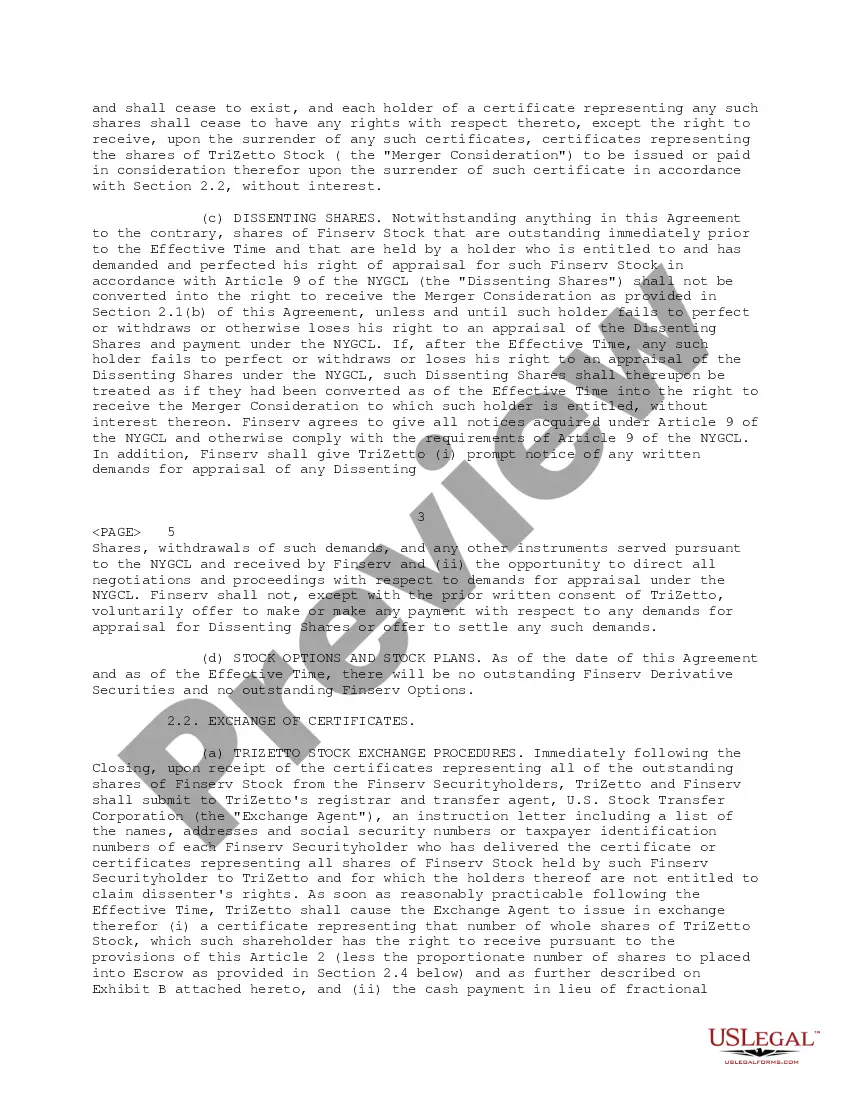
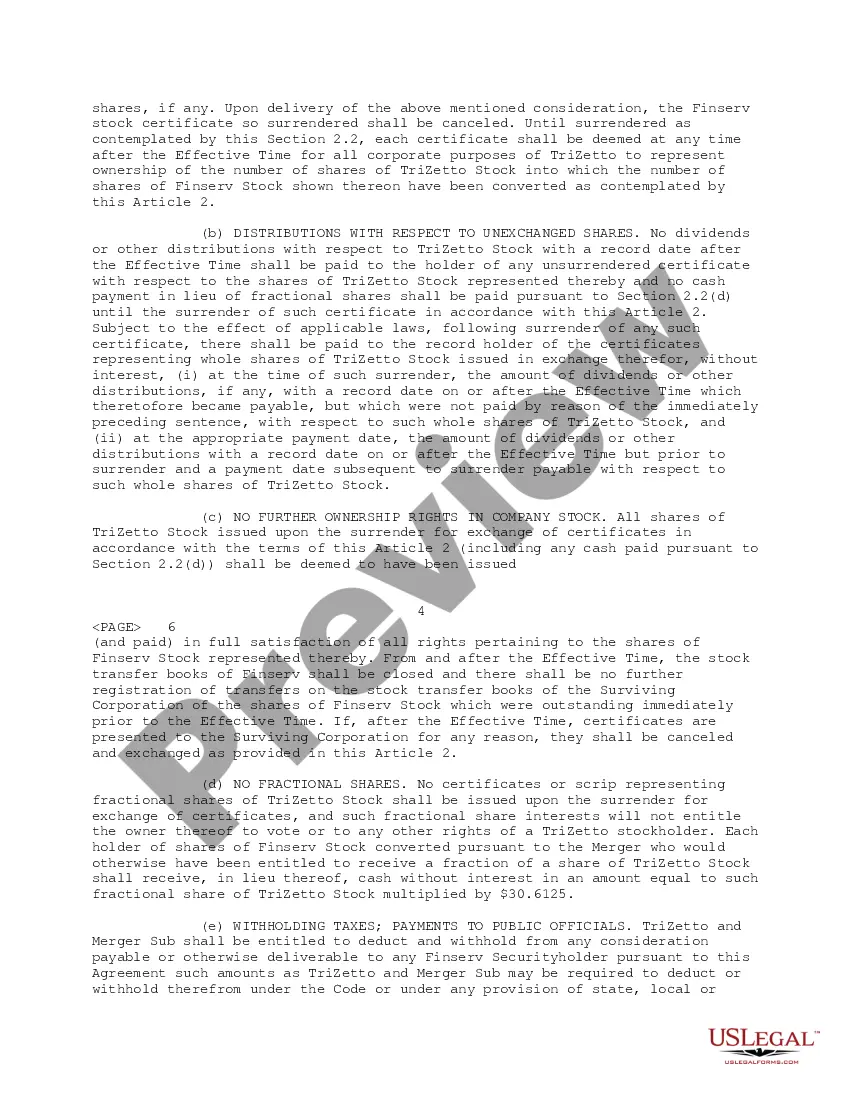
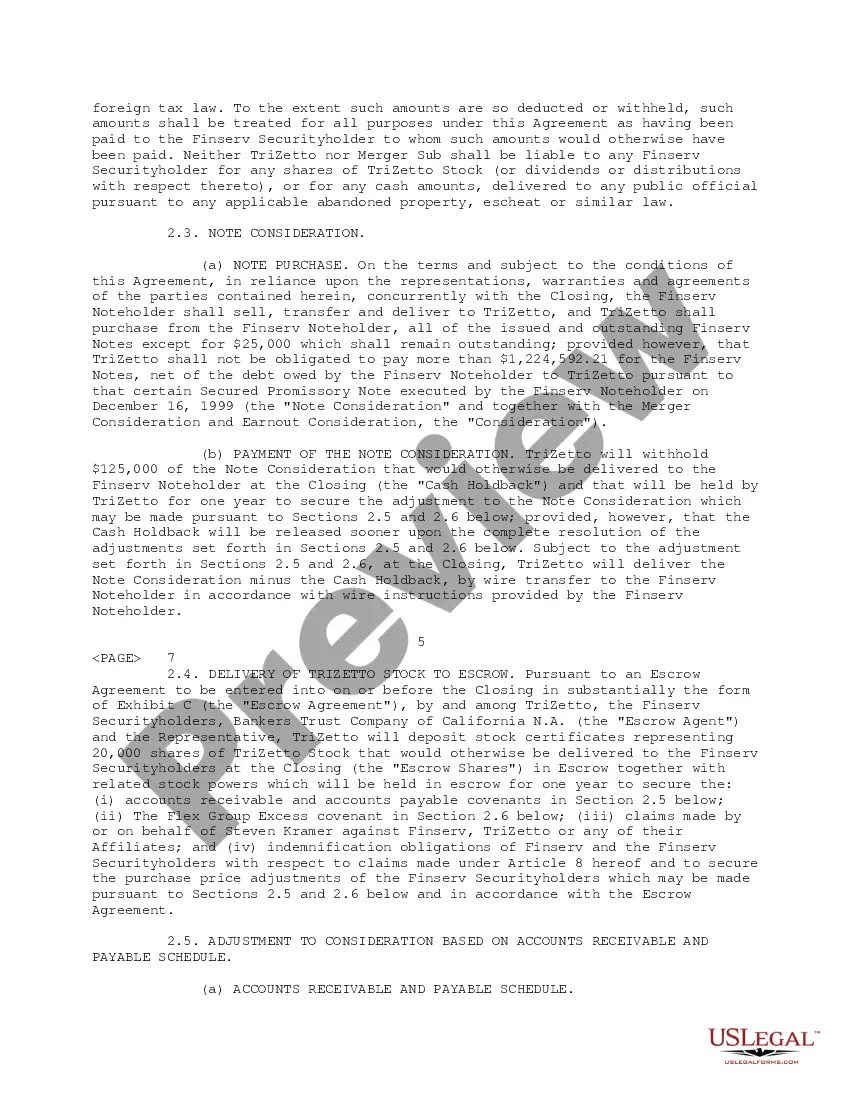
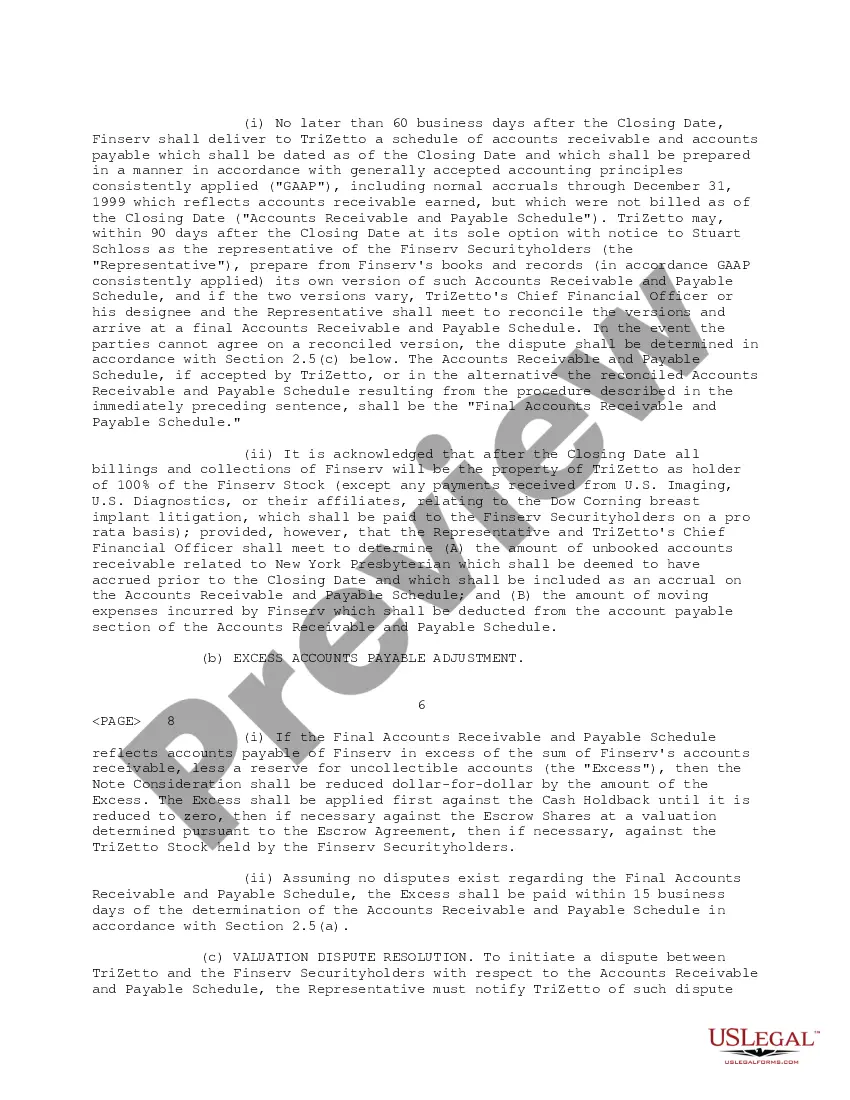
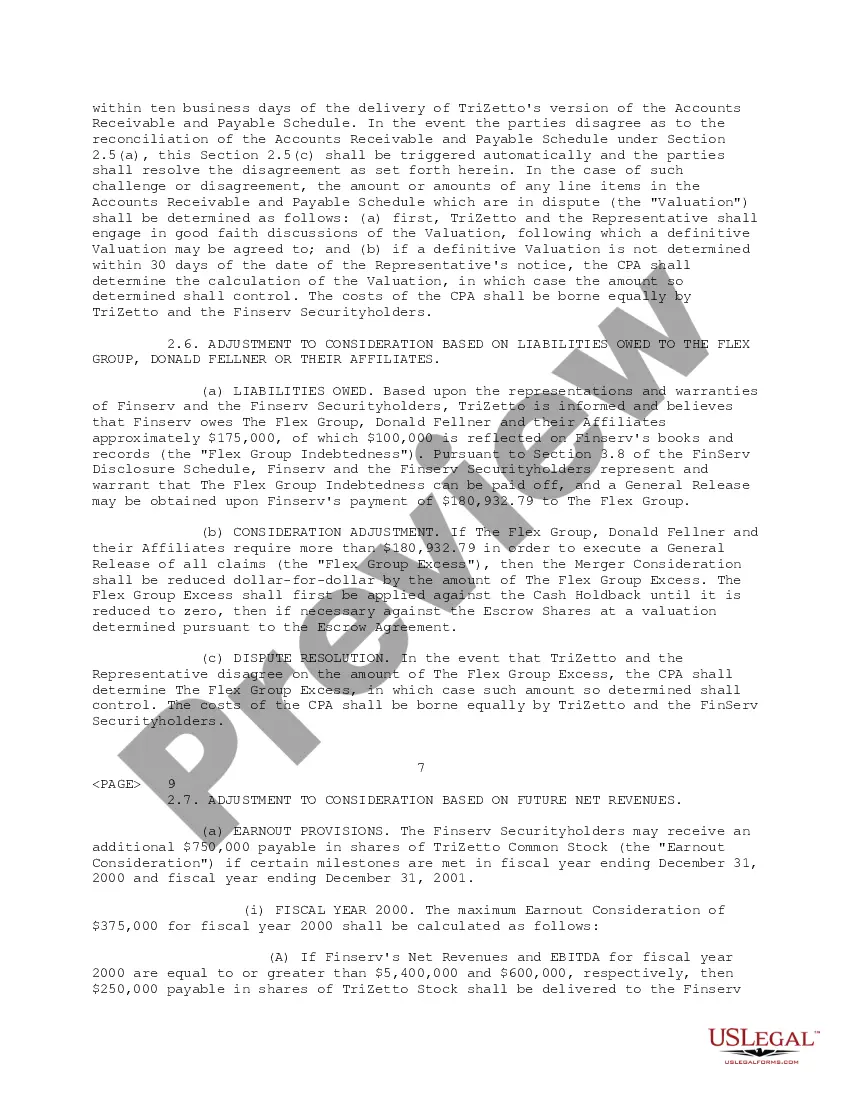
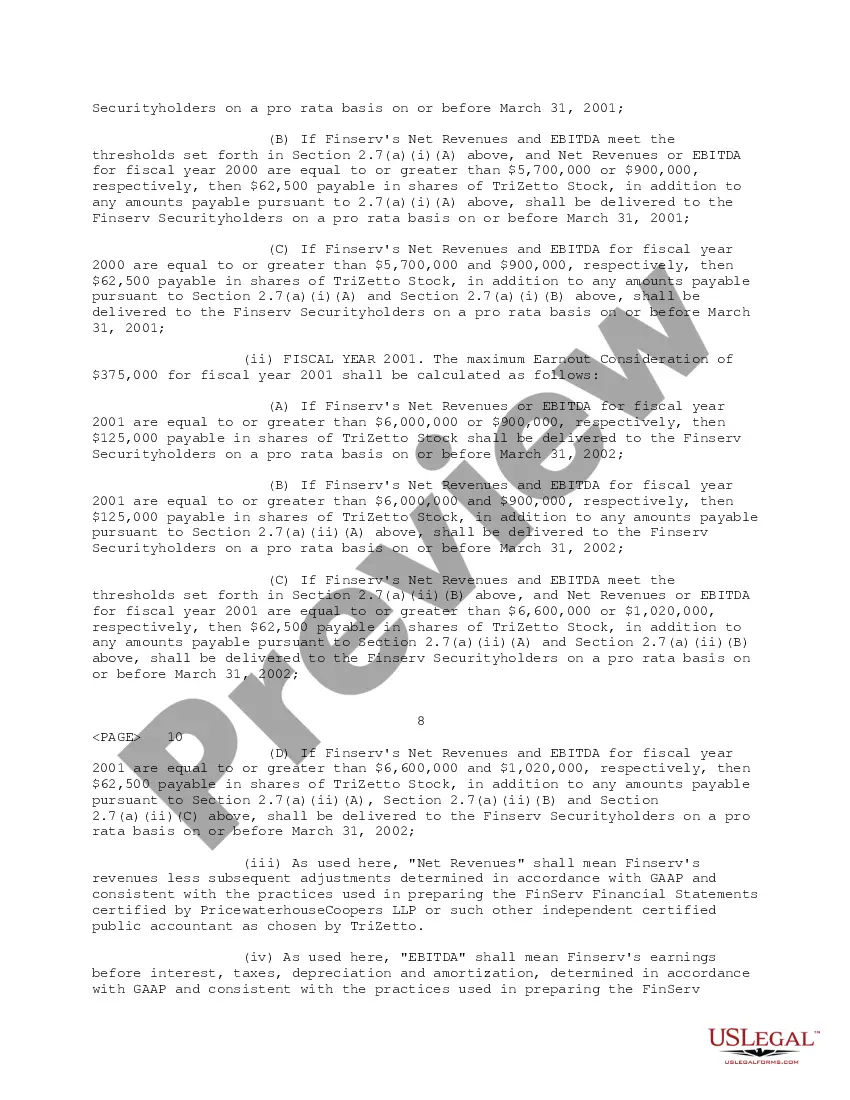
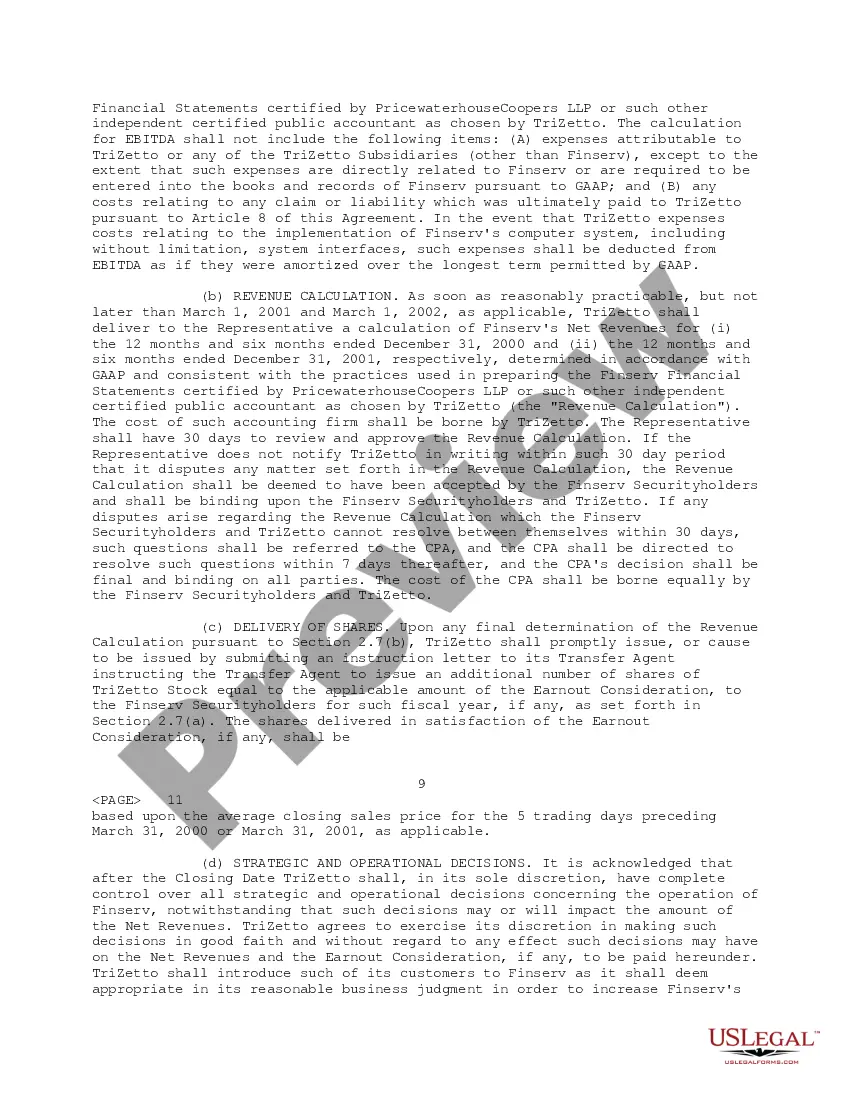
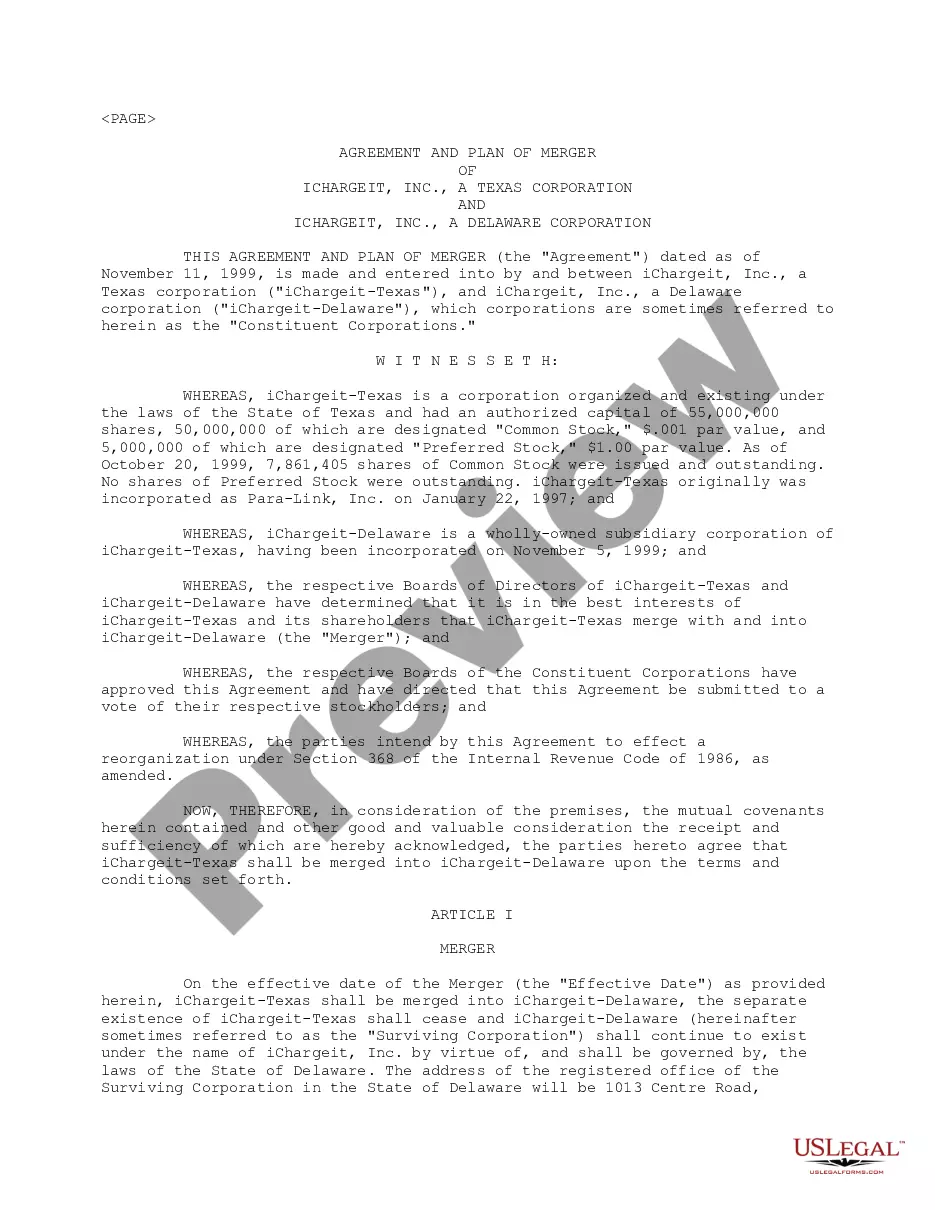
The Plan of Merger between The TriZetto Group, Inc., Finserv Acquisition Corp., and Finserv Health Care Systems, Inc. is a legal document that outlines the terms and conditions under which these three entities will consolidate into one entity. This form provides a thorough framework for the merger process, ensuring that all parties involved adhere to the legal requirements set forth. It differs from other business forms by specifically detailing the merger process and the rights and obligations of shareholders and companies involved in the merger.
Key parts of this document
- Recitals: Explains the background and purpose of the merger.
- Definitions: Provides definitions for key terms used throughout the agreement.
- Merger Details: Specifies the mechanics of the merger including the effective date and conversion of shares.
- Representations and Warranties: States the assurances that each party makes to one another.
- Covenants: Outlines actions each party agrees to undertake post-merger.
- Indemnification: Addresses liabilities and protections for all parties involved.
- Conditions to Closing: Lists the requirements that must be met for the merger to proceed.
- Termination: Describes how the agreement can be terminated before the merger is finalized.
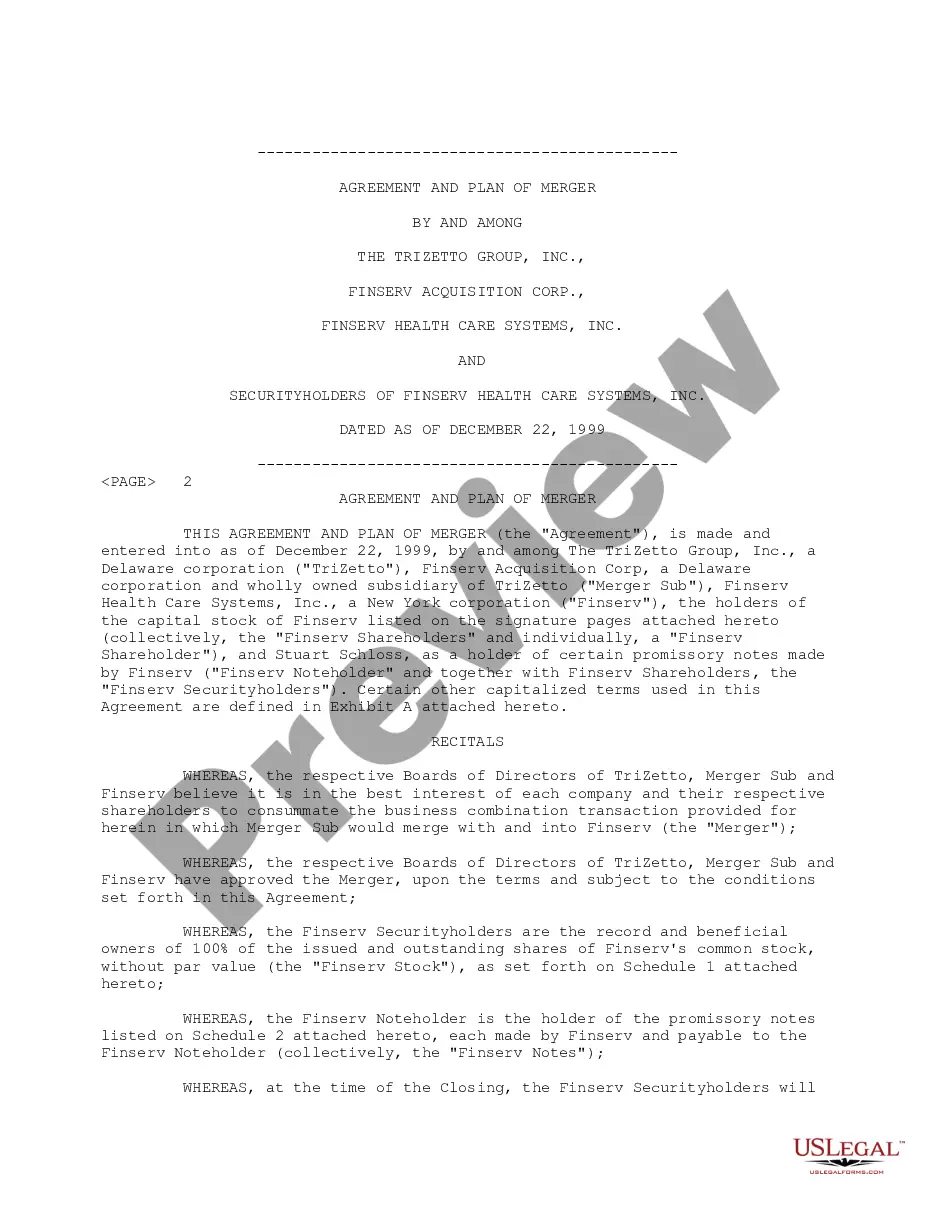

When to use this form
This form should be used when two or more corporations decide to merge into a single entity. It is applicable when all parties agree on the merger terms and require a legal framework for the completion of the transaction. Specific scenarios include businesses aiming to consolidate resources, expand their market presence, or simplify their corporate structure.
Who needs this form
Ideal users of this form include:
- Corporate executives and legal teams involved in mergers and acquisitions.
- Shareholders who need to understand the implications of the merger.
- Legal professionals drafting or reviewing merger agreements.
Completing this form step by step
To complete this form, follow these steps:
- Identify the parties involved in the merger, including their legal names and addresses.
- Clearly define the effective date of the merger and relevant company details.
- Detail the conversion of shares and other financial arrangements between the parties.
- Include any representations and warranties made by each party regarding financial conditions and business operations.
- Outline required actions and obligations each party must fulfill during and after the merger process.
- Review the conditions for closing and specify any termination rights each party holds.
Notarization guidance
This form does not typically require notarization unless specified by local law.
Get your form ready online
Our built-in tools help you complete, sign, share, and store your documents in one place.
Make edits, fill in missing information, and update formatting in US Legal Forms—just like you would in MS Word.
Download a copy, print it, send it by email, or mail it via USPS—whatever works best for your next step.
Sign and collect signatures with our SignNow integration. Send to multiple recipients, set reminders, and more. Go Premium to unlock E-Sign.
If this form requires notarization, complete it online through a secure video call—no need to meet a notary in person or wait for an appointment.
We protect your documents and personal data by following strict security and privacy standards.

Make edits, fill in missing information, and update formatting in US Legal Forms—just like you would in MS Word.

Download a copy, print it, send it by email, or mail it via USPS—whatever works best for your next step.

Sign and collect signatures with our SignNow integration. Send to multiple recipients, set reminders, and more. Go Premium to unlock E-Sign.

If this form requires notarization, complete it online through a secure video call—no need to meet a notary in person or wait for an appointment.

We protect your documents and personal data by following strict security and privacy standards.
Mistakes to watch out for
- Failing to clearly define all parties involved in the merger.
- Not including adequate representations and warranties.
- Overlooking to detail the conditions under which the merger can be terminated.
- Leaving out procedural steps required for closing the merger.
Benefits of completing this form online
- Convenient access to a legally vetted template ensures compliance with state laws.
- Editable format allows for customization to fit specific merger details.
- Includes all necessary clauses, reducing the need for additional legal consultations.
- The Plan of Merger serves as a legally binding document that facilitates the consolidation of two or more corporations.
- Proper completion and execution ensure enforceability and mitigate potential disputes.
Looking for another form?
Form popularity
FAQ
The health insurance premiums paid by the S corporation are reported on Form W-2, Box 14 S. This is the amount the shareholder deducts on page 1 of Form 1040, line 29 (Self- employed health insurance deduction)
When you view the W-2 Summary Report or download the actual W-2 form, the year-to-date S Corp Health contributions will be added to the total in Box 1 for federal taxable wages, Box 16 for state taxable wages, and Box 14, with the label SEHI for Shareholder Employee Health Insurance.
Offer health insurance to you and your employees. Pay insurance costs through your S corporation. Add health insurance costs to gross wages on your W-2. Deduct employee insurance premiums on your business tax return.
The bottom line is that in order for a shareholder to claim an above-the-line deduction, the health insurance premiums must ultimately be paid by the S corporation and must be reported as taxable compensation in the shareholder's W-2.
S Corp shareholders of 2% or more include their company-paid health insurance premiums in box one on Form W-2. Source: irs.gov. Report your S corporation's contributions to non-shareholder health insurance premiums on line 19 of Form 1120-S. Take your self-employed health insurance deduction on Form 1040 Schedule 1.
The premiums the business paid can be deducted on your Form 1040 (line 29) and as a business expense on Form 1120S. Your health insurance premiums paid by your business are included in your gross wages on your W-2.
As a greater than 2% shareholder employee of an S corporation, any health, disability, or accident insurance premiums paid by the corporation on the shareholder's behalf must be reported as taxable wages to the shareholder, subject to state and federal income tax withholding.
S-corporations can provide health insurance as a tax-free fringe benefit to its non-owner employees. In this case, the business offers a group health insurance policy to employees and deducts the cost as a business expense, paying no tax on the insurance premiums.
The health insurance premiums paid by the S corporation are reported on Form W-2, Box 14 S. This is the amount the shareholder deducts on page 1 of Form 1040, line 29 (Self- employed health insurance deduction)