Notice of Election to Exercise Stock Purchase Right and Record of Stock Transfer
About this form
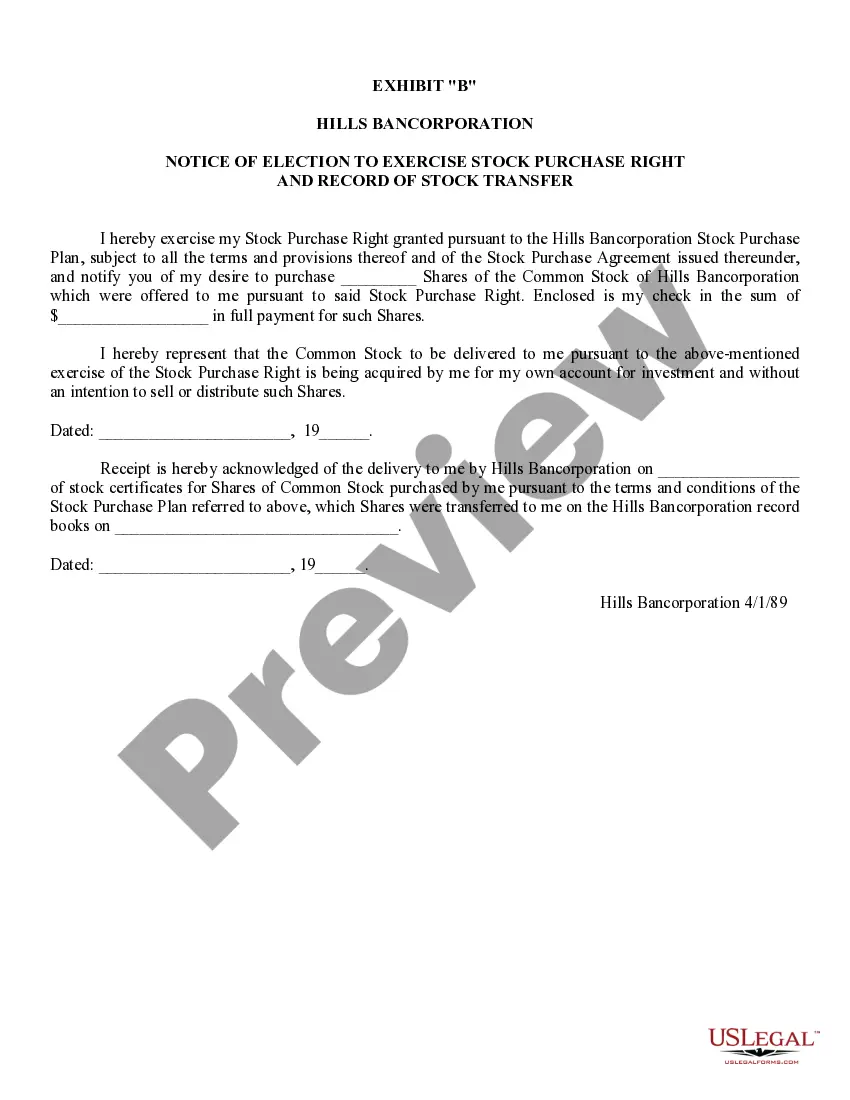
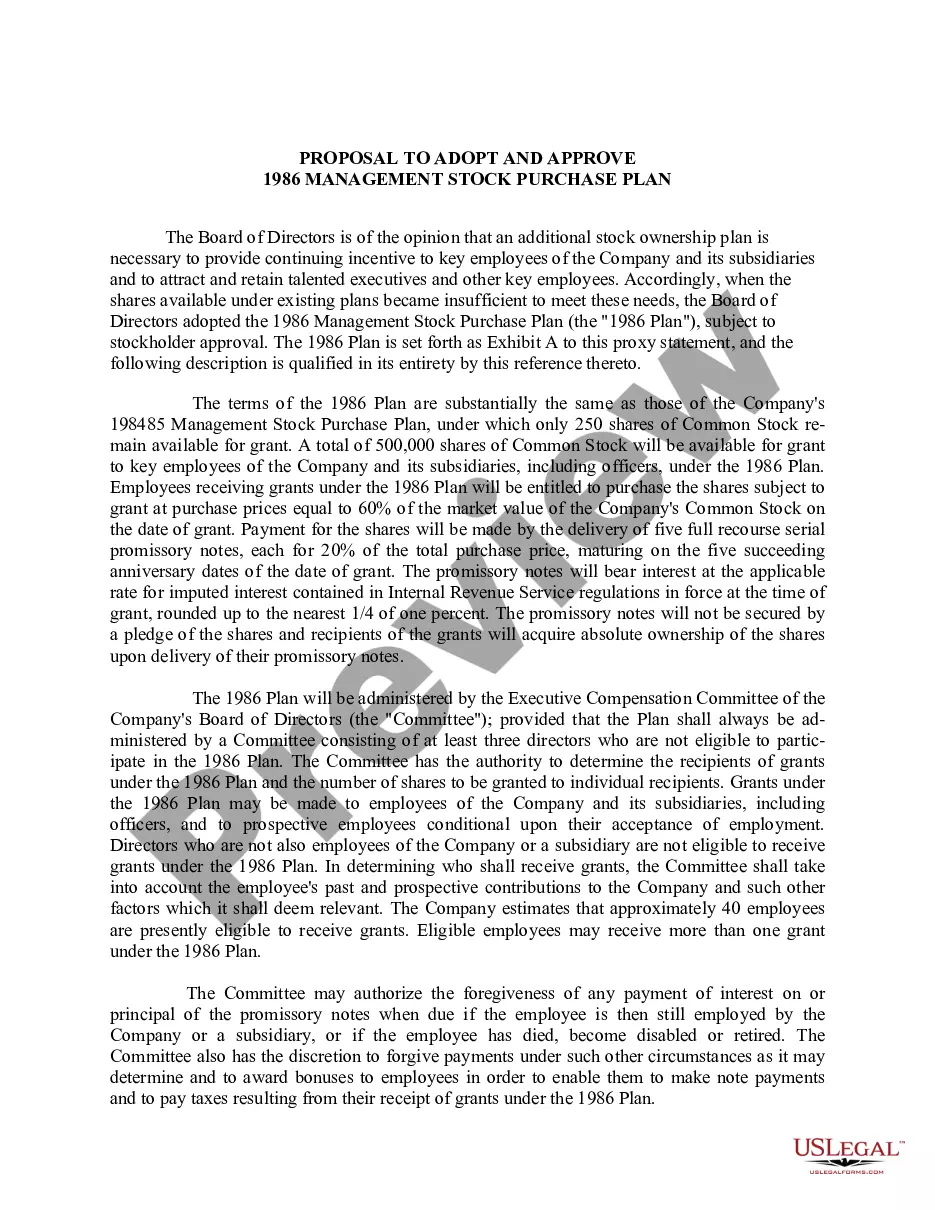
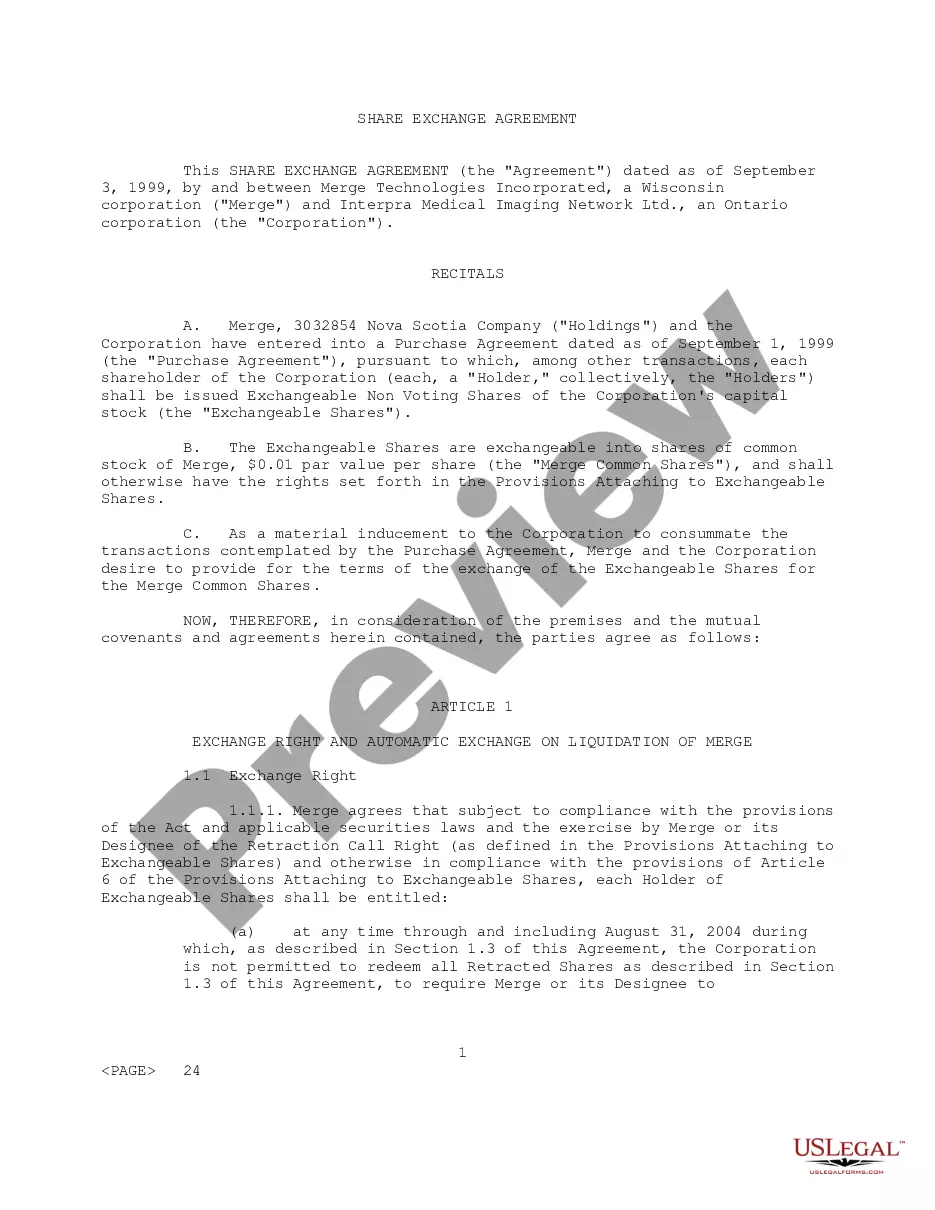
The Notice of Election to Exercise Stock Purchase Right and Record of Stock Transfer is a legal document that allows shareholders to formally indicate their intention to exercise their stock purchase rights under a specific stock purchase plan. This form is essential for managing stock ownership and completing the transfer process. Unlike other stock-related forms, it specifically details the election to purchase shares and the record of stock transfer, ensuring clarity and legal compliance in financial transactions.
Key parts of this document
- Identification of the shareholder exercising the stock purchase right.
- Specification of the number of shares to be purchased.
- Confirmation of payment for the shares, including the amount and method.
- Statement affirming that the shares are being acquired for personal investment, not for resale.
- Acknowledgment of receipt of stock certificates and the transfer date.

When to use this document
This form is used when a shareholder wishes to exercise their rights to purchase shares under a stock purchase plan. Situations may include when an employee or investor wants to convert options into actual shares, or when shareholders need to formally document their purchase intentions in accordance with corporate policies and regulations related to stock ownership.
Intended users of this form
This form is suitable for:
- Shareholders of Hills Bancorporation planning to exercise their stock purchase rights.
- Employees or individuals participating in the Hills Bancorporation Stock Purchase Plan.
- Financial or legal advisors assisting clients with stock transactions.
Instructions for completing this form
- Enter your name and contact information as the shareholder.
- Specify the number of shares you wish to purchase in the designated space.
- Calculate and enter the payment amount for the shares you are purchasing.
- Sign the form, indicating that you are purchasing for personal investment.
- Complete the acknowledgment section with the relevant dates and details of share delivery.
Notarization requirements for this form
This form does not typically require notarization to be legally valid. However, some jurisdictions or document types may still require it. US Legal Forms provides secure online notarization powered by Notarize, available 24/7 for added convenience.
Get your form ready online
Our built-in tools help you complete, sign, share, and store your documents in one place.
Make edits, fill in missing information, and update formatting in US Legal Forms—just like you would in MS Word.
Download a copy, print it, send it by email, or mail it via USPS—whatever works best for your next step.
Sign and collect signatures with our SignNow integration. Send to multiple recipients, set reminders, and more. Go Premium to unlock E-Sign.
If this form requires notarization, complete it online through a secure video call—no need to meet a notary in person or wait for an appointment.
We protect your documents and personal data by following strict security and privacy standards.

Make edits, fill in missing information, and update formatting in US Legal Forms—just like you would in MS Word.

Download a copy, print it, send it by email, or mail it via USPS—whatever works best for your next step.

Sign and collect signatures with our SignNow integration. Send to multiple recipients, set reminders, and more. Go Premium to unlock E-Sign.

If this form requires notarization, complete it online through a secure video call—no need to meet a notary in person or wait for an appointment.

We protect your documents and personal data by following strict security and privacy standards.
Typical mistakes to avoid
- Failing to specify the correct number of shares being purchased.
- Not including payment details or using an incorrect payment method.
- Neglecting to sign the form, which may invalidate the request.
- Leaving out the required acknowledgment of receipt of shares.
Why complete this form online
- Convenient access to the form for immediate download and completion.
- Editability allows users to customize the form easily as per their specific details.
- Reliability of having a form professionally drafted by licensed attorneys.
Looking for another form?










Form popularity
FAQ
The first opportunity you have to exercise your stock option(s) is when they vest. Prior to vesting, you can't exercise. Unvested shares are simply a future promise of hopefully valuable stock options. In the exercise and sell ASAP strategy, you exercise and sell your shares immediately when your options vest.
A disciplined stock option exercise strategy can prevent some big mistakes and significantly increase the value of your option grant. Here are eight guidelines for anyone who is thinking about exercising their employee stock options. Don't exercise too soon. But2026don't wait too long.
Use an "average out" strategy to exercise your options. If you intend to exercise your options in a cashless same-day sale, consider having a stock option exercise strategy, perhaps exercising monthly or quarterly, beginning two years before their expiration.
Non-qualified stock options (NSOs) are granted to employees, advisors, and consultants; incentive stock options (ISOs) are for employees only. With NSOs, you pay ordinary income taxes when you exercise the options, and capital gains taxes when you sell the shares.
With Non-qualified Stock Options, you must report the price break as taxable compensation in the year you exercise your options, and it's taxed at your regular income tax rate, which in 2020 can range from 10% to 37%.
Exercise your stock options to buy shares of your company stock, then sell just enough of the company shares (at the same time) to cover the stock option cost, taxes, and brokerage commissions and fees. The proceeds you receive from an exercise-and-sell-to-cover transaction will be shares of stock.
When you exercise an option, you usually pay a fee to exercise and a second commission to sell the shares. This combination is likely to cost more than simply selling the option, and there is no need to give the broker more money when you gain nothing from the transaction.
Exercising an option is not an obligation. You only exercise the option if you want to buy or sell the actual underlying asset. Most options are not exercised, even the profitable ones. For example, a trader buys a call option for a premium of $1 on a stock with a strike price of $10.