Proposal to ratify issuance of warrants to executive officers and certain directors
Overview of this form
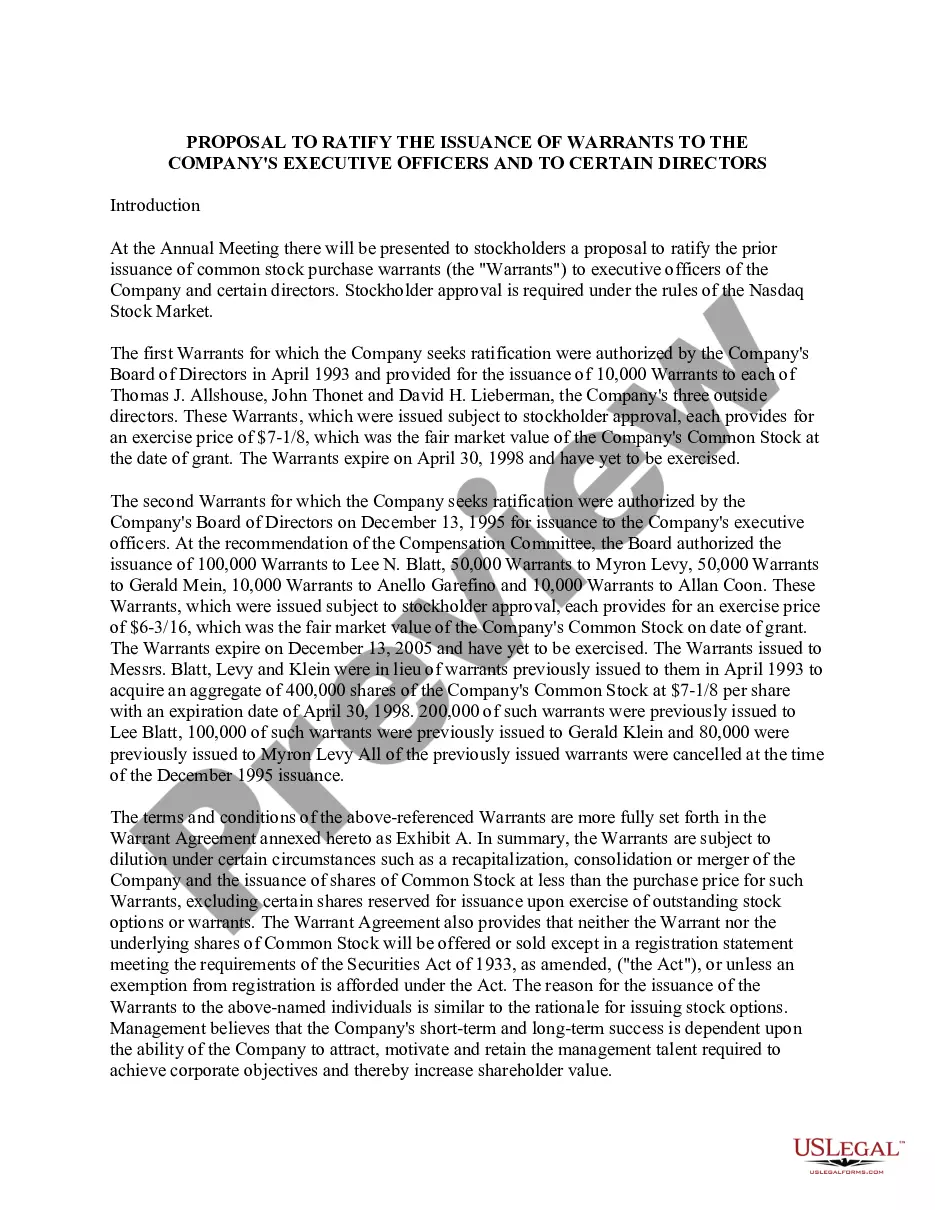
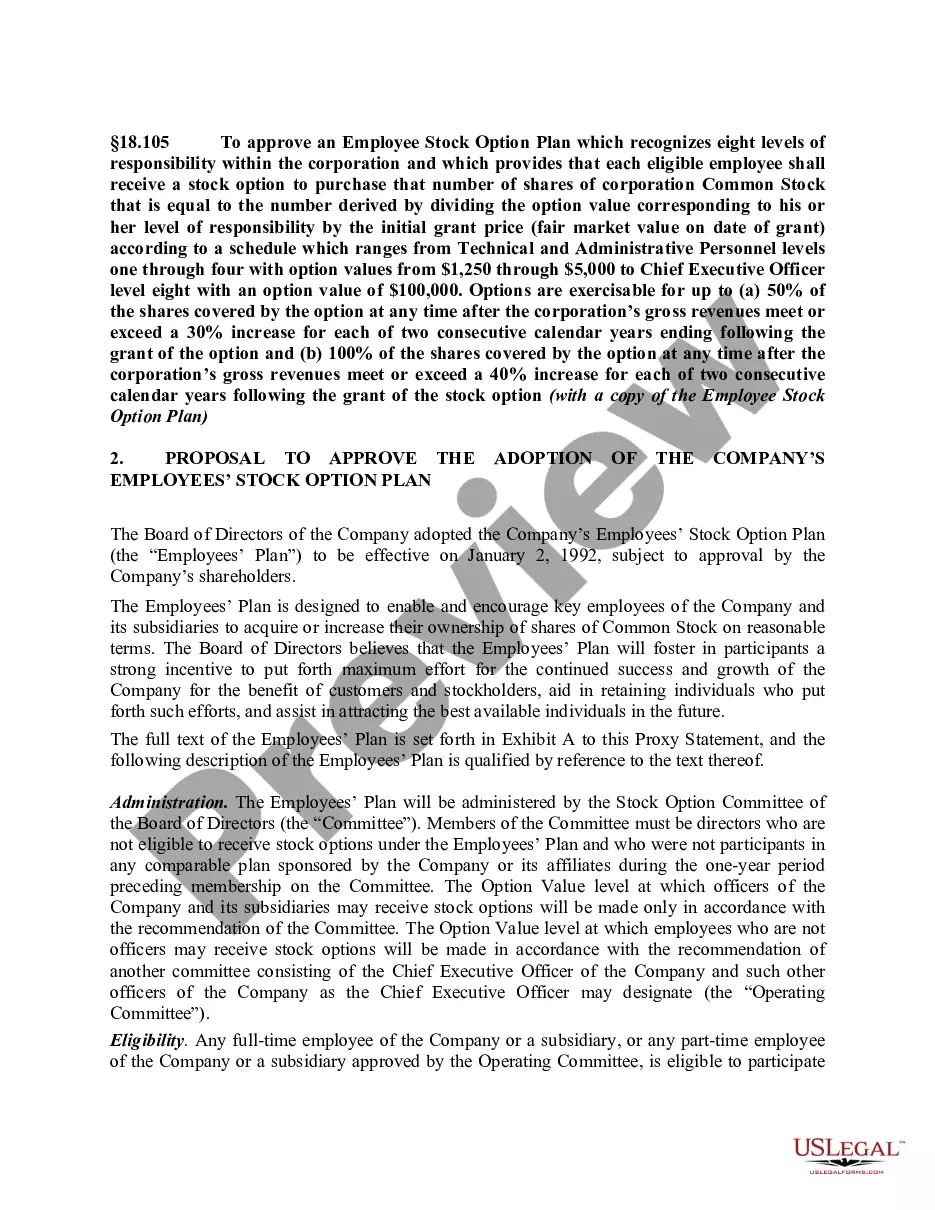
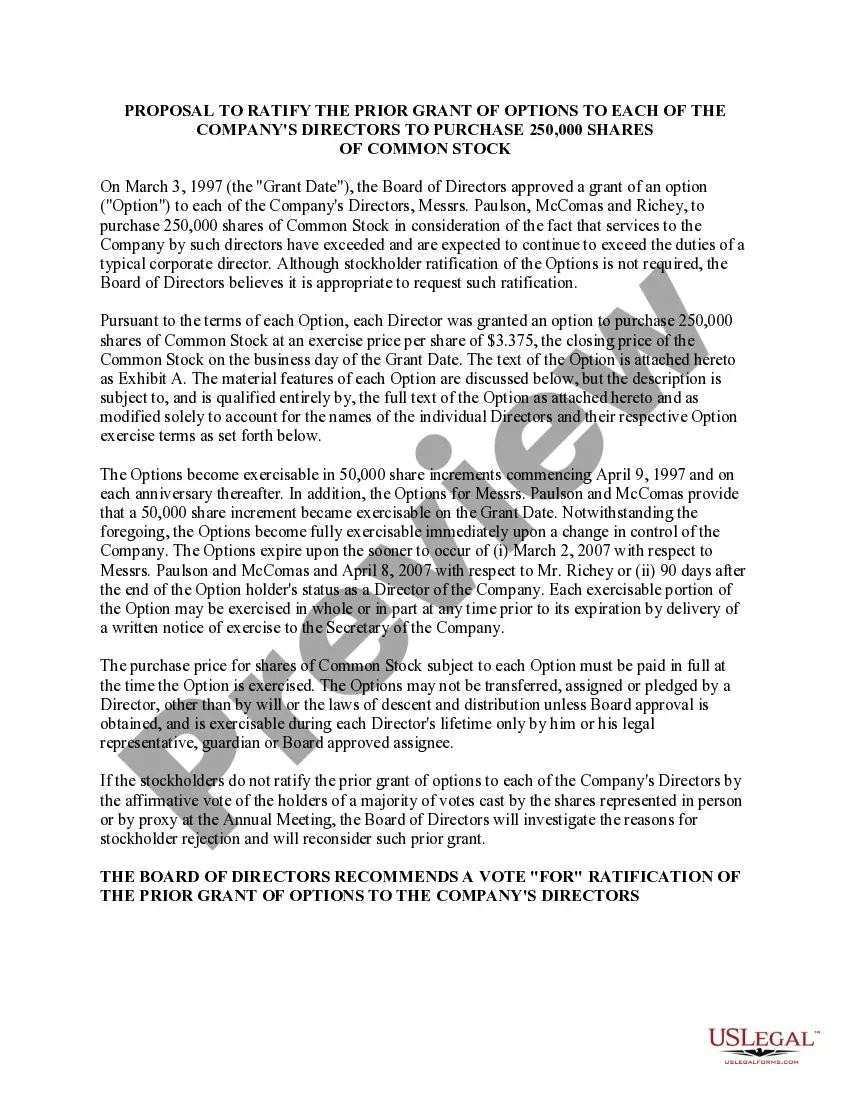
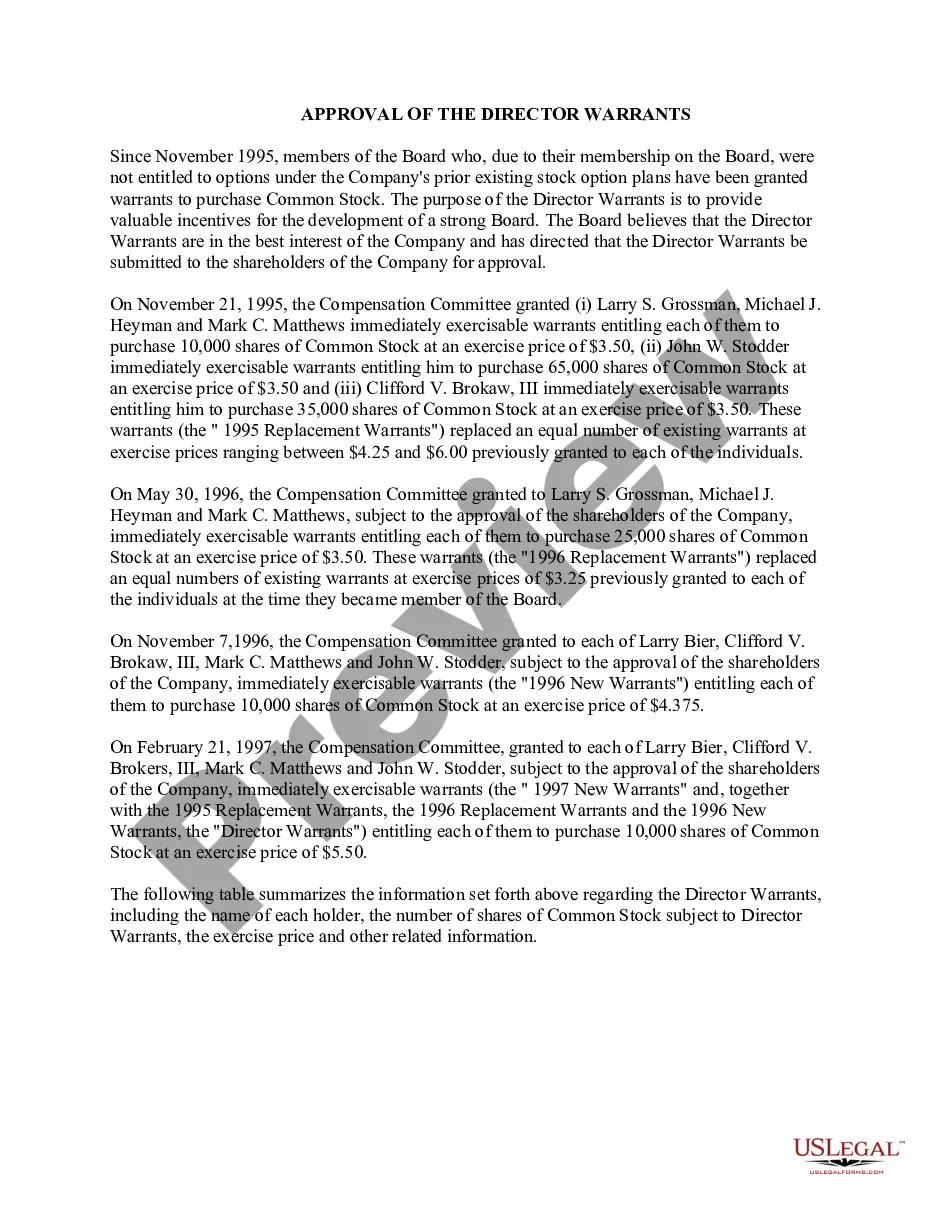
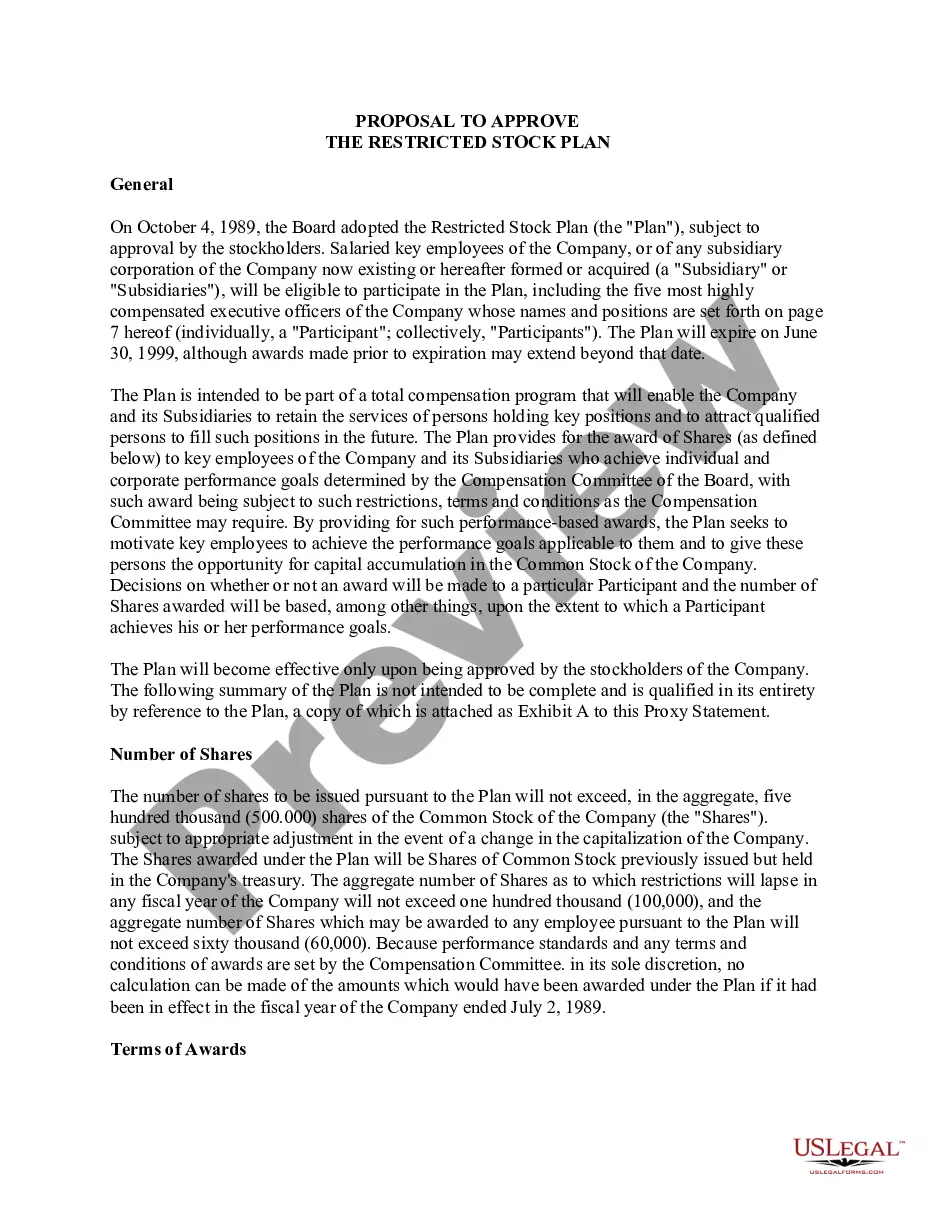
The Proposal to ratify issuance of warrants to executive officers and certain directors is a legal document used by companies seeking stockholder approval for warrants previously granted. This form outlines proposed ratification at an annual meeting and details the terms of the warrants, including exercise prices and expiration dates. It is essential for maintaining compliance with Nasdaq rules and ensuring transparent governance in corporate actions.
Key components of this form
- Introduction detailing the purpose of the proposal and stockholder meeting.
- Description of the warrants issued, including numbers, exercise prices, and expiration dates.
- Summary of the conditions and terms governing the warrants.
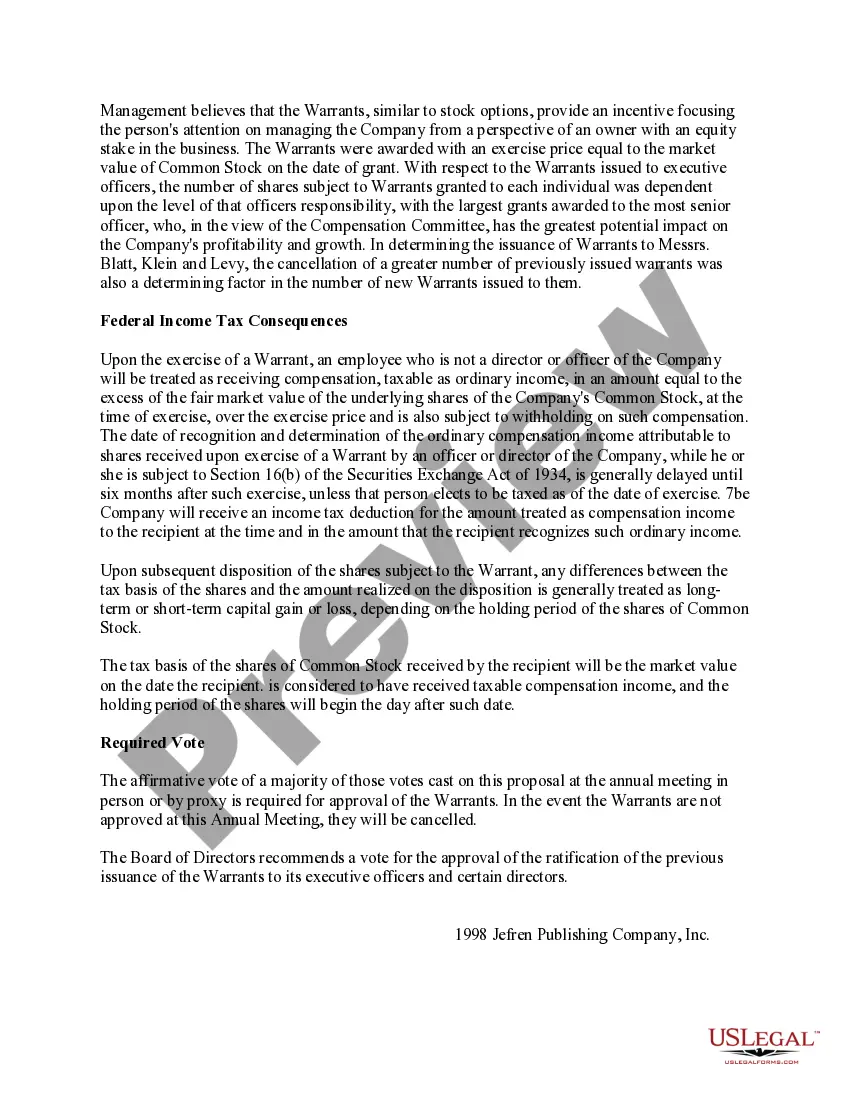
- Information about the tax implications for warrant holders upon exercise.
- Voting requirements needed for approval at the stockholder meeting.
When this form is needed
This form should be used when a company needs to present a proposal to its stockholders for ratifying the issuance of warrants to its executive officers and certain directors. This situation typically occurs during an annual meeting or special meeting where stockholder decisions on company governance are made.
Who needs this form
- Companies listed on the Nasdaq that have issued stock purchase warrants.
- Corporate boards looking to secure stockholder affirmation for past warrant issuances.
- Stockholders interested in understanding the terms and implications of the warrants being proposed for ratification.
How to complete this form
- Identify the relevant executive officers and directors involved.
- Outline the details of the warrants, including numbers issued and exercise prices.
- Specify the reasons for the issuance and how it aligns with corporate objectives.
- Prepare the form for presentation at the annual meeting, ensuring it meets Nasdaq requirements.
- Collect necessary approvals through a vote from stockholders in attendance or by proxy.
Does this form need to be notarized?
Notarization is generally not required for this form. However, certain states or situations might demand it. You can complete notarization online through US Legal Forms, powered by Notarize, using a verified video call available anytime.
Get your form ready online
Our built-in tools help you complete, sign, share, and store your documents in one place.
Make edits, fill in missing information, and update formatting in US Legal Forms—just like you would in MS Word.
Download a copy, print it, send it by email, or mail it via USPS—whatever works best for your next step.
Sign and collect signatures with our SignNow integration. Send to multiple recipients, set reminders, and more. Go Premium to unlock E-Sign.
If this form requires notarization, complete it online through a secure video call—no need to meet a notary in person or wait for an appointment.
We protect your documents and personal data by following strict security and privacy standards.

Make edits, fill in missing information, and update formatting in US Legal Forms—just like you would in MS Word.

Download a copy, print it, send it by email, or mail it via USPS—whatever works best for your next step.

Sign and collect signatures with our SignNow integration. Send to multiple recipients, set reminders, and more. Go Premium to unlock E-Sign.

If this form requires notarization, complete it online through a secure video call—no need to meet a notary in person or wait for an appointment.

We protect your documents and personal data by following strict security and privacy standards.
Common mistakes to avoid
- Failing to provide adequate rationale for the issuance of warrants.
- Not accurately recording the necessary details of the warrants, such as exercise prices and expiration dates.
- Neglecting to follow corporate governance procedures for stockholder meetings.
- Omitting tax implications in communications with stockholders.
Advantages of online completion
- Convenient access from anywhere, enabling quick adjustments to the proposal.
- Streamlined editing processes allow for easier customization to fit specific needs.
- Reliable templates drafted by licensed attorneys ensure compliance with legal standards.
Legal use & context
- The proposal requires a majority vote from stockholders for approval.
- Failure to secure approval will result in cancellation of the warrants.
- Adhering to this proposal helps maintain company integrity and transparency with stockholders.
Main things to remember
- This form is vital for formalizing stockholder approval of previously issued warrants.
- It outlines the terms of issuance and necessary voting procedures.
- Ensuring the accuracy of details is essential to prevent financial and regulatory issues.
Looking for another form?
Form popularity
FAQ
Since all warrant officers are non-commissioned officers, they are not saluted.
Commissioned Officers are the managers, problem solvers, key influencers and planners who lead Enlisted Soldiers in all situations. A Warrant Officer is a highly specialized expert and trainer in his or her career field.
The correct way to address a Chief Warrant Officer 3 named Mr. Miller is "Mr. Miller or Chief Miller", or written as CW3 Miller. In formal situations, a Chief Warrant Officer 3 should always be addressed by their full rank.
All warrant officers are addressed as "sir" or "ma'am" by subordinates. To gain the attention of a particular warrant officer in a group, they can be addressed as "Warrant Officer Bloggs, sir/ma'am" or by their appointment, e.g. "ASM Bloggs, sir/ma'am".
By regulation, warrant officers are addressed as 'Mr. (last name)' or 'Ms. (last name). ' However, many personnel address warrant officers as 'Chief (last name)'.
Mission and use. Army warrant officers are technical experts, combat leaders, trainers, and advisors.Warrant officers command the Army's waterborne and seagoing vessels, most Army bands, and as aircraft commanders of most Army Aviation aircraft.
Civilians can address them as Chief Warrant Officer or CWO or Mr/Mrs/Miss/Ms (followed by surname).
In the American Army, warrant officers rate a salute. It will be rare that you get any static for not saluting one. Warrant officers are technicians, and are not part of the chain of command.
For warrant officers, the pay grade designation begins with a "W."Commissioned officers outrank enlisted members and warrant officers. Warrant officers outrank enlisted members. So a commissioned officer in the grade of O-1 would outrank an Army sergeant major in the grade of E-9.