Stock Incentive Plan of Ambase Corp.
What is this form?
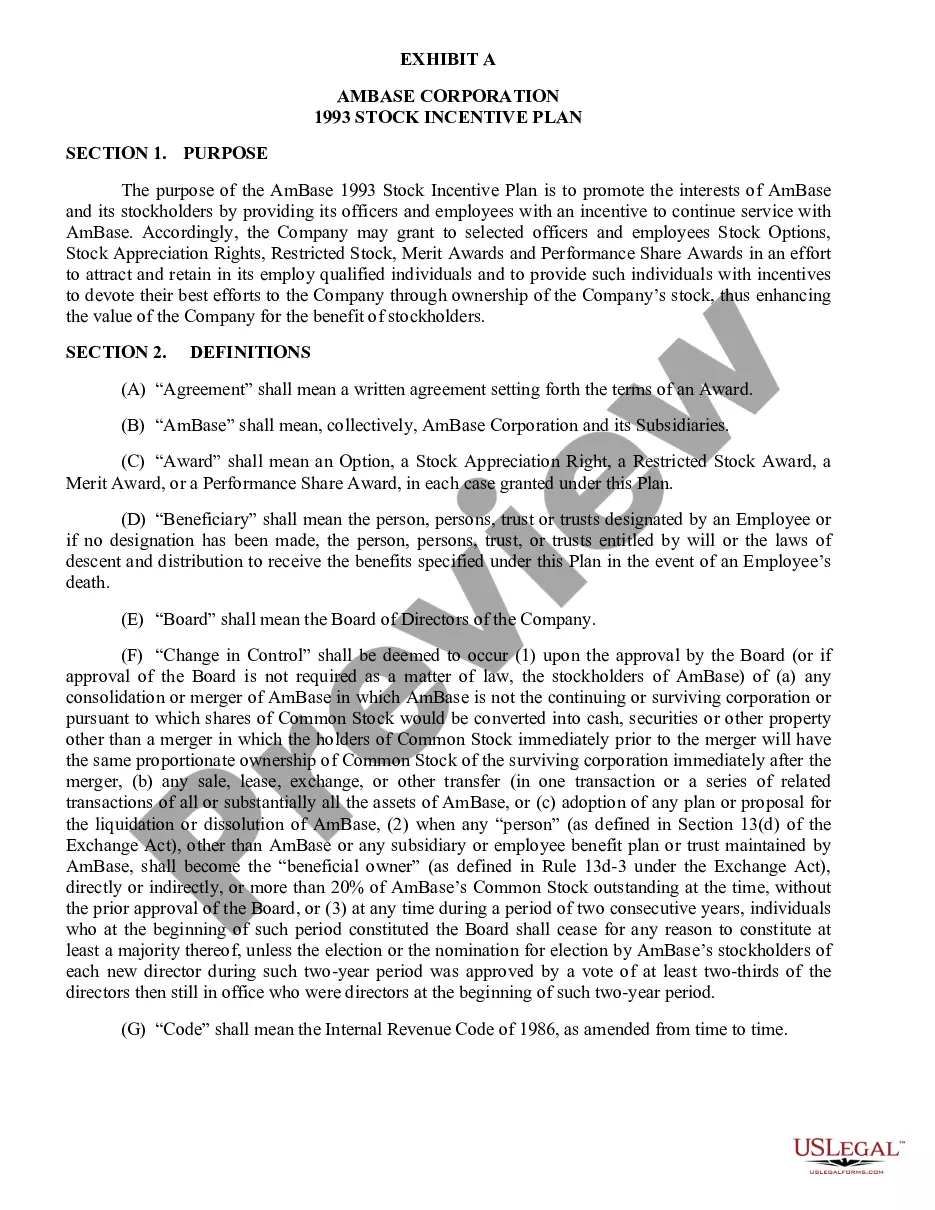
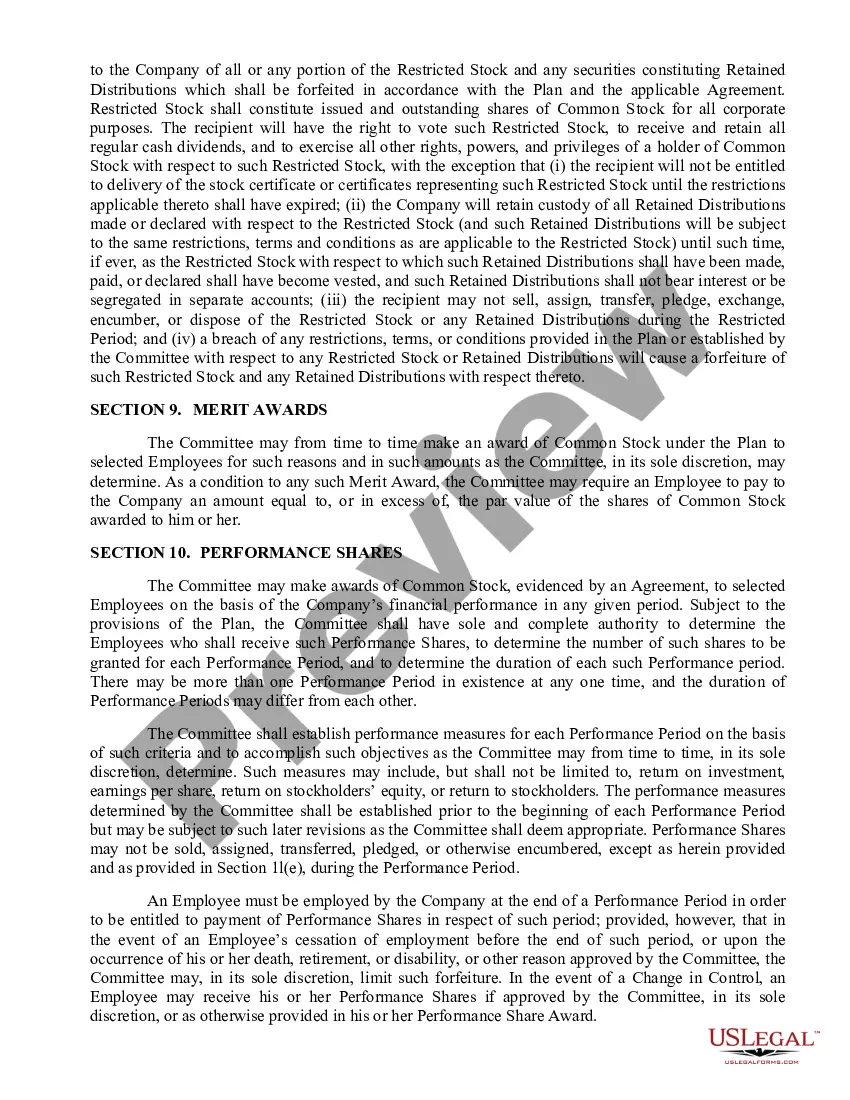
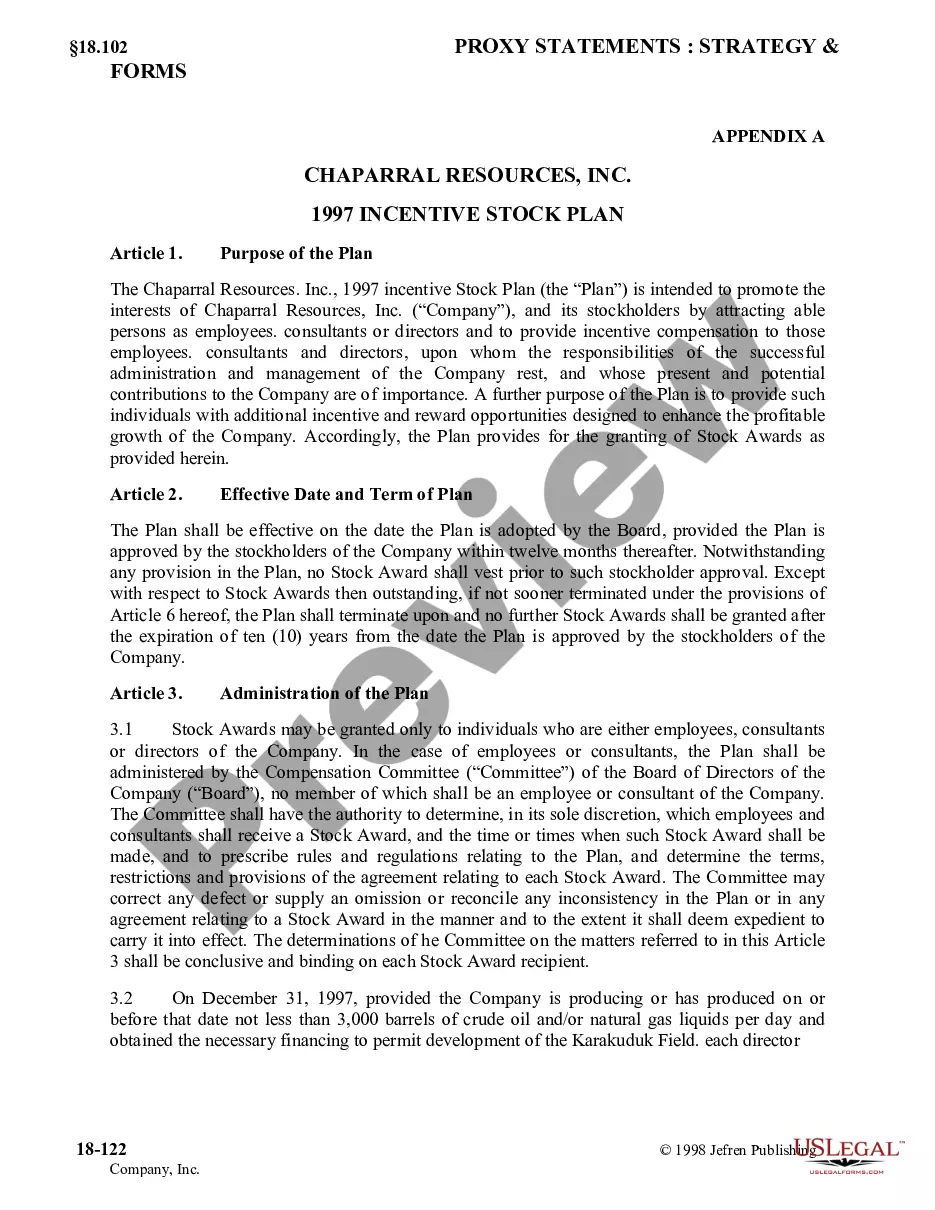
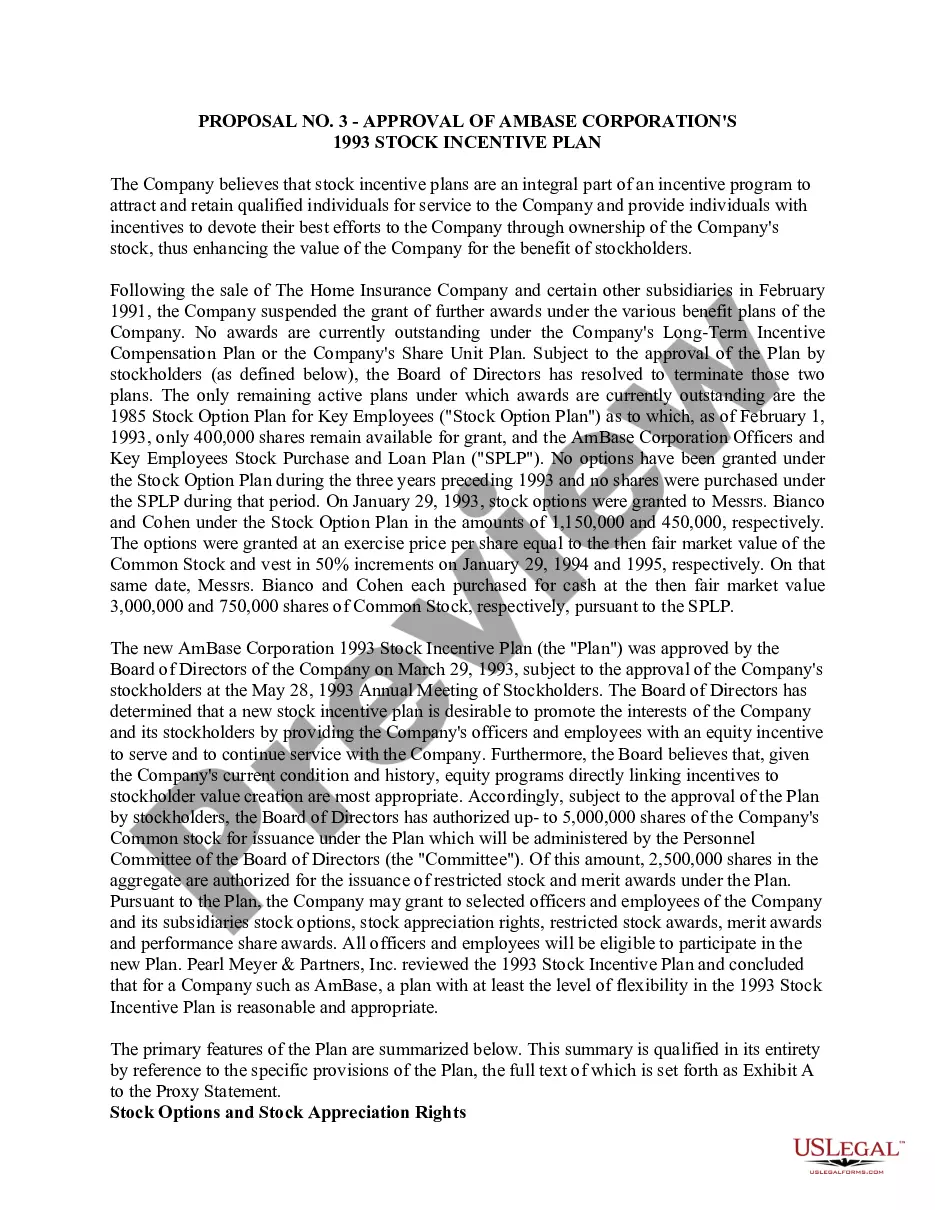
The Stock Incentive Plan of AmBase Corp. is a legal framework designed to provide incentives in the form of stock options and stock appreciation rights to employees and officers. This plan allows for various types of awards, including incentive stock options, non-qualified stock options, and restricted stock, aiming to attract, retain, and motivate employees by enabling them to benefit from the company's growth through the ownership of its stock. This form differs from other employment agreements as it specifically outlines the terms of stock-based compensation rather than general employment terms.
What’s included in this form
- Purpose: Promotes retention and motivation of employees through stock ownership.
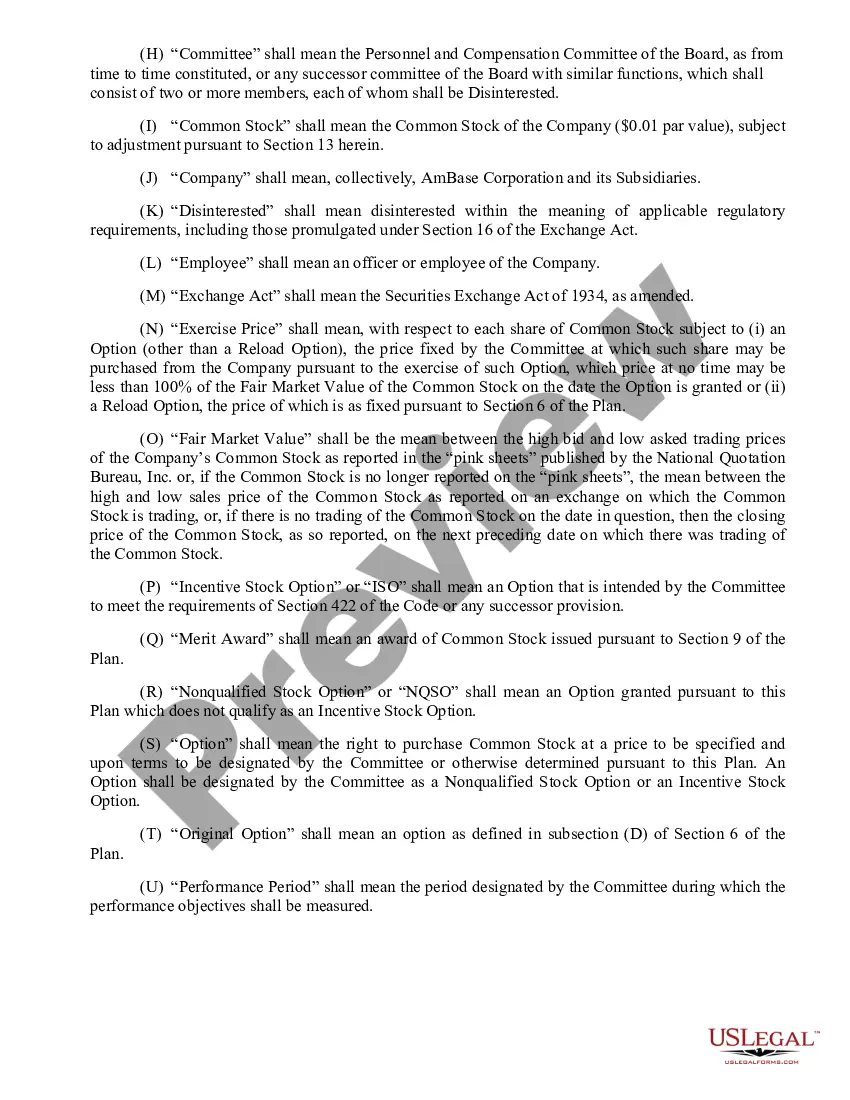
- Definitions: Clarifies terms such as "Award," "Option," and "Employee" which are key to understanding the plan.
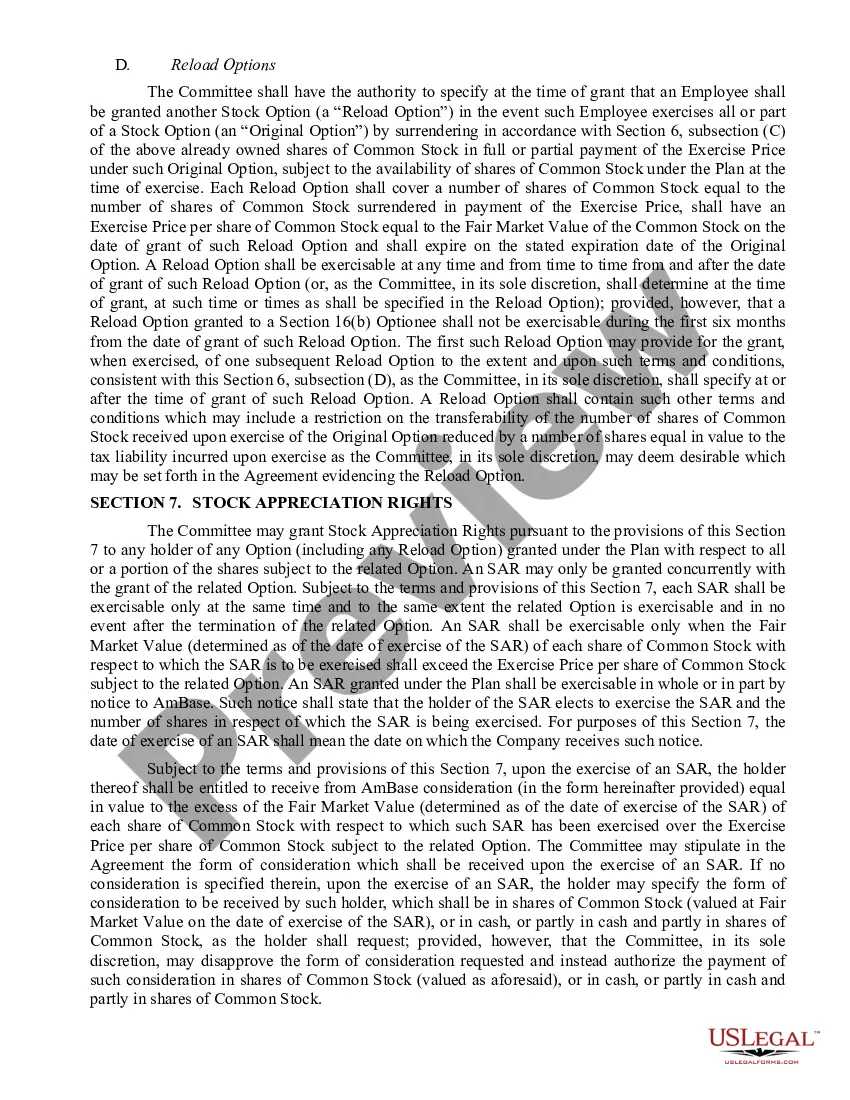
- Stock Options: Details on how and when employees can exercise their stock options.
- Restricted Stock Awards: Specifies the conditions under which employees receive awarded stock.
- Performance Share Awards: Outlines how performance metrics impact stock awards.










When to use this document
This form is applicable when an employer seeks to establish a stock incentive plan to reward employees for their contributions to the company's success. It is particularly useful in scenarios involving employment agreements where stock options and performance-based incentives are part of the compensation strategy. If a company wishes to implement a structured method of providing stock benefits to employees and align their interests with those of shareholders, this plan is necessary.
Who needs this form
- Companies looking to implement a stock incentive plan to reward and retain employees.
- Human resources professionals involved in employee compensation planning.
- Company boards and management teams aiming to motivate key employees through equity ownership.
How to prepare this document
- Identify the purpose and goals of the stock incentive plan specific to your company.
- Define key terms clearly to ensure all participants understand their rights and responsibilities.
- Outline the specific types of awards that will be granted and the conditions for each.
- Detail the stock options including exercise terms, vesting schedules, and expiration dates.
- Establish the performance metrics associated with performance shares, if applicable.
Does this form need to be notarized?
Notarization is not commonly needed for this form. However, certain documents or local rules may make it necessary. Our notarization service, powered by Notarize, allows you to finalize it securely online anytime, day or night.
Get your form ready online
Our built-in tools help you complete, sign, share, and store your documents in one place.
Make edits, fill in missing information, and update formatting in US Legal Forms—just like you would in MS Word.
Download a copy, print it, send it by email, or mail it via USPS—whatever works best for your next step.
Sign and collect signatures with our SignNow integration. Send to multiple recipients, set reminders, and more. Go Premium to unlock E-Sign.
If this form requires notarization, complete it online through a secure video call—no need to meet a notary in person or wait for an appointment.
We protect your documents and personal data by following strict security and privacy standards.

Make edits, fill in missing information, and update formatting in US Legal Forms—just like you would in MS Word.

Download a copy, print it, send it by email, or mail it via USPS—whatever works best for your next step.

Sign and collect signatures with our SignNow integration. Send to multiple recipients, set reminders, and more. Go Premium to unlock E-Sign.

If this form requires notarization, complete it online through a secure video call—no need to meet a notary in person or wait for an appointment.

We protect your documents and personal data by following strict security and privacy standards.
Common mistakes to avoid
- Failing to clearly define key terms and conditions of the stock options.
- Not including details on the vesting schedule, which can lead to confusion among employees.
- Neglecting to align the stock incentive plan with local and federal tax regulations.
Why complete this form online
- Convenience of downloading and customizing the form to meet specific company needs.
- Access to forms that are reviewed by licensed attorneys, ensuring legal compliance.
- Easy updates and revisions to reflect changes in regulations or company policy.
Summary of main points
- The Stock Incentive Plan is essential for companies aiming to motivate and retain talented employees.
- Clear definitions and terms are critical for successful implementation.
- Understanding localized regulations is vital for compliance and effective use of stock options.
Looking for another form?










Form popularity
FAQ
While early exercising an ISO may have the effect of minimizing any AMT liability, if the purpose of early exercising a stock option is to kickstart the capital gains holding period, early exercising an ISO just doesn't work.
When you exercise Incentive Stock Options, you buy the stock at a pre-established price, which could be well below actual market value. The advantage of an ISO is you do not have to report income when you receive a stock option grant or when you exercise that option.
Most grants of equity under an Equity Incentive Plan are subject to some form of vesting, with time-based vesting being the most common.Under this vesting structure, none of the equity vests until the one year anniversary of the vesting start date, at which point 25% of the equity vests (i.e., the one year cliff).
Incentive stock options, or ISOs, are options that are entitled to potentially favorable federal tax treatment. Stock options that are not ISOs are usually referred to as nonqualified stock options or NQOs.These do not qualify for special tax treatment.
NSO: What's the Difference? Incentive stock options are reserved for employees, offering them an opportunity to buy stock at a discounted price. What's more, ISOs are subject to the capital gains tax rate. However, the preferential tax treatment is subject to specific disposition timelines.
Exercising a stock option means purchasing the issuer's common stock at the price set by the option (grant price), regardless of the stock's price at the time you exercise the option.
With an ISO, the employee pays no tax on exercise, and the company gets no deduction. Instead, if the employee holds the shares for two years after grant and one year after exercise, the employee only pays capital gains tax on the ultimate difference between the exercise and sale price.
ISOs are taxed in two ways. The first method is on the spread, and the second is on any increase (or decrease) in the stock's value when it disposed of or sold. 2feff The income from ISOs is subject to regular income tax and alternative minimum tax, but it is not taxed for Social Security and Medicare purposes.
ISO as long as your company is performing well. Since your goal is capital appreciation, you may want to exercise your ISOs and purchase your company's shares on the year you plan to sell those shares. If you do this, the transaction would be a disqualifying disposition which is subject to ordinary income tax rates.