Proposals to the Board of Directors
Understanding this form
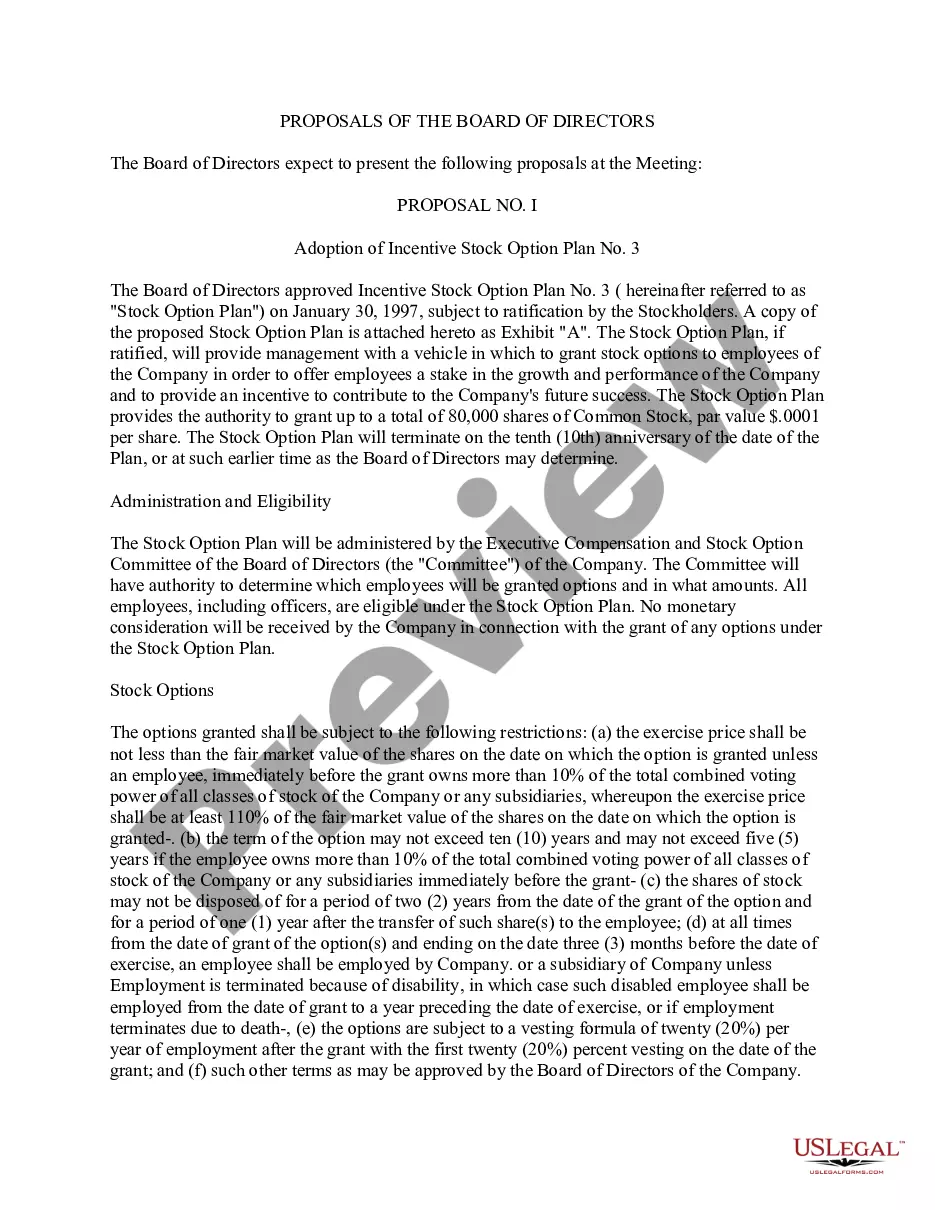
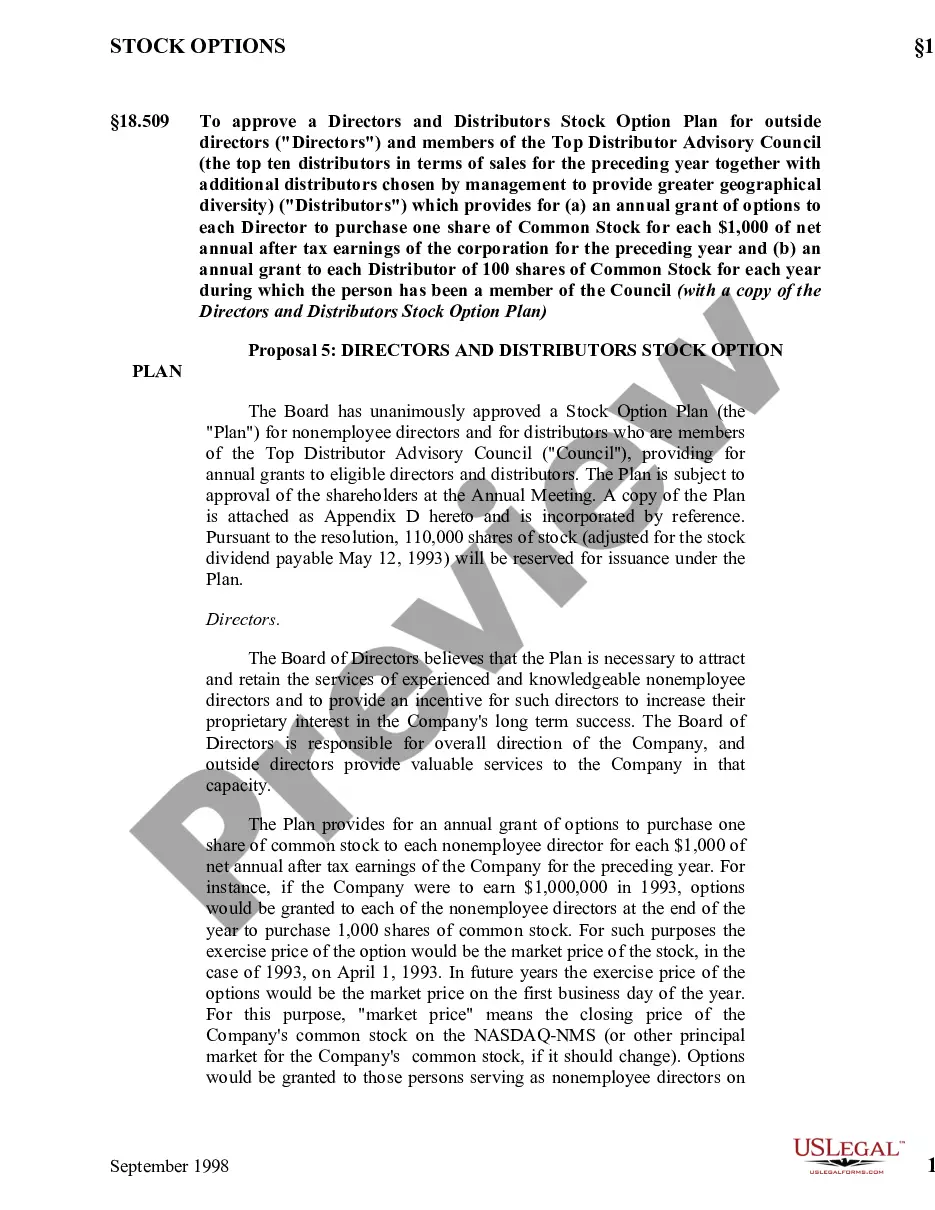
The Proposals to the Board of Directors form is designed for companies to present key agenda items during board meetings, specifically regarding stock options plans. This form allows the board to solicit shareholder approval for significant decisions such as the adoption of incentive stock options. It is essential for ensuring proper governance and compliance in corporate decision-making.
What’s included in this form
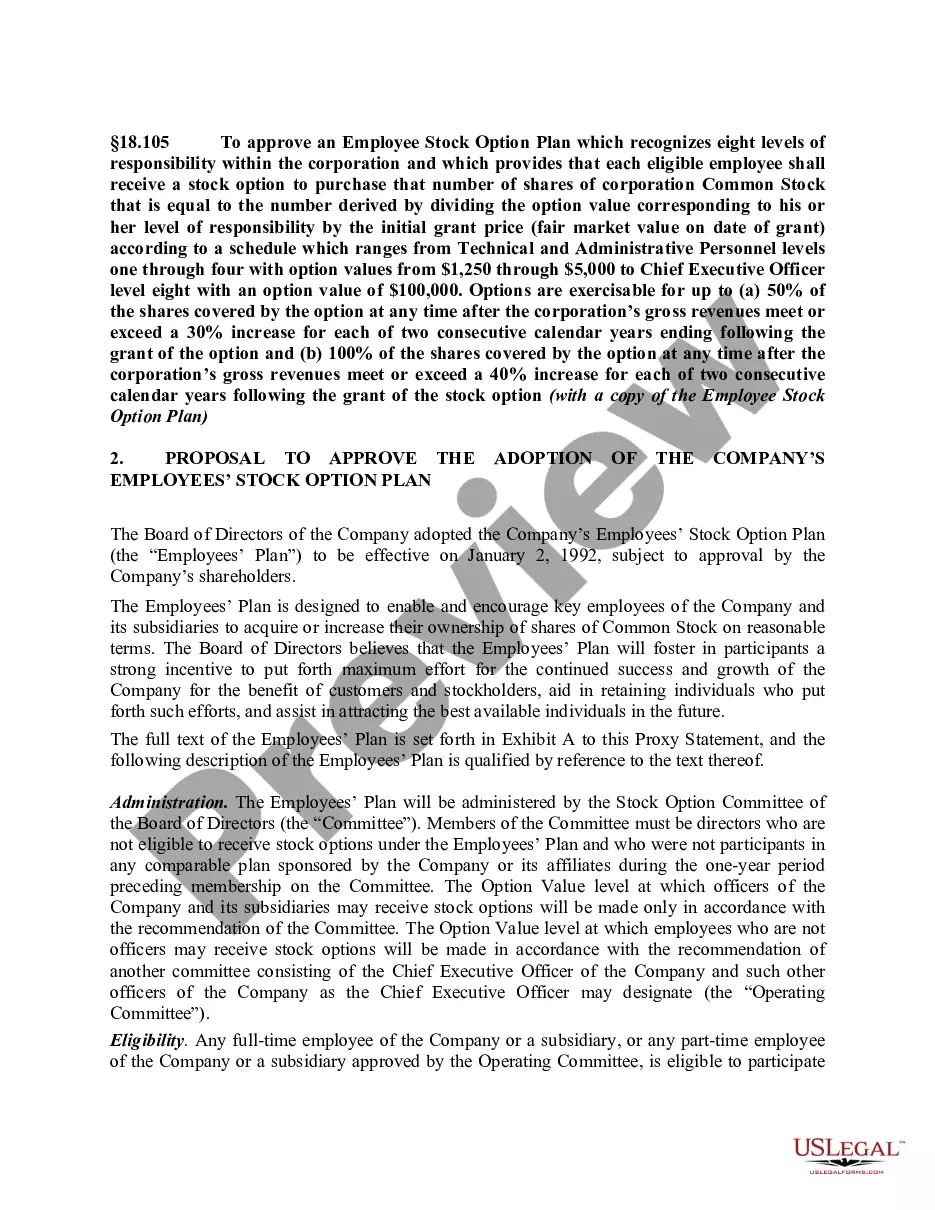
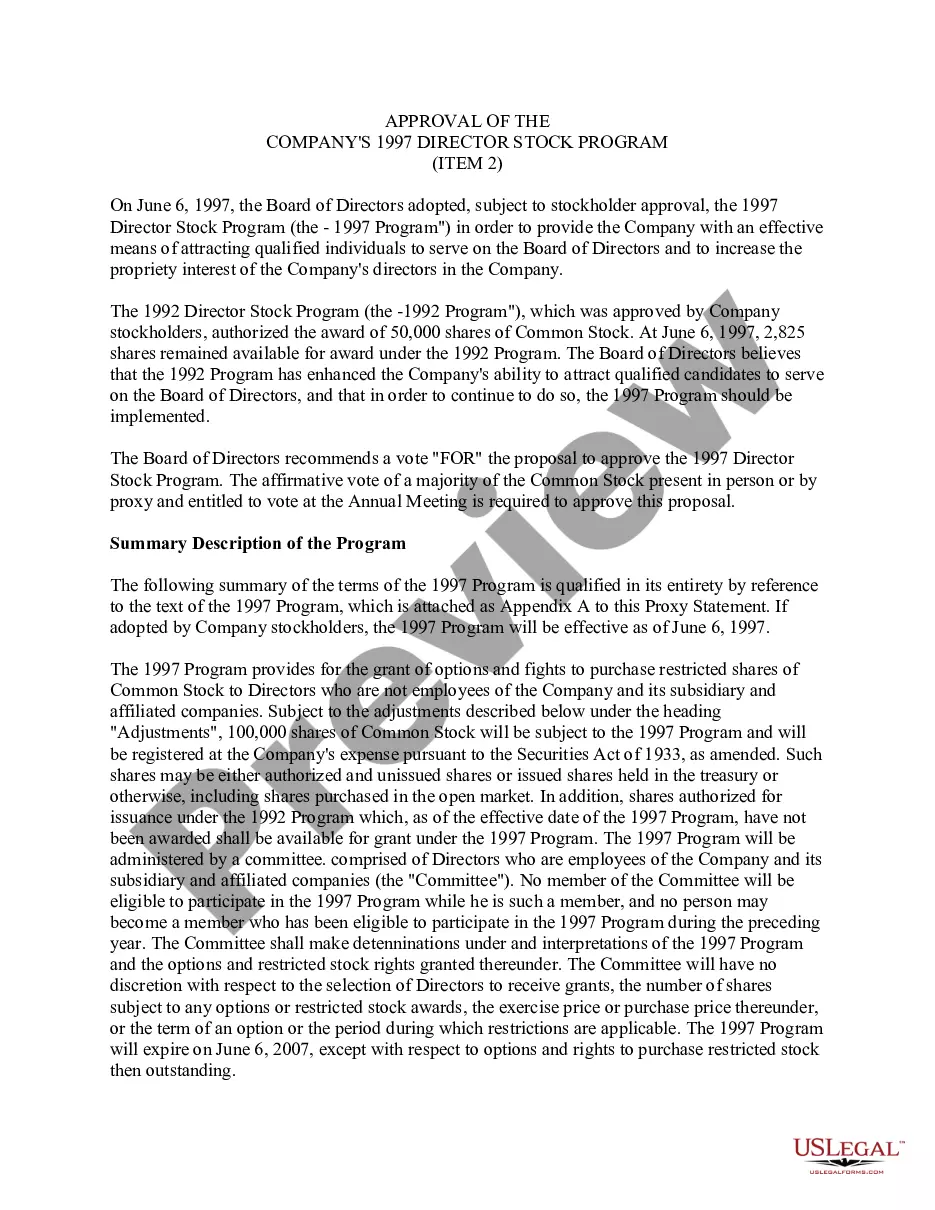
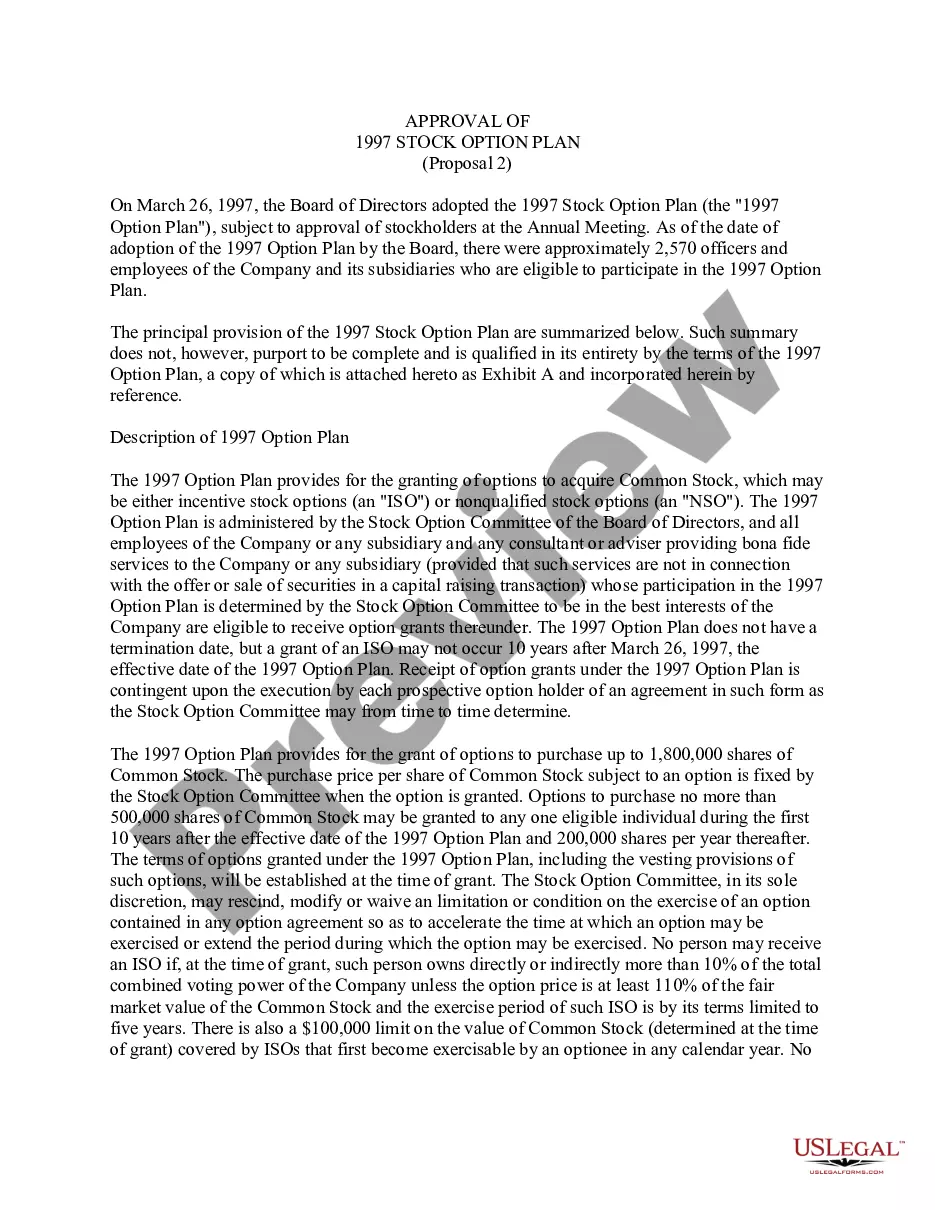
- Proposal details, including the adoption of the Incentive Stock Option Plan No. 3.
- Administrative structure of the stock option plan, including the Executive Compensation and Stock Option Committee's role.
- Eligibility criteria for employees who can receive stock options.
- Specific terms and restrictions governing the stock options including exercise price and holding periods.
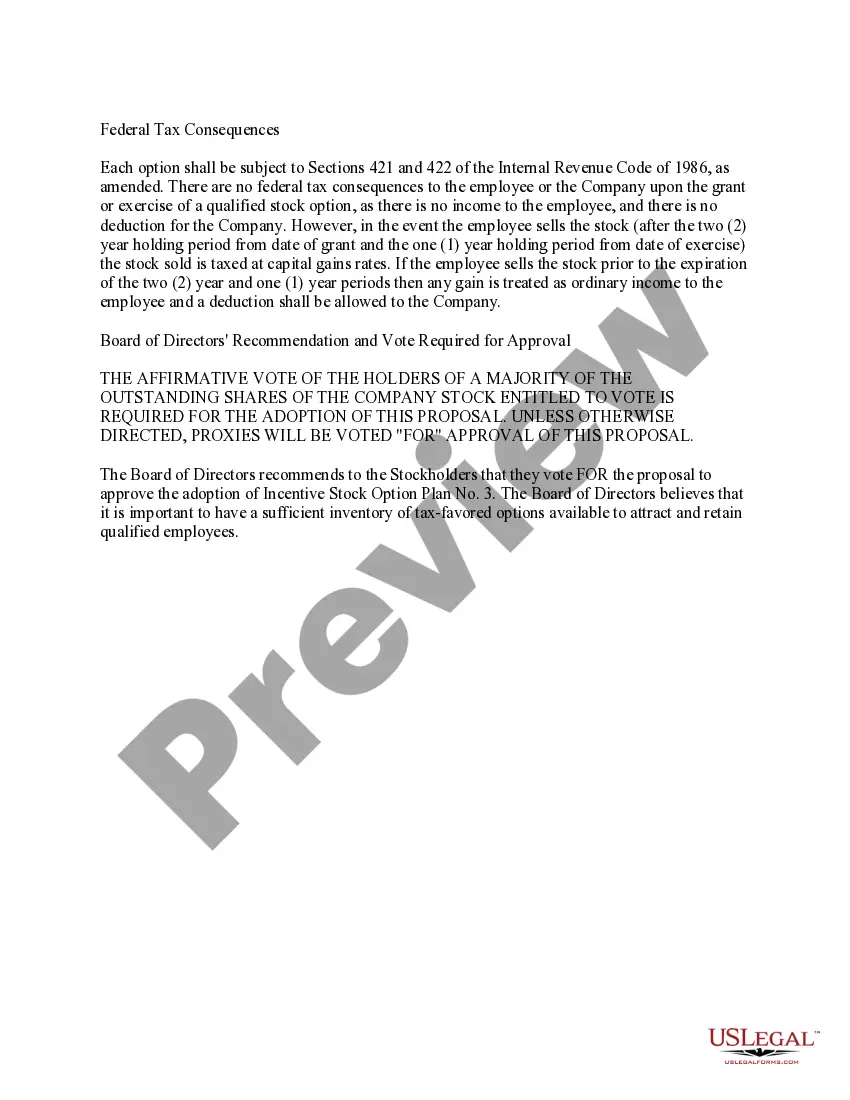
- Federal tax implications related to the grant and exercise of stock options.
- Voting requirements and recommendations from the board of directors for stockholder approval.

When this form is needed
This form should be used when a corporation plans to propose the adoption of a stock option plan during a board of directors meeting. It is particularly relevant when changes in employee compensation structures are being considered or when new incentives are necessary to attract and retain talent within the company.
Who can use this document
This form is intended for:
- Corporate boards of directors seeking to implement or modify incentive stock option plans.
- Legal counsel advising corporations on governance matters.
- Shareholder representatives interested in understanding and voting on proposals regarding stock options.
- Company executives who are responsible for employee compensation and incentive strategies.
Steps to complete this form
To complete the Proposals to the Board of Directors form, follow these steps:
- Enter the meeting details, including the date and agenda items.
- Outline the specific proposals being presented for shareholder approval.
- Attach relevant documents, such as the proposed stock option plan as an exhibit.
- Indicate the voting requirements necessary for the approval of the proposals.
- Provide the recommendation of the board of directors regarding the proposals.
Is notarization required?
This form does not typically require notarization unless specified by local law. It is advisable to check specific state requirements or company bylaws for any additional documentation needed for board proposals.
Get your form ready online
Our built-in tools help you complete, sign, share, and store your documents in one place.
Make edits, fill in missing information, and update formatting in US Legal Forms—just like you would in MS Word.
Download a copy, print it, send it by email, or mail it via USPS—whatever works best for your next step.
Sign and collect signatures with our SignNow integration. Send to multiple recipients, set reminders, and more. Go Premium to unlock E-Sign.
If this form requires notarization, complete it online through a secure video call—no need to meet a notary in person or wait for an appointment.
We protect your documents and personal data by following strict security and privacy standards.

Make edits, fill in missing information, and update formatting in US Legal Forms—just like you would in MS Word.

Download a copy, print it, send it by email, or mail it via USPS—whatever works best for your next step.

Sign and collect signatures with our SignNow integration. Send to multiple recipients, set reminders, and more. Go Premium to unlock E-Sign.

If this form requires notarization, complete it online through a secure video call—no need to meet a notary in person or wait for an appointment.

We protect your documents and personal data by following strict security and privacy standards.
Common mistakes to avoid
- Failing to attach required exhibits or detailed descriptions of proposals.
- Not specifying the voting procedure or forgetting to clarify proxy voting rules.
- Neglecting to update eligibility criteria or restrictions for stock options as company policies evolve.
- Overlooking federal tax implications when discussing stock options with employees.
- Missing key dates or deadlines related to shareholder meetings and voting.
Benefits of completing this form online
- Convenience of downloading and customizing the form to meet specific needs.
- Access to templates drafted by licensed attorneys, ensuring legal compliance.
- Time-saving compared to drafting legal documents from scratch.
- Easy to update and modify with changing corporate policies or laws.
- Streamlined process for obtaining board approval for critical decisions.
Legal use & context
- Enforceability of the proposals is contingent upon following corporate governance procedures.
- The document aids in maintaining transparency between the board and shareholders.
- Proper completion and approval can prevent legal disputes regarding governance practices.
Key takeaways
- The Proposals to the Board of Directors form is essential for companies considering incentive stock option plans.
- Understanding eligibility, voting requirements, and tax implications is crucial for proper compliance.
- This form supports corporate governance by facilitating transparent decision-making with shareholders.
Looking for another form?








Form popularity
FAQ
Limit your letter to three paragraphs and keep the writing tight; don't ramble. Review the professional managing director cover letter sample for examples of how to include specific skills that directly answer the job requirements. Maintain a warm, professional tone throughout the letter, like you were there in person.
The address of a letter to a board of directors begins with the title "Board of Directors." No quotation marks are used. The company's name goes on the next line. The third line has the street address, and the city, state and ZIP code are placed on the following line.
State you interest for the board with reasons. Overview what you have to offer include salient points from your matrix. Explain how your skills/ experiences/ networks will assist them with their current issues/ challenges.
List the Items to Include in Your Letter. The Format for a Letter to a Board. Start All Text on the Left-Hand Side of the Page. Use Letterhead if Possible. Use the Inside Address of the Board. Use the Correct Salutation. Get Straight to the Point. Maintain a Formal Tone.
Know your audience. This is the first and arguably one of the most important steps. Plan the structure of your presentation. Start big, then cut down. Make your data more memorable. Tell them what you're telling them. Keep the detail out of your presentation. Have your eye on the prize.
Step 1: Hold a Brainstorm Session. Step 2: Research. Step 3: Hook the Reader. Step 4: Present the Problem. Step 5: State Your Solution. Step 6: Outline the Project. Step 7: Bring It All Together. Step 8: Proofread Your Proposal.
1State your purpose. Do this clearly and concisely so that the reader knows immediately why you are writing.2Give some background information.3State a solution to the problem.4Show costs.5Conclusion.
To Whom It May Concern: Use only when you do not know to whom you must address the letter, for example, when writing to an institution. Dear colleagues, Use when writing to a group of people. Hello guys, Use when writing to a group of people you know very well. Your sincerely, Kind regards, Best,
Introduce yourself and provide background information. State your purpose for the proposal. Define your goals and objectives. Highlight what sets you apart. Briefly discuss the budget and how funds will be used. Finish with a call to action and request a follow-up. Close the letter and provide contact details.