Jury Instruction - Corruptly Influencing A Juror
What is this form?
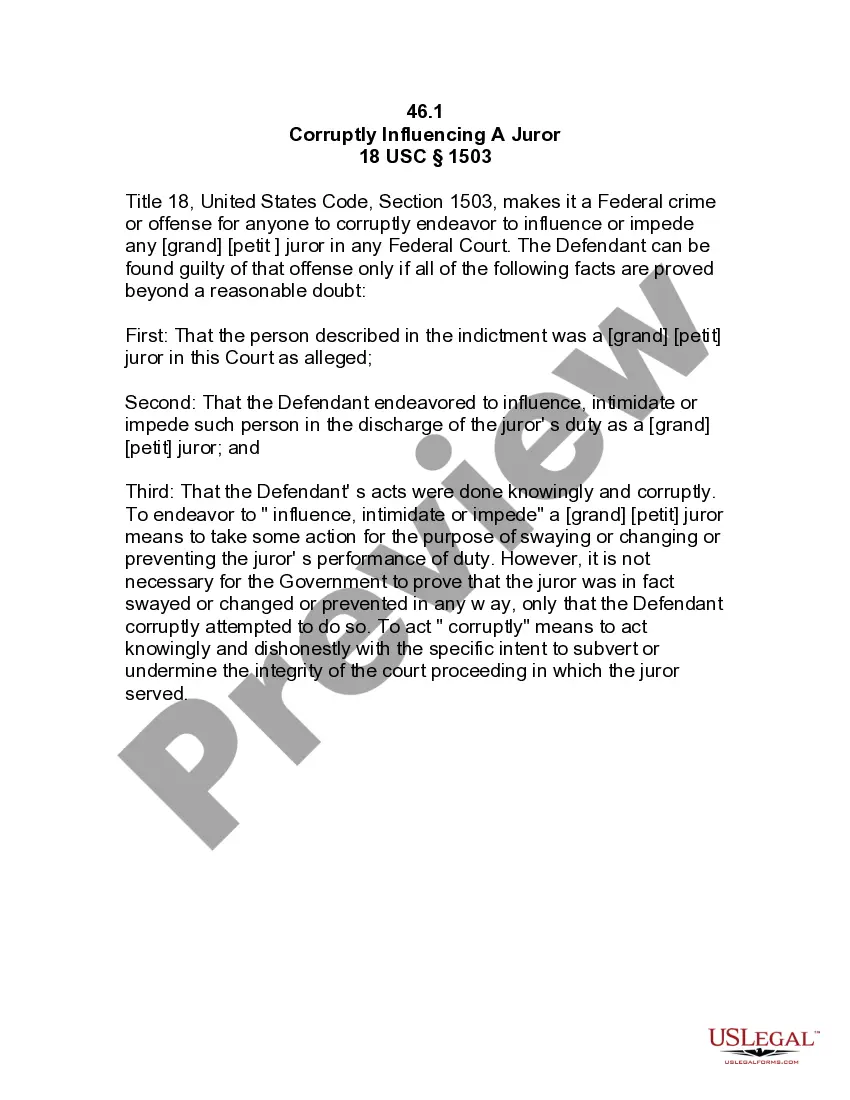
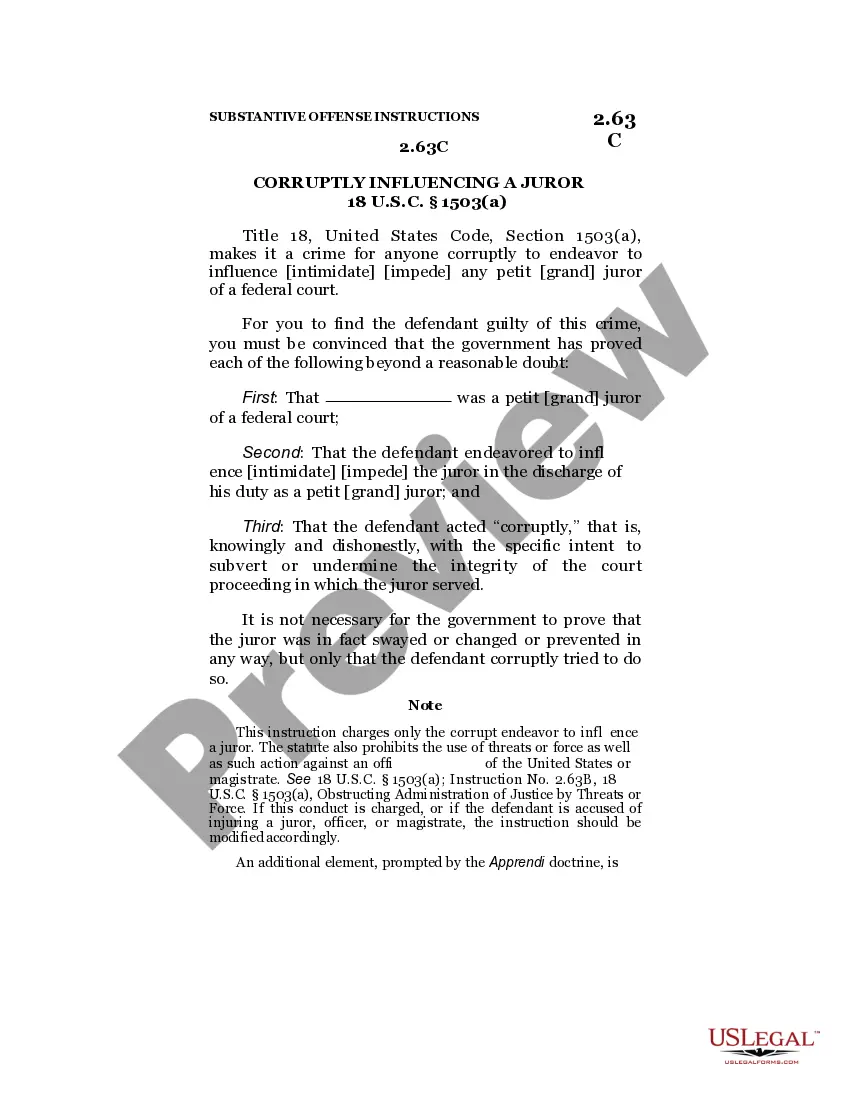
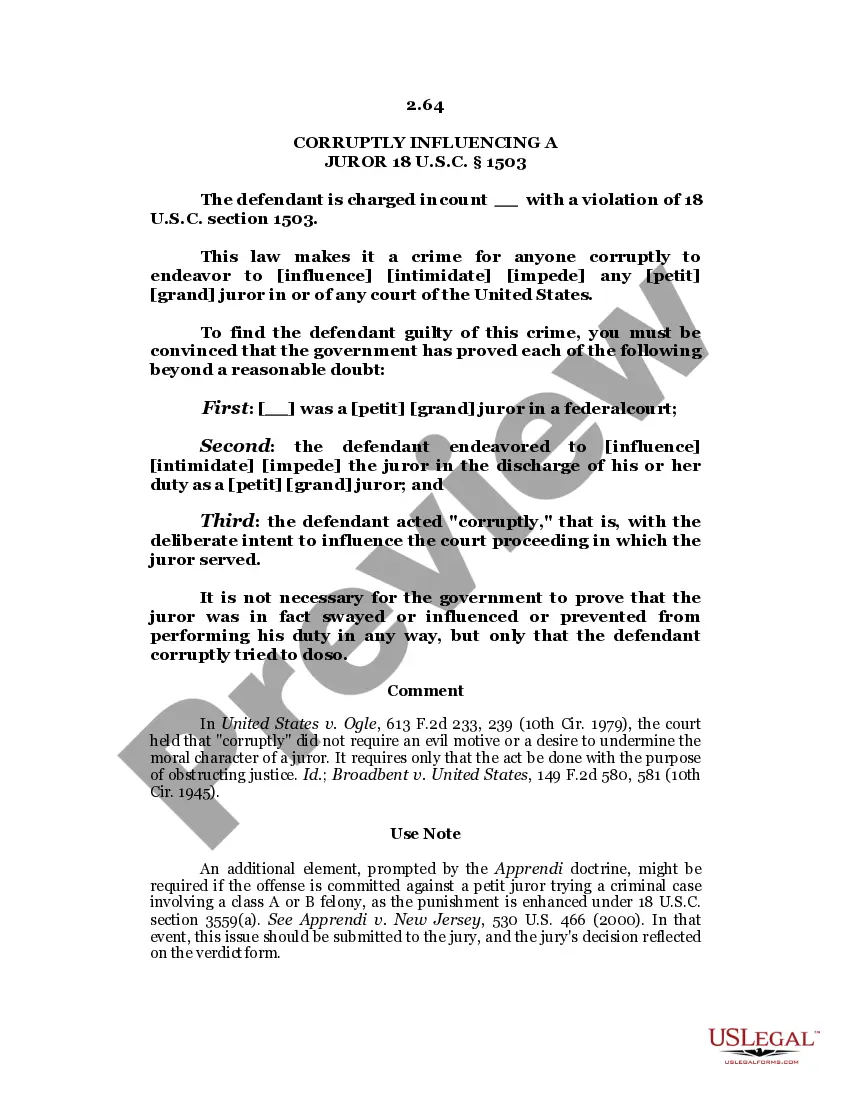
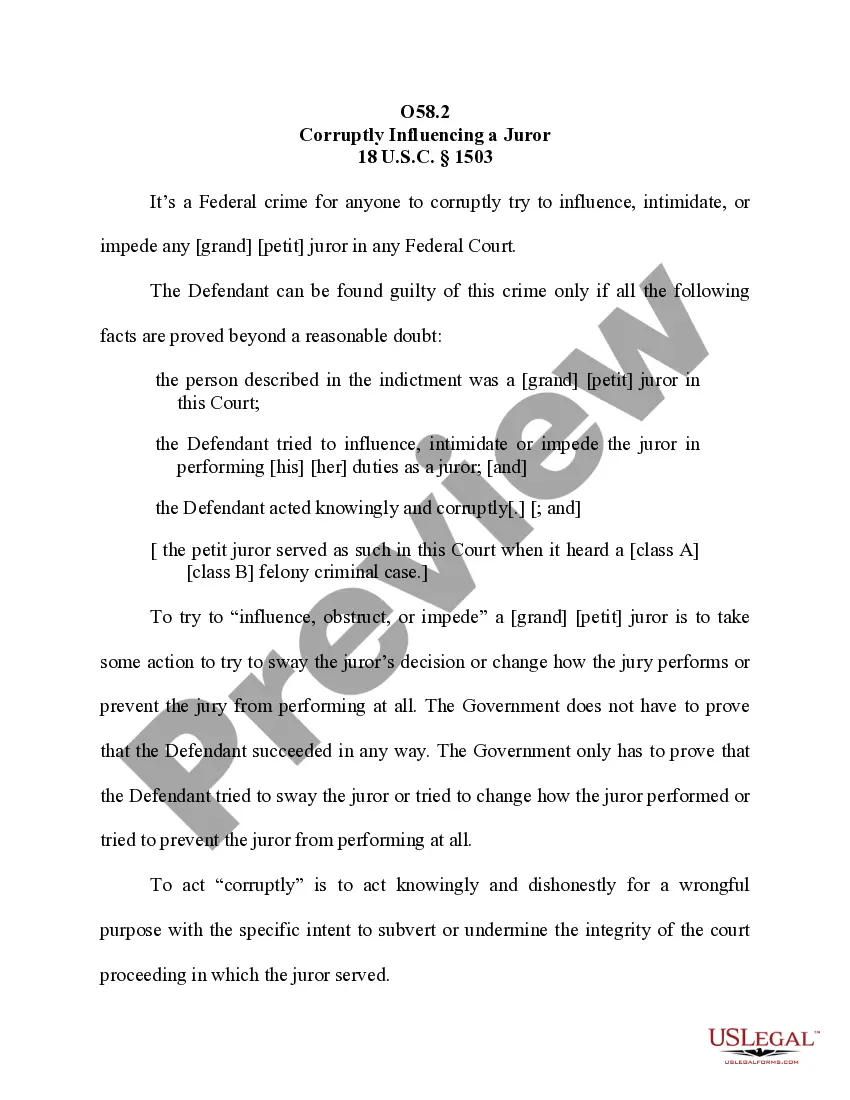
The Jury Instruction - Corruptly Influencing A Juror form provides essential guidelines for jury instructions related to the federal offense of attempting to corruptly influence a juror. This form distinguishes itself by outlining the necessary elements that must be proven in court for a conviction, ensuring clarity on the legal requirements involved in this serious crime. It serves as a model for legal professionals to customize for specific cases.
What’s included in this form
- Definition of corrupt influence, including actions intended to sway a juror.
- Clarification of the obligations of grand and petit jurors.
- Detailed elements of the offense, including the burden of proof for the prosecution.
- Penalties associated with the offense, depending on the severity of the case.

When this form is needed
This form should be used in legal settings where there are allegations of corrupt attempts to influence a juror. It is particularly relevant in cases involving serious felonies, ensuring that jury instructions appropriately reflect the seriousness of the charges. Legal practitioners may also utilize this form to educate jurors on the implications of corrupt influence during the trial process.
Intended users of this form
- Defense attorneys representing clients accused of influencing jurors.
- Prosecutors needing to instruct jurors on the implications of juror tampering.
- Judges presiding over cases related to jury integrity issues.
- Legal scholars and students studying jury instructions in criminal law.
How to complete this form
- Review the facts of the case and identify the individuals involved.
- Insert the specific actions taken by the defendant that could be construed as influencing a juror.
- Detail the roles and responsibilities of the jurors in the case.
- Ensure that the instructions clearly articulate the required standard of proof for the prosecution.
- Finalize the document by signing and dating as required.
Does this document require notarization?
This form does not typically require notarization to be legally valid. However, some jurisdictions or document types may still require it. US Legal Forms provides secure online notarization powered by Notarize, available 24/7 for added convenience.
Get your form ready online
Our built-in tools help you complete, sign, share, and store your documents in one place.
Make edits, fill in missing information, and update formatting in US Legal Forms—just like you would in MS Word.
Download a copy, print it, send it by email, or mail it via USPS—whatever works best for your next step.
Sign and collect signatures with our SignNow integration. Send to multiple recipients, set reminders, and more. Go Premium to unlock E-Sign.
If this form requires notarization, complete it online through a secure video call—no need to meet a notary in person or wait for an appointment.
We protect your documents and personal data by following strict security and privacy standards.

Make edits, fill in missing information, and update formatting in US Legal Forms—just like you would in MS Word.

Download a copy, print it, send it by email, or mail it via USPS—whatever works best for your next step.

Sign and collect signatures with our SignNow integration. Send to multiple recipients, set reminders, and more. Go Premium to unlock E-Sign.

If this form requires notarization, complete it online through a secure video call—no need to meet a notary in person or wait for an appointment.

We protect your documents and personal data by following strict security and privacy standards.
Avoid these common issues
- Failing to properly define what constitutes corrupt influence.
- Overlooking the necessity of providing clear instructions on the burden of proof.
- Not customizing the form to reflect the specifics of the case at hand.
- Assuming all jurors understand legal terminology without clarification.
Benefits of completing this form online
- Convenient access to up-to-date legal language and formats.
- Ability to customize the form to fit specific legal situations easily.
- Secure download and storage options for sensitive legal documents.
- Quick submission and filing processes when used in conjunction with other legal tools.
Looking for another form?






Form popularity
FAQ
The judge can direct a jury, but cannot oblige it to go along with his interpretation.The law makes it clear that this is an offence and, assuming that the accusation is proven beyond any reasonable doubt, a judge would probably request a guilty verdict to be returned.
Pre-trial publicity. Characteristics of the defendant. Minority influence.
These are civil or criminal jury instructions approved by a state court, bench committee, or bar association. They are commonly used by courts in the relevant jurisdiction, as they ease the process of drafting fair jury instructions and theoretically do not have errors.
According to the Supreme Court, the jury-trial right applies only when serious offenses are at handpetty offenses don't invoke it. For purposes of this right, a serious offense is one that carries a potential sentence of more than six months' imprisonment.
Groups exert influence on individuals through the discussion of decision alternatives. Typically, juries make decisions in an egalitarian fashion, where each juror's position is given a fair hearing by other jurors.
While jurors base their predeliberation judgments on different, but equal, information, the group decision (verdict) is based on information pooling and shared memories. Differences in individual judgments of the same information arise from differences in memory and attention among jurors.
An impartial juror is someone capable and willing to decide the case solely on the evidence presented at trial.A sitting juror's actual bias, which would have supported a challenge for cause, renders him unable to perform his duty and thus subject to discharge and substitution. (People v. Keenan (1988) 46 Cal.
The judge instructs the jury about the relevant laws that should guide its deliberations. (In some jurisdictions, the court may instruct the jury at any time after the close of evidence.The judge reads the instructions to the jury. This is commonly referred to as the judge's charge to the jury.