Jury Instruction - First Degree Murder - Felony Murder
What is this form?
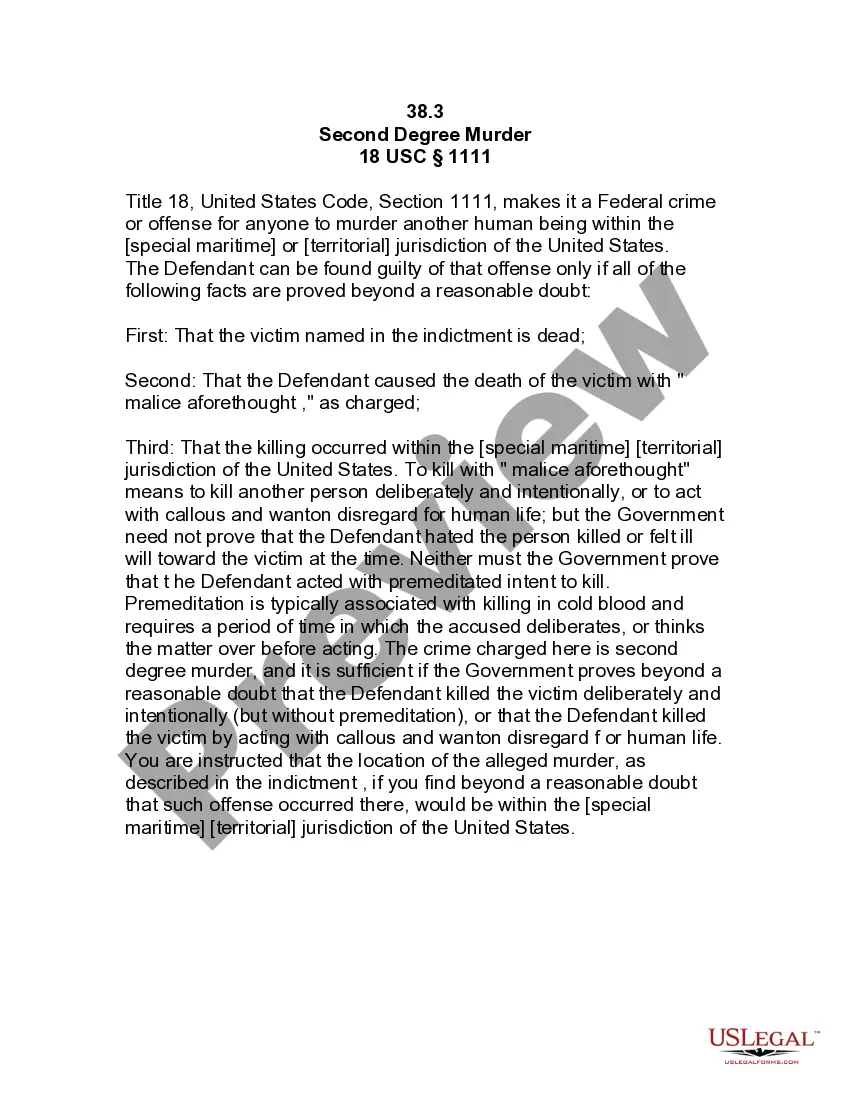
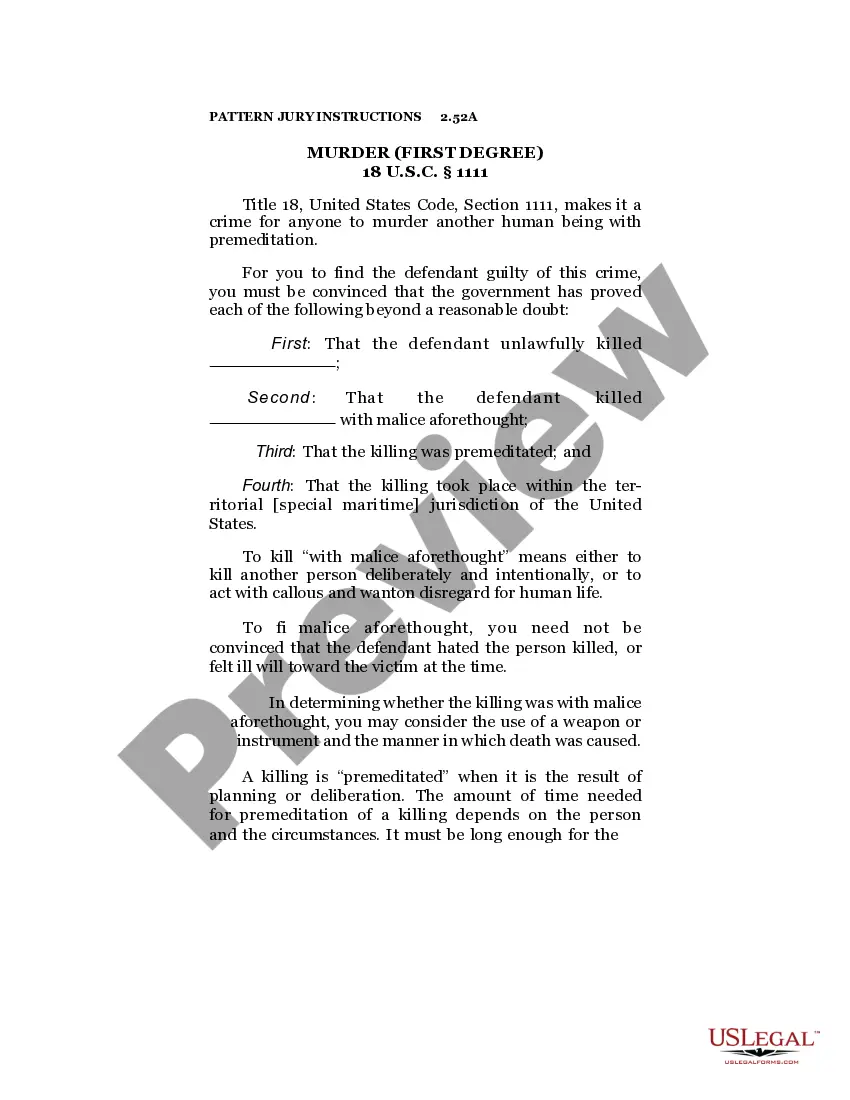
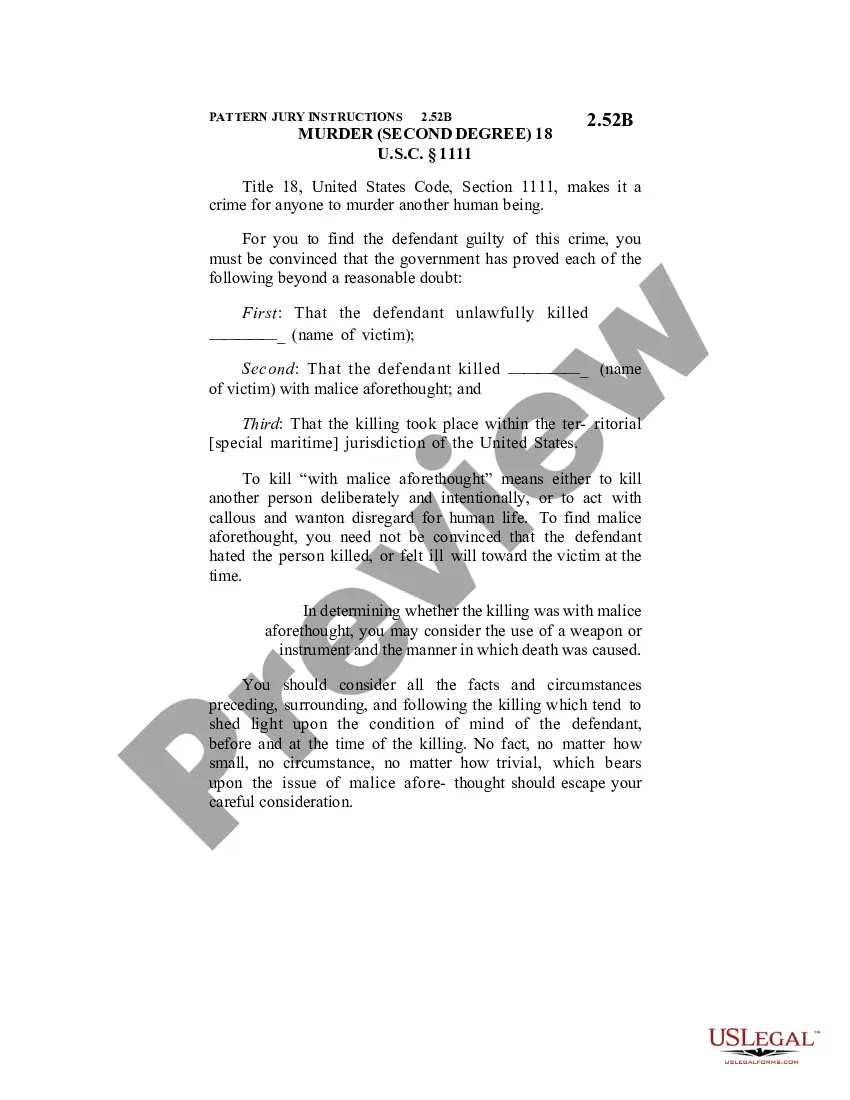
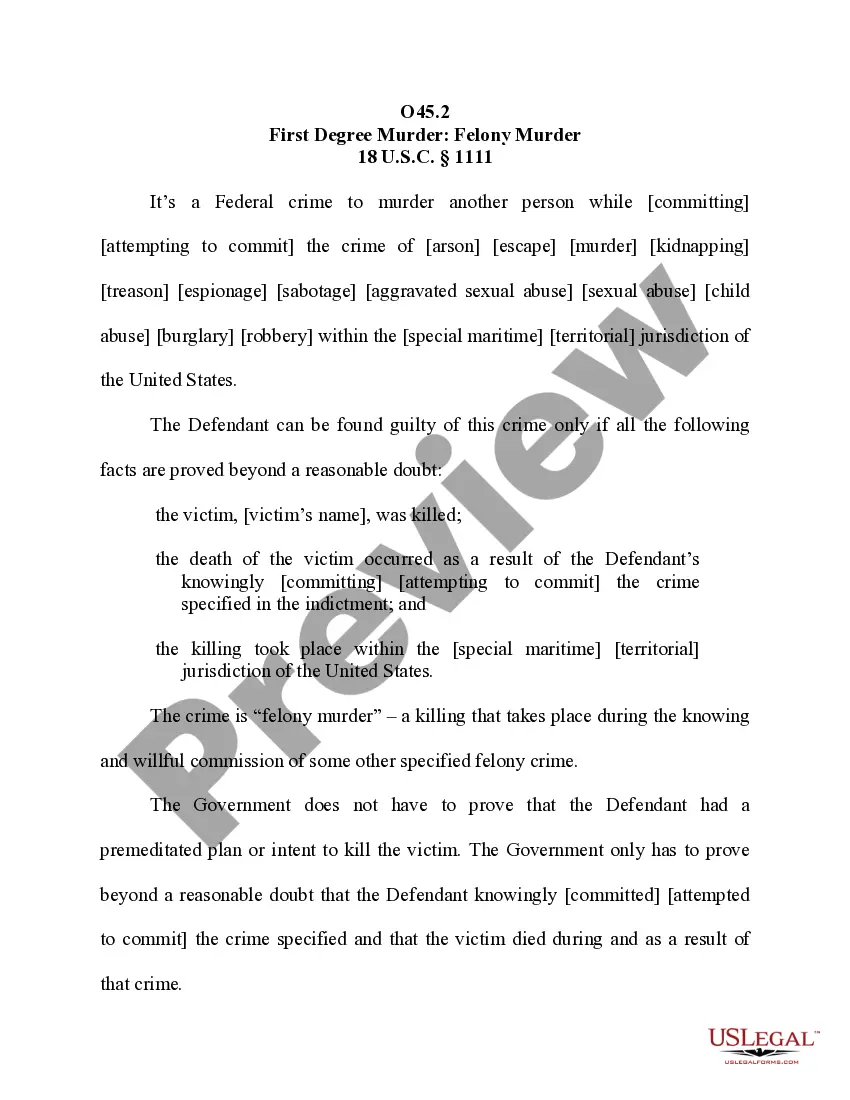
The Jury Instruction - First Degree Murder - Felony Murder is a legal template used to present specific instructions to a jury in felony murder cases. This form outlines the necessary legal standards and criteria that must be established during a trial in which a defendant is accused of committing murder while engaged in the commission of another felony. Unlike other jury instructions, this form focuses specifically on the nuances of felony murder, making it crucial for cases involving serious offenses such as arson, robbery, or kidnapping.
Key parts of this document
- Definition of first degree murder and felony murder under federal law.
- Criteria that the prosecution must prove beyond a reasonable doubt.
- Details on the necessary facts about the victim and the circumstances of death.
- Instructions on the jurisdictional requirements for special maritime territory.
- Clarification on the absence of need for premeditated intent to kill in felony murder cases.
When to use this document
This form should be used in criminal trials where a defendant is charged with felony murder. It is applicable in cases where a death occurs during the commission of another serious felony. Legal practitioners can utilize this jury instruction to guide jurors on their responsibilities and the legal thresholds needed to assess guilt in these complex situations.
Intended users of this form
- Criminal defense attorneys representing clients charged with felony murder.
- Prosecutors involved in felony murder cases.
- Judges presiding over cases involving felony murder charges.
- Law students or legal interns researching jury instructions for criminal law coursework.
Instructions for completing this form
- Read the instructions thoroughly to understand the key legal standards.
- Identify the specific felony charges related to the case.
- Adjust the model questions provided to fit the particulars of the case at hand.
- Ensure that the criteria for proving guilt are clearly articulated for jurors.
- Review the complete document for clarity and accuracy before submitting it in court.
Notarization guidance
Notarization is not commonly needed for this form. However, certain documents or local rules may make it necessary. Our notarization service, powered by Notarize, allows you to finalize it securely online anytime, day or night.
Get your form ready online
Our built-in tools help you complete, sign, share, and store your documents in one place.
Make edits, fill in missing information, and update formatting in US Legal Forms—just like you would in MS Word.
Download a copy, print it, send it by email, or mail it via USPS—whatever works best for your next step.
Sign and collect signatures with our SignNow integration. Send to multiple recipients, set reminders, and more. Go Premium to unlock E-Sign.
If this form requires notarization, complete it online through a secure video call—no need to meet a notary in person or wait for an appointment.
We protect your documents and personal data by following strict security and privacy standards.

Make edits, fill in missing information, and update formatting in US Legal Forms—just like you would in MS Word.

Download a copy, print it, send it by email, or mail it via USPS—whatever works best for your next step.

Sign and collect signatures with our SignNow integration. Send to multiple recipients, set reminders, and more. Go Premium to unlock E-Sign.

If this form requires notarization, complete it online through a secure video call—no need to meet a notary in person or wait for an appointment.

We protect your documents and personal data by following strict security and privacy standards.
Common mistakes
- Failing to adapt the jury instructions to the specific facts of the case.
- Omitting critical elements that the prosecution must prove beyond a reasonable doubt.
- Neglecting to clarify jurisdictional issues related to special maritime territory.
- Using legal jargon that may confuse jurors unfamiliar with legal terminology.
Advantages of online completion
- Convenient access to professionally drafted jury instructions anytime.
- Editability allows tailoring of instructions to specific cases.
- Reliable format in compliance with current legal standards.
- Instant downloadable form can expedite the preparation process for trials.
Looking for another form?
Form popularity
FAQ
Putting aside felony murder, the real difference between first and second-degree murder is the intent or mindset the defendant had when they took the action they did. Third-degree murder (also called manslaughter) is an unplanned, unintentional killing that is not part of another felony.
Homicides can be divided into many overlapping legal categories, including murder, manslaughter, justifiable homicide, killing in war (either following the laws of war or as a war crime), euthanasia, and capital punishment, depending on the circumstances of the death.
First-degree murder is the most serious of all homicide offenses. It involves any intentional murder that is willful and premeditated with malice aforethought. Premeditation requires that the defendant planned the murder before it was committed or was lying in wait for the victim.
In most US jurisdictions there is a hierarchy of acts, known collectively as homicide, of which first-degree murder and felony murder are the most serious, followed by second-degree murder and, in a few states, third-degree murder, followed by voluntary manslaughter and involuntary manslaughter which are not as serious
Felony murder is a subset of first-degree murder and is charged when a person is killed during the commission of a felony, such as a robbery or rape.