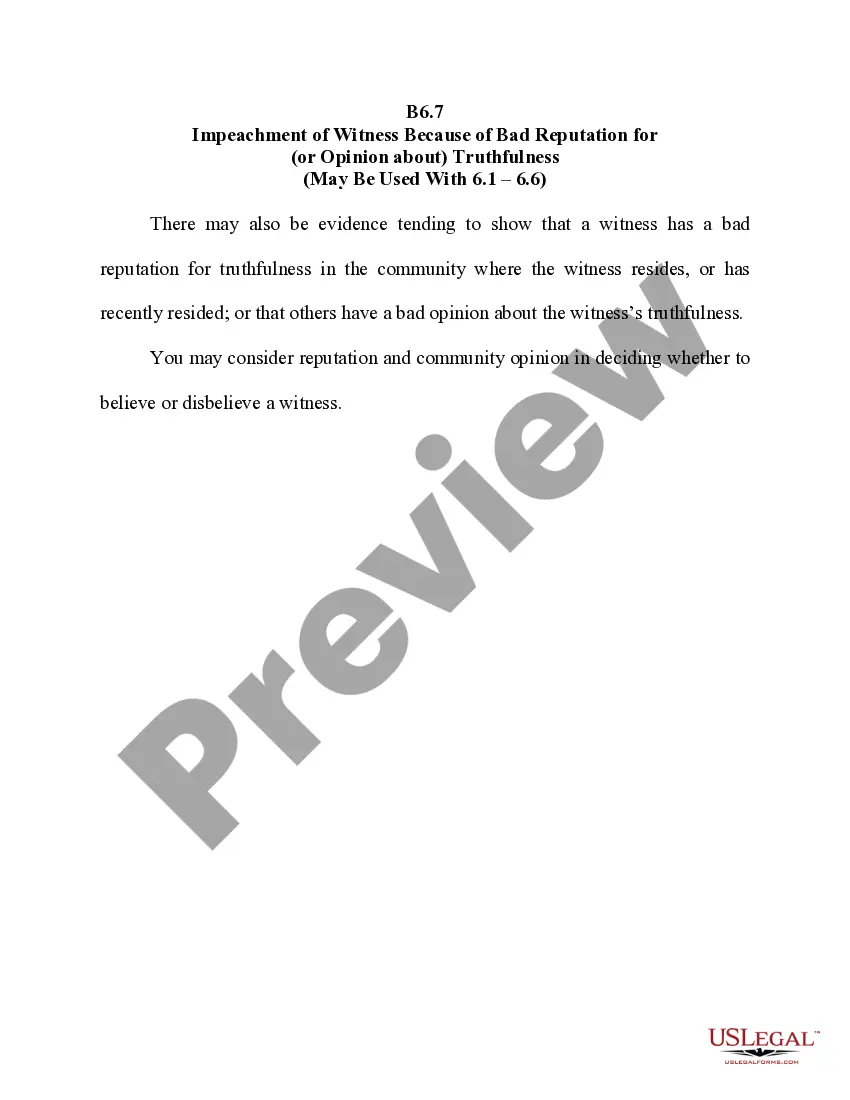
Jury Instruction - Impeachment - Bad Reputation or Opinion Concerning Truthfulness - May Be Used With 6.1 - 6. 6
What is this form?
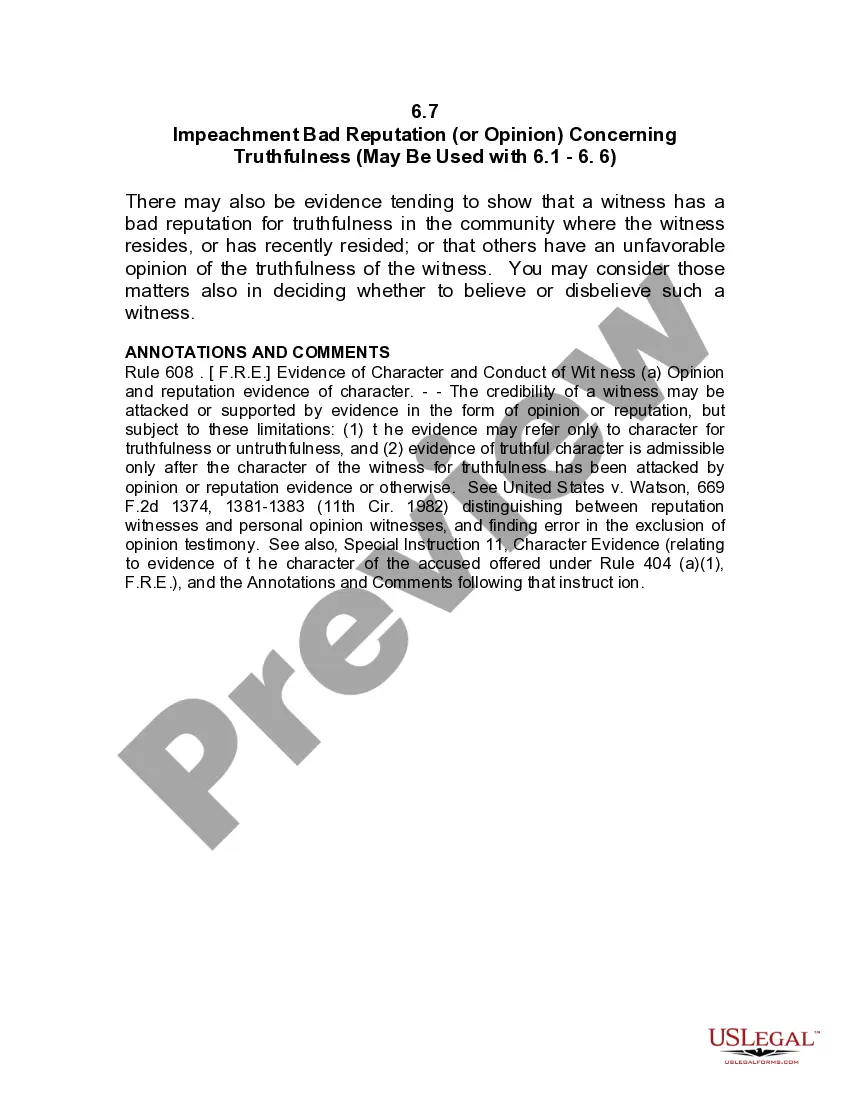
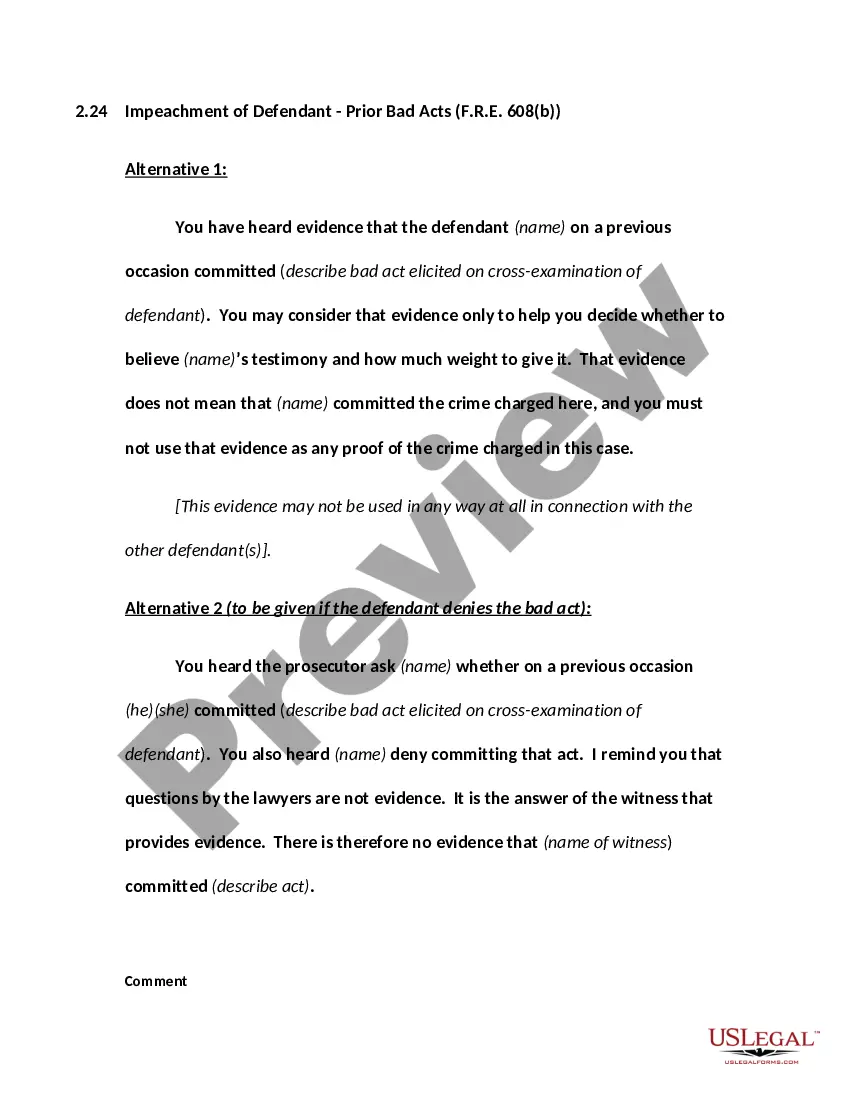
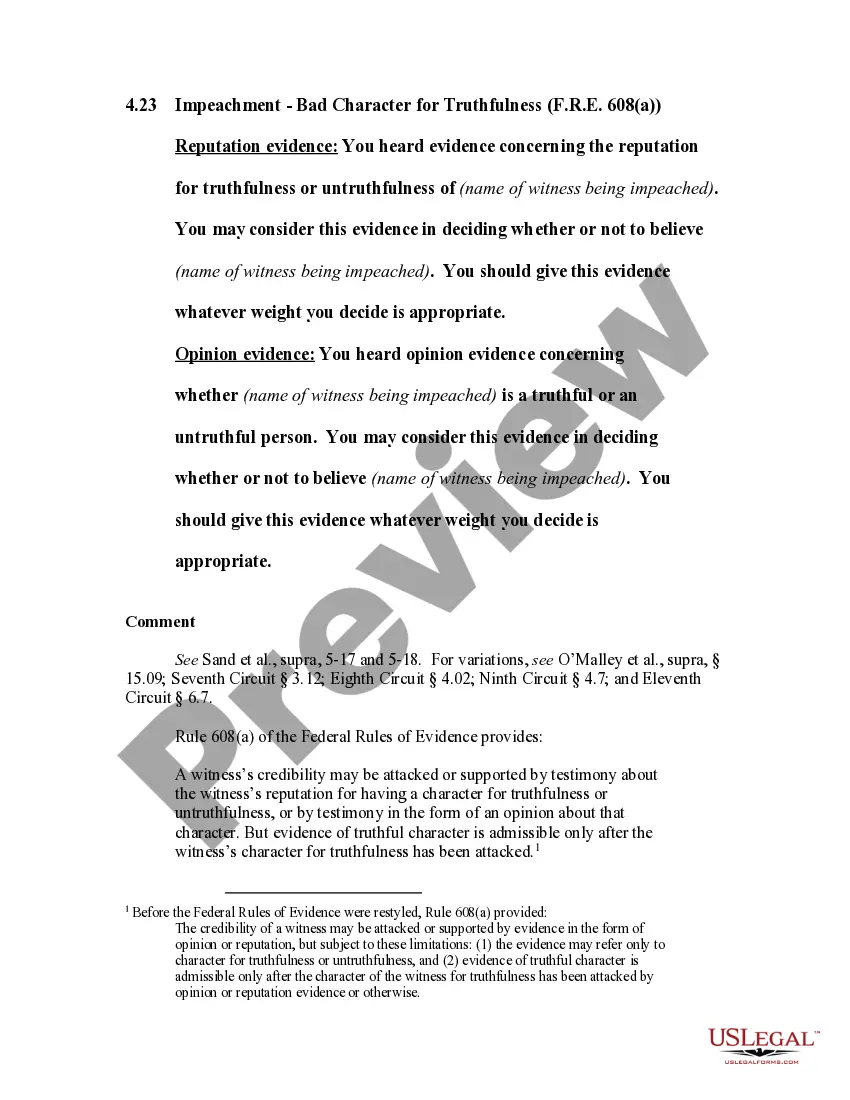
This form is a Jury Instruction for Impeachment based on Bad Reputation or Opinion Concerning Truthfulness. It outlines how jurors can consider evidence related to a witness's credibility in terms of their reputation within the community or general opinions about their truthfulness. This specific instruction may be used in conjunction with other jury instructions related to credibility, making it distinct for its focus on the character of witnesses in a legal proceeding.
Key parts of this document
- Introduction to jury instruction on witness impeachment.
- Definition of evidence concerning a witness's bad reputation for truthfulness.
- Guidance on considering opinions about a witness's credibility.
- Citations from relevant legal rulings and annotations related to character evidence.
Situations where this form applies
This form should be used during court proceedings when a party wants to challenge the credibility of a witness. It is applicable in cases where the witness's reputation for truthfulness or the community's opinion about the witness may affect the jury's decision-making. Such scenarios often arise in criminal cases, civil lawsuits, or any legal setting where witness testimony is presented.
Who this form is for
- Attorneys representing parties in legal proceedings.
- Judges who need to instruct juries on assessing witness credibility.
- Legal aid organizations assisting individuals in understanding trial procedures.
How to complete this form
- Review the standard language provided in the jury instruction.
- Modify the sample instructions to suit the specific case.
- Ensure references to applicable federal rules are included appropriately.
- Consider the context in which the witness's reputation may impact the case and adjust language as necessary.
Notarization guidance
In most cases, this form does not require notarization. However, some jurisdictions or signing circumstances might. US Legal Forms offers online notarization powered by Notarize, accessible 24/7 for a quick, remote process.
Get your form ready online
Our built-in tools help you complete, sign, share, and store your documents in one place.
Make edits, fill in missing information, and update formatting in US Legal Forms—just like you would in MS Word.
Download a copy, print it, send it by email, or mail it via USPS—whatever works best for your next step.
Sign and collect signatures with our SignNow integration. Send to multiple recipients, set reminders, and more. Go Premium to unlock E-Sign.
If this form requires notarization, complete it online through a secure video call—no need to meet a notary in person or wait for an appointment.
We protect your documents and personal data by following strict security and privacy standards.

Make edits, fill in missing information, and update formatting in US Legal Forms—just like you would in MS Word.

Download a copy, print it, send it by email, or mail it via USPS—whatever works best for your next step.

Sign and collect signatures with our SignNow integration. Send to multiple recipients, set reminders, and more. Go Premium to unlock E-Sign.

If this form requires notarization, complete it online through a secure video call—no need to meet a notary in person or wait for an appointment.

We protect your documents and personal data by following strict security and privacy standards.
Typical mistakes to avoid
- Failing to adapt the instruction to fit the particular case details.
- Neglecting to reference state-specific rules on witness credibility.
- Overlooking the importance of including relevant legal citations.
Advantages of online completion
- Convenient access to professionally drafted legal forms.
- Editable to meet specific case needs and formatting requirements.
- Reliable resource for accurate information on jury instructions.
Legal use & context
- This form is essential for enhancing jury understanding of witness credibility.
- It helps ensure that jurors can fairly evaluate the reliability of testimony based on evidence of reputation.
- The use of this form is governed by Federal Rules of Evidence, particularly Rule 608.
Looking for another form?

Form popularity
FAQ
The three most widely accepted contemporary theories of truth are i the Correspondence Theory ; ii the Semantic Theory of Tarski and Davidson; and iii the Deflationary Theory of Frege and Ramsey. The competing theories are iv the Coherence Theory , and v the Pragmatic Theory .
Truth is the property of being in accord with fact or reality. In everyday language, truth is typically ascribed to things that aim to represent reality or otherwise correspond to it, such as beliefs, propositions, and declarative sentences. Truth is usually held to be the opposite of falsehood.
Religious truth. This truth is about relationships God and God's relationship with us. Moral truth. Concerned with right and wrong. Symbolic truth. Much of the truth found in scriptures is revealed through the use of symbols. Proverbial truth. A type of folksy wisdom. Historical truth. Scientific truth.
They didn't know; they believed. The Bible has much to say about truth and directly relates it to God. In fact, the definition of truth in "Harper's Bible Dictionary" includes the statement that "God is truth." And this is how He is understood in Christian Science, the Science by which Jesus healed.
(Entry 1 of 2) 1a(1) : the body of real things, events, and facts : actuality. (2) : the state of being the case : fact. (3) often capitalized : a transcendent fundamental or spiritual reality.
Truth is the property of being in accord with fact or reality. In everyday language, truth is typically ascribed to things that aim to represent reality or otherwise correspond to it, such as beliefs, propositions, and declarative sentences. Truth is usually held to be the opposite of falsehood.
The Importance of Truth. Truth matters, both to us as individuals and to society as a whole. As individuals, being truthful means that we can grow and mature, learning from our mistakes. For society, truthfulness makes social bonds, and lying and hypocrisy break them.
Truth is in fact a verified or indisputable fact. We just believe as Christians the facts are laid out in the Bible. We believe every answer to life and the truth on any topic is laid out in the Bible. Jesus was saying to us it is an indisputable fact that I am the Son of God. I am the way, the truth and the life.
He is the true representation of God and has been from the beginning - the root reality behind all things - the source of all things. If we look at the context of the passage, Jesus' main point seems to be that He is the true representative of God to mankind.