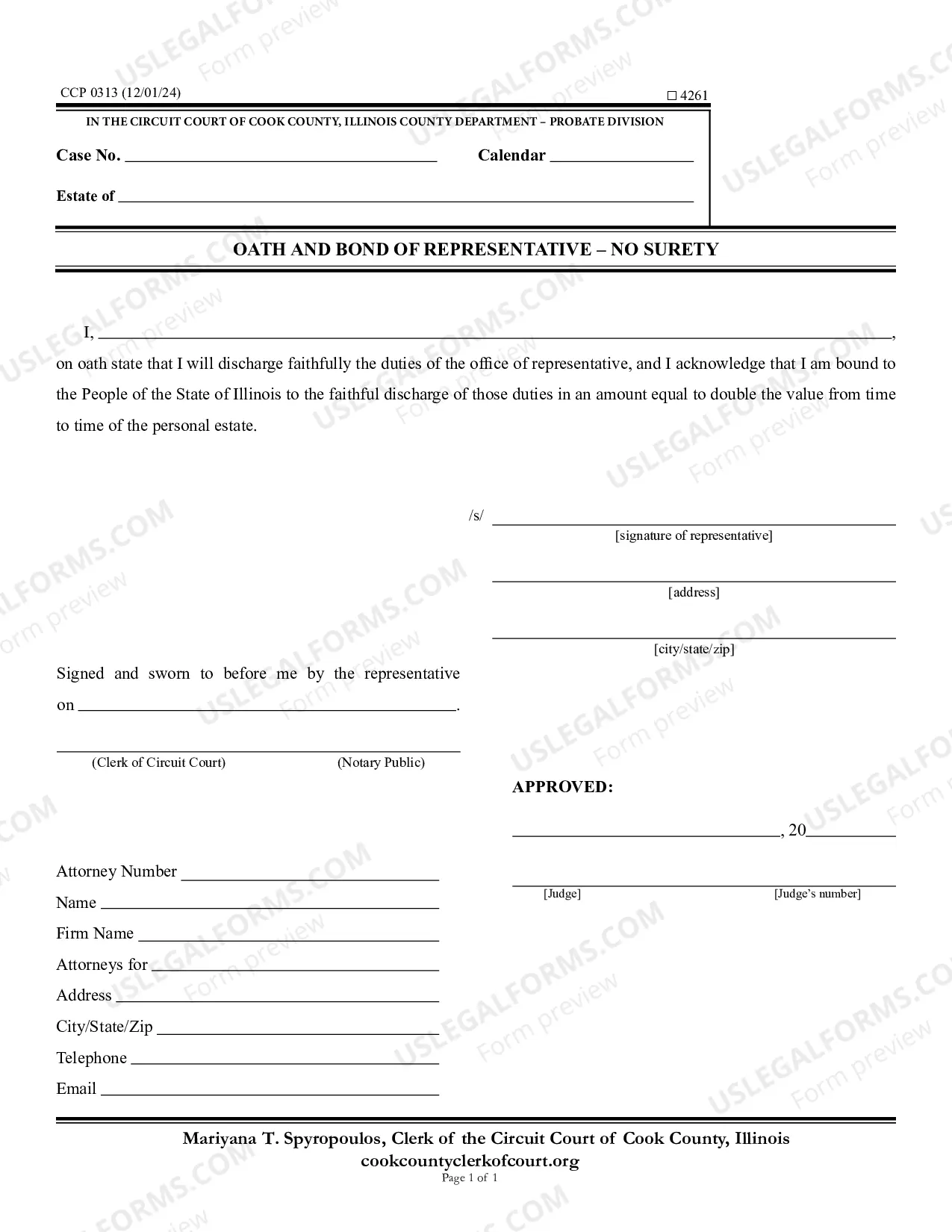
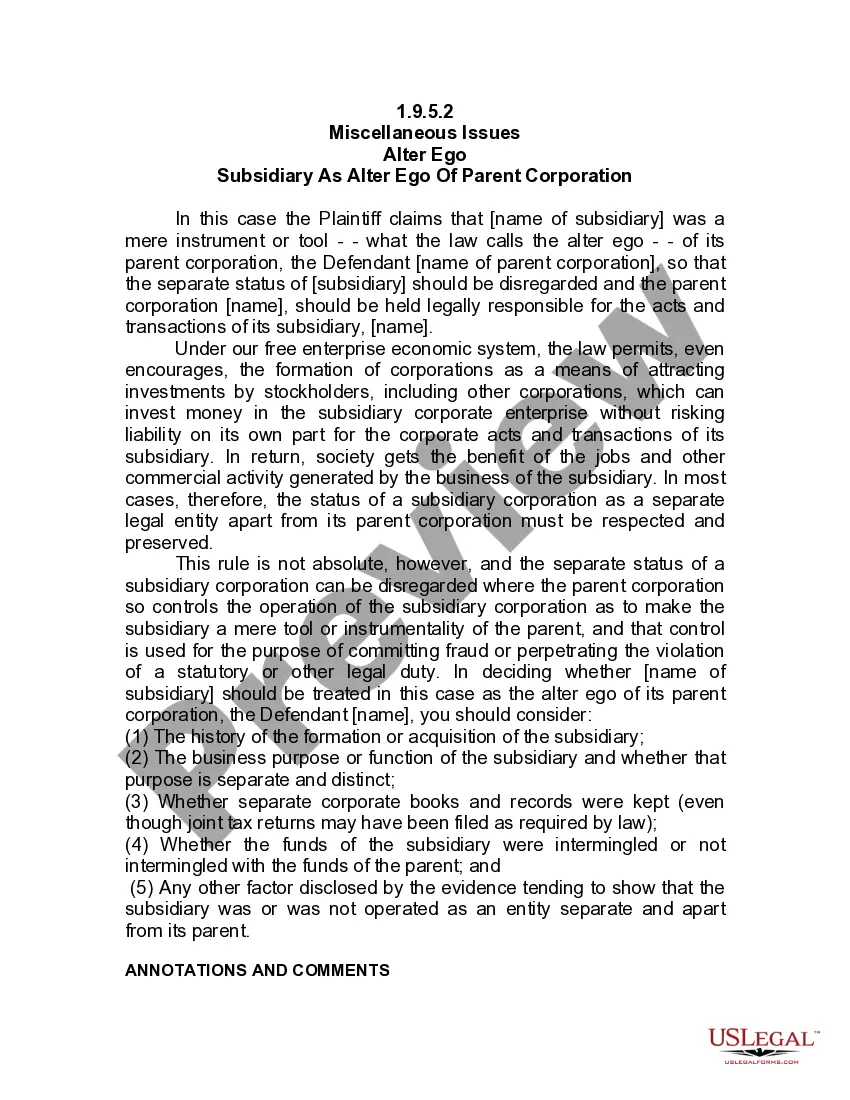
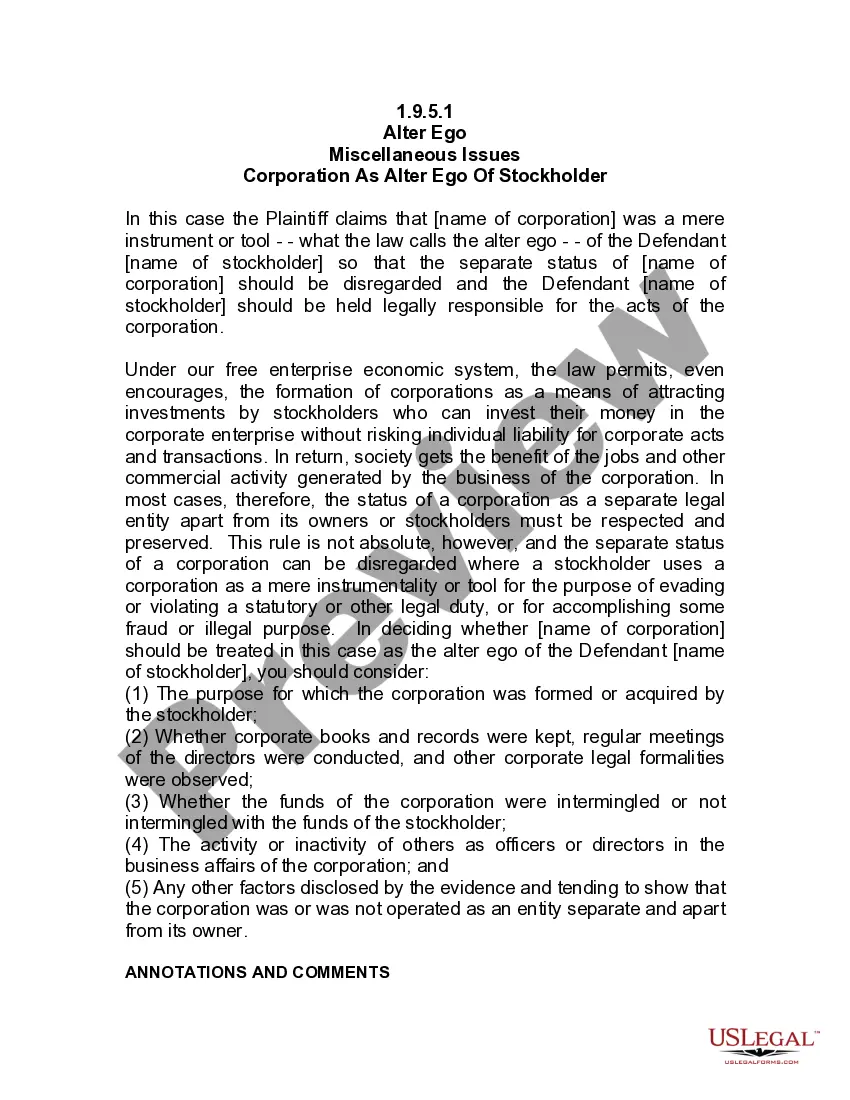
Jury Instruction - 1.9.5.2 Subsidiary As Alter Ego Of Parent Corporation
What is this form?
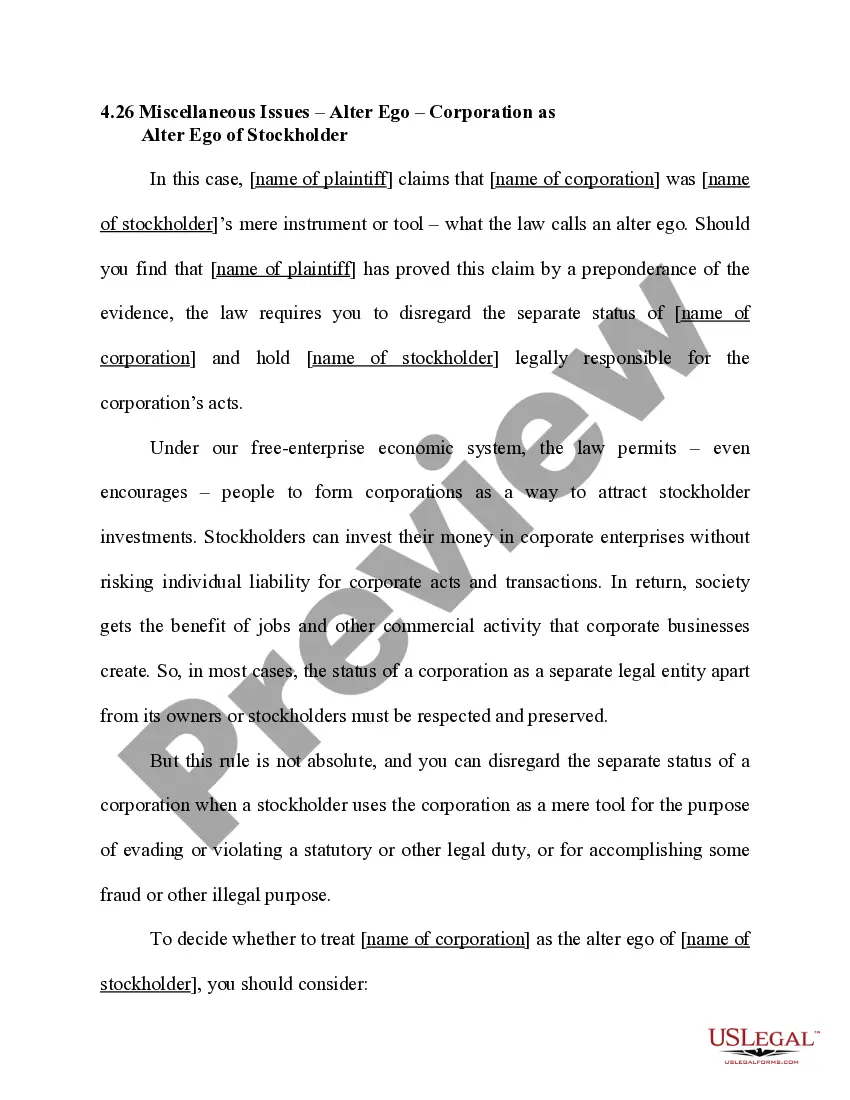
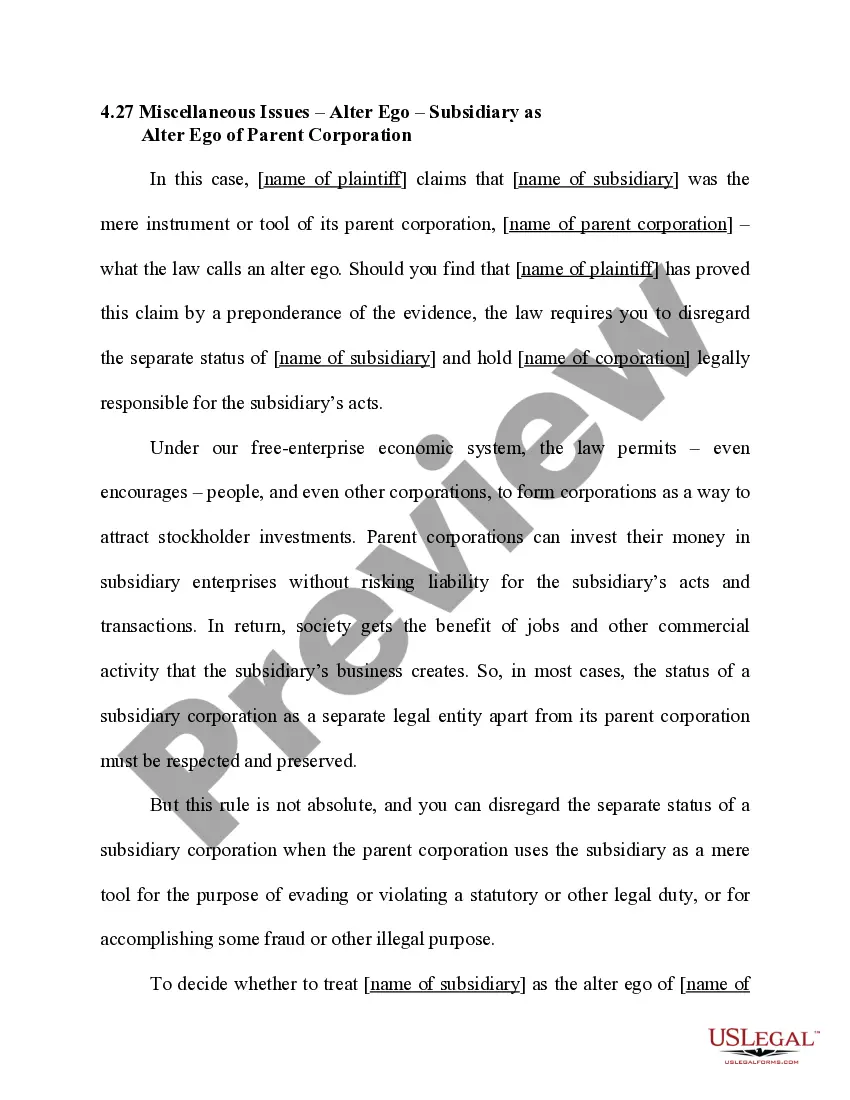
This form is a sample jury instruction related to the legal doctrine of alter ego, specifically focusing on the status of a subsidiary as an alter ego of its parent corporation. It outlines how to determine if the separate legal status of a subsidiary should be disregarded in favor of holding its parent corporation liable for its actions. This form is essential for attorneys seeking to present arguments related to corporate structure and liability in court, differing from standard jury instructions by addressing corporate relationships specifically.
Key components of this form
- Definition of the alter ego doctrine in corporate law.
- Criteria for determining if a subsidiary is merely an instrumentality of the parent corporation.
- Factors to consider, including corporate history, purpose, record-keeping, and financial practices.
- Guidance on establishing the level of control the parent company exerts over the subsidiary.


Situations where this form applies
You should use this form when involved in litigation where a plaintiff claims that a subsidiary corporation should not be treated as a separate entity from its parent. This situation usually arises in cases where there are allegations of fraud or wrongdoing committed through corporate structures, and it's necessary to argue that the parent corporation should be held liable for the subsidiary's actions.
Who should use this form
- Attorneys representing plaintiffs in corporate litigation cases.
- Legal professionals involved in disputes concerning corporate liability.
- Corporate lawyers advising on obligations and risks of corporate structures.
- Parties involved in lawsuits questioning the independence of a subsidiary corporation.
How to complete this form
- Identify the plaintiff and defendant corporate entities involved.
- Review the relationship between the parent corporation and its subsidiary.
- Apply the factors listed to assess whether the subsidiary should be regarded as an alter ego.
- Draft your jury instructions to reflect findings specific to your case.
- Ensure clarity and focus on the legal standards that apply in your jurisdiction.
Notarization guidance
In most cases, this form does not require notarization. However, some jurisdictions or signing circumstances might. US Legal Forms offers online notarization powered by Notarize, accessible 24/7 for a quick, remote process.
Get your form ready online
Our built-in tools help you complete, sign, share, and store your documents in one place.
Make edits, fill in missing information, and update formatting in US Legal Forms—just like you would in MS Word.
Download a copy, print it, send it by email, or mail it via USPS—whatever works best for your next step.
Sign and collect signatures with our SignNow integration. Send to multiple recipients, set reminders, and more. Go Premium to unlock E-Sign.
If this form requires notarization, complete it online through a secure video call—no need to meet a notary in person or wait for an appointment.
We protect your documents and personal data by following strict security and privacy standards.

Make edits, fill in missing information, and update formatting in US Legal Forms—just like you would in MS Word.

Download a copy, print it, send it by email, or mail it via USPS—whatever works best for your next step.

Sign and collect signatures with our SignNow integration. Send to multiple recipients, set reminders, and more. Go Premium to unlock E-Sign.

If this form requires notarization, complete it online through a secure video call—no need to meet a notary in person or wait for an appointment.

We protect your documents and personal data by following strict security and privacy standards.
Avoid these common issues
- Failing to adequately establish the control exerted by the parent corporation over its subsidiary.
- Neglecting to include all relevant facts and evidence that demonstrate the operating relationship.
- Misunderstanding or misapplying the legal standards for alter ego claims.
- Submitting incomplete jury instructions that do not align with case-specific issues.
Why complete this form online
- Convenience of accessing and downloading legal forms anytime.
- Editability allows legal professionals to tailor the form to specific cases.
- Reliability of forms drafted by licensed attorneys ensuring legal compliance.
Looking for another form?


Form popularity
FAQ
An alter ego (Latin, "the other I") is a second self, which is believed to be distinct from a person's normal or original personality. A person who has an alter ego is said to lead a double life. So, alter ego sounds more like an identity disorder.
Generally, What is an Alter Ego Cause of Action? The alter ego doctrine allows a party to pierce the corporate veil and pursue shareholders of a corporation based upon the manner in which the corporation has been managed.
Commingling of funds and other assets, failure to segregate funds of the separate entities and the unauthorized diversion of corporate funds or assets to other than corporate uses. The treatment by an individual of the assets of the corporation as his own.
Definition. Legal doctrine whereby the court finds a corporation lacks a separate identity from an individual or corporate shareholder, resulting in injustice to the corporation's debtors.
STEP 1: Live in Context. To build an Alter Ego and live as your heroic self, you need to get specific as to which particular field you want to improve. STEP 2: Identify the Frustration. What are you most frustrated within that context? STEP 3: The Flipside. STEP 4: Find Your Superpowers. STEP 5: The Activation Event.
The definition of an alter ego is someone with whom you are very close friends. An example of an alter ego is someone with whom you have been friends since childhood. The other self.
Determine why you want an alter ego. It could be as simple as a pen name or as complex as a completely different persona. Figure out the personality of your alter ego. Create a distinct image. Write your alter ego's origin story. Pick a name. Be different. Create a uniform.
Generally, to pierce a corporate veil the plaintiff must prove two things: (1) there is a "unity of interest and ownership" between the corporation and its owner, and (2) it would be unfair if the acts in question are treated as those of the corporation alone.