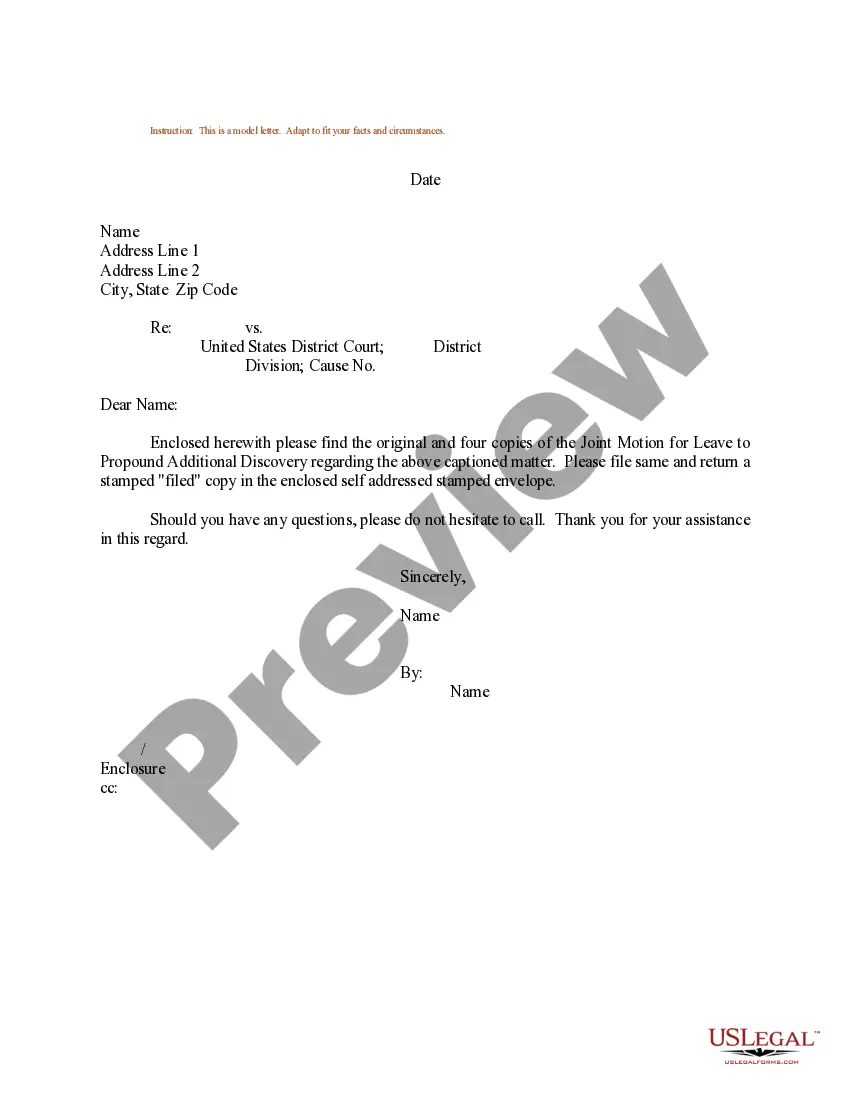
Sample Letter to Clerk for filing Joint Motion for Leave to Propound Additional Discovery
About this form
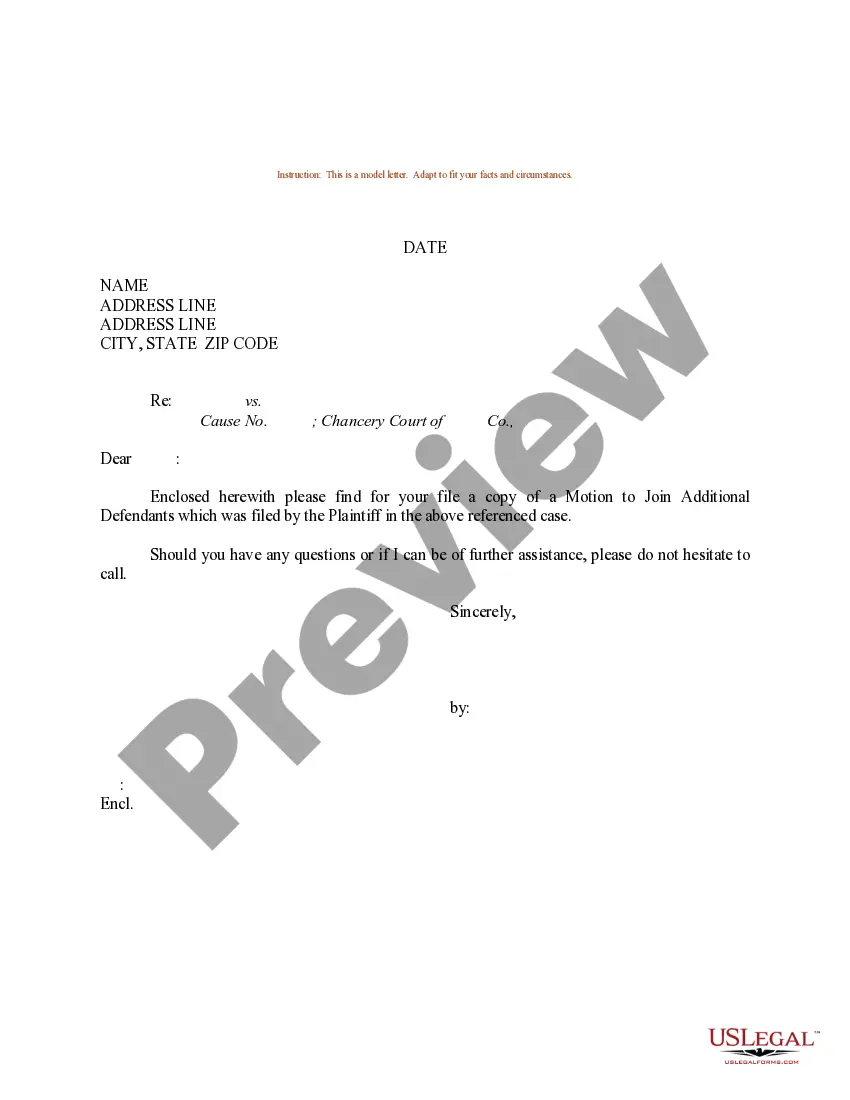
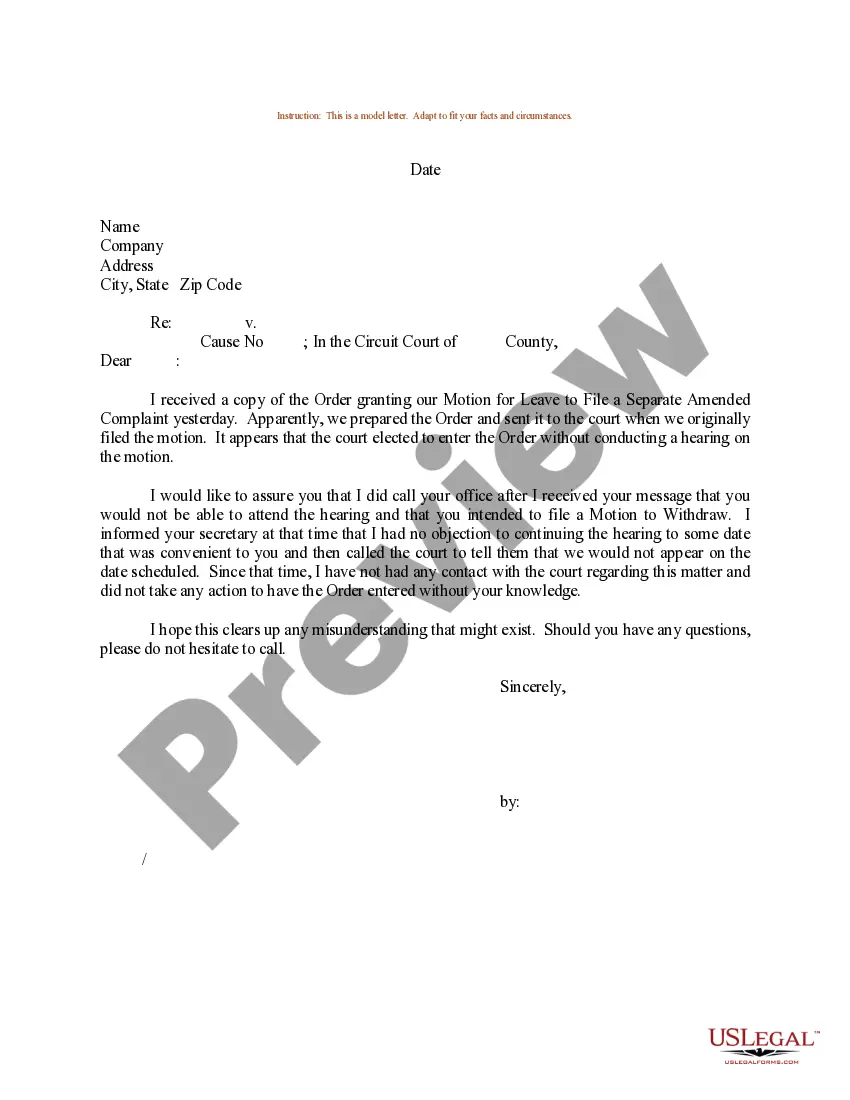
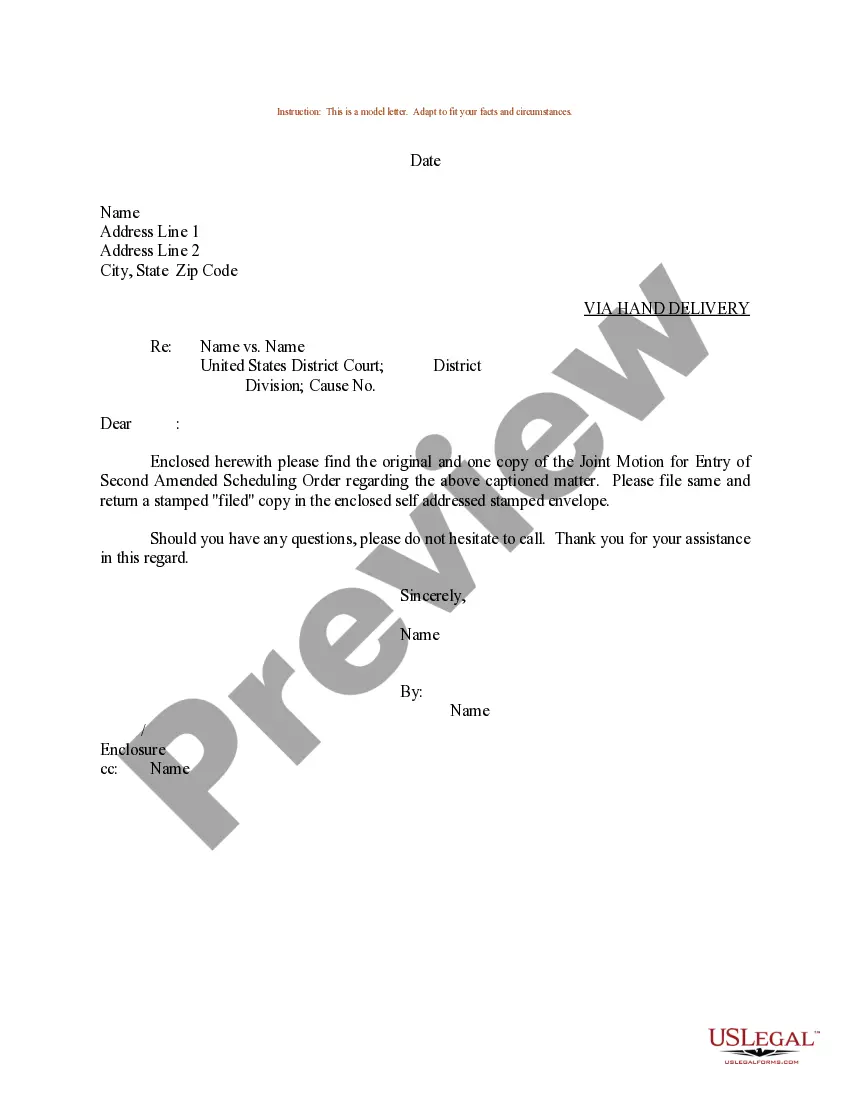
This form is a sample letter used for filing a Joint Motion for Leave to Propound Additional Discovery. Its primary purpose is to communicate with the court clerk regarding additional discovery requests in a legal case. This form distinguishes itself from other legal letters by focusing specifically on the need for further discovery beyond what has already been provided, ensuring that parties have all necessary evidence for their cases.
Key components of this form
- Date: Enter the date of the letter.
- Recipient's information: Provide the clerk's name, address, city, state, and zip code.
- Salutation: A formal greeting to the clerk.
- Body of the letter: Detailed explanation of the reason for the motion and specific additional discovery requests.
- Closing: A professional sign-off with your name and contact information.
Common use cases
This letter should be used when legal parties need to request additional discovery materials from the opposing party or the court. It is typically necessary when the existing discovery is insufficient for preparing for trial or a hearing, and the requesting party believes that more information is critical to their case.
Who can use this document
- Attorneys representing clients in civil litigation.
- Pro se litigants who are self-representing and need more discovery materials.
- Any party in a legal case that requires additional evidence to support their claims or defenses.
How to prepare this document
- Identify the date you are writing the letter.
- Fill in the clerk's name and address accurately.
- Write a formal salutation addressing the clerk.
- Clearly state why additional discovery is needed, including any specific requests.
- Sign the letter and add your contact information at the bottom.
Does this document require notarization?
In most cases, this form does not require notarization. However, some jurisdictions or signing circumstances might. US Legal Forms offers online notarization powered by Notarize, accessible 24/7 for a quick, remote process.
Get your form ready online
Our built-in tools help you complete, sign, share, and store your documents in one place.
Make edits, fill in missing information, and update formatting in US Legal Forms—just like you would in MS Word.
Download a copy, print it, send it by email, or mail it via USPS—whatever works best for your next step.
Sign and collect signatures with our SignNow integration. Send to multiple recipients, set reminders, and more. Go Premium to unlock E-Sign.
If this form requires notarization, complete it online through a secure video call—no need to meet a notary in person or wait for an appointment.
We protect your documents and personal data by following strict security and privacy standards.

Make edits, fill in missing information, and update formatting in US Legal Forms—just like you would in MS Word.

Download a copy, print it, send it by email, or mail it via USPS—whatever works best for your next step.

Sign and collect signatures with our SignNow integration. Send to multiple recipients, set reminders, and more. Go Premium to unlock E-Sign.

If this form requires notarization, complete it online through a secure video call—no need to meet a notary in person or wait for an appointment.

We protect your documents and personal data by following strict security and privacy standards.
Common mistakes to avoid
- Failing to address the letter to the correct clerk.
- Not clearly stating the specific additional discovery needed.
- Omitting the date, which can delay processing.
- Using informal language in a professional document.
Advantages of online completion
- Convenience of completing it from anywhere, at any time.
- Easily editable format allows for quick adjustments to fit your case.
- Reliability of forms drafted by licensed attorneys to ensure legal compliance.
Legal use & context
- This letter serves as a formal request and must comply with local court rules regarding motions and discovery.
- Ensure that the justification provided is persuasive and aligns with applicable laws.
- Keep copies of all correspondence sent to the court for future reference.
Looking for another form?
Form popularity
FAQ
During a meeting, a motion is made via three simple words: I move that. Any member with a proposal for the group to consider whether substantive or procedural should simply seek recognition by the chairperson and when recognized, say, I move that . . . . Again, there are subcategories.
The purpose of discovery is to allow the parties to obtain full knowledge of the issues and facts of the lawsuit before going to trial. An experienced family law attorney will use discovery to help you identify the various strengths and weaknesses of each side of the case.
A motion is a written request or proposal to the court to obtain an asked-for order, ruling, or direction.For example, in the state of California, the defendant in a defamation lawsuit will usually file an anti-SLAPP motion to dismiss.
Step 1: Prepare and exchange your initial disclosures. Within thirty days after the defendant files his answer, the plaintiff and defendant must exchange: Step 2: File the early case conference report. Step 3: Ask the court to allow more discovery if you want it.
The motion must include a separate "Notice of Motion" which includes a brief summary of the nature of the motion, the deadline for filing a response, and if there is a hearing, the date, time, and location of the hearing.
That disclosure is accomplished through a methodical process called "discovery." Discovery takes three basic forms: written discovery, document production and depositions.
If the motion has been filed with the Clerk of Court you would be able to obtain a copy from the clerk's office in the county where the motion was filed.
Discovery in a criminal case refers to the exchange of evidence and statements between opposing sides of a case.Typically, a defense attorney will file a Notice of Appearance, informing the Court and the prosecutor of his or her role in the case, and a Discovery Demand requesting particular information.
Motion: A request to the court to issue an order to compel discovery. Points and Authorities: Supporting documentation for the motion detailing the submitted request for discovery, the opposing side's failure to comply, and an explanation of why the discovery is relevant to the case.