Products and Services Differentiation Worksheet
What this document covers
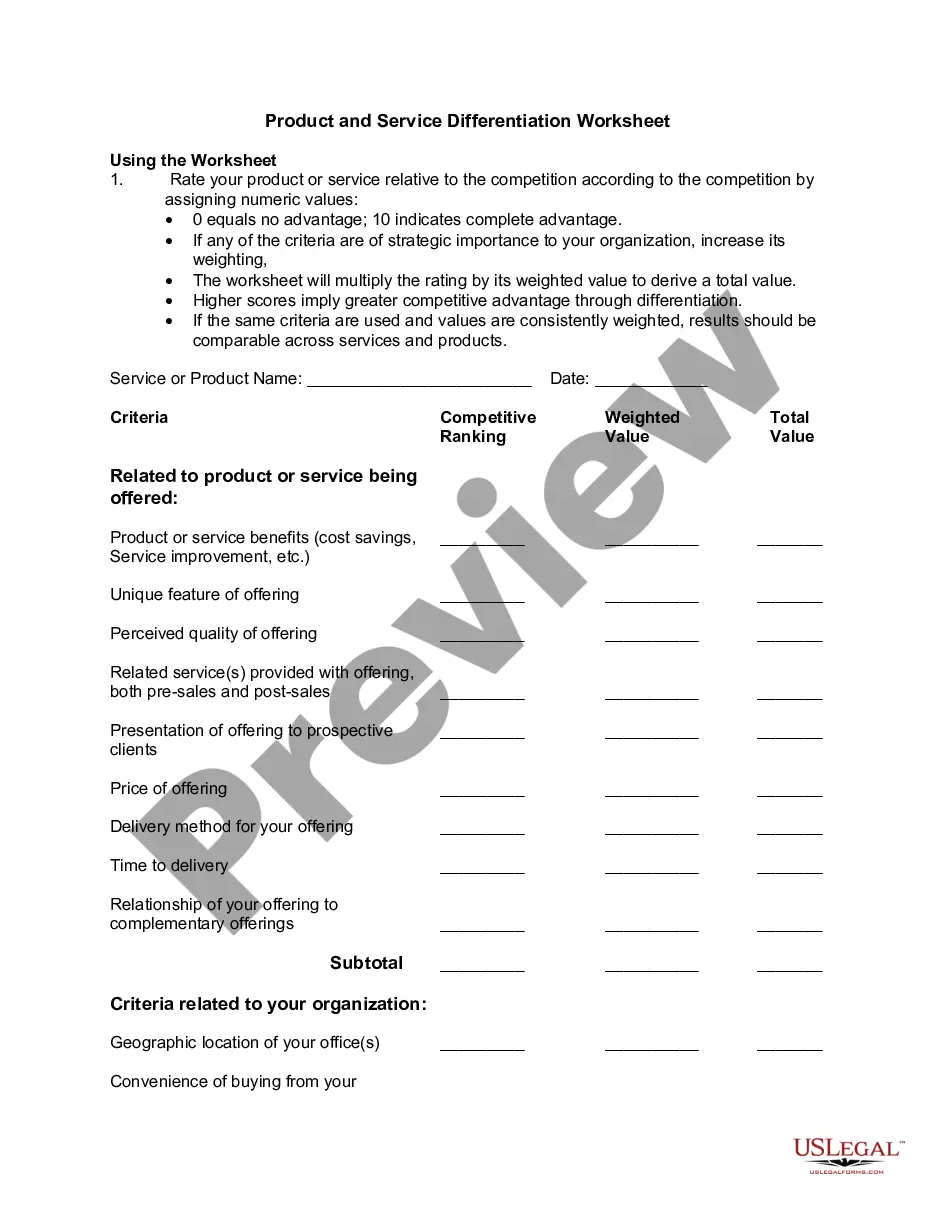
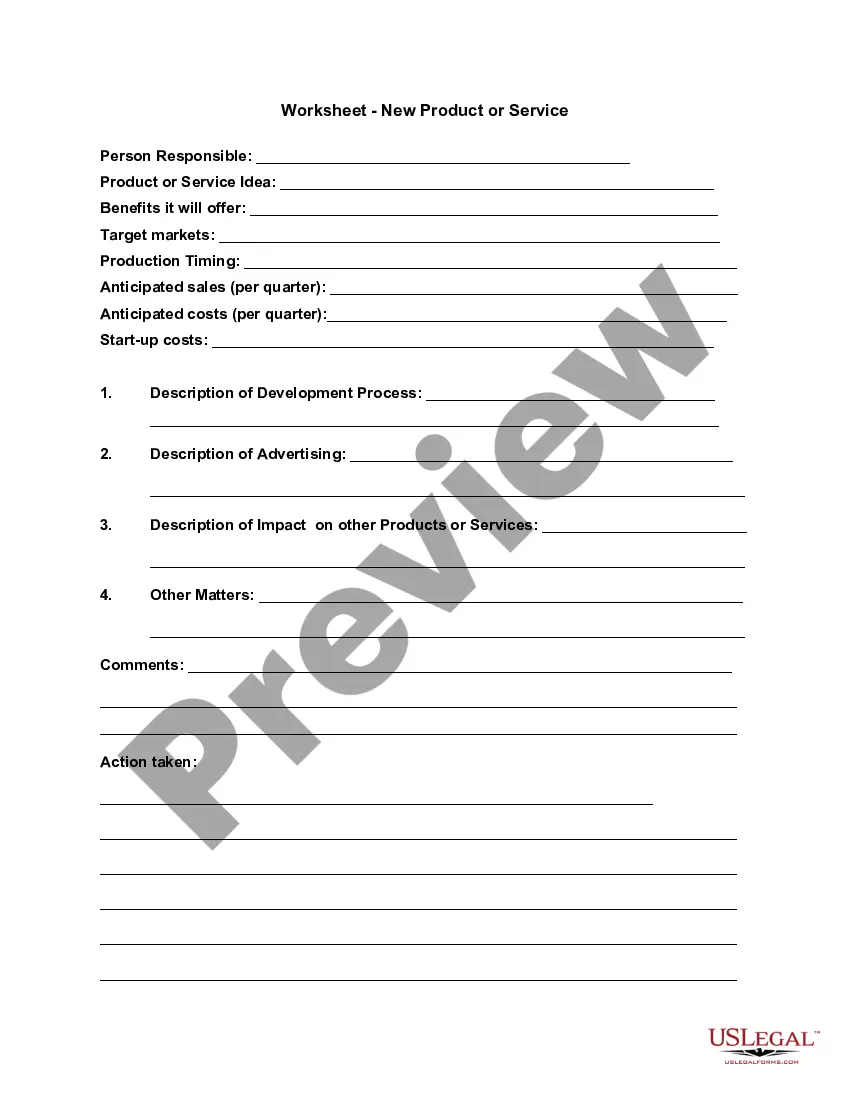
The Products and Services Differentiation Worksheet is a tool designed to help businesses identify and articulate the unique aspects of their products or services compared to competitors. This form serves as a structured guide to evaluate various criteria that can contribute to a product's or service's competitive advantage. Unlike generic forms, this worksheet is specifically tailored to assist in the marketing strategy process by enabling businesses to assess their offerings systematically.
Main sections of this form
- Product or service benefits: Assessing advantages like cost savings or service improvements.
- Unique features: Identifying aspects that set your offering apart from competitors.
- Perceived quality: Evaluating the market's view of your product's quality.
- Related services: Considering pre-sales and post-sales services provided.
- Presentation: Analyzing how your offerings are presented to potential clients.
- Pricing strategy: Reviewing the price point of your offering relative to competitors.
- Delivery method: Evaluating how your product or service is delivered to customers.
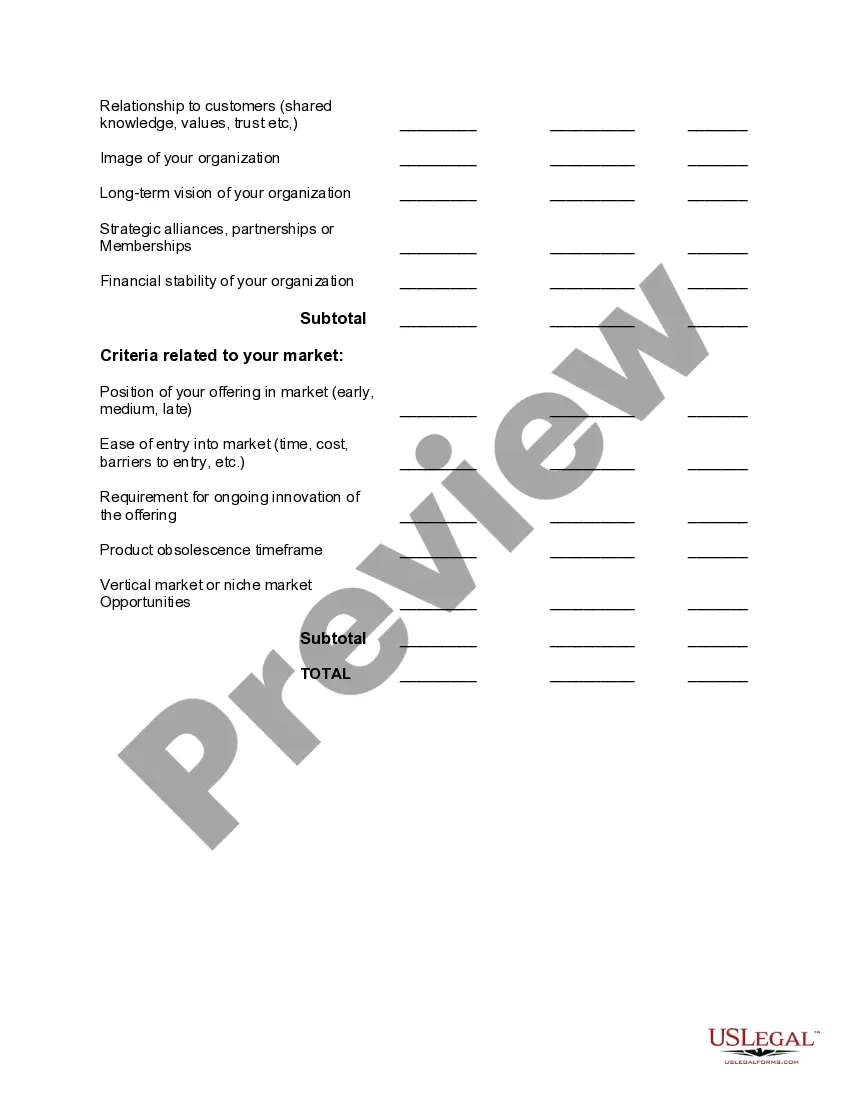
- Geographic location: Accounting for the physical location of your organization.
- Customer relationship: Assessing the connection and trust established with clients.
- Innovation requirement: Understanding the need for ongoing innovation in your marketing strategy.
Common use cases
This worksheet is useful when businesses wish to enhance their marketing strategies by clearly defining what makes their products or services unique. It can also be employed during competitive analysis, product launch planning, or when evaluating potential improvements to existing offerings. Additionally, it serves as a foundation for strategic discussions within marketing teams and guides decision-making in product development.
Who needs this form
- Marketing professionals seeking to differentiate their product or service.
- Business owners looking to enhance their competitive advantage.
- Product managers involved in product development and positioning.
- Consultants assisting organizations with marketing strategy.
- Sales teams aiming to understand and communicate their offerings effectively.
Completing this form step by step
- Identify the product or service you want to evaluate and enter its name.
- Assign numeric values from zero to ten for each criterion based on competitive advantage.
- Adjust the weighting of criteria that are strategically important for your business.
- Calculate the total value for each section by multiplying ratings by their weighted values.
- Review scores to identify areas for improvement and strategies for differentiation.
Does this form need to be notarized?
This form usually doesn’t need to be notarized. However, local laws or specific transactions may require it. Our online notarization service, powered by Notarize, lets you complete it remotely through a secure video session, available 24/7.
Get your form ready online
Our built-in tools help you complete, sign, share, and store your documents in one place.
Make edits, fill in missing information, and update formatting in US Legal Forms—just like you would in MS Word.
Download a copy, print it, send it by email, or mail it via USPS—whatever works best for your next step.
Sign and collect signatures with our SignNow integration. Send to multiple recipients, set reminders, and more. Go Premium to unlock E-Sign.
If this form requires notarization, complete it online through a secure video call—no need to meet a notary in person or wait for an appointment.
We protect your documents and personal data by following strict security and privacy standards.

Make edits, fill in missing information, and update formatting in US Legal Forms—just like you would in MS Word.

Download a copy, print it, send it by email, or mail it via USPS—whatever works best for your next step.

Sign and collect signatures with our SignNow integration. Send to multiple recipients, set reminders, and more. Go Premium to unlock E-Sign.

If this form requires notarization, complete it online through a secure video call—no need to meet a notary in person or wait for an appointment.

We protect your documents and personal data by following strict security and privacy standards.
Mistakes to watch out for
- Failing to adjust the weight of important criteria, leading to inaccurate results.
- Overlooking relevant competitors when rating advantages.
- Neglecting to revisit and update the worksheet as market conditions change.
Benefits of using this form online
- Convenience of immediate access and downloading templates.
- Editability allows for easy modifications as business strategies evolve.
- Reliability from using forms drafted by licensed attorneys, ensuring compliance with applicable laws.
Legal use & context
- This worksheet is meant for internal use in developing marketing strategies and is not a legally binding document.
- Using this form can help improve clarity in organizational offerings, but outcomes depend on effective implementation of identified strategies.
Quick recap
- The Products and Services Differentiation Worksheet aids in identifying unique product attributes.
- Effective use of this form can enhance market positioning and competitive advantage.
- Regular updates and evaluations using this form are crucial for adapting to market changes.
Looking for another form?
Form popularity
FAQ
Differentiation means tailoring instruction to meet individual needs. Whether teachers differentiate content, process, products, or the learning environment, the use of ongoing assessment and flexible grouping makes this a successful approach to instruction.
Flexible-pace learning. Collaborative learning. Progressive tasks. Digital resources. Verbal support. Variable outcomes. Ongoing assessment.
Microlearning. Spaced Repetition. Interactivity. Gamification. Leaderboards. Peer Learning. Mobile Learning. Just in Time training (JITT)
Five components of instruction can be differentiated: (1) contentwhat a student needs to learn or how the student will gain access to the knowledge, ideas, and skills; (2) processhow the student will come to master and "own" the knowledge, ideas, and skills; (3) producthow the student will summatively show what he
Differentiate Through Teams. Reflection and Goal Setting. Mini-Lessons, Centers, and Resources. Voice and Choice in Products. Differentiate Through Formative Assessments. Balance Teamwork and Individual Work.
Four ways to differentiate instruction. According to Tomlinson, teachers can differentiate instruction through four ways: 1) content, 2) process, 3) product, and 4) learning environment.
Differentiate Through Teams. Reflection and Goal Setting. Mini-Lessons, Centers, and Resources. Voice and Choice in Products. Differentiate Through Formative Assessments. Balance Teamwork and Individual Work.