Motion to Withdraw Funds from the Court's Registry
What is this form?
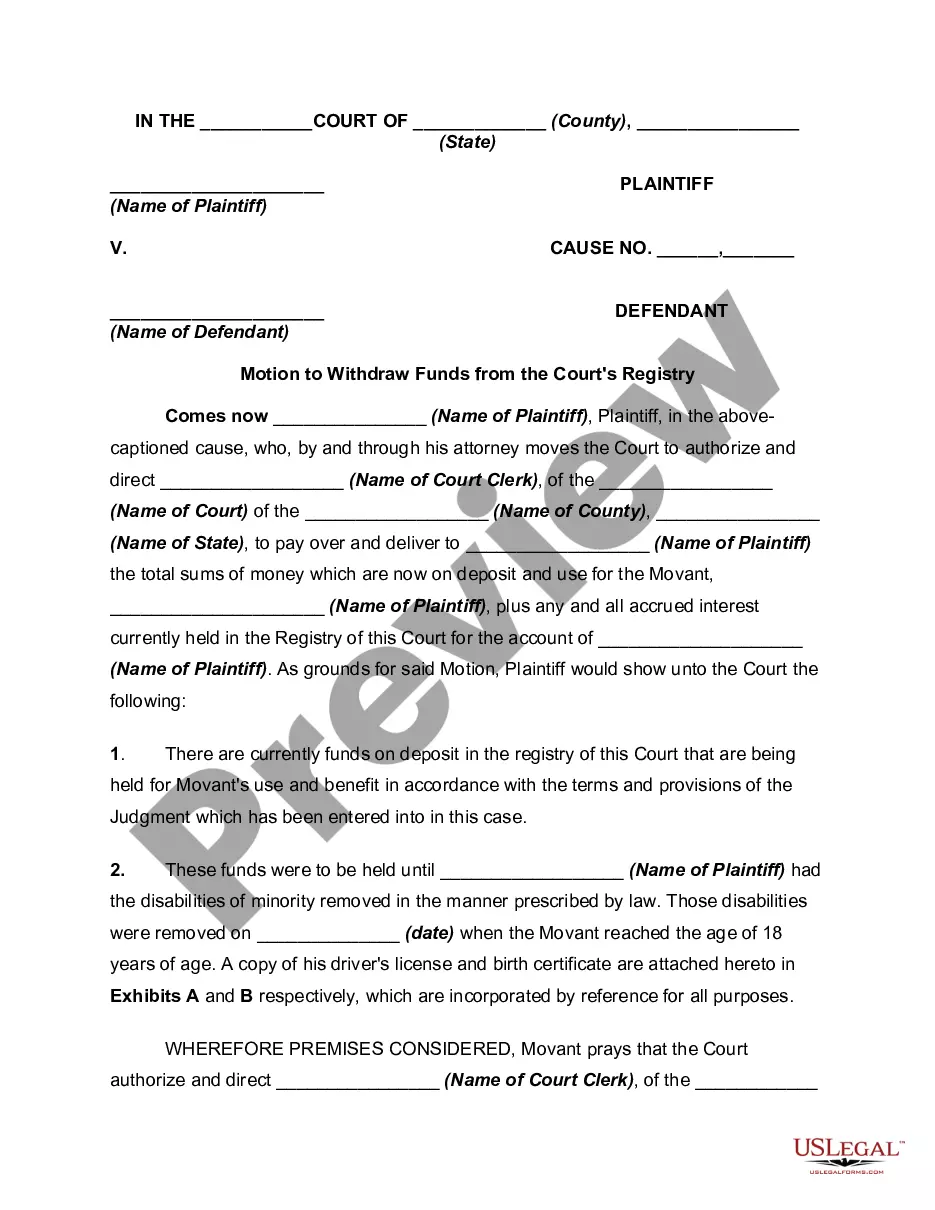
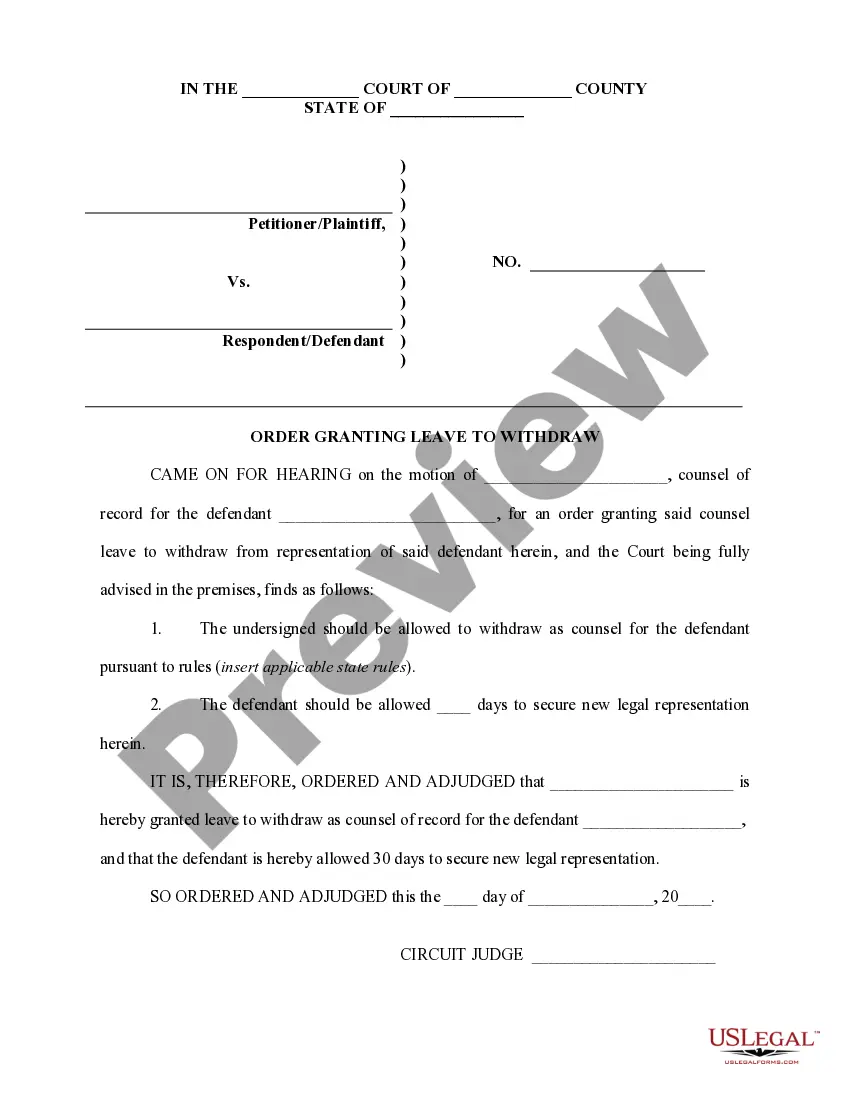
The Motion to Withdraw Funds from the Court's Registry is a legal document that allows a party to request the release of funds that have been deposited in court. The purpose of this form is to relieve the depositor of responsibility over the funds while ensuring the rightful party can access the money awarded by the court. This form is specifically used in situations where the funds are held in the court's registry pending the outcome of litigation or other judicial proceedings.
What’s included in this form
- Identifying information, including the names of the plaintiff and defendant.
- The court name and location details.
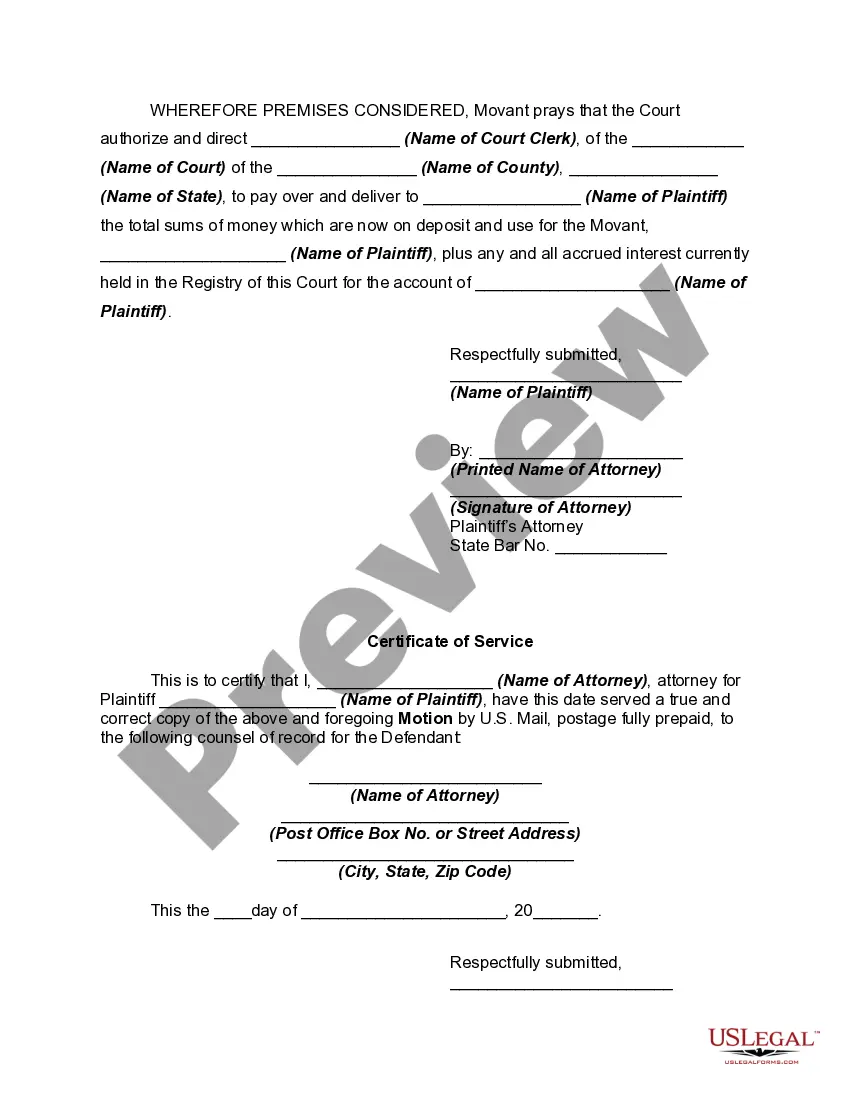
- Clear request for the release of funds, including the total amount and accrued interest.
- Grounds for the motion, including relevant legal milestones such as age of majority.
- Signature and identification of the attorney representing the plaintiff.
- Certificate of service detailing the notification of the motion to the defendant's counsel.
Common use cases
This form is used when a party, typically a plaintiff, needs to withdraw funds that have been placed in the court's registry. Common scenarios include cases where the plaintiff has reached the age of majority and is entitled to receive funds previously withheld, or when there is a need to access funds during ongoing litigation to cover expenses.
Who this form is for
- Individuals or entities who are plaintiffs in a legal action involving court-held funds.
- Parents or guardians acting on behalf of minor plaintiffs whose funds are held in trust by the court.
- Attorneys representing plaintiffs seeking to withdraw funds from the court's registry.
How to complete this form
- Identify the parties involved by filling in the names of the plaintiff and defendant.
- Provide the name of the court and its location.
- Clearly outline the amount of money being withdrawn along with any applicable interest.
- State the grounds for the motion, including any relevant dates or events that justify the withdrawal.
- Include the contact information and signature of the attorney representing the plaintiff.
- Attach necessary documentation, such as proof of age, in exhibits as specified in the form.
Notarization guidance
In most cases, this form does not require notarization. However, some jurisdictions or signing circumstances might. US Legal Forms offers online notarization powered by Notarize, accessible 24/7 for a quick, remote process.
Get your form ready online
Our built-in tools help you complete, sign, share, and store your documents in one place.
Make edits, fill in missing information, and update formatting in US Legal Forms—just like you would in MS Word.
Download a copy, print it, send it by email, or mail it via USPS—whatever works best for your next step.
Sign and collect signatures with our SignNow integration. Send to multiple recipients, set reminders, and more. Go Premium to unlock E-Sign.
If this form requires notarization, complete it online through a secure video call—no need to meet a notary in person or wait for an appointment.
We protect your documents and personal data by following strict security and privacy standards.

Make edits, fill in missing information, and update formatting in US Legal Forms—just like you would in MS Word.

Download a copy, print it, send it by email, or mail it via USPS—whatever works best for your next step.

Sign and collect signatures with our SignNow integration. Send to multiple recipients, set reminders, and more. Go Premium to unlock E-Sign.

If this form requires notarization, complete it online through a secure video call—no need to meet a notary in person or wait for an appointment.

We protect your documents and personal data by following strict security and privacy standards.
Avoid these common issues
- Failing to provide complete information about the parties involved.
- Not attaching necessary documentation to support the request.
- Omitting the attorney's signature or failing to certify service to the opposing counsel.
- Using incorrect legal terminology or failing to follow state-specific requirements.
Why complete this form online
- Convenience: Easily access and complete legal forms from your own device.
- Editability: Modify the document to fit your specific case using user-friendly tools.
- Reliability: Ensure that you are using the most up-to-date form created by licensed attorneys.
Quick recap
- The Motion to Withdraw Funds is essential for accessing court-held money after a legal ruling.
- Complete the form accurately to avoid delays in processing.
- Always attach necessary documentation to support your request.
Looking for another form?








Form popularity
FAQ
The Motion to Withdraw Funds from the Court's Registry is a legal document used to request release of funds held in the court’s registry. It relieves the depositor of responsibility over the funds while ensuring the rightful party can access the money awarded by the court, typically when the plaintiff reaches the age of majority or needs funds during litigation.
A judge may deny the motion if it lacks proper grounds or documentation, if the defendant's counsel has not been properly served, or if the funds are not yet legally eligible for withdrawal under the court’s rules. The motion should clearly present identifying information, the amount sought, and the grounds for withdrawal.
If granted, the court authorizes the release of the specified funds from the court's registry to the named party or their attorney, as described in the motion. The release should reflect the amount requested and any accrued interest, with proof of service on the defendant's counsel.
The form requires identifying information for the plaintiff and defendant, the court name and location, a clear request for release of funds including the total amount and accrued interest, stated grounds for the motion (such as age of majority), the attorney's signature, and a certificate of service confirming notification to the defendant's counsel.
In this context, a motion to disburse funds is the request to release funds held in the court's registry to the entitled party. The Motion to Withdraw Funds from the Court's Registry provides the necessary elements to request that release, including court details, parties, the amount, grounds, attorney's signature, and service information.
This form is tailored for funds in the court's registry and requires specific components—identifying information for the plaintiff and defendant, court name and location, a clear release request with amount and interest, grounds including milestones like age of majority, and a certificate of service. A generic disburse funds motion may not include these registry-specific elements.