Agreement by Co-Tenants Restricting Right of Partition
About this form
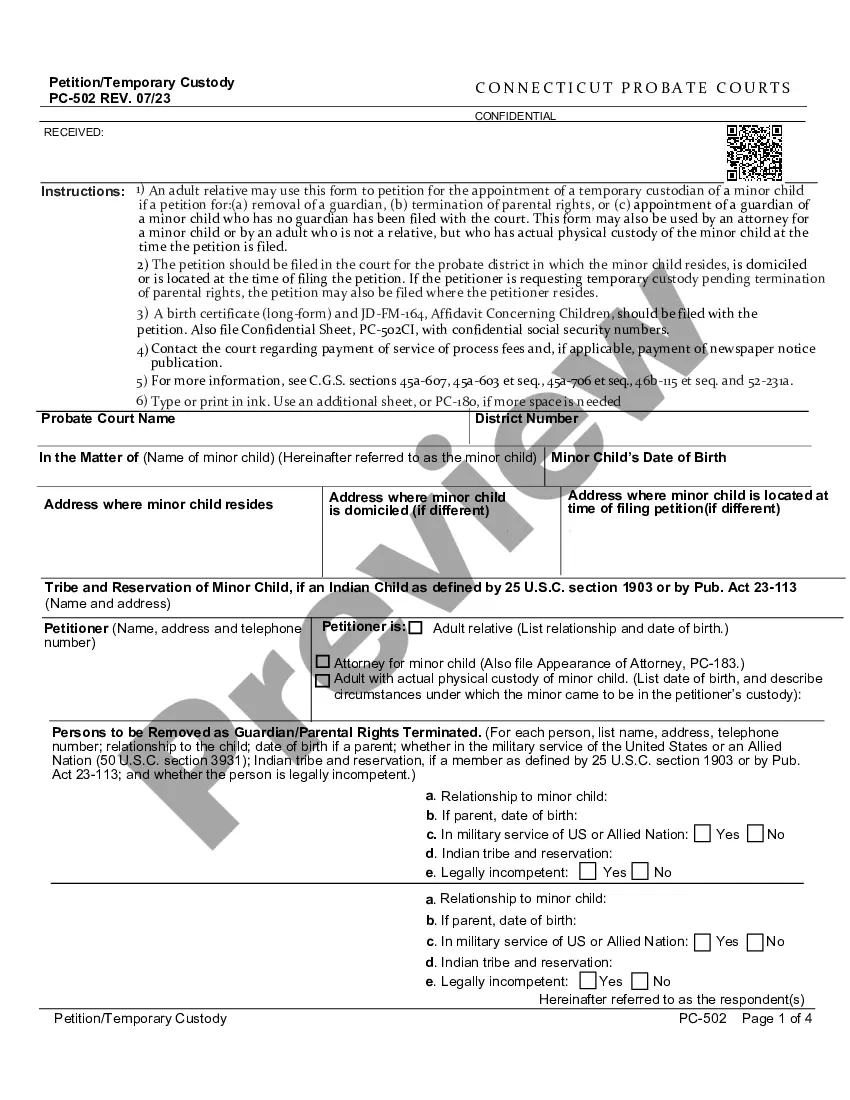
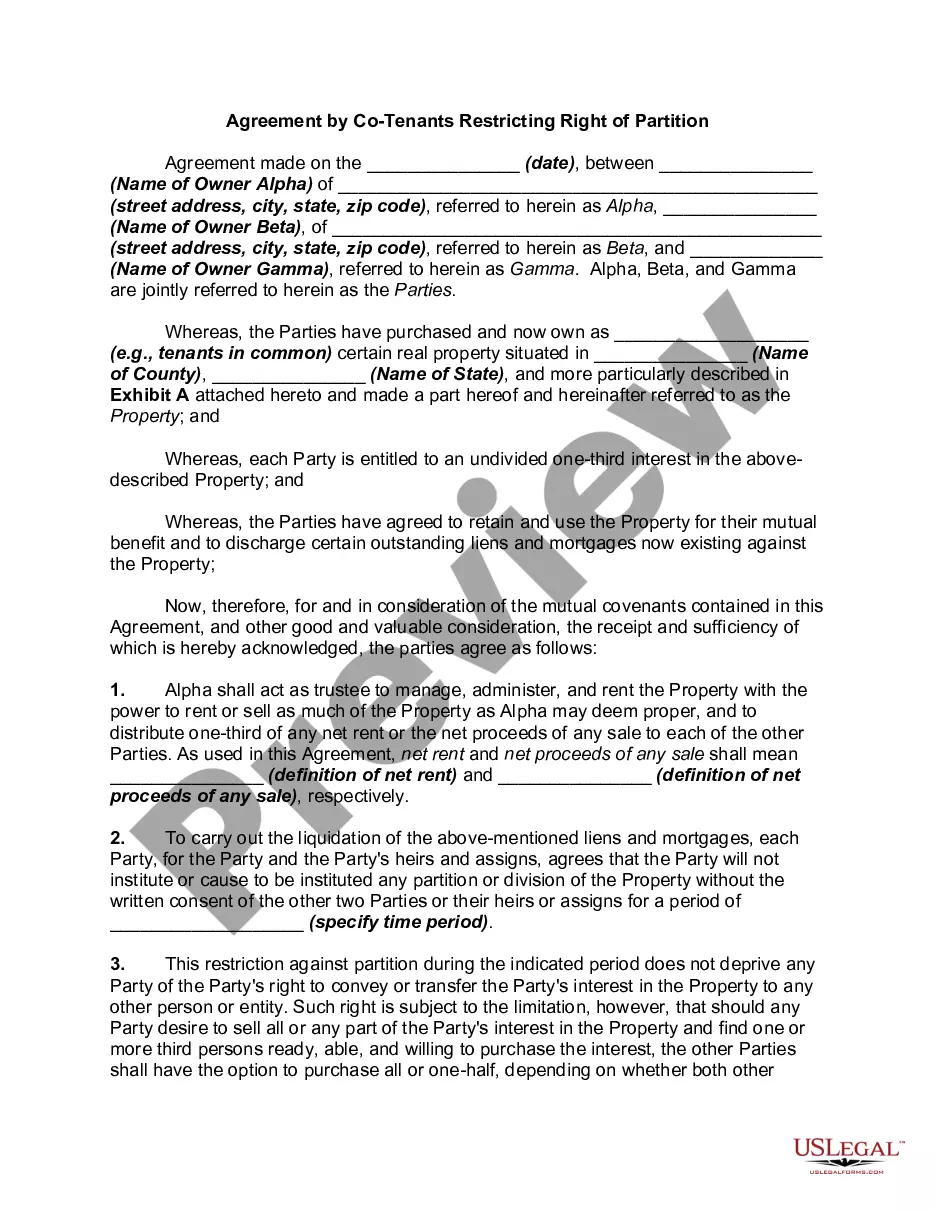
The Agreement by Co-Tenants Restricting Right of Partition is a legal document designed for co-owners of real property to manage their ownership interests collaboratively. This agreement restricts the ability of any owner to seek a partition or division of the property without the consent of the other owners. Unlike standard partition actions, which may lead to court involvement for property division, this agreement enables co-owners to outline their intentions and responsibilities clearly, preventing disputes and preserving cooperation among parties.
Form components explained
- Identification of the parties involved, including names and addresses.
- Description of the property ownership structure (e.g., tenants in common).
- Detailed responsibilities assigned to a designated trustee for managing the property.
- Specific timeframe within which partition rights are restricted.
- Provisions for the sale of interest in the property, including necessary consent from other co-owners.
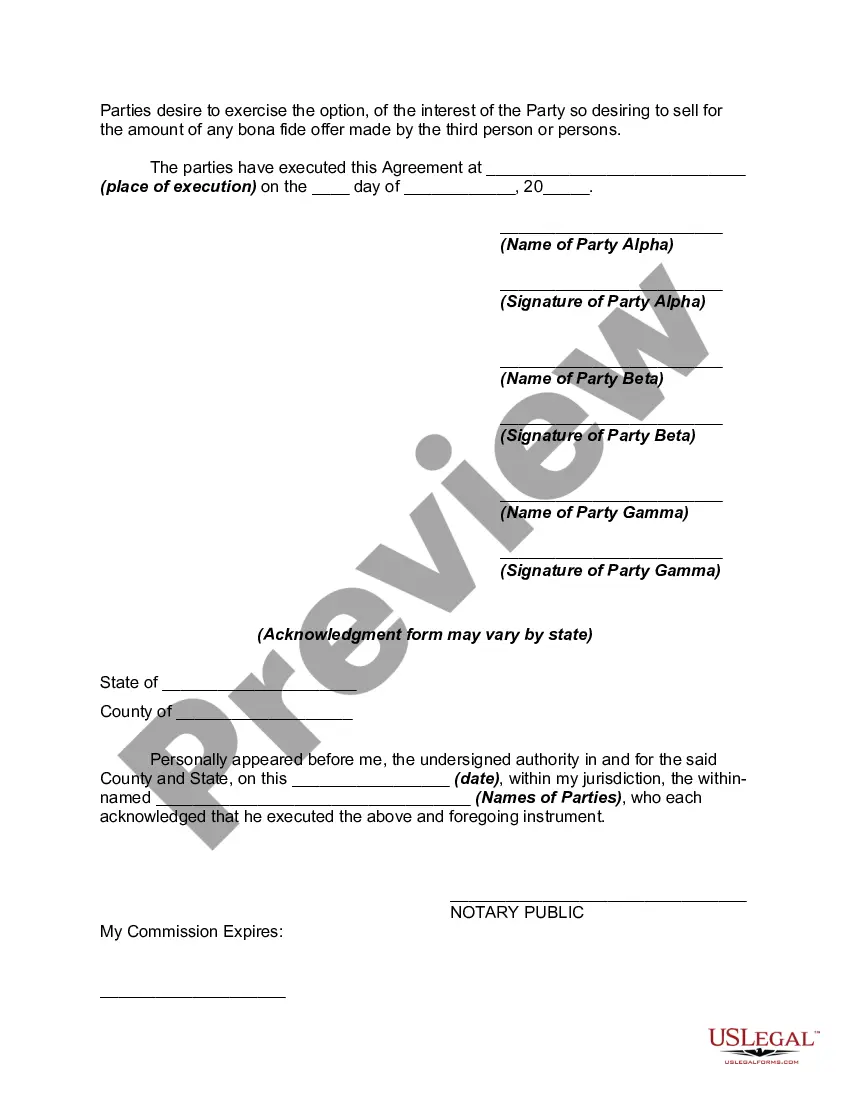
- Identification of the location and conditions for choosing notary public acknowledgment.

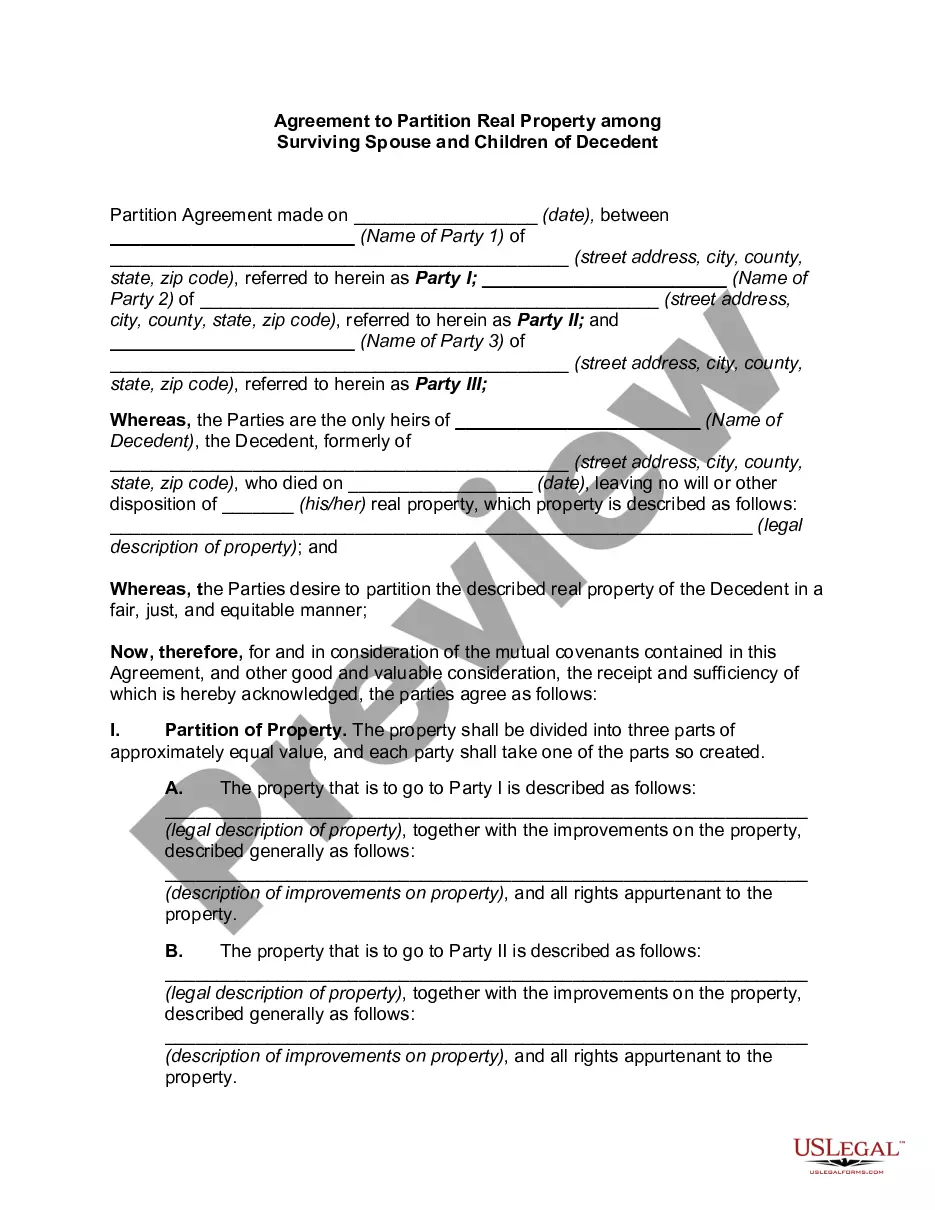
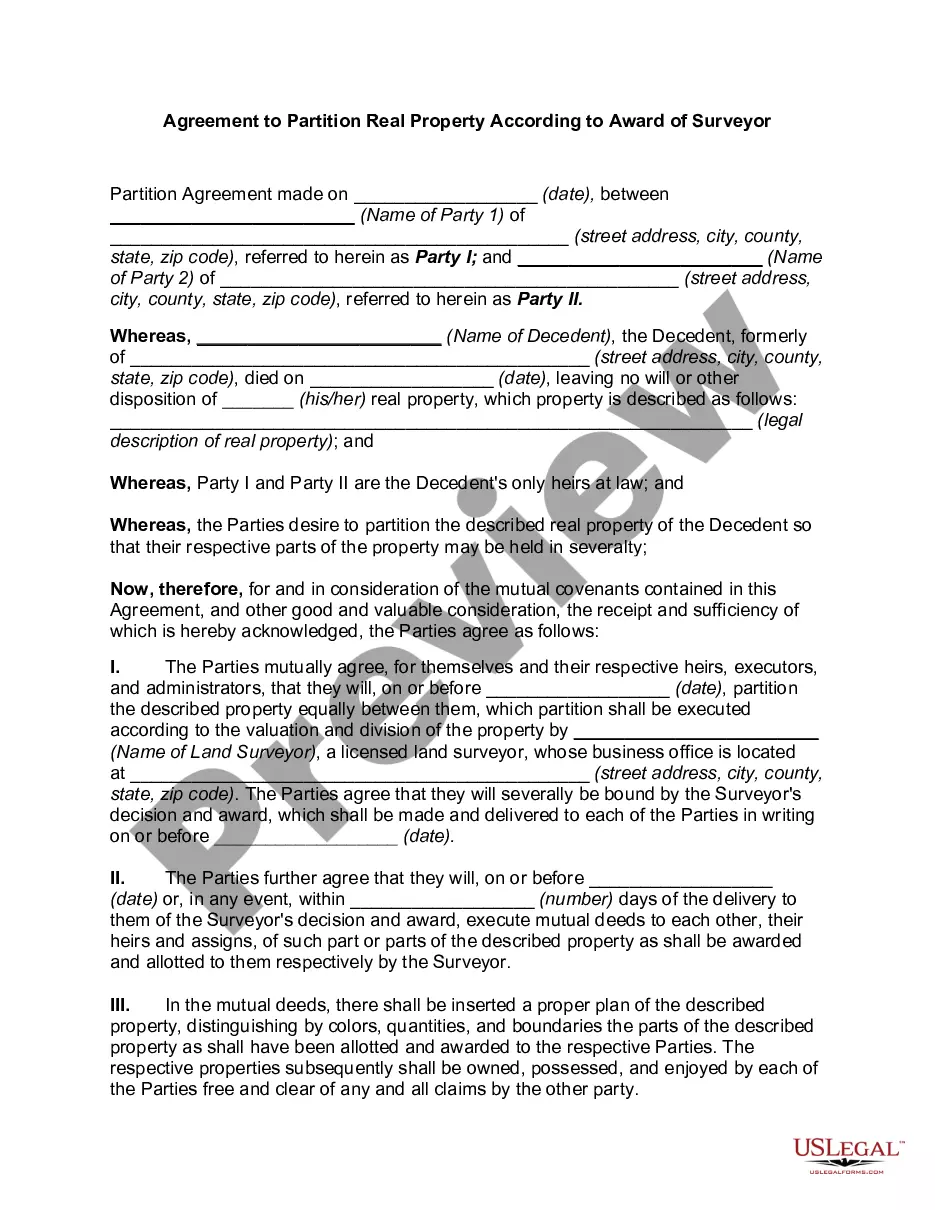
Situations where this form applies
This form is useful in scenarios where multiple parties jointly own a piece of property and wish to prevent any one owner from independently initiating a partition action. It is ideal for friends, family members, or business partners who want to ensure that decisions regarding the property are made collectively. It can help mitigate conflicts and maintain harmony among co-owners while managing the property effectively.
Who needs this form
- Co-owners of a property who wish to clarify their rights and responsibilities.
- Individuals considering a joint purchase of real estate.
- Partners or family members who want to formalize agreements regarding shared property.
- Anyone seeking to avoid disputes that may arise from property partition actions.
Instructions for completing this form
- Identify all parties involved by clearly stating their full names and addresses.
- Specify the property involved, including its description and how it is owned.
- Define the responsibilities of the trustee managing the property, including rental and selling authority.
- Set the duration for the partition restriction to remain in effect.
- Sign the agreement in the presence of a notary public, if required, and include acknowledgment.
Notarization guidance
Yes, this form must be notarized to be legally valid. The notarization process helps confirm the identity of the parties involved and ensures that the agreement is executed properly. US Legal Forms offers integrated online notarization, available 24/7 through secure video calls, allowing you to comply with legal requirements conveniently without the need for travel.
Get your form ready online
Our built-in tools help you complete, sign, share, and store your documents in one place.
Make edits, fill in missing information, and update formatting in US Legal Forms—just like you would in MS Word.
Download a copy, print it, send it by email, or mail it via USPS—whatever works best for your next step.
Sign and collect signatures with our SignNow integration. Send to multiple recipients, set reminders, and more. Go Premium to unlock E-Sign.
If this form requires notarization, complete it online through a secure video call—no need to meet a notary in person or wait for an appointment.
We protect your documents and personal data by following strict security and privacy standards.

Make edits, fill in missing information, and update formatting in US Legal Forms—just like you would in MS Word.

Download a copy, print it, send it by email, or mail it via USPS—whatever works best for your next step.

Sign and collect signatures with our SignNow integration. Send to multiple recipients, set reminders, and more. Go Premium to unlock E-Sign.

If this form requires notarization, complete it online through a secure video call—no need to meet a notary in person or wait for an appointment.

We protect your documents and personal data by following strict security and privacy standards.
Common mistakes to avoid
- Failing to specify the property accurately, leading to confusion over ownership.
- Not clearly defining the roles and responsibilities of the trustee.
- Neglecting to include all parties involved in the agreement.
- Overlooking the requirement for signatures and notarization, if applicable.
Benefits of using this form online
- Immediate access to legally valid templates drafted by licensed attorneys.
- The ability to customize the form easily to fit your specific needs.
- Downloadable and printable for your convenience.
- Secure and efficient process without the need for in-person visits.
Looking for another form?
Form popularity
FAQ
Co-tenants can agree among themselves that one co-tenants has the right to exclusive possession. - The law encourages parties in conflict to resolve the conflict by private agreement rather than by a lawsuit.
Can A Partition Be Stopped? Typically, a partition action cannot be stopped once a lawsuit is filed because anyone who wants to dissolve ownership that is jointly owned with another person has a legal right to sell his/her interest if desired.
Tenants in common and joint tenants can petition a court to partition the property. This means that the court is being asked to divide the property into different lots or sections. There are two general types of partitions.
Joint tenants have undivided interests in the whole property. This means all tenants have the right to possession of the entire property. If joint tenants refuse entry to another joint tenant, the "ousted" tenant can sue the others for damages.
Joint and several liability Anyone contemplating entering into a joint tenancy, or becoming the guarantor of a joint tenant, should be advised that they could be sued individually by the landlord for all the obligations and rent due under the agreement eg for the rent debt of defaulting tenants.
The deed specifies that the joint tenants own an equal amount of interest in the purchased property and are thus equally liable for it financially. Since the joint tenants have equal interest, the property cannot be sold without all parties' consent.
This is known as 'Severing the Joint Tenancy'. It requires service of a written notice of change the 'severance'. It can be done without the other owner's cooperation or agreement. It is recorded at the Land Registry, and the other owner will know it has been done but only 'after the event' so to speak.
If you're joint tenants and you both want to leave, either you or your ex-partner can end the tenancy by giving notice. You'll both need to move out.You can apply to court to change your ex-partner's tenancy to your name, or remove their name from a joint tenancy.
A partition deed is executed by co-owners In case a partition is by mutual consent, a partition deed is executed by the co-owners. The partition deed is required to be registered at the office of the sub-registrar of the place where the property is situated as in case of any other registration.