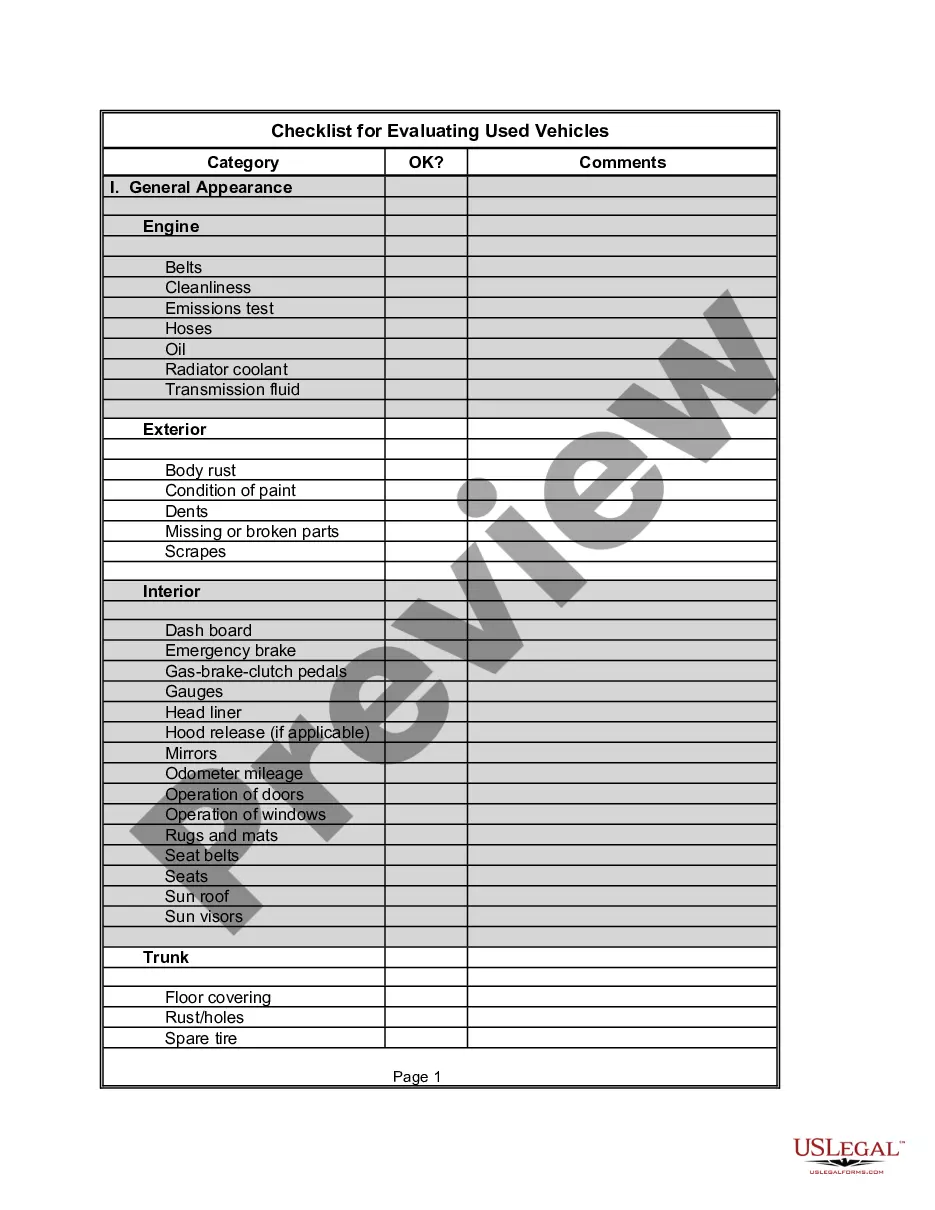
Checklist for Evaluating Used Vehicles or Cars
About this form
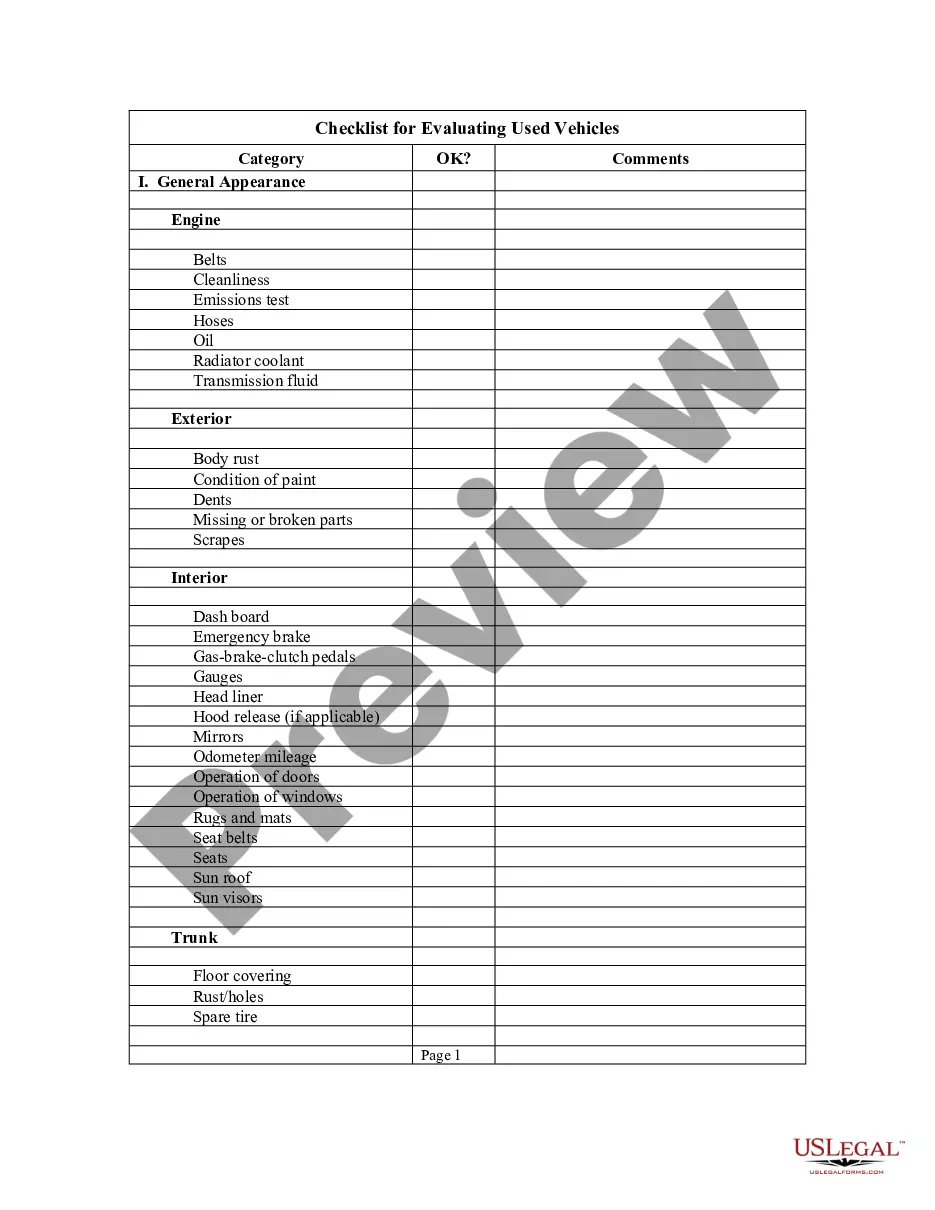
The Checklist for Evaluating Used Vehicles or Cars is a helpful tool that guides potential buyers through the essential factors to consider before purchasing a used vehicle. Unlike other forms, this checklist focuses specifically on assessing the vehicle's condition, safety features, and operational capabilities, to help minimize the risks associated with buying a used car.
Form components explained
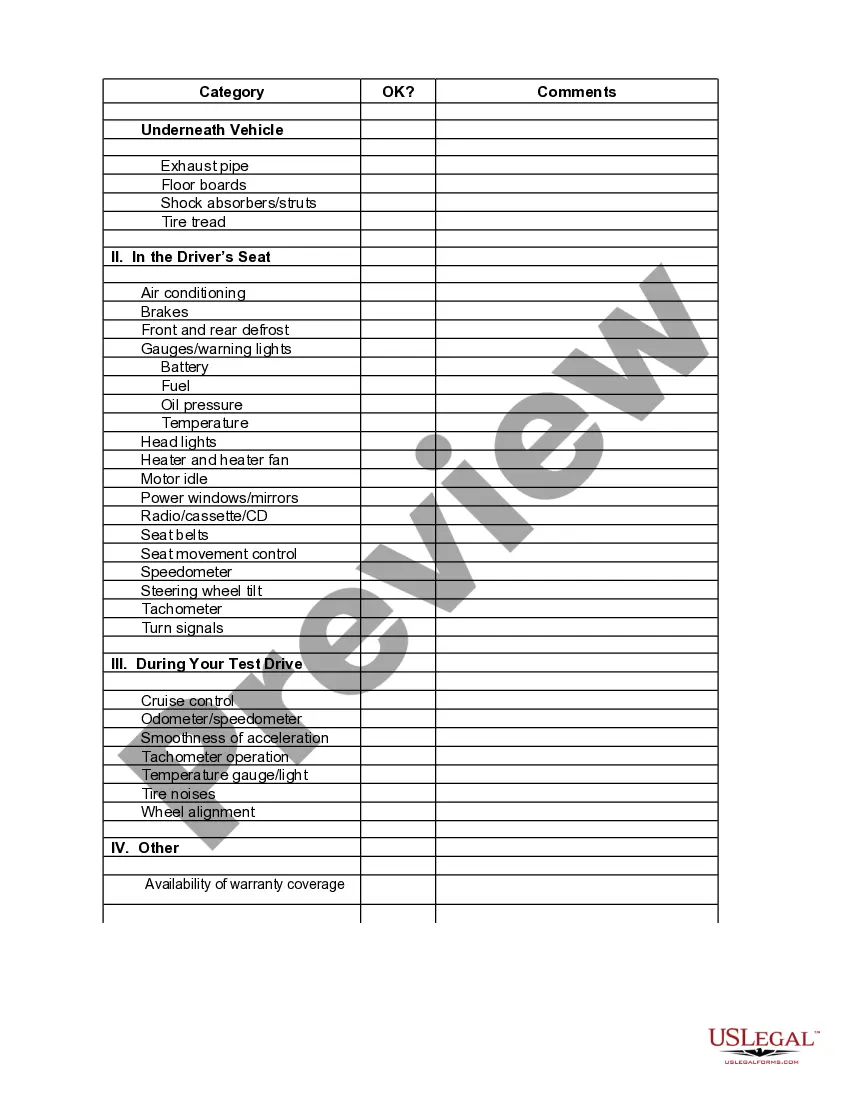
- Checklist for evaluating the condition of the vehicleâs underbody and exhaust system.
- List of critical functions and features to inspect while seated in the driver's seat, such as brakes and gauges.
- Items to monitor during the test drive, including acceleration smoothness and tire noises.
- Section to check the availability of warranty coverage.
When to use this document
This form is beneficial when you are considering purchasing a used vehicle. Use this checklist to conduct a thorough evaluation of the car before finalizing your purchase. It will help you identify any safety concerns, operational issues, or potential repairs that may be necessary.
Intended users of this form
This checklist is ideal for:
- Individuals or families looking to purchase a used car.
- First-time car buyers who may not be familiar with key inspection points.
- Anyone wishing to ensure that a used vehicle is in safe and working condition before buying.
How to complete this form
- Review each section of the checklist and evaluate the vehicle's condition, including its underbody and essential mechanical parts.
- Inspect the driver's seat features and functions, including all gauges and safety measures.
- Take the vehicle for a test drive and note the performance of critical systems like acceleration and braking.
- Check for warranty coverage options and note any exclusions or limitations.
- Make notes and comments for each category to inform your decision.
Does this form need to be notarized?
This form does not typically require notarization unless specified by local law. Always check with local regulations if you are uncertain.
Get your form ready online
Our built-in tools help you complete, sign, share, and store your documents in one place.
Make edits, fill in missing information, and update formatting in US Legal Forms—just like you would in MS Word.
Download a copy, print it, send it by email, or mail it via USPS—whatever works best for your next step.
Sign and collect signatures with our SignNow integration. Send to multiple recipients, set reminders, and more. Go Premium to unlock E-Sign.
If this form requires notarization, complete it online through a secure video call—no need to meet a notary in person or wait for an appointment.
We protect your documents and personal data by following strict security and privacy standards.

Make edits, fill in missing information, and update formatting in US Legal Forms—just like you would in MS Word.

Download a copy, print it, send it by email, or mail it via USPS—whatever works best for your next step.

Sign and collect signatures with our SignNow integration. Send to multiple recipients, set reminders, and more. Go Premium to unlock E-Sign.

If this form requires notarization, complete it online through a secure video call—no need to meet a notary in person or wait for an appointment.

We protect your documents and personal data by following strict security and privacy standards.
Avoid these common issues
- Failing to inspect hidden areas like the undercarriage for rust or damage.
- Ignoring warning lights or unusual sounds during the test drive.
- Overlooking the importance of verifying the car's history and condition with a professional.
Advantages of online completion
- The checklist is easily accessible for download, allowing you to print or save it for your convenience.
- You can customize the checklist based on your vehicle choices and preferences.
- Using this form helps streamline the evaluation process and ensures a thorough inspection.
Key takeaways
- The checklist for evaluating used vehicles helps buyers assess critical aspects of a car's condition.
- This form is designed for various buyers, especially those new to purchasing used vehicles.
- Completing this checklist can prevent mistakes and lead to a more informed decision.
Looking for another form?


Form popularity
FAQ
The mechanic should check, among other items, the engine, transmission, suspension, wheels, and electrical systems. He should also check the structural integrity of the vehicle's body and its state of maintenance. Go with the mechanic on a test drive and ask about any issues that come up.
Obviously price is a starting point, but to help you narrow down your choices further, you need to focus on the following three factors: Quality, Cost of Ownership, and Reliability. Let's take a look at each one, explain why they're important, and provide you with the best resources for further research.
SHARE: When buying a new car, there are many factors to consider. The car needs to fulfill your wants, needs, and lifestyle demands. Also, you'll want to consider the resale value, costs of ownership, desired features, incentive and trade-in options, and pricing and financing.
Engine oil. Brake fluid. Coolant. Drive belts. Transmission fluid. Power-steering fluid. Battery.
Body condition. Check each body panel and the roof, looking for scratches, dents, and rust. Glass. Look carefully at the vehicle glass to make sure there are no cracks or large, pocked areas. Suspension. Walk around the car to see if it's standing level. Lights and lenses. Tires.
Analyse your needs and determine which type of car you require before you head out to evaluate a used car. Find out which source is the most reliable for buying used cars, online, local dealers, certified used cars sellers, etc. Ask around, read about other people's experiences, talk to your friends.
Body condition. Check each body panel and the roof, looking for scratches, dents, and rust. Glass. Look carefully at the vehicle glass to make sure there are no cracks or large, pocked areas. Suspension. Walk around the car to see if it's standing level. Lights and lenses. Tires.
Budget. Buyer's remorse is a very real thing when it comes to purchasing used cars. Lifestyle. Another aspect to consider, whether it is buying a used car or a brand-new one, is whether it can complement your lifestyle. Financing. Insurance. Reputation. Ownership and Car Title. Vehicle History. Pre-Purchase Inspection.
You should try to have the inspection performed by a mechanic with whom you've already built a relationship. And ideally, the inspection should include a test drive over a route that includes hills, bumps and potholes to reveal suspension problems and engine performance issues.