Employment Agreement with Provisions for Noncompetition, Confidentiality, and Termination on Disability or Discontinuance of Business
Overview of this form
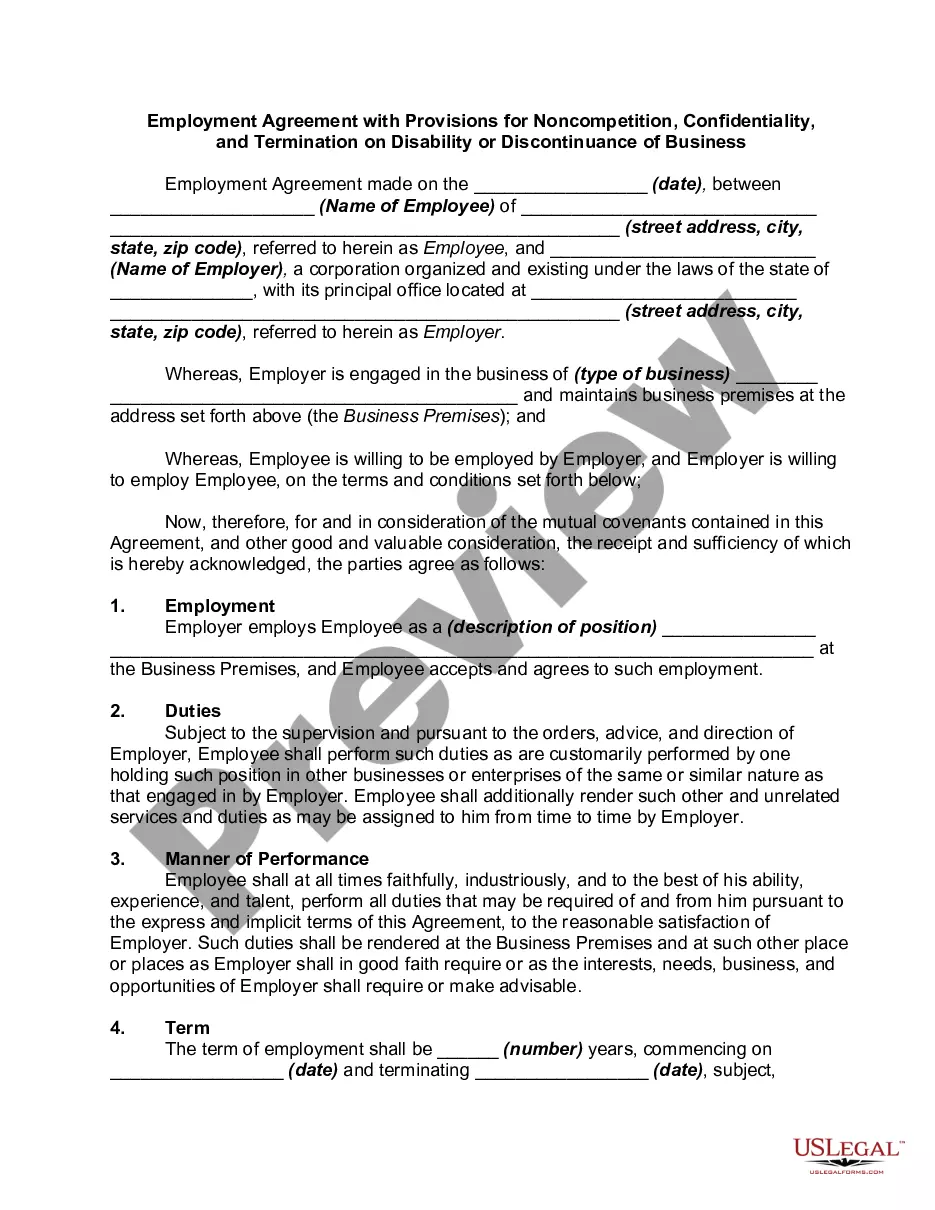
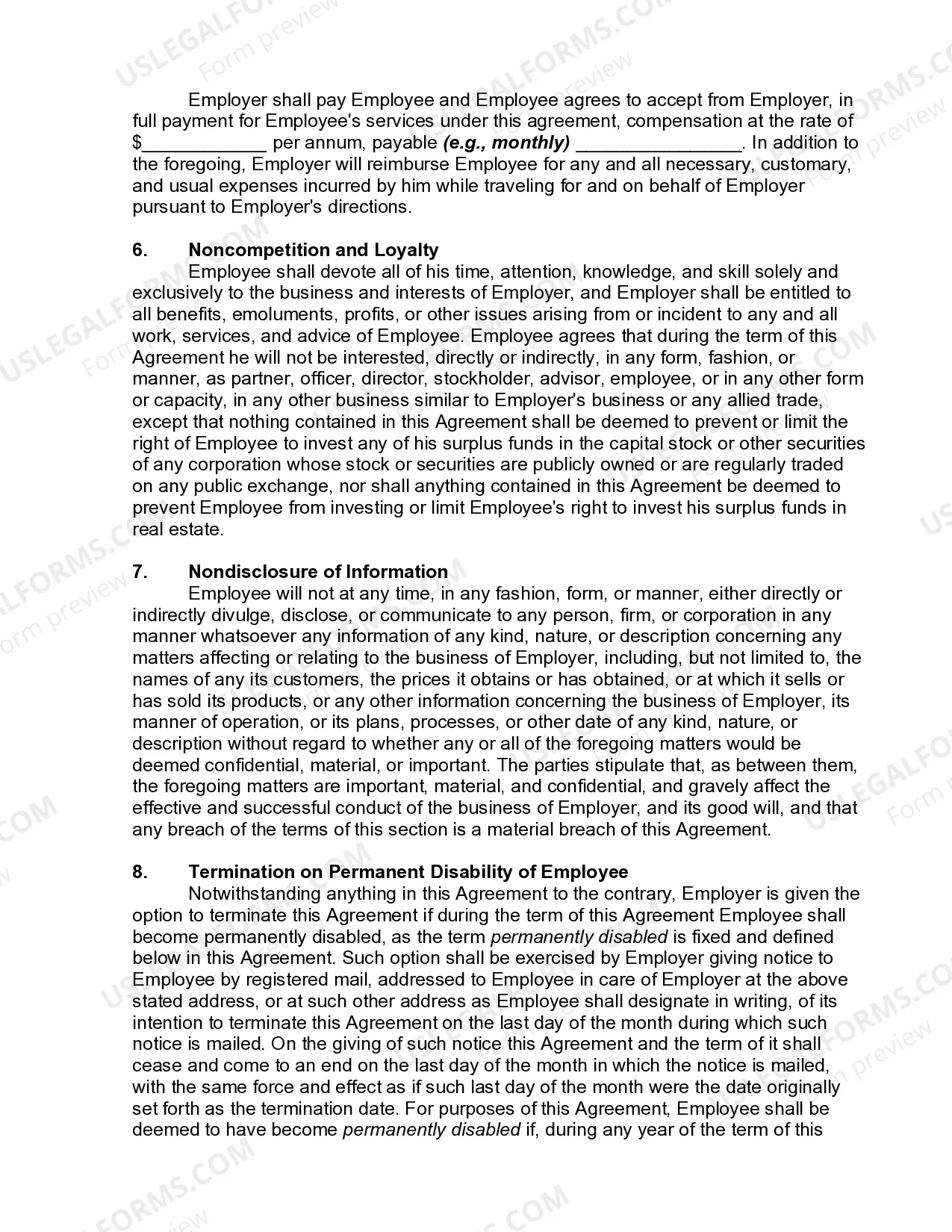
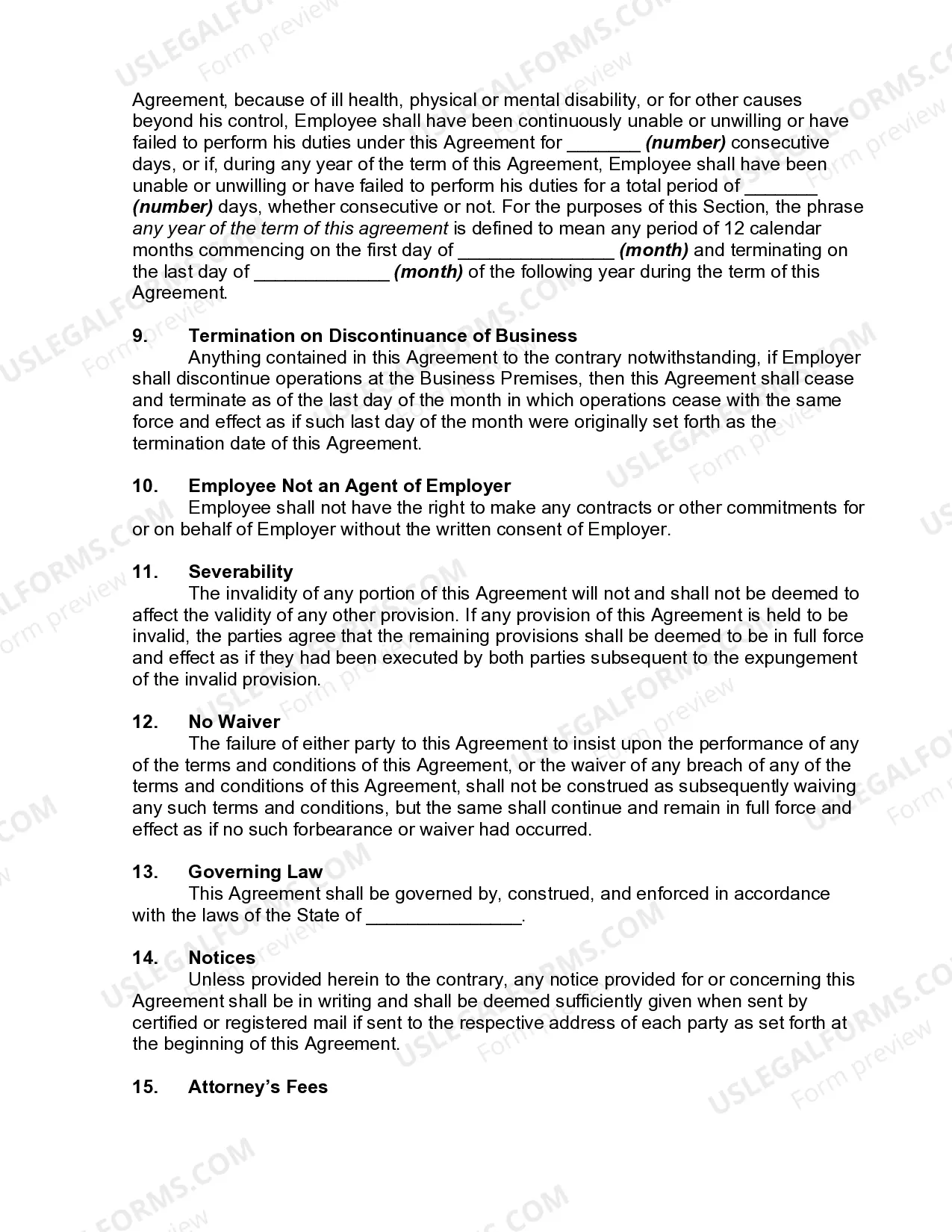
This Employment Agreement with Provisions for Noncompetition, Confidentiality, and Termination on Disability or Discontinuance of Business outlines the terms of employment between an employer and employee, specifically addressing noncompetition, confidentiality, and conditions for termination. This agreement is essential for businesses looking to protect their interests during and after the employment period, setting it apart from simpler employment contracts that might not include such provisions.
Key parts of this document
- The parties involved (Employer and Employee) with their addresses.
- Description of the position and duties expected of the Employee.
- Terms of employment, including duration and compensation details.
- Provisions for noncompetition to prevent conflicts of interest.
- Confidentiality clauses to protect sensitive business information.
- Termination conditions, including options for disability and discontinuation of business.
Situations where this form applies
This form is used when an employer intends to formalize the terms of employment with an employee while ensuring that business interests are protected. Scenarios include hiring new employees in competitive industries, establishing confidentiality around proprietary information, or when planning for potential termination due to disability or business closures.
Intended users of this form
- Employers seeking to establish clear employment terms with their employees.
- Businesses in competitive industries needing to protect proprietary information.
- Employers who want specific terms related to noncompetition and confidentiality enforced.
- Companies that anticipate the need for disability provisions in employment contracts.
Steps to complete this form
- Identify the parties by entering the names and addresses of the Employee and Employer.
- Specify the position and describe the duties the Employee will be expected to perform.
- Fill in the term of employment, dates of commencement, and termination, if applicable.
- Enter compensation details, including the annual salary amount and payment frequency.
- Review and complete the confidentiality and noncompetition clauses as per your business needs.
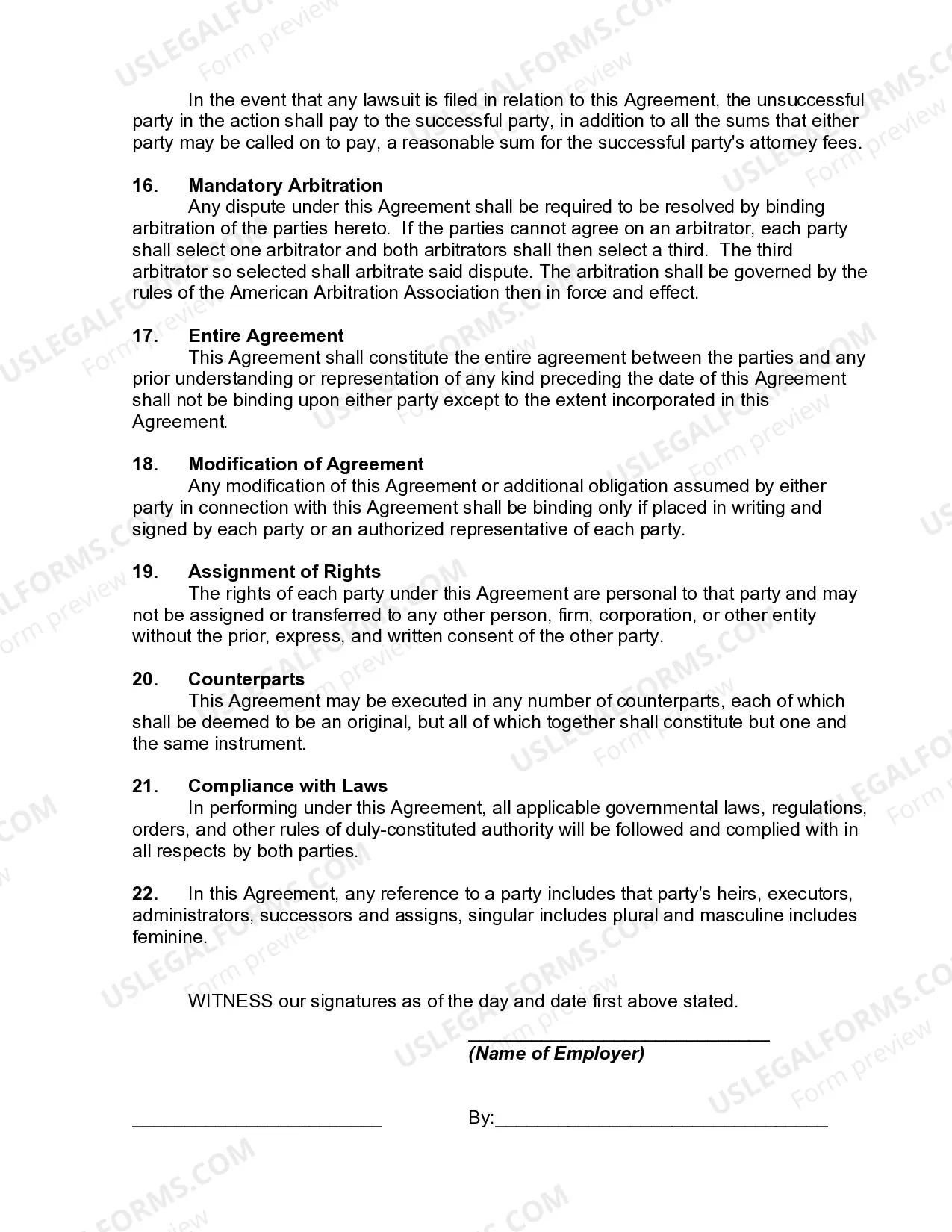
- Obtain signatures from both parties to finalize the agreement.
Does this form need to be notarized?
This form does not typically require notarization unless specified by local law. However, it is advisable to consult with a legal professional to ensure compliance with state-specific requirements.
Get your form ready online
Our built-in tools help you complete, sign, share, and store your documents in one place.
Make edits, fill in missing information, and update formatting in US Legal Forms—just like you would in MS Word.
Download a copy, print it, send it by email, or mail it via USPS—whatever works best for your next step.
Sign and collect signatures with our SignNow integration. Send to multiple recipients, set reminders, and more. Go Premium to unlock E-Sign.
If this form requires notarization, complete it online through a secure video call—no need to meet a notary in person or wait for an appointment.
We protect your documents and personal data by following strict security and privacy standards.

Make edits, fill in missing information, and update formatting in US Legal Forms—just like you would in MS Word.

Download a copy, print it, send it by email, or mail it via USPS—whatever works best for your next step.

Sign and collect signatures with our SignNow integration. Send to multiple recipients, set reminders, and more. Go Premium to unlock E-Sign.

If this form requires notarization, complete it online through a secure video call—no need to meet a notary in person or wait for an appointment.

We protect your documents and personal data by following strict security and privacy standards.
Common mistakes
- Failing to specify the term of employment or compensation details.
- Leaving out critical clauses regarding noncompetition and confidentiality.
- Not ensuring both parties sign the agreement.
- Neglecting to adapt the form to state-specific laws if required later.
- Using vague language that can lead to misinterpretation of duties and expectations.
Why use this form online
- Immediate access to a professionally drafted form tailored for legal clarity.
- Easy customization to meet specific employer and employee needs.
- Secure storage of completed forms for future reference and legal compliance.
- Convenient download options for quick and efficient use.
Key takeaways
Key takeaways about the Employment Agreement:
- The agreement sets forth employment terms, protecting both employer and employee interests.
- Incorporates essential clauses like noncompetition and confidentiality to safeguard business secrets.
- This form is designed for use across multiple states but should be aligned with state laws.
- Accurate completion is critical to prevent misunderstandings and enforceability issues.
Looking for another form?
Form popularity
FAQ
Names of the Parties. The employer's organisation details and the employee's full name and address. Start Date. Job Title and Description. Place of Work. Hours of Work. Probationary Period. Salary. Assessments.
Contract Types Overview. Express and Implied Contracts. Unilateral and Bilateral Contracts. Unconscionable Contracts. Adhesion Contracts. Aleatory Contracts. Option Contracts. Fixed Price Contracts.
By law, an employment contract must contain the following contractual clauses, known as 'express terms': Name and address of employer and employee.When the contract is expected to end if temporary or fixed term. Job title or a brief description of duties.
Company Name. Nature of Work: Your duty hours will be 40 hours a week. Salary & Benefits: You will be drawing a salary of $8000 per month. Rules & Regulations: The company expects you to stick to all the rules and regulations effective at the time of your employment.
Identify the employee and the business hiring them. List the date that the employment contract will be made effective. Provide the name of the role that the employee will fill. List the term of employment. Detail the pay and benefits the employee receives.
Fixed price contracts. With a fixed price contract the buyer (that's you) doesn't take on much risk. Cost-reimbursable contracts. With a cost-reimbursable contract you pay the vendor for the actual cost of the work. Time and materials contracts.
There are three types of employment status: employee, worker and self-employed. The three are often not in practice used correctly and the difference is not always known.
Get it in writing. Keep it simple. Deal with the right person. Identify each party correctly. Spell out all of the details. Specify payment obligations. Agree on circumstances that terminate the contract. Agree on a way to resolve disputes.
Types of Employment Contracts: Permanent employment, temporary employment and independent contractors.