Submission to Arbitration of Dispute between Building Construction Contractor and Owner
About this form
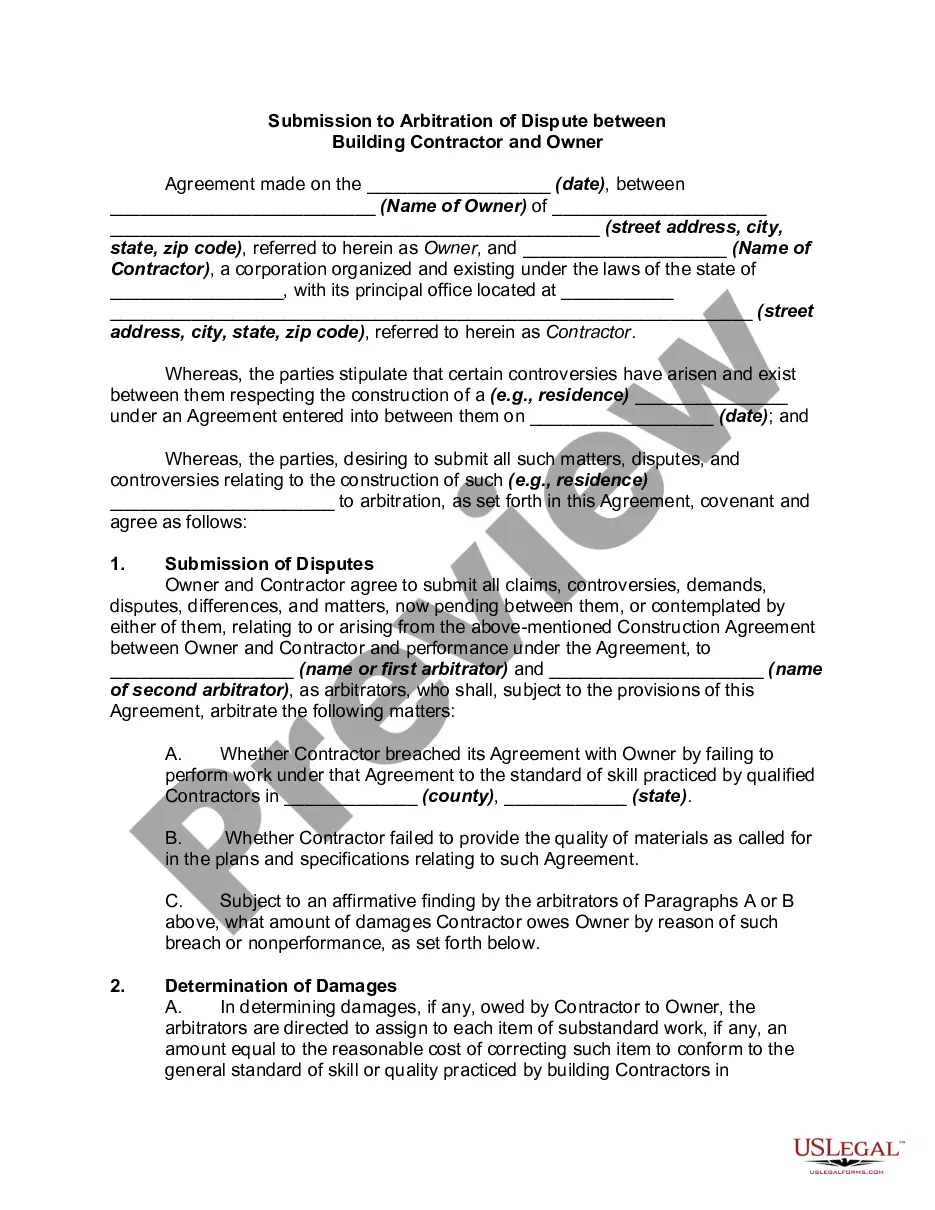
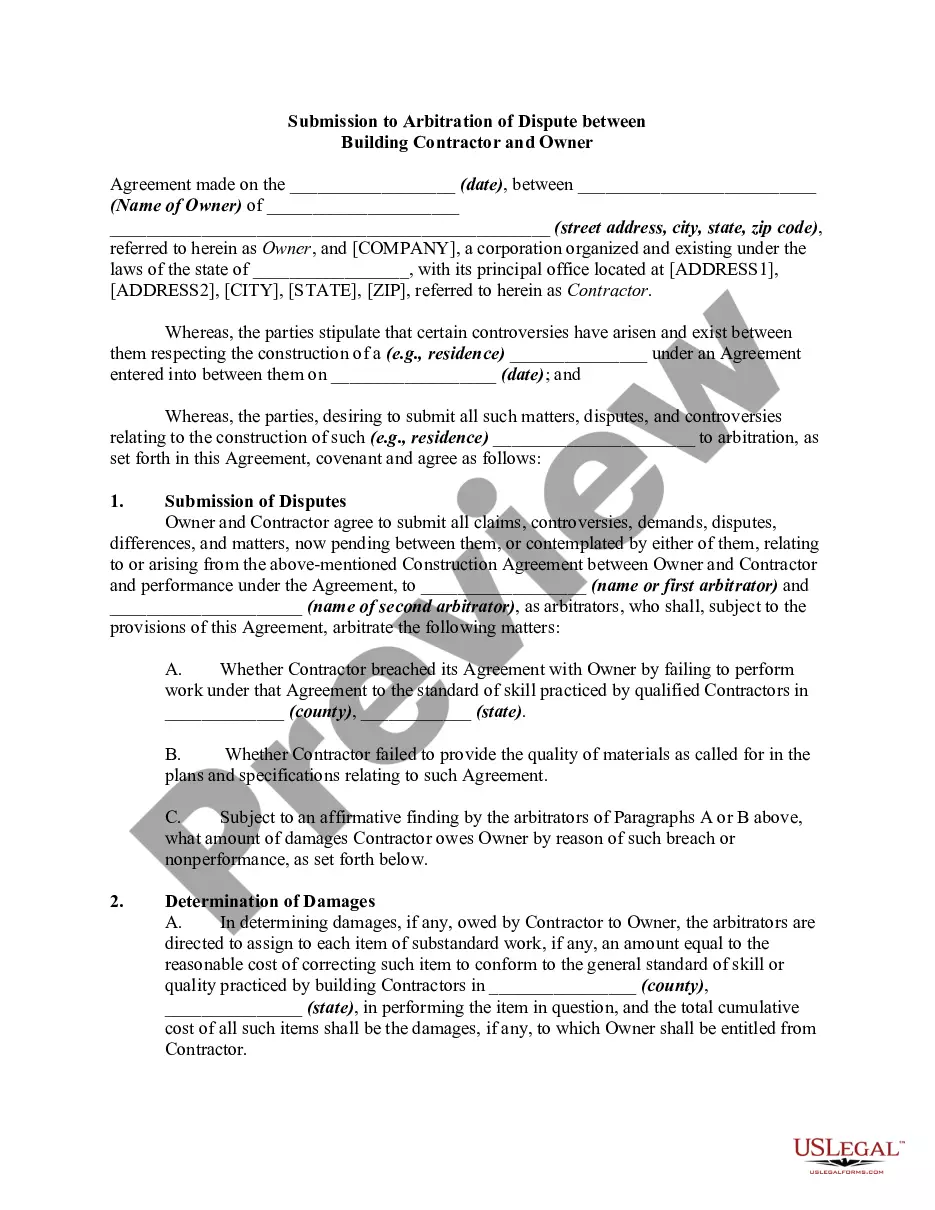
The Submission to Arbitration of Dispute between Building Construction Contractor and Owner is a legal agreement that enables parties involved in a construction project to resolve disputes through arbitration rather than litigation. This form establishes the framework for submitting disagreements about contract performance, quality of materials, and other related issues to an arbitrator or arbitration panel. Unlike regular contracts, this arbitration submission bindingly outlines the process and grounds for arbitration, ensuring that both parties adhere to the decisions made by the arbitrators.
Main sections of this form
- Identification of the parties involved: Owner and Contractor, along with their contact information.
- Submission of disputes clause outlining what claims will be arbitrated.
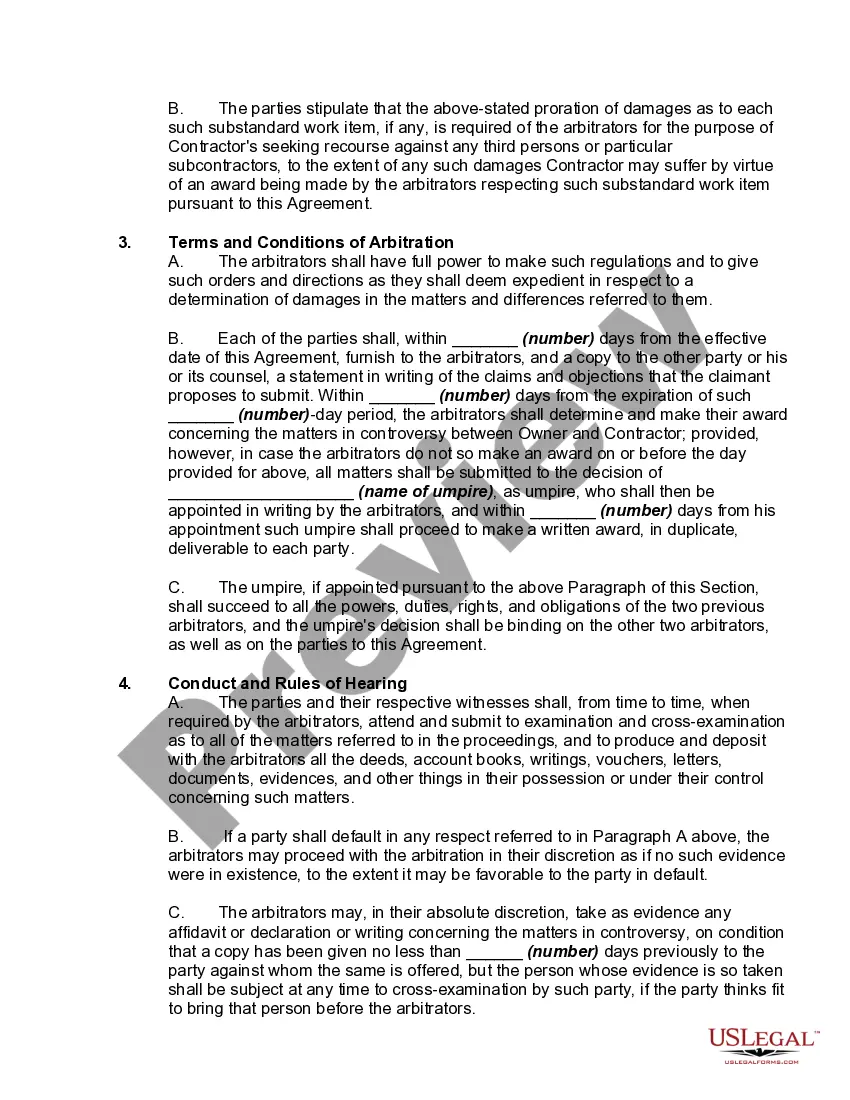
- Determination of damages which specifies how damages will be calculated by the arbitrators.
- Terms and conditions of arbitration detailing the procedure for the arbitration hearing.
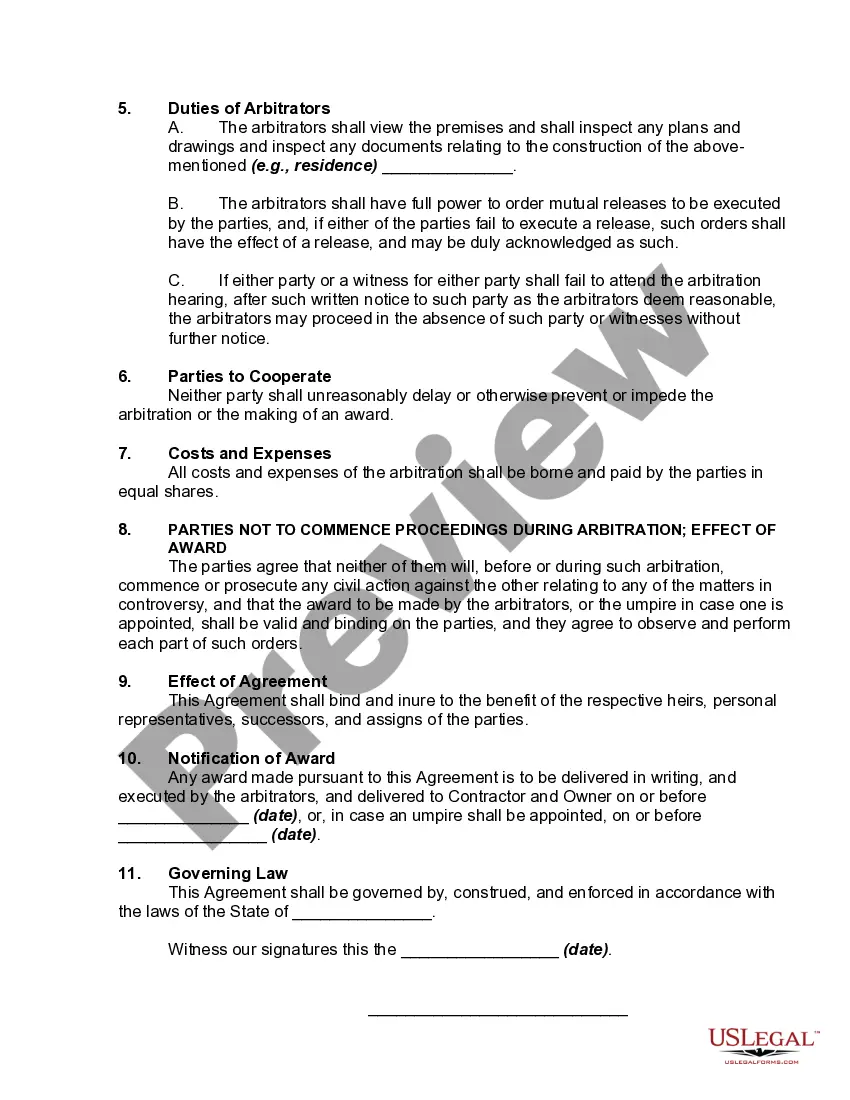
- Provisions related to costs and expenses associated with the arbitration process.
- Governing law section outlining the jurisdictional laws applicable to the agreement.



Situations where this form applies
This form should be utilized when a dispute arises between a building construction contractor and the property owner regarding contract performance, quality of work, or other contractual obligations. It is beneficial when both parties prefer a binding resolution to their conflicts without resorting to court. Use this form to formalize the agreement to submit disputes to arbitration, ensuring clear guidelines for resolving potential issues that may arise during the construction project.
Intended users of this form
- Construction contractors and subcontractors seeking to clarify dispute resolution processes with clients.
- Property owners who desire a structured approach to resolving disputes related to construction work.
- Legal representatives of contractors or owners needing to establish arbitration protocols in construction agreements.
How to prepare this document
- Identify the parties by entering the name and contact details of the Owner and Contractor.
- Specify the date of the original construction Agreement referenced in the arbitration clause.
- Outline the specific claims and disputes to be submitted to arbitration in the provided sections.
- Assign names to the arbitrators and set deadlines for submitting claims and objections.
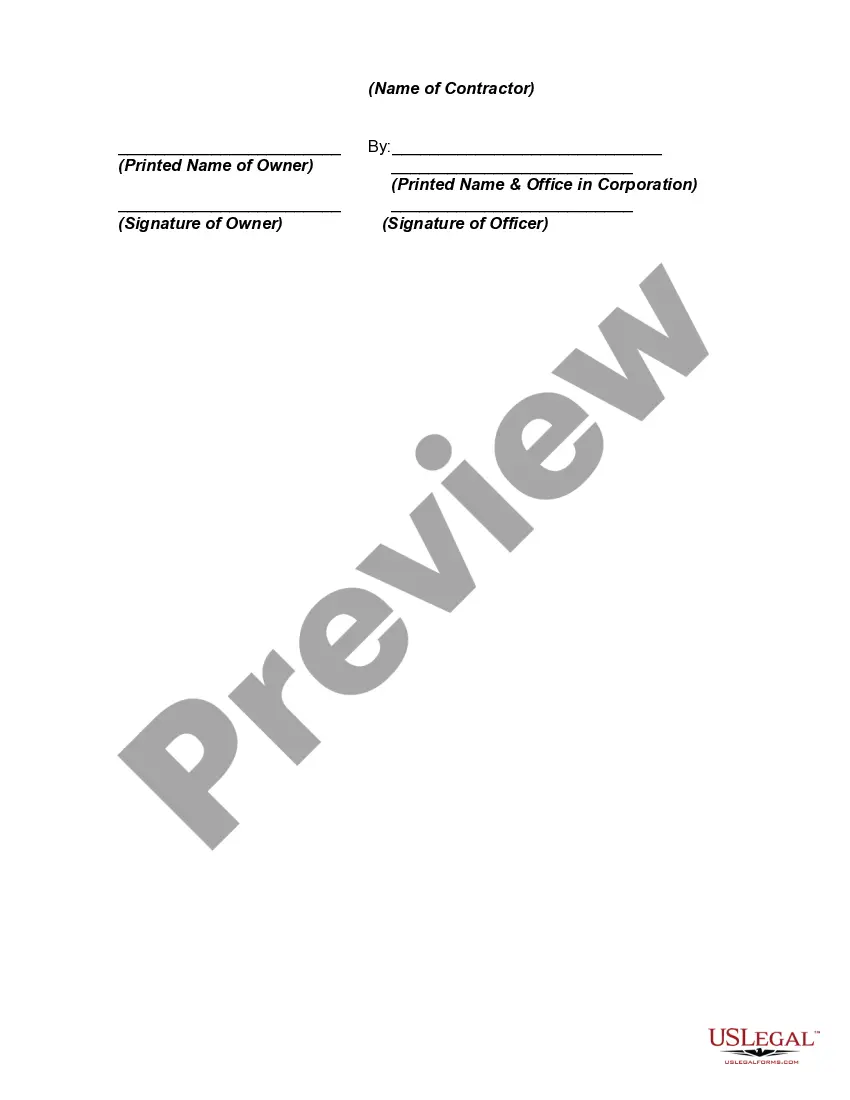
- Ensure both parties sign the agreement, indicating their acceptance of the arbitration terms.
Notarization requirements for this form
Notarization is not commonly needed for this form. However, certain documents or local rules may make it necessary. Our notarization service, powered by Notarize, allows you to finalize it securely online anytime, day or night.
Get your form ready online
Our built-in tools help you complete, sign, share, and store your documents in one place.
Make edits, fill in missing information, and update formatting in US Legal Forms—just like you would in MS Word.
Download a copy, print it, send it by email, or mail it via USPS—whatever works best for your next step.
Sign and collect signatures with our SignNow integration. Send to multiple recipients, set reminders, and more. Go Premium to unlock E-Sign.
If this form requires notarization, complete it online through a secure video call—no need to meet a notary in person or wait for an appointment.
We protect your documents and personal data by following strict security and privacy standards.

Make edits, fill in missing information, and update formatting in US Legal Forms—just like you would in MS Word.

Download a copy, print it, send it by email, or mail it via USPS—whatever works best for your next step.

Sign and collect signatures with our SignNow integration. Send to multiple recipients, set reminders, and more. Go Premium to unlock E-Sign.

If this form requires notarization, complete it online through a secure video call—no need to meet a notary in person or wait for an appointment.

We protect your documents and personal data by following strict security and privacy standards.
Avoid these common issues
- Not clearly identifying the parties involved or providing incomplete contact information.
- Failing to specify the disputes that will be submitted for arbitration.
- Not adhering to deadlines for submission of claims and objections.
- Omitting signatures from both parties, which can render the agreement unenforceable.
Why use this form online
- Convenient access to the form allows for quick and straightforward completion.
- Editable fields enable users to customize the agreement according to their specific needs.
- Reliability of the legal form, ensuring it has been drafted by licensed attorneys and compliant with legal standards.
Looking for another form?
Form popularity
FAQ
Negotiation. Mediation. Expert determination. Adjudication. Arbitration. Litigation.
Check Your Contract. The first step to resolving any dispute with a contractor is to carefully review your contract. Communicate and Negotiate. You may be able to resolve most disputes with contractors by keeping the lines of communication open and negotiating a settlement. Mediation. Arbitration. Go to Court. Key Takeaways.
Proceedings are simple, faster and less expensiveDisputes can be resolved through arbitration much faster, simpler and less expensive than it would take if the parties resort to court action. Being contractual in nature, arbitration permits the parties to specify the time and place for hearings.
Far too few parties are aware of submission agreements, which allow parties to submit their dispute to arbitration, even in the absence of an arbitration clause in the underlying contract.The dispute referred to arbitration shall be decided in accordance with the law of specify jurisdiction.
Assertively confront your contractor.When talking with the contractor, explain why you are unhappy with his work, and get him to sign a document detailing the solutions that you have both agreed on, so that if he flakes, you have written proof.
If a dispute arises during construction of your project, do not proceed immediately to court! Your contract may require you to use alternative dispute resolution (ADR) techniques such as negotiation, mediation or arbitration to resolve your disputes.
Go to Small Claims Court. Small claims court is a legal venue for homeowners who feel they are owed money back from a contractor. Hire an Attorney. File a Complaint with the State. Pursue a Bond Claim. Post Reviews.
Out of Court Options. Don't feel that litigation is your only option or even your first option. State and Local Agencies. Your state contractor licensing agency or a trade group may have a resolution program for general contractor disputes. Mediation and Binding Arbitration.
Never Tell a Contractor They are the Only One Bidding on the Job. Don't Tell a Contractor Your Budget. Never Ask a Contractor for a Discount if You Pay Upfront. Don't Tell a Contractor That You Aren't in A Hurry. Do Not Let a Contractor Choose the Materials.