Agreement for Sale of Sole Proprietorship Law Practice with Restrictive Covenant
What this document covers
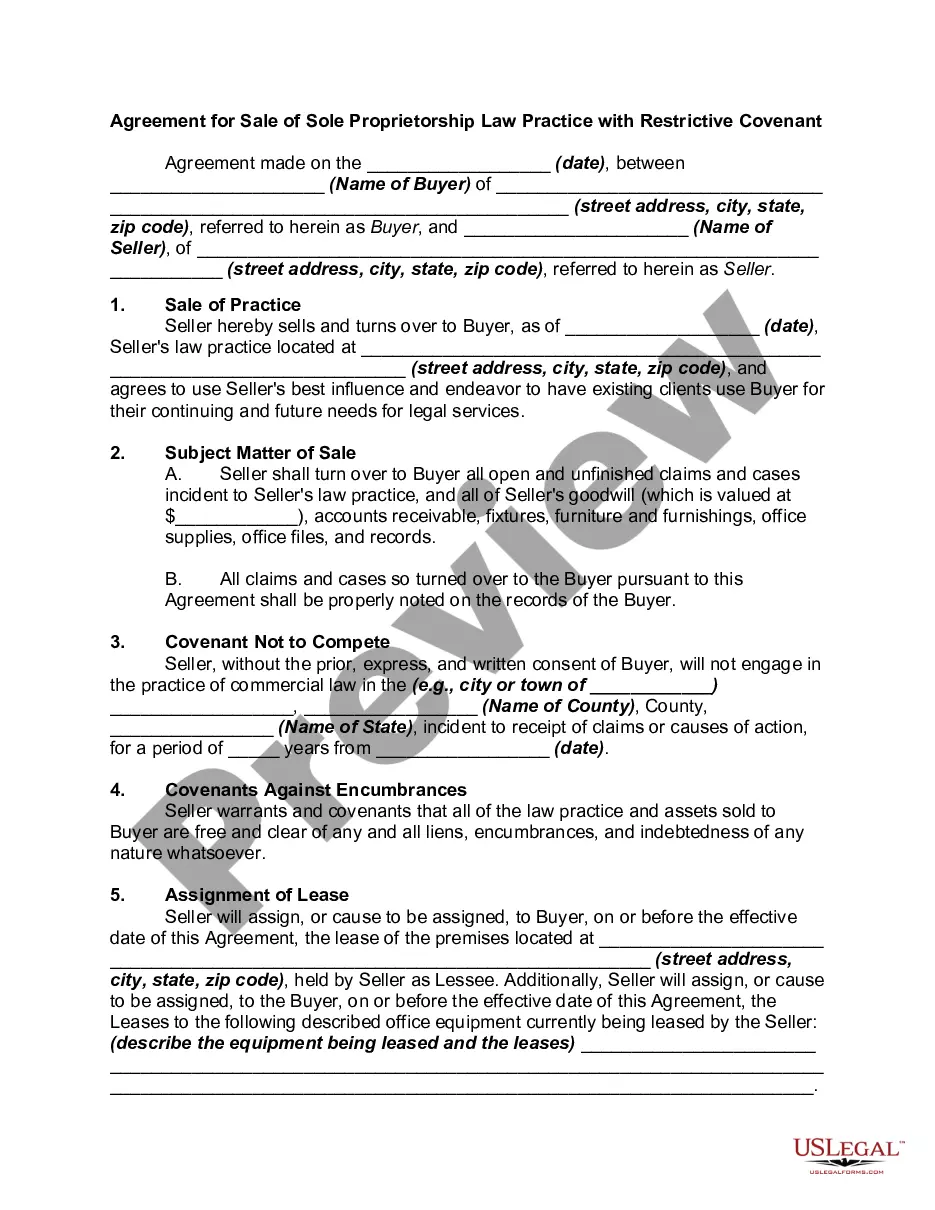
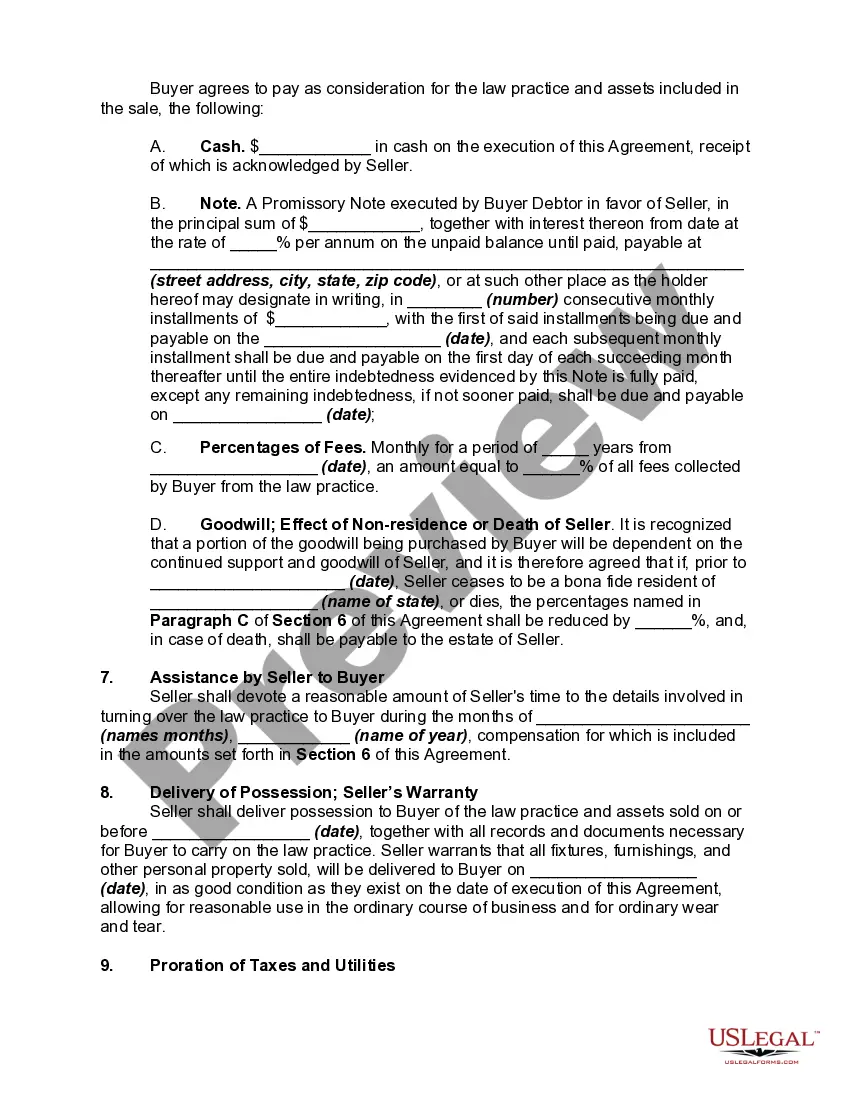
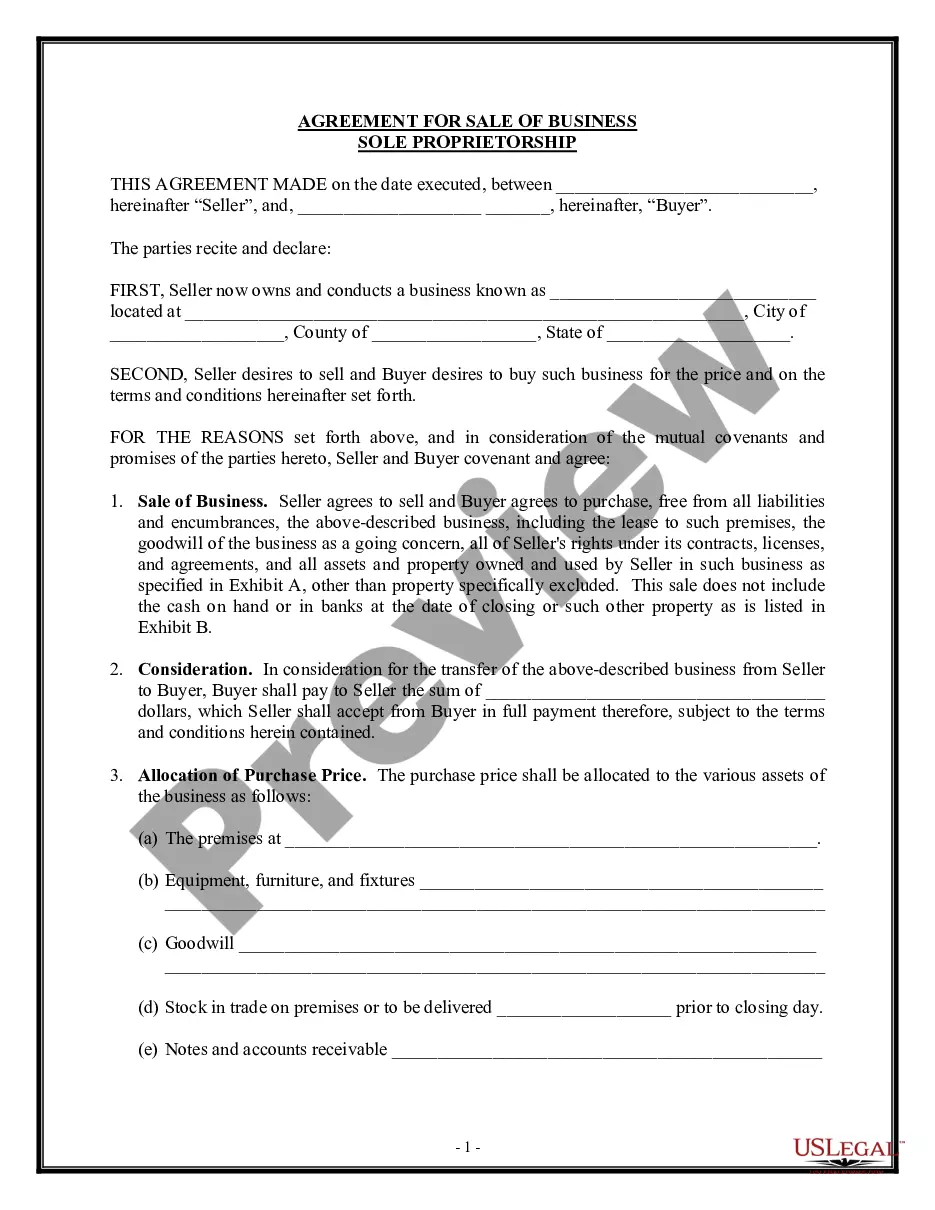
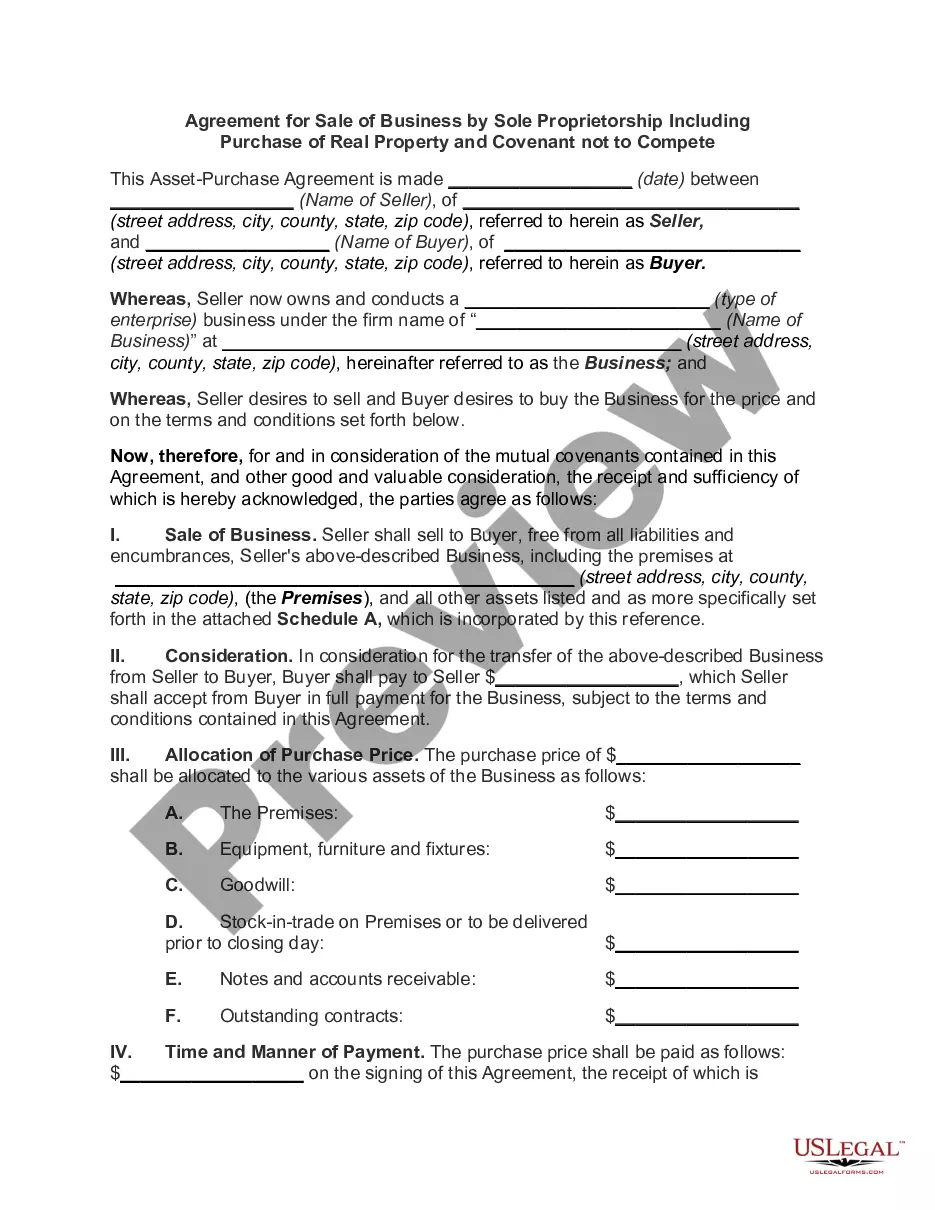
The Agreement for Sale of Sole Proprietorship Law Practice with Restrictive Covenant is a legal document that facilitates the sale of a law practice owned by a sole proprietor. This agreement details the terms of the sale, including the assets involved, payment structure, and any restrictive covenants to prevent competition after the sale. This form is essential in ensuring that both the buyer and seller understand their rights and obligations during this complex transaction.
Main sections of this form
- Date of the agreement and identities of the buyer and seller.
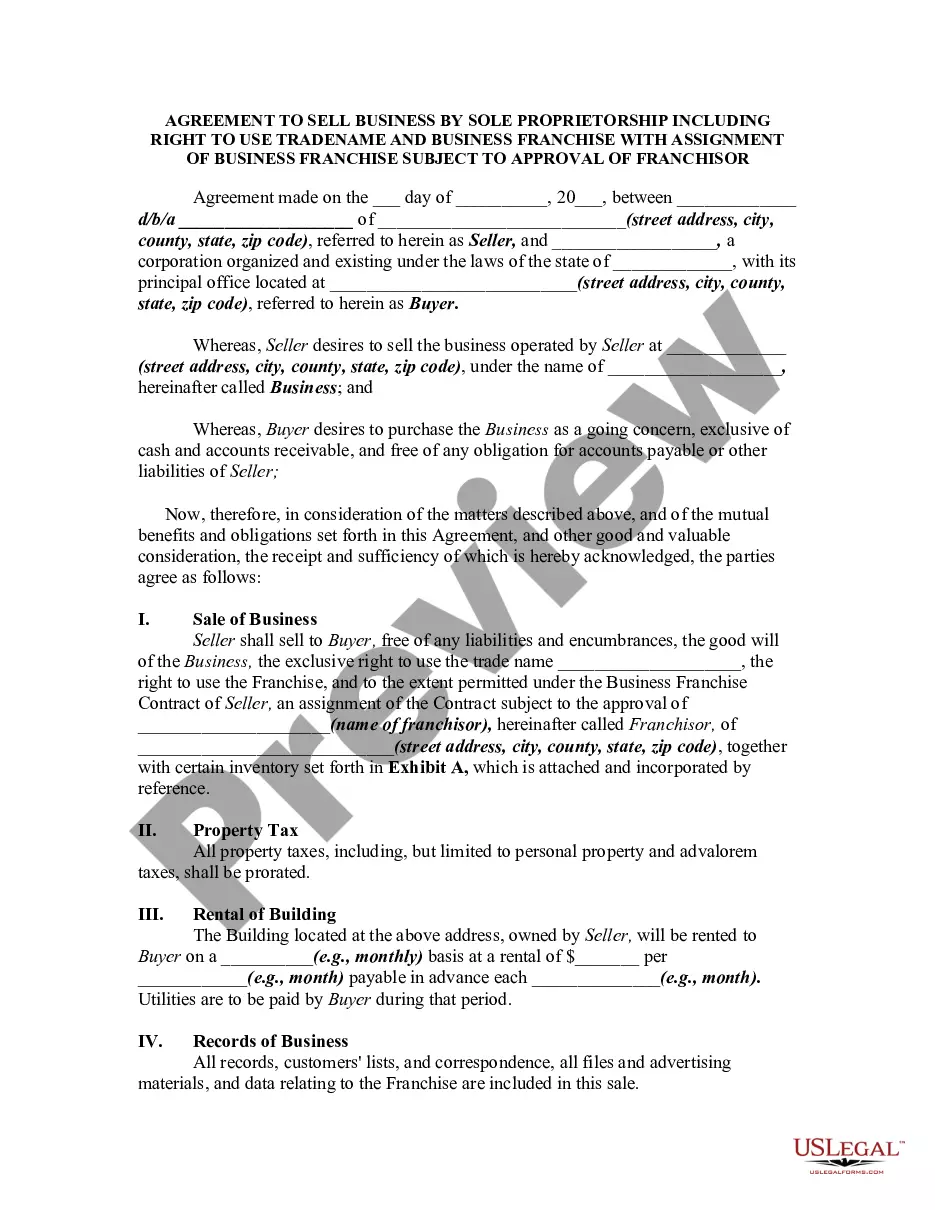
- Details of the law practice being sold, including goodwill and assets.
- Restrictive covenant preventing the seller from practicing law in a specified area for a defined period.
- Warranties regarding encumbrances and the condition of the transferred assets.
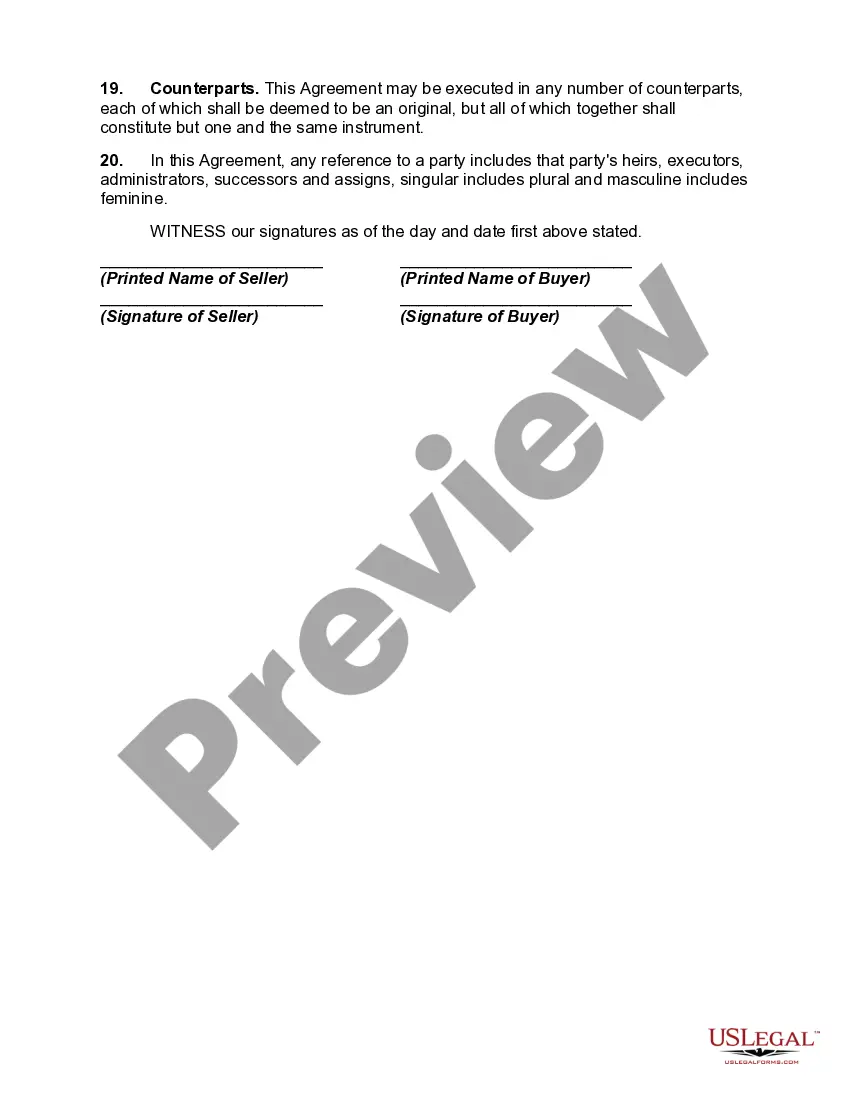
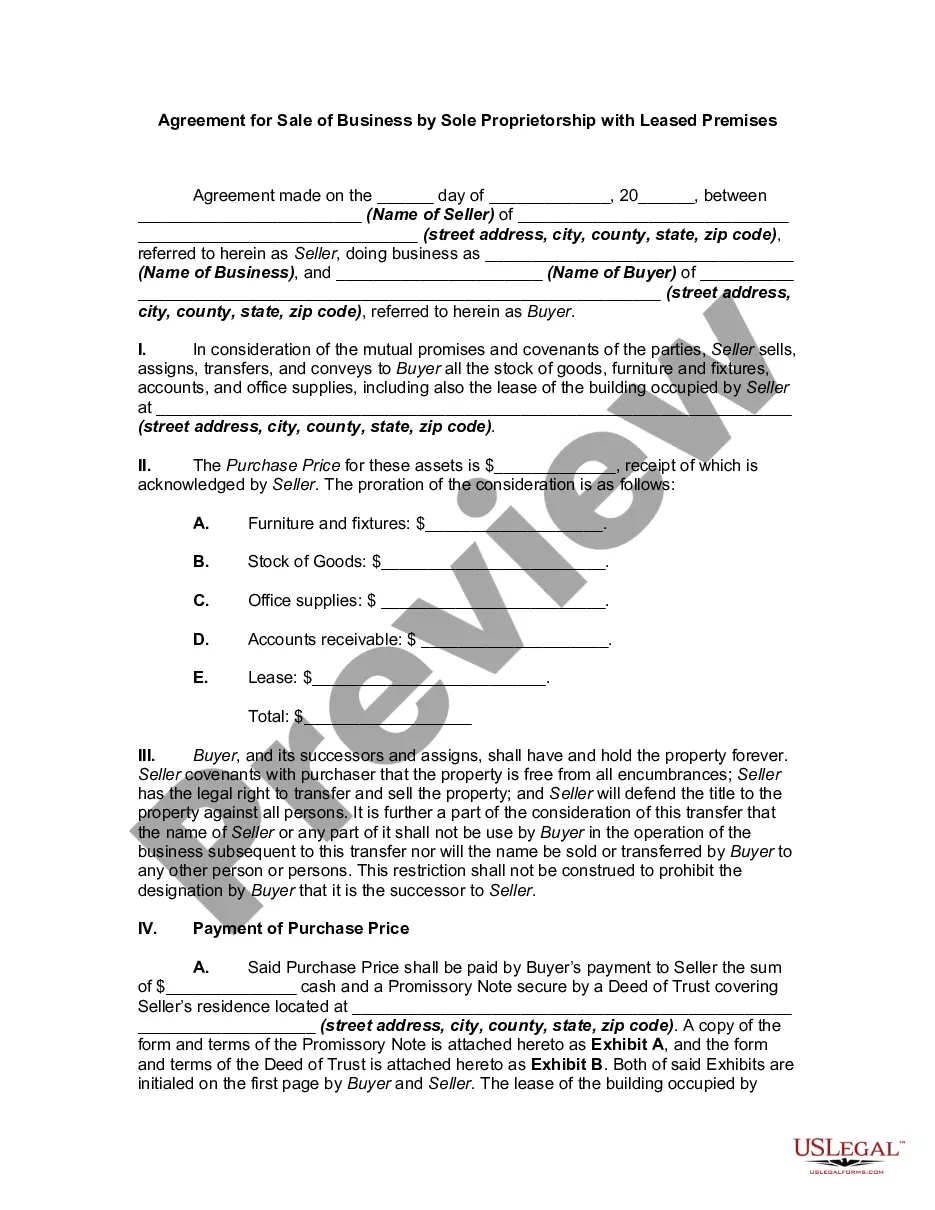
- Payment terms, including cash, promissory notes, and potential profit-sharing arrangements based on fees collected.
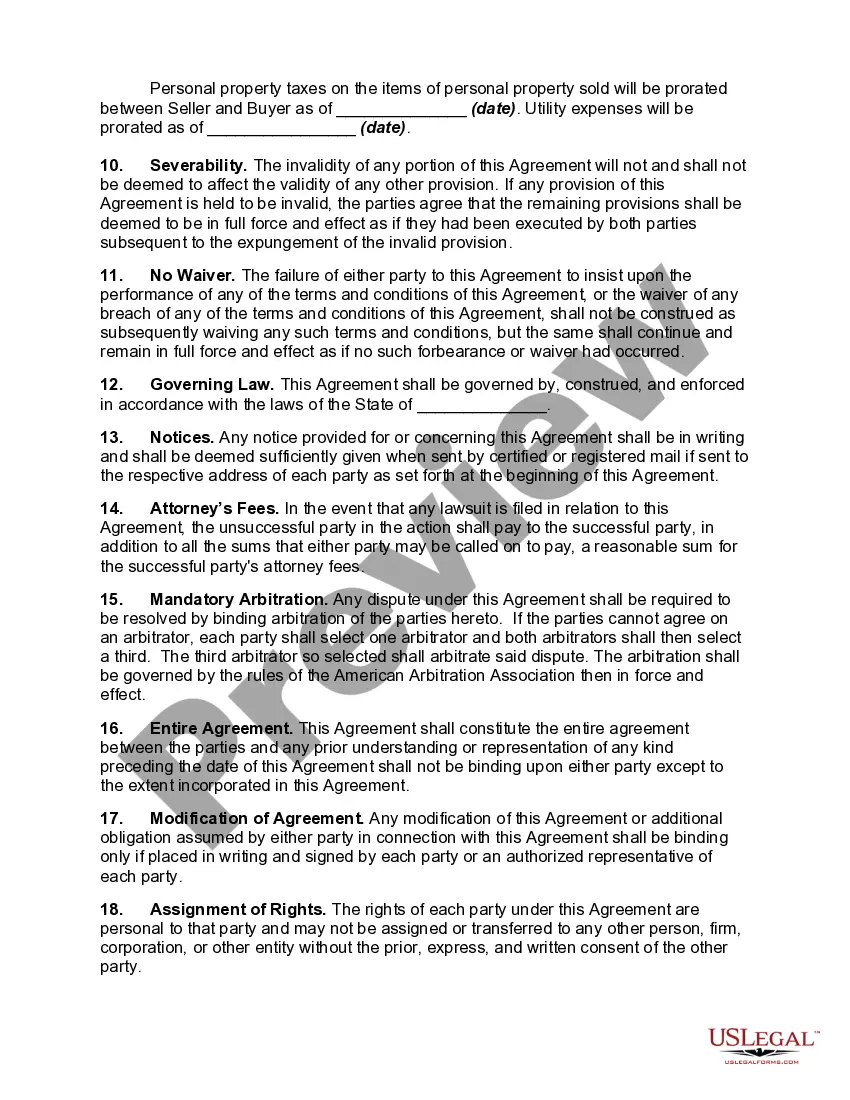
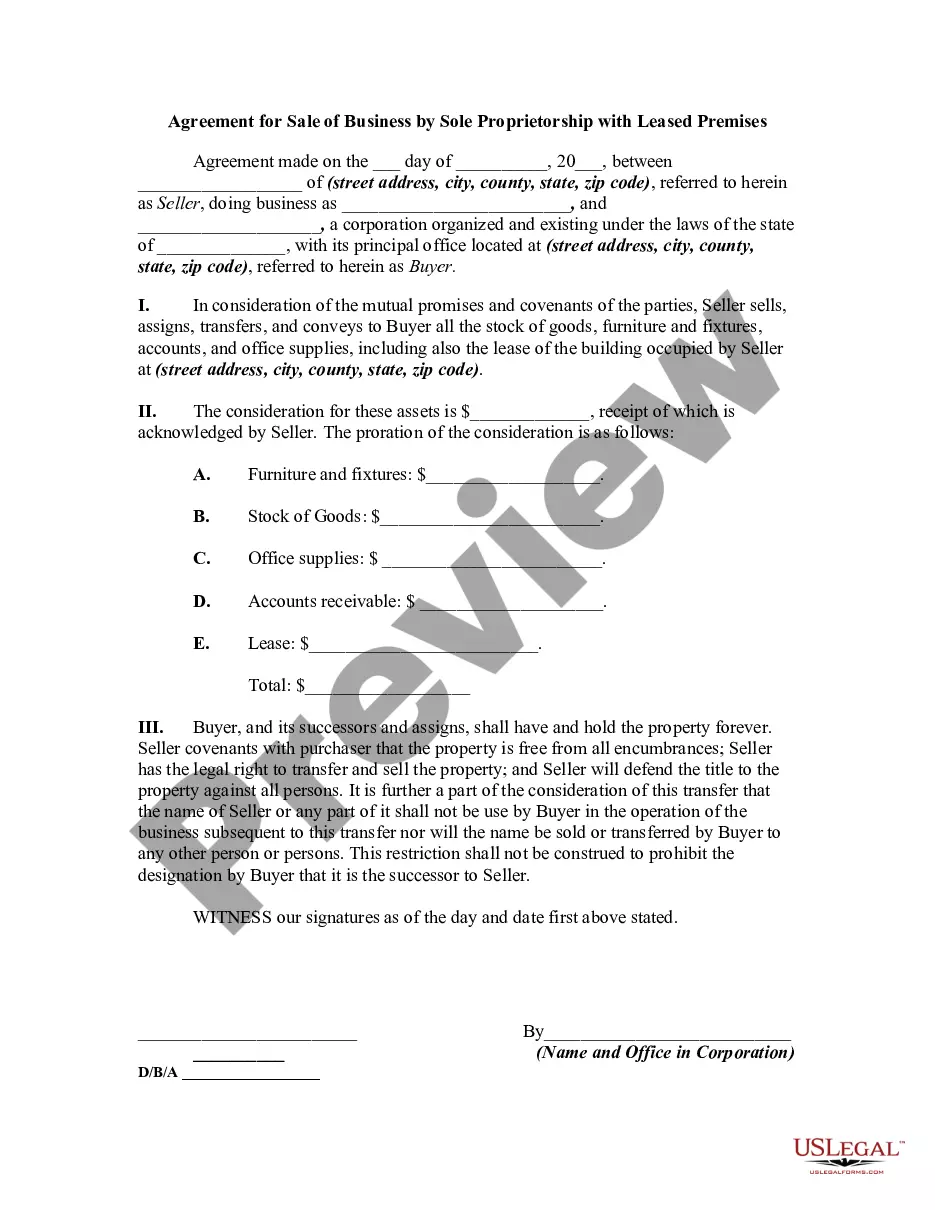
- Provisions for the assignment of leases and utilities, as well as proration details.
Common use cases
This form should be used when a sole proprietor seeks to sell their law practice to another party. It is applicable in scenarios where the seller wants to transfer ongoing cases, client relationships, and business assets. The agreement is also important when there is concern about competition, as it includes a clause that restricts the seller from practicing law in the same jurisdiction for a specified period.
Who needs this form
- Sole proprietors in the legal field looking to sell their practice.
- Buyers interested in acquiring an established law practice.
- Attorneys and law firms seeking to formalize the transfer of practice assets and ongoing client relationships.
Steps to complete this form
- Identify and enter the date of the agreement and the full names and addresses of both the buyer and seller.
- Specify the law practice being sold, including location and key assets such as client files and equipment.
- Detail the payment terms, clearly indicating any cash payments and the structure of promissory notes or profit-sharing agreements.
- Include any restrictive covenants regarding future competition and the jurisdiction of its enforcement.
- Ensure all parties sign the agreement, and make note of any required dates for transfer of assets or leases.
Does this form need to be notarized?
This form does not typically require notarization unless specified by local law. However, having it notarized can add an extra layer of security and validity to the agreement process.
Get your form ready online
Our built-in tools help you complete, sign, share, and store your documents in one place.
Make edits, fill in missing information, and update formatting in US Legal Forms—just like you would in MS Word.
Download a copy, print it, send it by email, or mail it via USPS—whatever works best for your next step.
Sign and collect signatures with our SignNow integration. Send to multiple recipients, set reminders, and more. Go Premium to unlock E-Sign.
If this form requires notarization, complete it online through a secure video call—no need to meet a notary in person or wait for an appointment.
We protect your documents and personal data by following strict security and privacy standards.

Make edits, fill in missing information, and update formatting in US Legal Forms—just like you would in MS Word.

Download a copy, print it, send it by email, or mail it via USPS—whatever works best for your next step.

Sign and collect signatures with our SignNow integration. Send to multiple recipients, set reminders, and more. Go Premium to unlock E-Sign.

If this form requires notarization, complete it online through a secure video call—no need to meet a notary in person or wait for an appointment.

We protect your documents and personal data by following strict security and privacy standards.
Typical mistakes to avoid
- Failing to specify all assets included in the sale, leading to disputes later on.
- Omitting the restrictive covenant clause, which can affect the seller's ability to compete.
- Inaccurate or incomplete payment terms that could result in financial confusion.
Why complete this form online
- Convenience of downloading and customizing the form as needed.
- Access to expert-drafted templates, ensuring legal compliance and clarity.
- Ability to edit the form to fit specific circumstances without the costs of an attorney.
Legal use & context
- This agreement is legally binding once signed by both parties, ensuring protection for both buyer and seller.
- Including a restrictive covenant can help prevent future competition and protect the buyer's investment.
- Non-compliance with the terms of this agreement can result in legal disputes, thus itâs crucial to understand all clauses before signing.
Quick recap
- This agreement is essential for formalizing the sale of a sole proprietorship law practice.
- It protects both parties by clearly stating the terms of the sale, including payment and any restrictions on the seller.
- Ensure that the agreement complies with state laws and regulations specific to legal practice sales.
Looking for another form?
Form popularity
FAQ
A restrictive covenant is an agreement that restricts a company or other party to a contract from engaging in certain actions. For example, a restrictive covenant entered into with a public company might limit the amount of dividends the firm can pay its shareholders.
Certain restrictive covenants will be enforceable, if you are able to prove that they are: reasonable. necessary to protect legitimate business interests; and. of a duration no longer than is necessary to protect those interests.
Limitations On Home Color. Rent And Lease Restrictions. Restrictions On Business Usage. Limitations On Permissible Pets. Requirements For Exterior Maintenance. Restrictions On Exterior Constructions.
What Is A Restrictive Covenant? A restrictive covenant is a document registered at the Alberta Land Titles Office. Essentially, the document includes an agreement between the owners of two or more properties. In some instances, the same person or company owns all the pieces of land to which the restriction is applied.
A restrictive covenant creates a deed restricted community. It is an agreement that states what a homeowner can or cannot do with their house or land. They are binding legal obligations which sellers write into the deed or contract of the property, and they can have penalties against buyers who fail to follow them.
Definition: In human resources, a restrictive covenant is a clause which limits an employee from seeking placement with his/her ex-employer till a certain time limit after leaving the business/organisation. A restrictive covenant started out as a legal term to govern land owners.
In other words, you may be able to remove your restrictive covenant- but there are no guarantees.If you can agree to have the covenant removed, a 'Deed of Release of Restrictive Covenant' should be drawn up and signed by the dominant and servient owners.
If there is a restrictive covenant on your property you may be able to remove it. The first step would be to negotiate with the original developer or landowner to enter into a formal agreement to remove the covenants from the title.
The law has long regarded any covenant 'in restraint of trade' as being void, because it is potentially anti-competitive in its effect and hence against public policy. They are only enforceable if the effect is strictly limited to what is necessary to protect certain business information and relationships.