Notice of Attorney's Special or Charging Lien Regarding an Accident Case
What is this form?
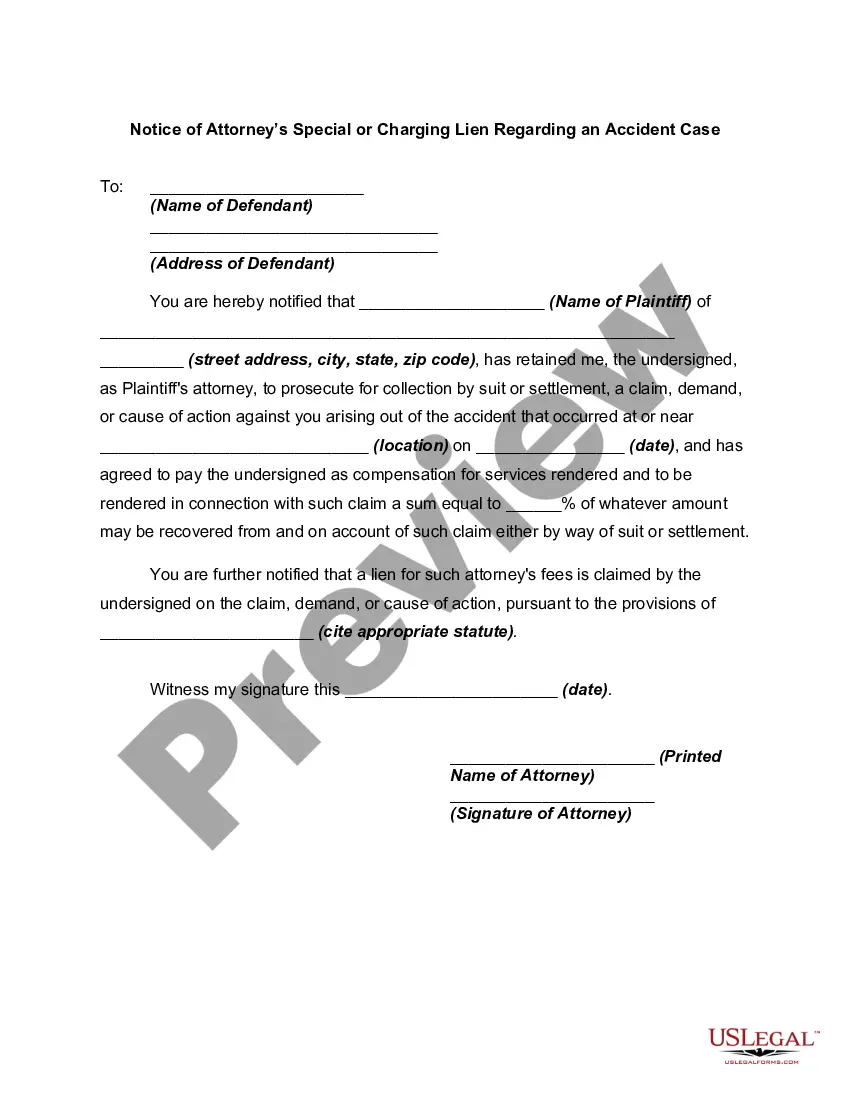
The Notice of Attorney's Special or Charging Lien Regarding an Accident Case is a legal document used by attorneys to inform a defendant that a lien exists on any potential recovery from an accident case. This form is essential for establishing the attorney's right to collect fees from any settlement or judgment awarded to the plaintiff. Unlike other liens, this specific lien pertains to cases involving accidents where legal representation is sought to recover damages.
Main sections of this form
- Identification of the defendant involved in the accident.
- Name and contact information of the plaintiff.
- Details about the accident, including location and date.
- Specification of the attorney's fees as a percentage of recovery.
- Citation of the appropriate statute that supports the lien.
- Signatures of the attorney and the date of signing.
When this form is needed
This form should be used when an attorney is officially representing a plaintiff in an accident case and has established a fee agreement that includes a lien on any potential recovery. It is necessary to notify the defendant of this lien to ensure the attorney's right to collect fees is legally recognized. This document is important in cases where an accident has led to damages and where legal action is being considered or pursued.
Who can use this document
- Attorneys representing clients in accident cases.
- Plaintiffs seeking legal representation for their claims.
- Defendants in accident cases who need to understand potential legal obligations regarding attorney fees.
Steps to complete this form
- Identify and enter the defendant's name and address at the top of the form.
- Fill in the plaintiff's name and complete address.
- Provide the location and date of the accident in the designated sections.
- Specify the percentage of the recovery that will be awarded to the attorney as fees.
- Cite the relevant statute that governs the lien in your jurisdiction.
- Have the attorney print and sign their name, including the date of completion.
Does this document require notarization?
This form does not typically require notarization to be legally valid. However, some jurisdictions or document types may still require it. US Legal Forms provides secure online notarization powered by Notarize, available 24/7 for added convenience.
Get your form ready online
Our built-in tools help you complete, sign, share, and store your documents in one place.
Make edits, fill in missing information, and update formatting in US Legal Forms—just like you would in MS Word.
Download a copy, print it, send it by email, or mail it via USPS—whatever works best for your next step.
Sign and collect signatures with our SignNow integration. Send to multiple recipients, set reminders, and more. Go Premium to unlock E-Sign.
If this form requires notarization, complete it online through a secure video call—no need to meet a notary in person or wait for an appointment.
We protect your documents and personal data by following strict security and privacy standards.

Make edits, fill in missing information, and update formatting in US Legal Forms—just like you would in MS Word.

Download a copy, print it, send it by email, or mail it via USPS—whatever works best for your next step.

Sign and collect signatures with our SignNow integration. Send to multiple recipients, set reminders, and more. Go Premium to unlock E-Sign.

If this form requires notarization, complete it online through a secure video call—no need to meet a notary in person or wait for an appointment.

We protect your documents and personal data by following strict security and privacy standards.
Typical mistakes to avoid
- Failing to include accurate contact information for all parties involved.
- Not specifying the percentage of fees, which can lead to disputes later.
- Omitting the citation of the relevant statute, which is necessary for legal validity.
- Not signing or dating the form, making it unenforceable.
Advantages of online completion
- Convenient access to a legally compliant template anytime, anywhere.
- Editable sections allow for customization based on specific details of the case.
- Guaranteed reliability, as the forms are drafted by licensed attorneys.
Looking for another form?

Form popularity
FAQ
The right of a lawyer to hold a client's property until the client pays for legal services provided. The property may include business files, official documents, and money awarded by a court.
2. States where the lien law doesn't require a written contract. In these states, contractors and suppliers are generally allowed to file a lien even if they don't have a written contract.These states typically permit parties with verbal, oral, or even implied contracts to claim lien rights.
Someone who is owed money is generally not able to just put a lien on property without first securing a judgment. Securing a judgment requires the creditor to sue the debtor. This may be through circuit court in many jurisdictions. If under a certain dollar amount, this suit may be through the small claims court.
Which is a voluntary lien against a person's property? Mortgage lien.
A type of attorney's lien under which a lawyer acquires an interest in a judgment awarded to the client. This may mean that the lawyer can eventually claim a portion of any money paid to the client due to the judgment. The lien arises because the client's failure to pay for legal services. See Retaining lien (compare).
A lien is a demand for repayment that may be placed against your personal injury case. Your health insurance provider may also issue a lien to recover any money it spends on your personal injury accident treatment.
If a creditor gets a judgment against you, it can then place a lien on your property. The lien gives the creditor an interest in your property so that it can get paid for the debt you owe.And in some cases, the lien gives the creditor the right to force a sale of your property in order to get paid.
The short answer to that question is usually no. If somebody owes you money you could sue them, you could obtain a judgment, you can obtain what's called a "judgment lien" and once you get the judgment lien, you can have the court record that against their property including the real estate.