Release of Claims against Estate by Creditor
Understanding this form
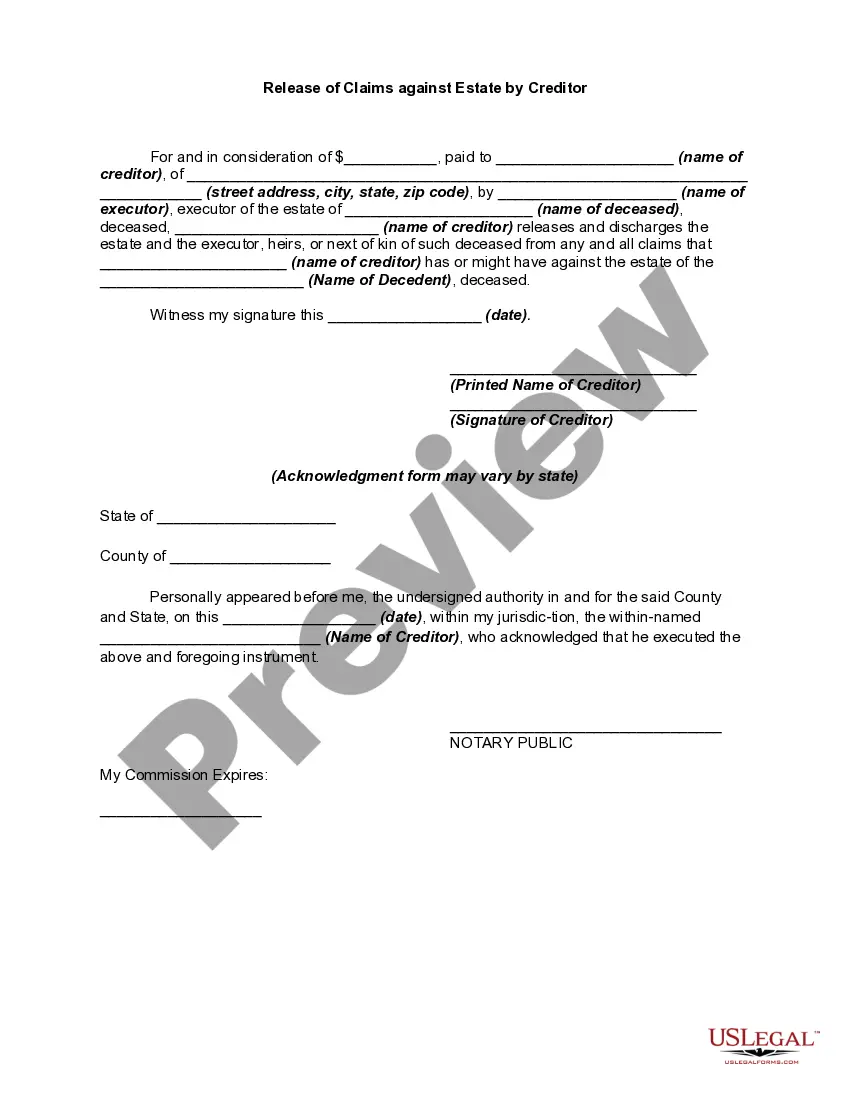
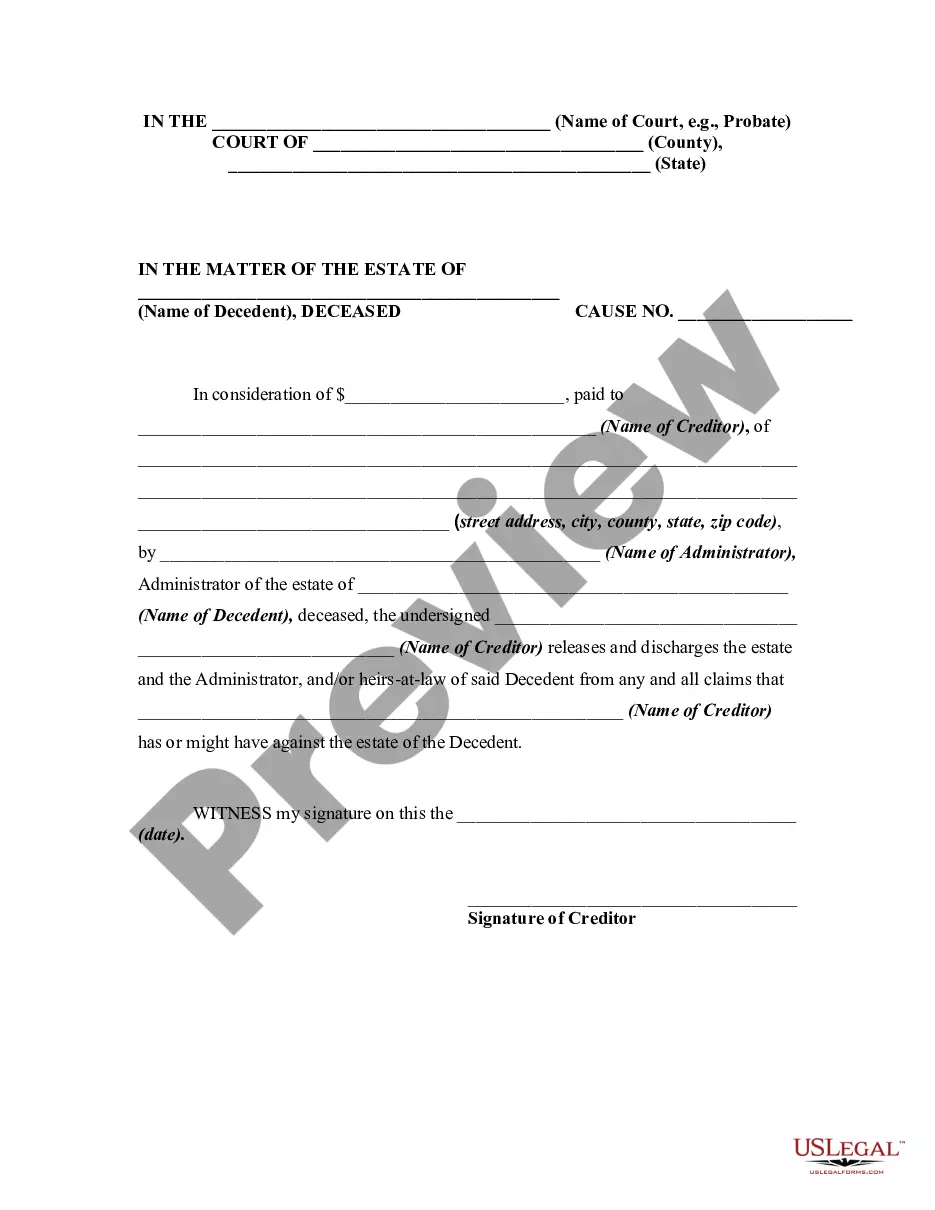
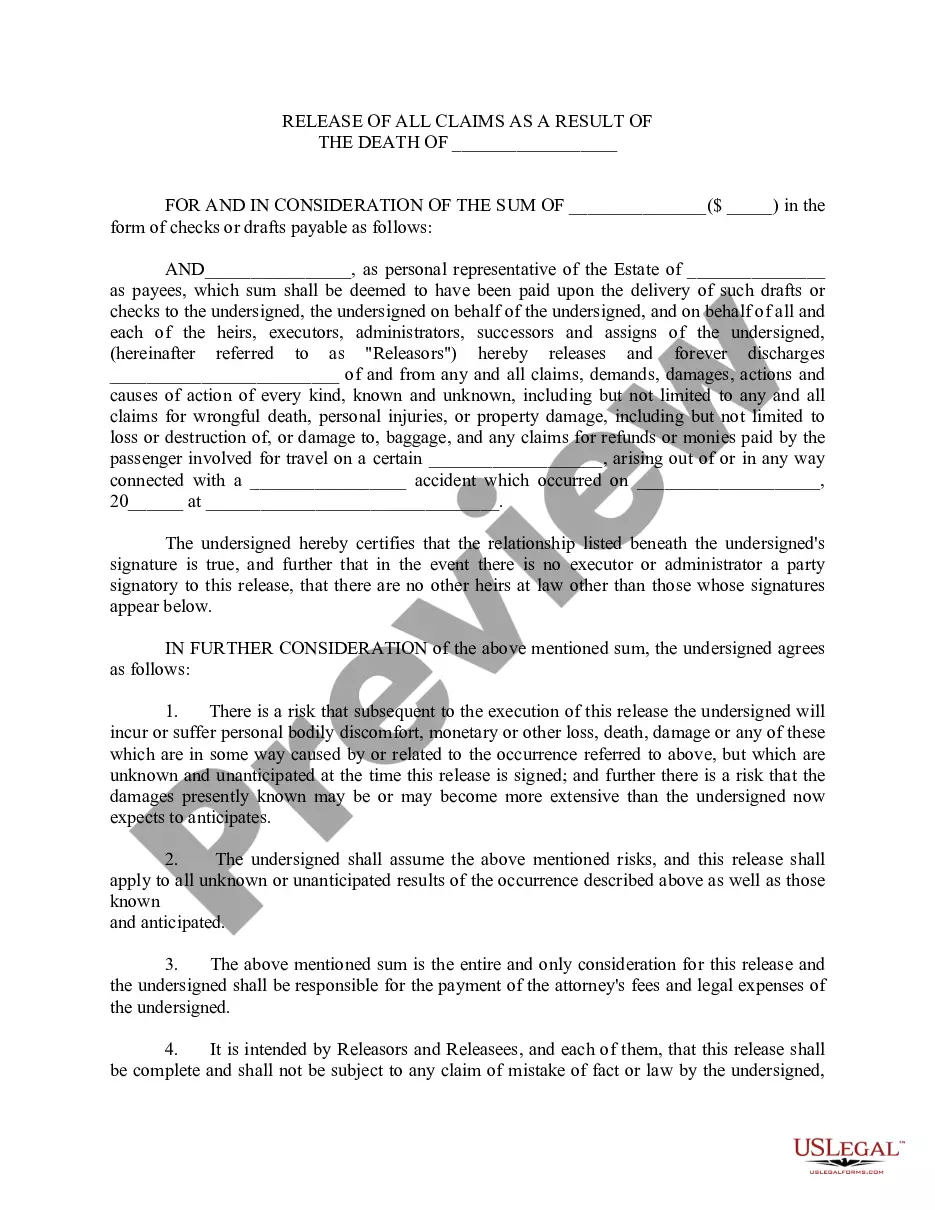
The Release of Claims against Estate by Creditor is a legal document that allows a creditor to formally release any claims they may have against a deceased person's estate. This form is essential in the probate process, ensuring that the estate's executor can settle debts before distributing assets to the heirs. It differs from similar documents by specifically focusing on the release aspect, allowing creditors to affirm that they will not pursue further claims against the estate once they receive payment or compensation.
Key parts of this document
- Creditor's name and address, identifying who is releasing claims.
- Name of the executor of the deceased's estate, affirming their role.
- The name of the deceased, clarifying whose estate is involved.
- Consideration paid, specifying what amount is being exchanged for the release.
- Signature of the creditor, providing legal validation to the agreement.
- Notary acknowledgment, which may be required to ensure authenticity.
Situations where this form applies
This form should be used when a creditor has a valid claim against a deceased person's estate but wishes to release that claim after receiving payment or compensation. It is applicable in situations where the creditor, after evaluating their claim and the estateâs ability to pay, decides to discharge their rights in exchange for a specified amount, facilitating the estate's smooth probate process.
Who this form is for
- Creditors of a deceased individual who have claims against the estate.
- Executors managing the deceased's estate seeking to settle debts.
- Heirs or beneficiaries wanting assurance that claims against the estate have been resolved.
How to prepare this document
- Identify the creditor by entering their name and address at the beginning of the form.
- Fill in the name of the executor who is responsible for the estate.
- Specify the name of the deceased to clarify whose estate is referenced.
- Enter the amount being paid to the creditor as consideration for the release.
- Have the creditor sign and date the document to validate their release of claims.
- If required, complete the notary acknowledgment section to ensure the document is legally binding.
Notarization requirements for this form
Yes, this form must be notarized to be legally valid. Notarization helps verify the identity of the creditor and the authenticity of their signature. US Legal Forms offers integrated online notarization services that are available 24/7, allowing users to complete the notarization process securely via video call without the need to travel.
Get your form ready online
Our built-in tools help you complete, sign, share, and store your documents in one place.
Make edits, fill in missing information, and update formatting in US Legal Forms—just like you would in MS Word.
Download a copy, print it, send it by email, or mail it via USPS—whatever works best for your next step.
Sign and collect signatures with our SignNow integration. Send to multiple recipients, set reminders, and more. Go Premium to unlock E-Sign.
If this form requires notarization, complete it online through a secure video call—no need to meet a notary in person or wait for an appointment.
We protect your documents and personal data by following strict security and privacy standards.

Make edits, fill in missing information, and update formatting in US Legal Forms—just like you would in MS Word.

Download a copy, print it, send it by email, or mail it via USPS—whatever works best for your next step.

Sign and collect signatures with our SignNow integration. Send to multiple recipients, set reminders, and more. Go Premium to unlock E-Sign.

If this form requires notarization, complete it online through a secure video call—no need to meet a notary in person or wait for an appointment.

We protect your documents and personal data by following strict security and privacy standards.
Common mistakes to avoid
- Failing to specify the amount of consideration paid to the creditor.
- Not including the correct names of the estateâs executor and deceased individual.
- Omitting the notary acknowledgment where required, which can invalidate the form.
- Leaving out signatures or dates, resulting in an incomplete document.
Why use this form online
- Convenience of completing and downloading the form anytime, anywhere.
- Editability allows users to input their specific details easily.
- Reliability, with templates drafted by licensed attorneys ensuring legal compliance.
Key takeaways
- The Release of Claims against Estate by Creditor is essential for settling debts during the probate process.
- Creditors must ensure the form is accurately completed and notarized for it to be valid.
- Using this form can simplify the process of resolving claims against a deceased individualâs estate.
Looking for another form?
Form popularity
FAQ
The statute of limitations for filing a claim against an estate is a strict one year from the date of the debtor's death (pursuant to California Code of Civil Procedure Section 366.2). This limitation period applies regardless of whether the judgment creditor knew the judgment debtor had died!
First things first: At death, your assets become your estate. The process of dividing up debt after your death is called probate. The length of time creditors have to make a claim against the estate depends on where you live. It can range anywhere from three months to nine months.
Creditors typically can't go after certain assets like your retirement accounts, living trusts or life insurance benefits to pay off debts. These assets go to the named beneficiaries and aren't part of the probate process that settles your estate.
Fully documented claims (including documents of ID and personal representative documents) must be received within 30 years of the date of death. If BVD receives a claim whether fully documented or not, outside the 30 year time limit it will not be considered.
Paying off debts from the estate Well-established practice is that an executor will wait six months after the date of death to allow for any creditors to intimate their claims before making payment to beneficiaries.
They can do this by sending a copy of your death certificate to each creditor.Your creditors will inform the three major credit bureaus (Experian, TransUnion and Equifax) of your death so they can prevent others from using your name to apply for credit.
Creditors' RightsCreditors, however, have only a set amount of timeabout three to six months, in most statesto submit formal claims to your executor. A creditor who is properly notified of the probate court proceeding cannot file a claim after the deadline passes.
Timespan for Creditors to Make Claim For unsecured debts, the time limit ranges from 3-6 months in most states. State laws require executors to post notice of the death, either in a newspaper or directly to known creditors to give them a chance to file a claim. No claims are accepted after the time frame has expired.
Lessons for Creditors and Beneficiaries However, until the petition is granted and an executor or personal representative is appointed, the creditor will not be able to sue the decedent's estate and in the interim the available assets may be dissipated.