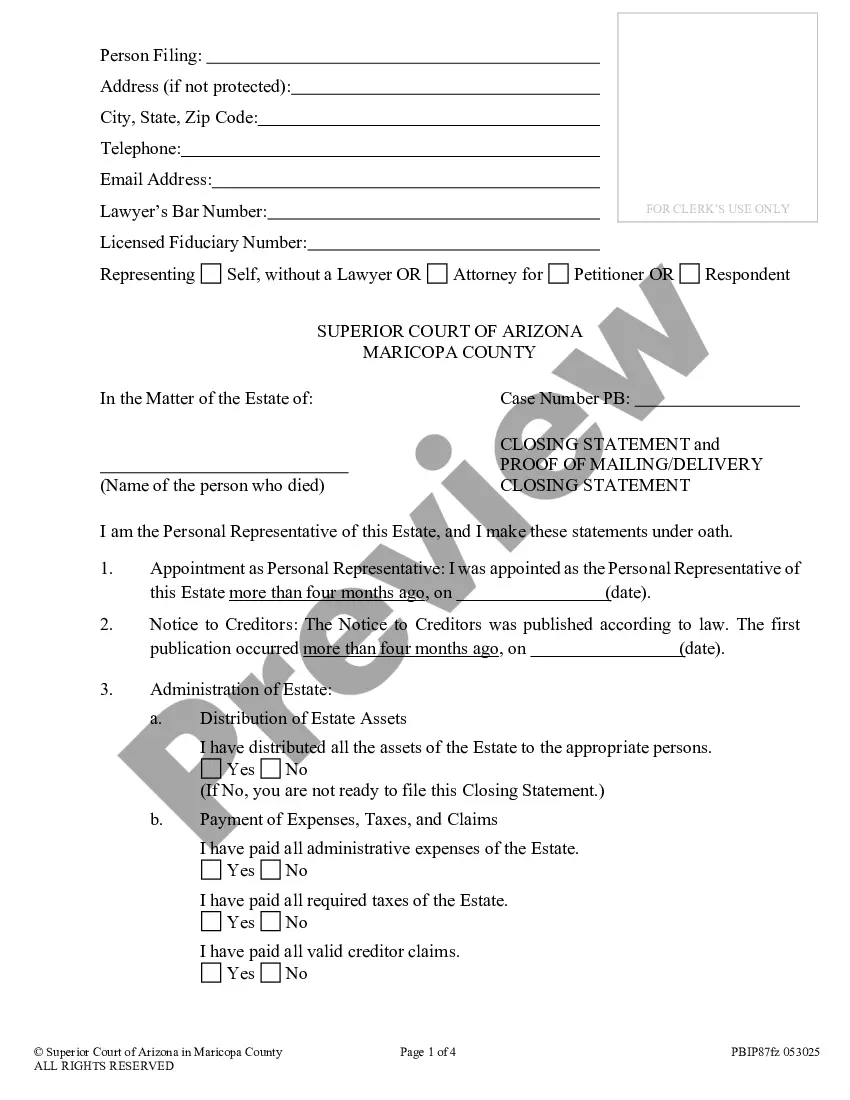
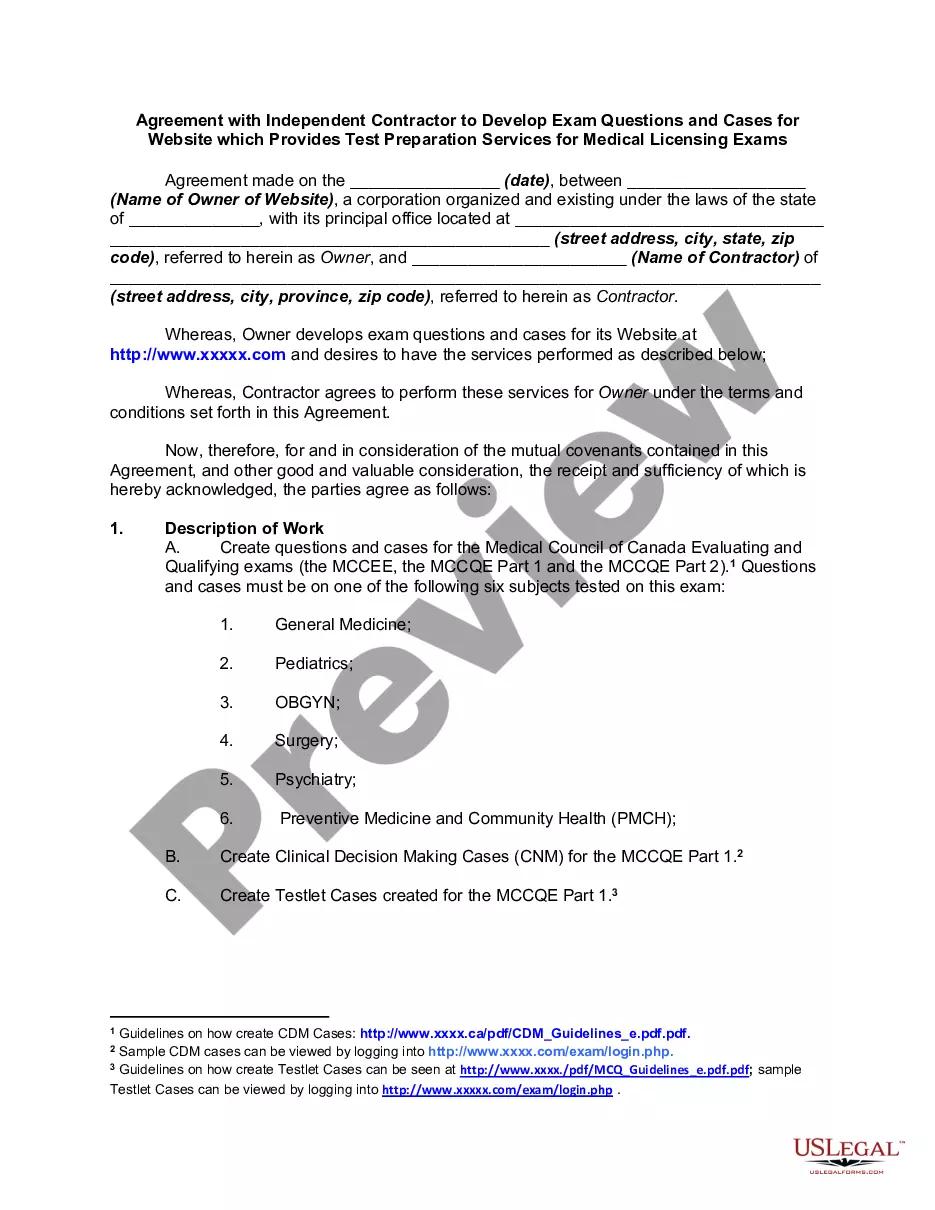
Privacy Policy and Terms of Use for Web Site which Provides Test Preparation Services for Medical Licensing Exams
Understanding this form
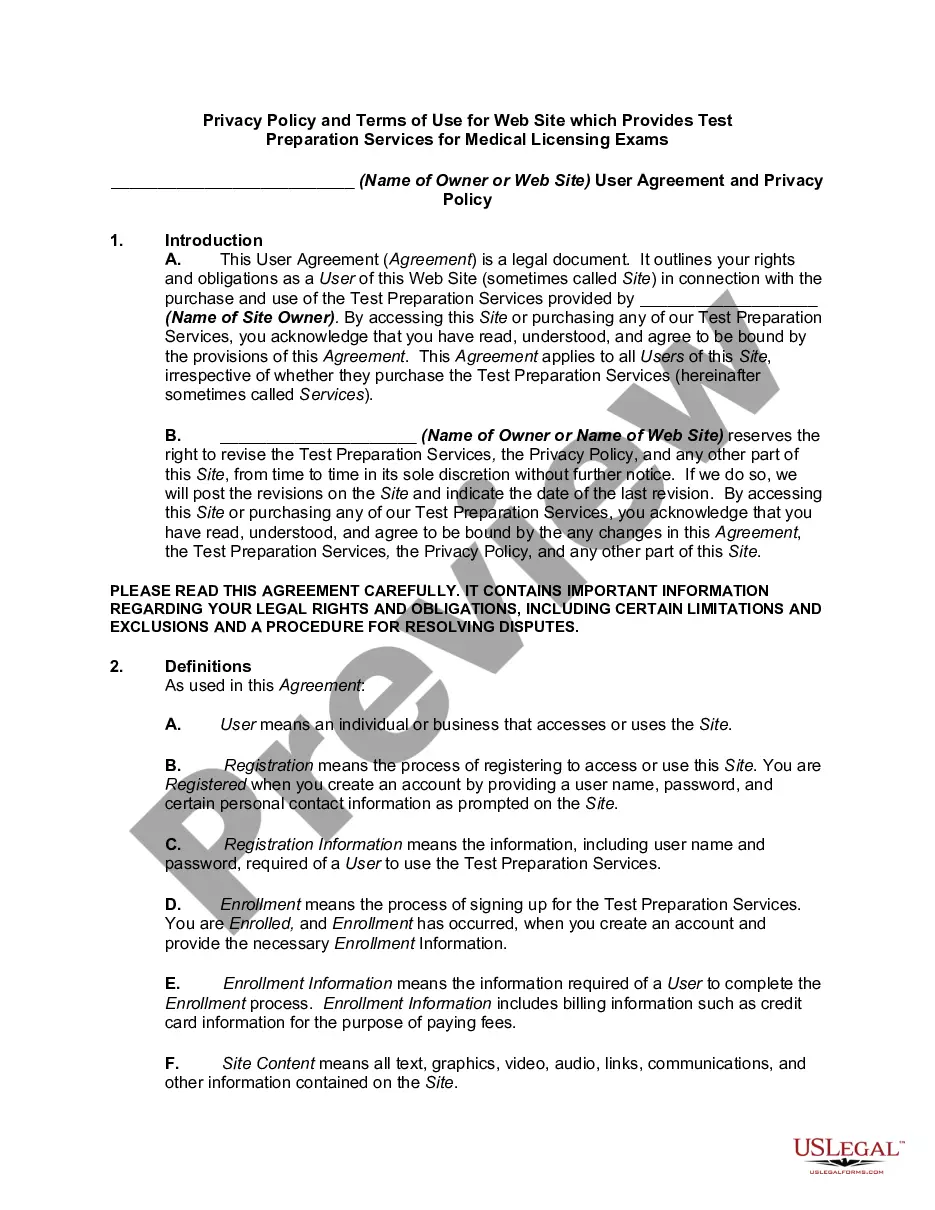
This Privacy Policy and Terms of Use form is a legal agreement that outlines the rights and responsibilities of users when accessing a website offering test preparation services for medical licensing exams. This form is essential to protect the privacy of users and to clarify the terms under which services are provided, differentiating it from general terms of service forms tailored for various online platforms.
Key components of this form
- Introduction: Details the agreement's legality and the user's acknowledgment of its terms.
- Definitions: Clarifies key terms used throughout the agreement.
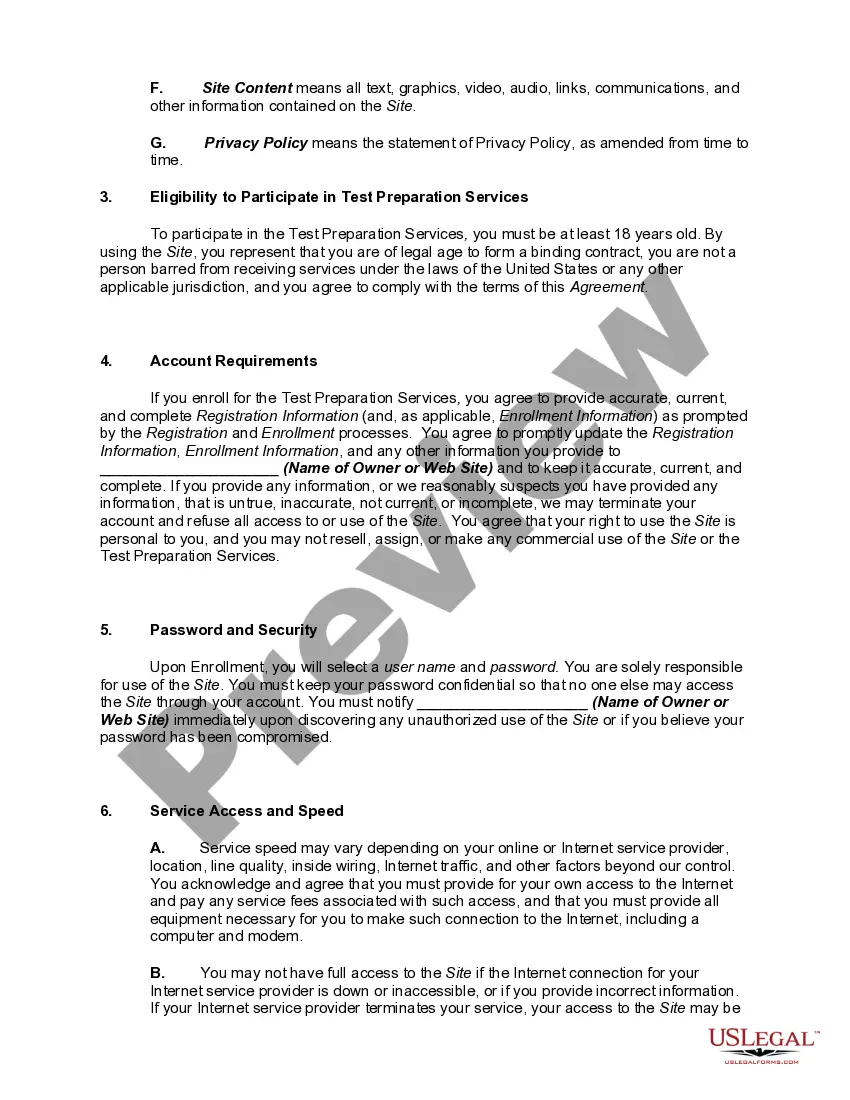
- Account Requirements: Outlines the information users must provide to register and enroll in services.
- Privacy Policy: Describes how personal information is collected, used, and protected.
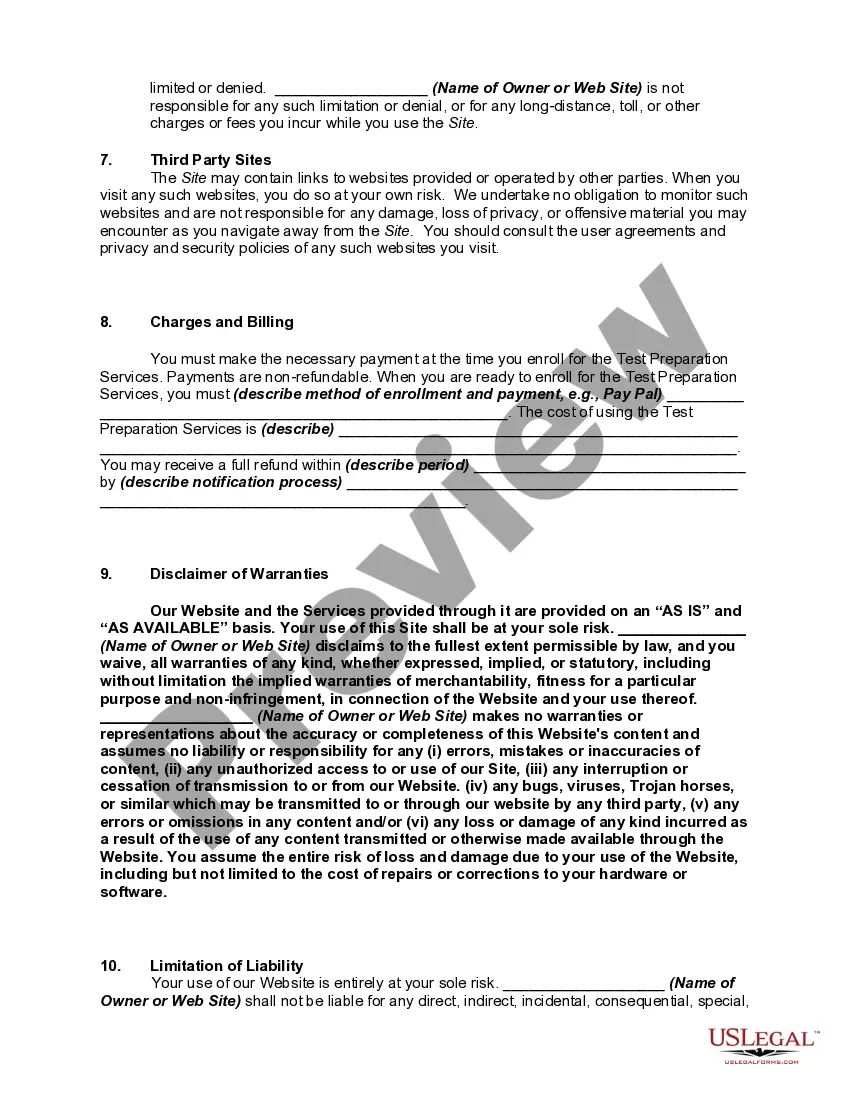
- Indemnification: Details user responsibilities regarding claims resulting from their use of the site.
When to use this document
This form should be utilized when creating a website that offers test preparation services, ensuring that users are informed about their rights and the handling of their personal information. It is particularly relevant when users are asked to provide personal data and payment information, thus establishing legal protection for both the service provider and its users.
Who needs this form
This form is intended for:
- Website owners providing test preparation services, particularly in the medical field.
- Developers of educational platforms seeking to ensure compliance with privacy laws.
- Businesses aiming to clarify usage terms to protect themselves legally.
Instructions for completing this form
- Identify the name of the website owner or organization providing the services.
- Clearly define the terms and definitions relevant to users and their engagement with the site.
- Outline privacy practices, ensuring users understand how their information will be handled.
- Specify the enrollment and payment process for accessing the services.
- Review the terms thoroughly to ensure compliance with applicable laws and adjust as necessary.
Notarization guidance
Notarization is generally not required for this form. However, certain states or situations might demand it. You can complete notarization online through US Legal Forms, powered by Notarize, using a verified video call available anytime.
Get your form ready online
Our built-in tools help you complete, sign, share, and store your documents in one place.
Make edits, fill in missing information, and update formatting in US Legal Forms—just like you would in MS Word.
Download a copy, print it, send it by email, or mail it via USPS—whatever works best for your next step.
Sign and collect signatures with our SignNow integration. Send to multiple recipients, set reminders, and more. Go Premium to unlock E-Sign.
If this form requires notarization, complete it online through a secure video call—no need to meet a notary in person or wait for an appointment.
We protect your documents and personal data by following strict security and privacy standards.

Make edits, fill in missing information, and update formatting in US Legal Forms—just like you would in MS Word.

Download a copy, print it, send it by email, or mail it via USPS—whatever works best for your next step.

Sign and collect signatures with our SignNow integration. Send to multiple recipients, set reminders, and more. Go Premium to unlock E-Sign.

If this form requires notarization, complete it online through a secure video call—no need to meet a notary in person or wait for an appointment.

We protect your documents and personal data by following strict security and privacy standards.
Common mistakes to avoid
- Failing to clearly explain how personal information is used and shared.
- Not updating the policy regularly to reflect changes in law or business practices.
- Using legal jargon that may confuse users rather than providing clear and understandable language.
Advantages of online completion
- Convenience of digital access allows for quick updates and accessibility for users.
- Editability enables website owners to tailor the agreement to changing legal requirements.
- Reliability in ensuring compliance with legal standards helps safeguard against liability.
Legal use & context
- This document is enforceable in a court of law and provides clear guidelines for both users and the website owner.
- Including a privacy policy is often legally required to protect user data and boost trust.
- Failing to use a clear agreement may expose the site operator to legal risks.
Main things to remember
- A Privacy Policy and Terms of Use form is essential for protecting user information online.
- Understanding user rights and obligations helps build trust between users and service providers.
- Regular reviews and updates of the document are necessary to maintain compliance with evolving laws.
Looking for another form?









Form popularity
FAQ
According to the USMLE Step 1 Content Outline, Step 1 questions are classified in 1 of 18 major areas. Questions mainly covers basic scientific principles including anatomy, behavioral sciences, biochemistry, biostatistics & epidemiology, microbiology, pathology, pharmacology, and physiology.
Before you can apply for a medical license, you must pass a three-step test called the United States Medical Licensing Examination (USMLE), also known as the board exam.
All medical school graduates who have passed Step 1, Step 2 CK, and Step 2 CS: apply through FSMB. Information and links to an online or paper application are available on the Medical Licensing Examination page of the FSMB website.
Visit the exam log-in page. The NBME will email you your USMLE ID and a temporary password. Once you receive this information, you should log in to the menu item: Apply for the USMLE. You will then be successfully logged on to the NBME Interactive Website. You will be asked to read the application instructions.
On February 12, 2020, the Federation of State Medical Boards (FSMB) and the National Board of Medical Examiners (NBME) announced the following policy changes: USMLE Step 1 will be a pass/fail exam.
USMLE Step 1. Votes: 46 80.7% USMLE Step 2 CK. Votes: 7 12.3% USMLE Step 2 CS. Votes: 5 8.8% USMLE Step 3. Votes: 5 8.8%
The USMLE Step 1, in particular, is one of the most stressful and difficult exams you will take in your medical school career. Your performance on this exam will essentially set the tone for your success, or failure, in the residency match process.Basically, you must do well on this exam.
Unlike the USMLE Step 1, Step 2 CK, and Step 2 CS (which we have also been discussing in recent weeks), the USMLE Step 3 is not required for ECFMG certification or for success in the residency application process.
It is more difficult to prepare to do well on the MCAT as compared to step 1. You can study for step 1, not so much for the mcat. I know of people who had average or below average mcat's do really well in med school, crush step 1/2 and go on to outstanding residencies.