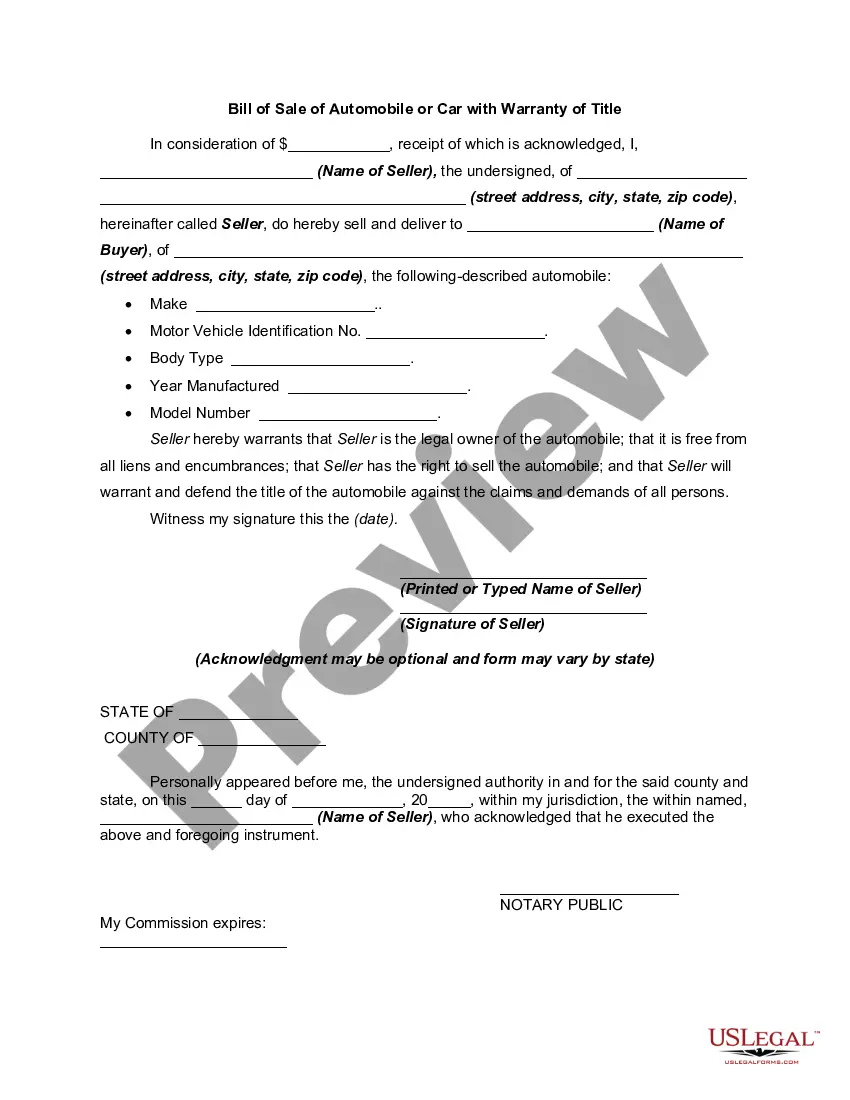
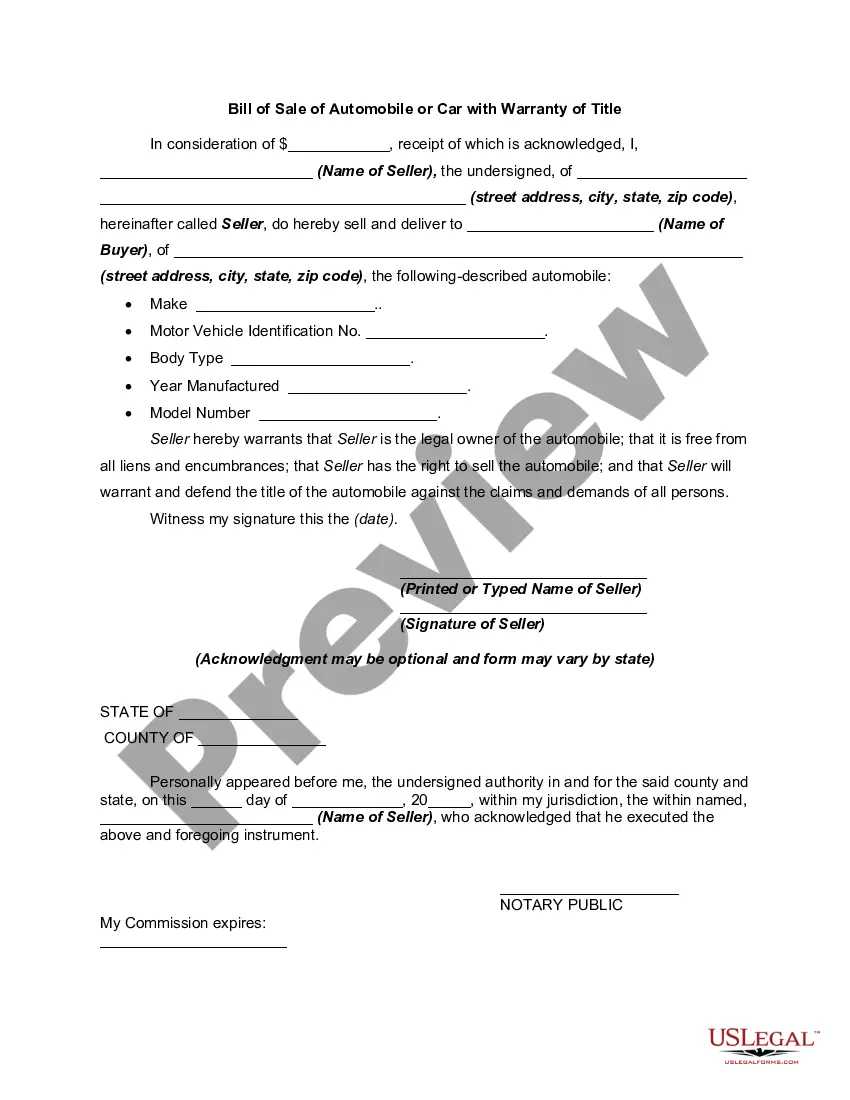
Bill of Sale of Automobile or Car with Warranty of Title
What this document covers
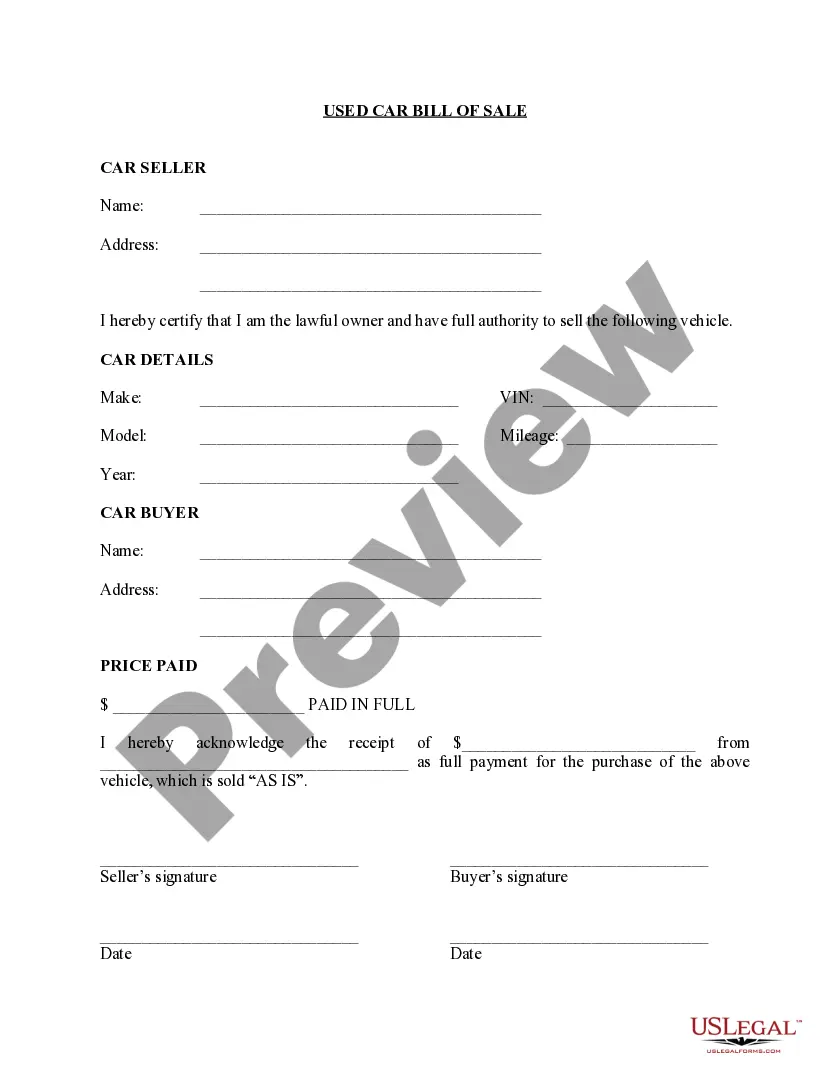
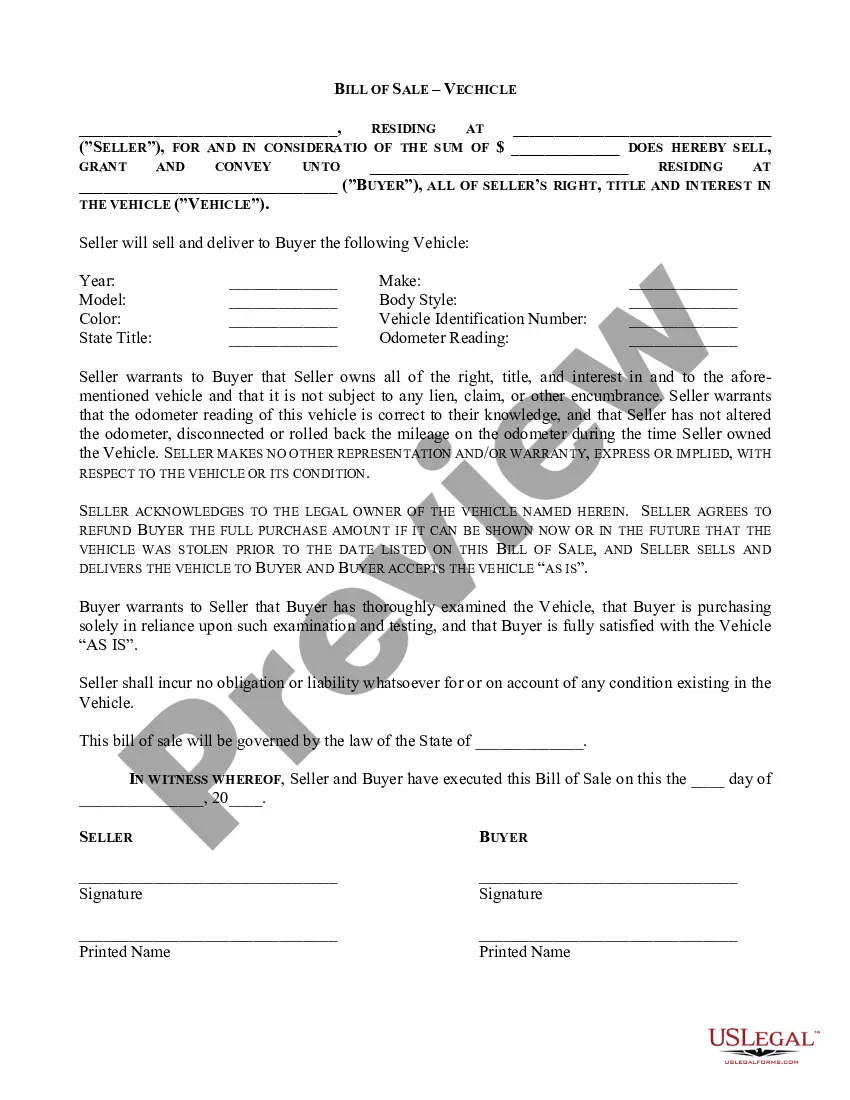
The Bill of Sale of Automobile or Car with Warranty of Title is a legal document used to transfer ownership of a vehicle from the seller to the buyer. This form not only details the sale transaction but also includes a warranty of title, assuring the buyer that the seller is the rightful owner and that the vehicle is free from any legal claims or liens. This form distinguishes itself from other sale documents by providing added protection for the buyer regarding the title ownership.
Key parts of this document
- Consideration amount: The price for which the vehicle is being sold.
- Seller's information: Name and address of the seller.
- Buyer's information: Name and address of the buyer.
- Vehicle description: Make, model, year, and Vehicle Identification Number (VIN) of the automobile.
- Warranty statement: Assurance from the seller that they own the vehicle and it is free of encumbrances.
- Signatures: Signatures of both the seller and a notary public (if required).
Situations where this form applies
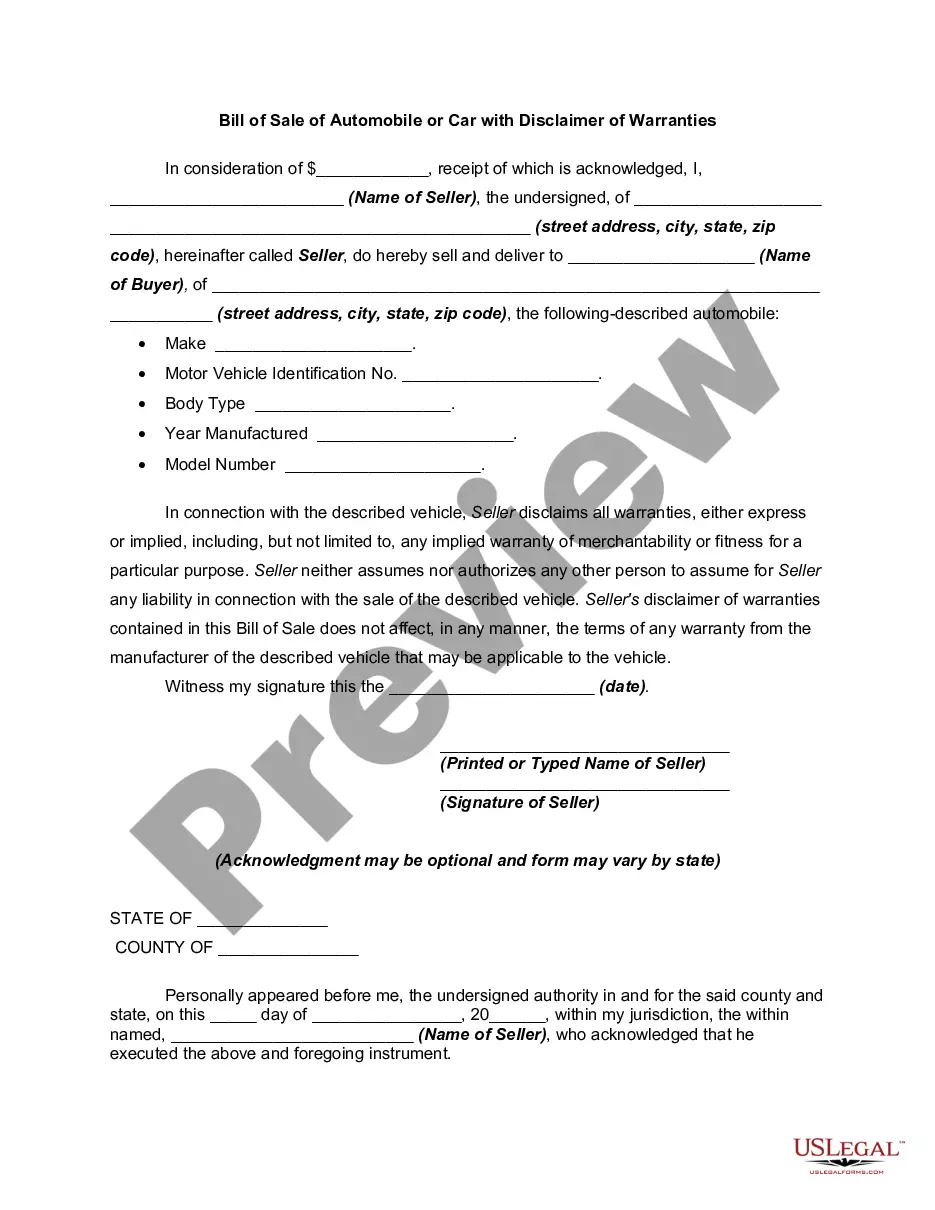
This bill of sale form is essential when you are buying or selling an automobile. It is particularly useful when you want to provide a secure transaction with a warranty of title, assuring the buyer of the sellerâs legal ownership. Use this form when there is a change of ownership, whether in a private sale or as part of a dealership transaction, to formalize the sale and protect both parties involved.
Who can use this document
This form is intended for:
- Individuals buying or selling a car privately.
- Dealerships facilitating automobile sales.
- Anyone who wants to ensure clear and legal ownership transfer of a vehicle.
Instructions for completing this form
- Identify the parties: Complete the seller's and buyer's names and addresses.
- Specify the vehicle: Fill in the make, model, year, and VIN of the vehicle being sold.
- Enter consideration: Indicate the sale price of the vehicle.
- Warrant ownership: The seller should confirm that they are the legal owner and the title is clear of liens.
- Sign the document: Both the seller and a notary public (if required) should sign and date the form.
Does this form need to be notarized?
This form does not typically require notarization unless specified by local law. Check your stateâs requirements to ensure legal validity.
Get your form ready online
Our built-in tools help you complete, sign, share, and store your documents in one place.
Make edits, fill in missing information, and update formatting in US Legal Forms—just like you would in MS Word.
Download a copy, print it, send it by email, or mail it via USPS—whatever works best for your next step.
Sign and collect signatures with our SignNow integration. Send to multiple recipients, set reminders, and more. Go Premium to unlock E-Sign.
If this form requires notarization, complete it online through a secure video call—no need to meet a notary in person or wait for an appointment.
We protect your documents and personal data by following strict security and privacy standards.

Make edits, fill in missing information, and update formatting in US Legal Forms—just like you would in MS Word.

Download a copy, print it, send it by email, or mail it via USPS—whatever works best for your next step.

Sign and collect signatures with our SignNow integration. Send to multiple recipients, set reminders, and more. Go Premium to unlock E-Sign.

If this form requires notarization, complete it online through a secure video call—no need to meet a notary in person or wait for an appointment.

We protect your documents and personal data by following strict security and privacy standards.
Avoid these common issues
- Failing to complete all sections of the form, which may lead to disputes.
- Not including detailed vehicle information, such as the VIN.
- Omitting signatures or dates, which can render the document invalid.
Advantages of online completion
- Convenience: Access and complete the form from anywhere at any time.
- Editability: Make changes easily before printing or finalizing.
- Reliability: Legal forms are drafted by licensed attorneys to ensure compliance with laws.
Looking for another form?
Form popularity
FAQ
Similar to a receipt, a bill of sale is a written instrument that attests to a buyer's purchase of property from a seller.In other words, receipts are not bills of sale but a bill of sale may serve as a receipt.
The date of the sale. A description of the car, including its: Year, make and model. The selling price of the car. If the car is a gift or partial gift, you should still create a bill of sale. Warranty information. The full names, addresses and signatures of the buyer and seller.
When land, houses, apartments, and other forms of real estate are sold or leased, the real estate usually comes with at least one warranty. In a sale of realty, the seller usually includes a warranty regarding the title to the property.This means that some party other than the seller has a claim to the property.
A warranty bill of sale offers protections for the buyer that a simple receipt does not. This kind of bill of sale clearly details what is being sold and gives a guarantee to the buyer about the seller's ownership rights. The bill of sale promises that the buyer holds full and clear title to the item sold.
Can a Bill of Sale Be Handwritten? A bill of sale is a legal document that verifies you have sold your car and provides basic information about the vehicle or any other item and the terms of the sale.As, with any legal written document a bill of sale can be handwritten.
Begin by labeling the receipt as "Bill of Sale" and list the date of the transaction. Identify all the pertinent identification for your car so there's no confusion about what's being sold. Write the car make, model, registration number and mileage on the face of the receipt.
A deed is not a bill of sale. Rather, it conveys what is legally included in the sale. This includes legal details and property specifications. It also usually includes information such as property lines, square footage, landmarks, and additional buildings.
Step 1: Complete a bill of sale. Step 2: Exchange funds. Step 3: Release any liens on the car title. Step 1: Obtain the car title from the seller. Step 2: Fill out the title transfer section on the title. Step 3: Submit the paperwork to the DMV.
A bill of sale is good for a buyer because it documents the condition of the car at the time you bought it; this way if you later find that there are damages that the seller never told you about, you have proof. Having a bill of sale also protects you in the event that the seller denies having sold the car to you.