Reservation of Rights Letter
Overview of this form
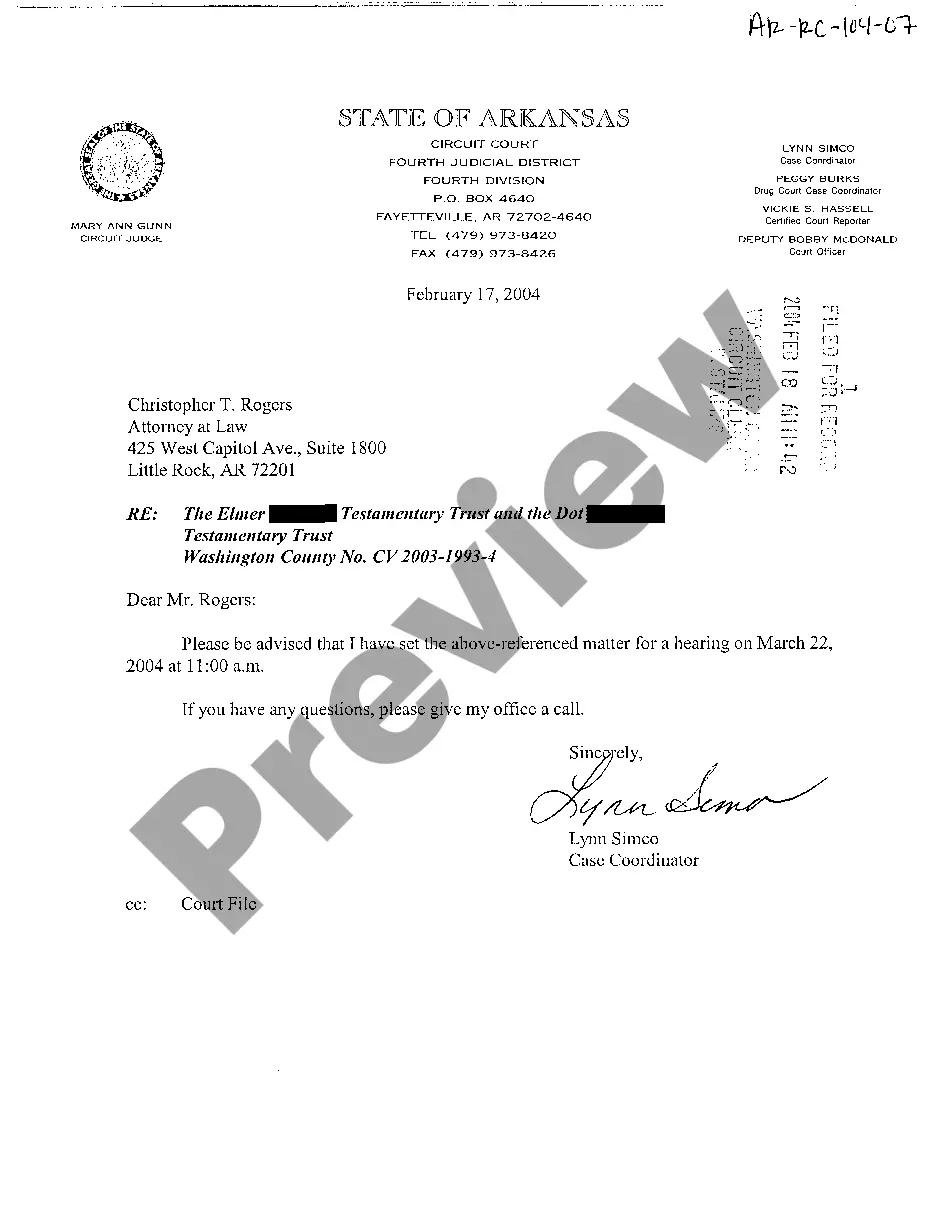
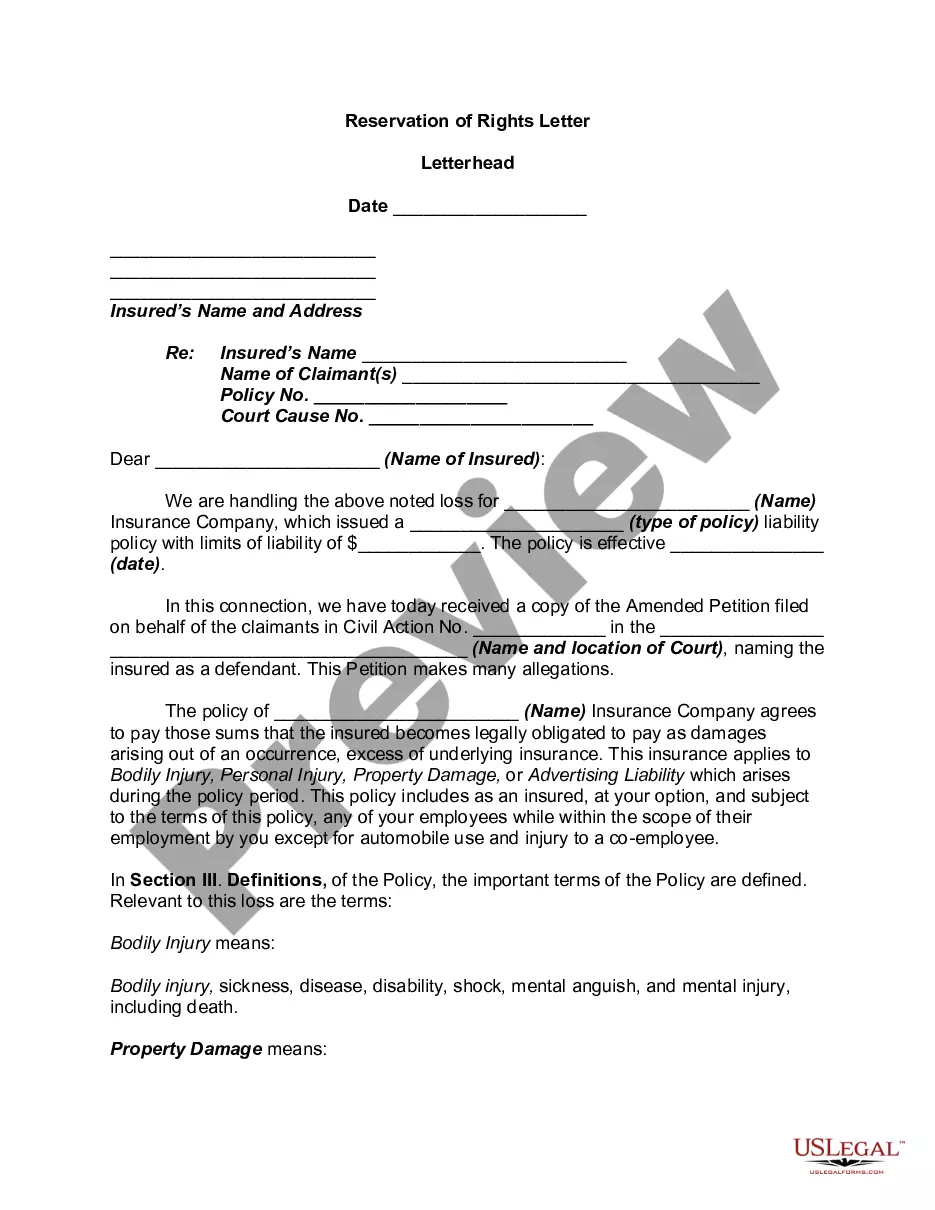
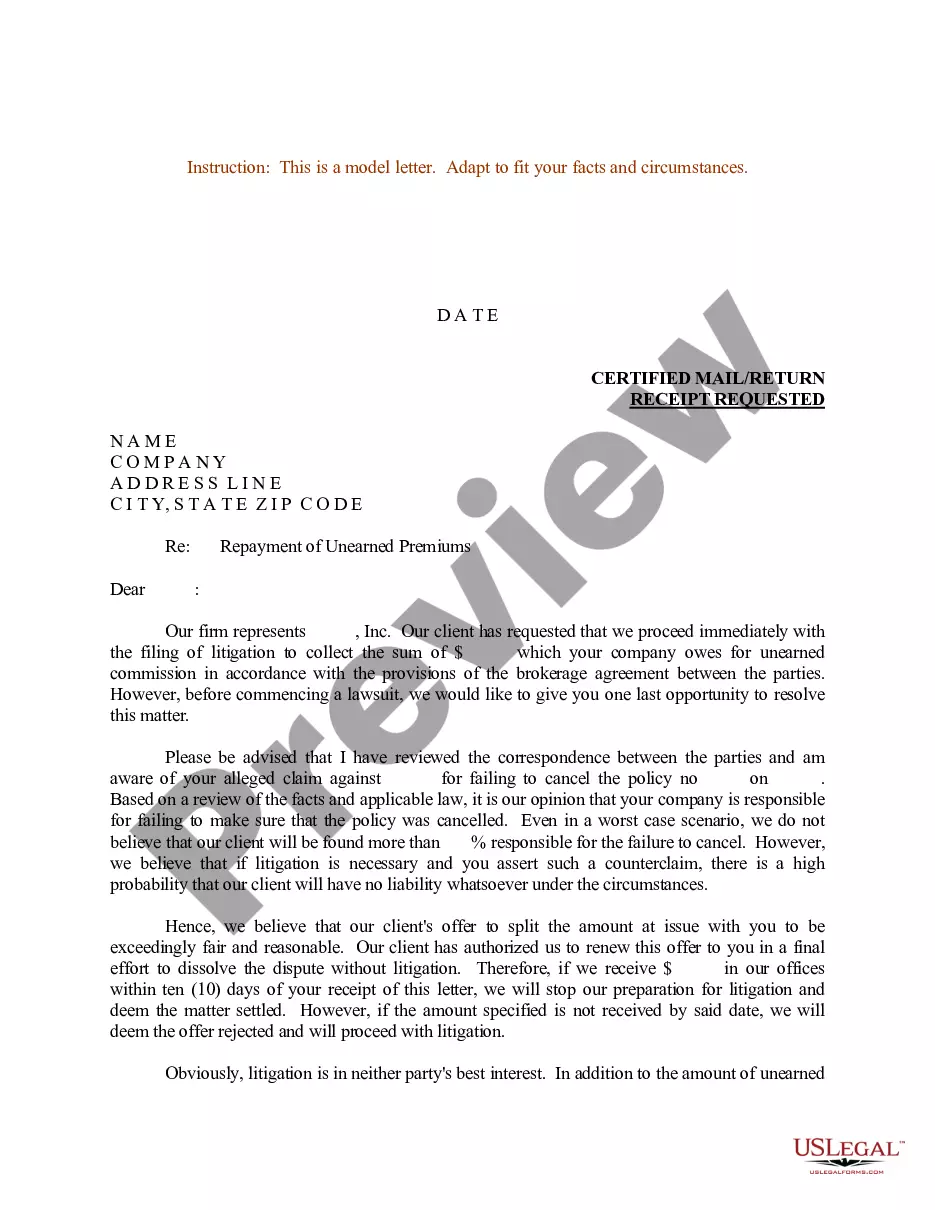
A Reservation of Rights Letter is a legal document used by liability insurance carriers to protect and defend their insured against claims while reserving the right to deny coverage for some or all of the allegations made against them. This form is necessary when there are mixed allegations within a claim, such as claims that include both covered and non-covered allegations. It is essential for business owners, as it helps them monitor possible coverage issues and the implications of an adverse judgment.
Key parts of this document
- Letterhead displaying the sender's information.
- Date field for documentation purposes.
- Insured's name and address for correct identification.
- Details about the insurance policy, including type and limits of liability.
- Allegations detailed in the Amended Petition relevant to the claim.
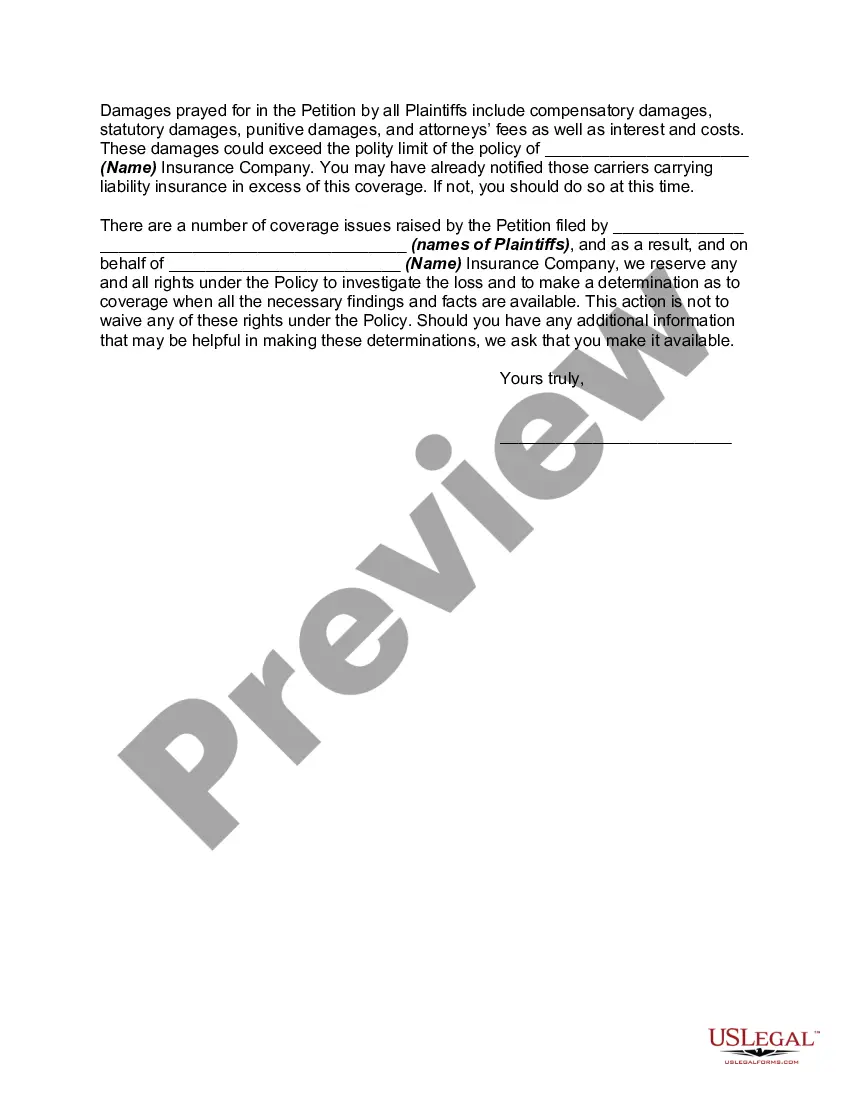
- Reservation of rights statement indicating further investigation is needed.

When to use this document
This form should be used when an insurance company receives a claim that raises questions about coverage. It is commonly executed in situations where the allegations could involve both covered and uncovered claims or when claims exceed the policy limits. Business owners facing lawsuits should utilize this letter to formalize their insurance company's position while investigations are ongoing.
Who can use this document
- Insurance companies responsible for defending claims against their insureds.
- Business owners who are facing lawsuits or claims that may not be fully covered by their liability insurance policy.
- Legal representatives or attorneys handling insurance-related disputes or claims.
How to prepare this document
- Fill in the letterhead with the insurance company's name and contact information.
- Enter the date the letter is being sent.
- Provide the insured's name and address for identification.
- List the claimant's name, policy number, and court details accurately.
- Clearly outline the allegations and specify which fall under bodily injury, property damage, or advertising injury.
- Conclude with the reservation of rights statement and signatures of the authorized representatives.
Does this document require notarization?
This form does not typically require notarization unless specified by local law.
Get your form ready online
Our built-in tools help you complete, sign, share, and store your documents in one place.
Make edits, fill in missing information, and update formatting in US Legal Forms—just like you would in MS Word.
Download a copy, print it, send it by email, or mail it via USPS—whatever works best for your next step.
Sign and collect signatures with our SignNow integration. Send to multiple recipients, set reminders, and more. Go Premium to unlock E-Sign.
If this form requires notarization, complete it online through a secure video call—no need to meet a notary in person or wait for an appointment.
We protect your documents and personal data by following strict security and privacy standards.

Make edits, fill in missing information, and update formatting in US Legal Forms—just like you would in MS Word.

Download a copy, print it, send it by email, or mail it via USPS—whatever works best for your next step.

Sign and collect signatures with our SignNow integration. Send to multiple recipients, set reminders, and more. Go Premium to unlock E-Sign.

If this form requires notarization, complete it online through a secure video call—no need to meet a notary in person or wait for an appointment.

We protect your documents and personal data by following strict security and privacy standards.
Common mistakes to avoid
- Failing to specify all relevant allegations listed in the claim.
- Neglecting to provide complete or accurate policy details.
- Omitting the reservation of rights statement or key disclaimers.
- Not updating the letter if new information about the claim arises.
Why use this form online
- Convenience of easily downloading and filling out the form at your convenience.
- Editability allows for customization to meet specific claim requirements.
- Access to templates drafted by licensed attorneys ensures legal accuracy.
Legal use & context
- A Reservation of Rights Letter is enforceable in court, outlining an insurer's position regarding coverage.
- It protects insurers by allowing them to defend claims while investigating coverage issues.
- Failure to issue this form when necessary may limit an insurer's ability to contest claims later.
Quick recap
- This form helps manage liability claims with mixed allegations.
- It is crucial for business owners to monitor their insurance coverage in legal claims.
- Accurate completion ensures the insurerâs rights are preserved during legal processes.
Looking for another form?

Form popularity
FAQ
State that you are reserving all of your rights under the policy; state that you will cooperate and will provide the information the insurer requested to the attorney the insurer retained to defend you; correct any errors as to dates or facts set forth in the ROR letter;
ROR letters are used when an insurer identifies coverage defenses and/or policy defenses. Insurance companies routinely send reservation of rights letters, as failing to send one can waive their rights. If you receive one, you should contact your insurance company to find out why your claim may not be covered.
The reservation of rights letter contains specific information about the claim, including the policy in question, the claim made against the policy, and the part of the claim that may not be covered.
Insurance companies send a reservation of rights letters because not doing so could be considered a waiver of their rights at a later time.Under a liability insurance policy, your insurer may have a broader obligation to defend the insured than to actually secure against losses.
There are states that required insurance companies to send a letter by certified mail when your rates are transitioned to a much higher premium. Also, if you have been in a bad wreck and they have been seeking verbal recordings or written information from you on the accounts of the incident.
A court might wonder why the insurer abandoned the claim after it initially thought it was covered. The court could say that by its own acts, the insurer waived its rights to deny coverage. The legal system often refers to this as bad faith.A reservation of rights letter does not mean the claim isn't covered.
This creates a potential conflict of interest because the insurer-retained defense counsel may be able to control the insured's defense in such a way as to affect the outcome of the coverage issue.
Reservation of rights is a useful tool for the insurer to protect itself against the risk of loss of coverage or avoidance rights.