Report on the filing or determination of an action or appeal regarding a copyright
What is this form?
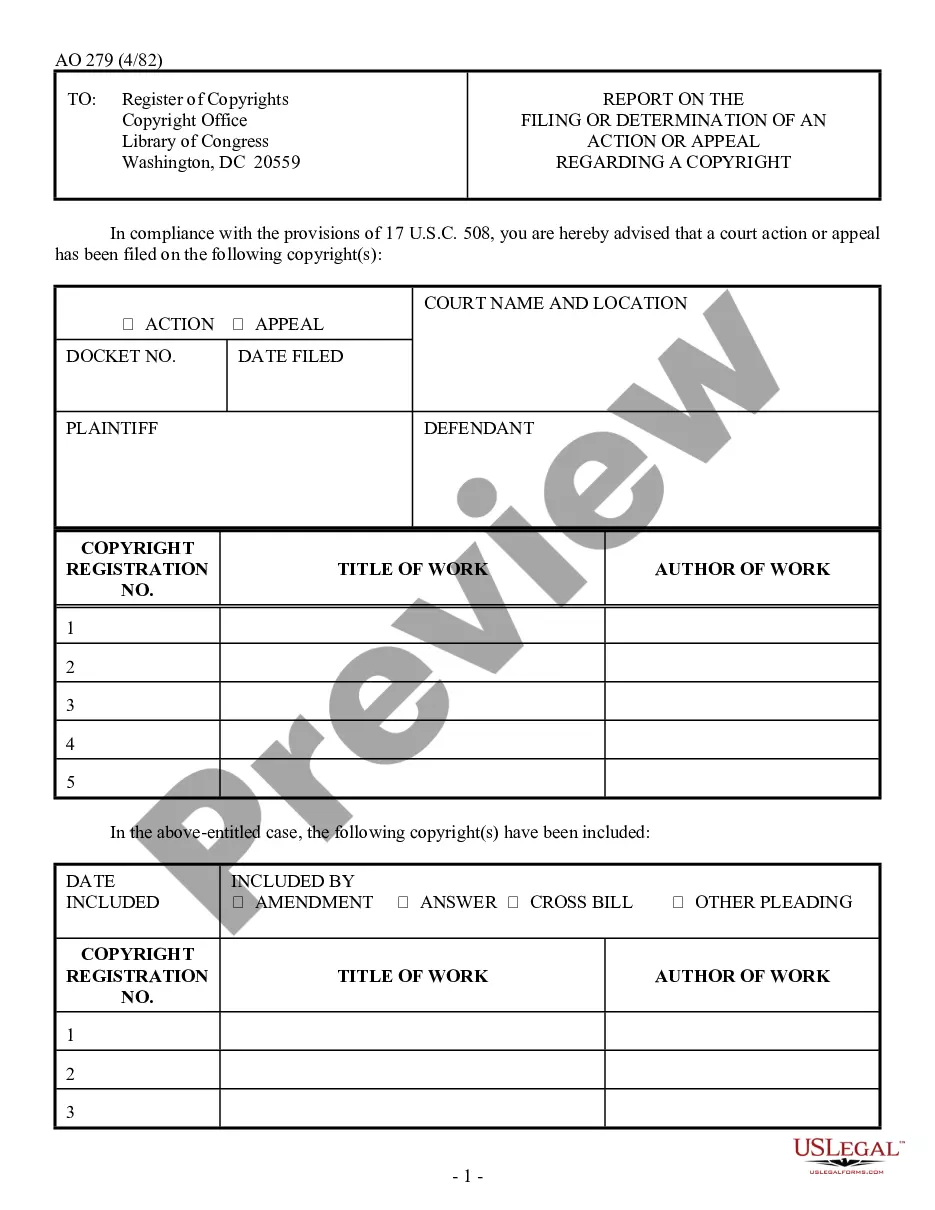
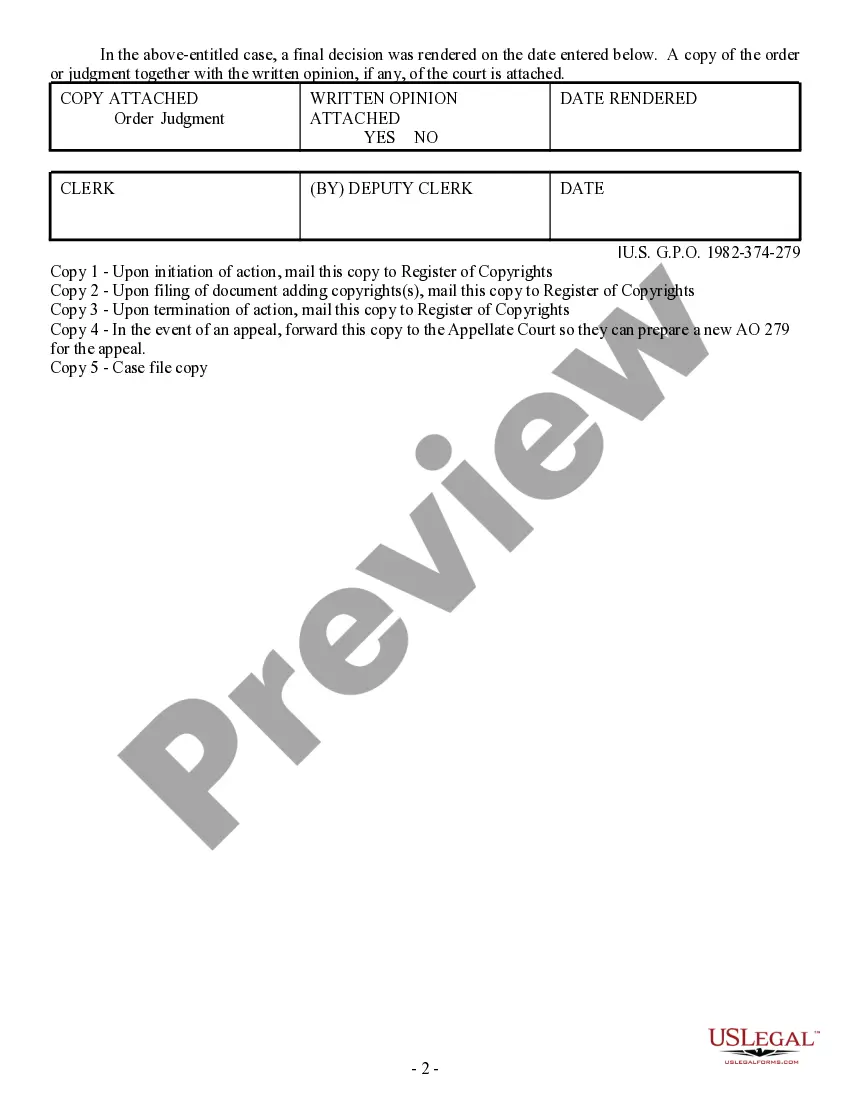
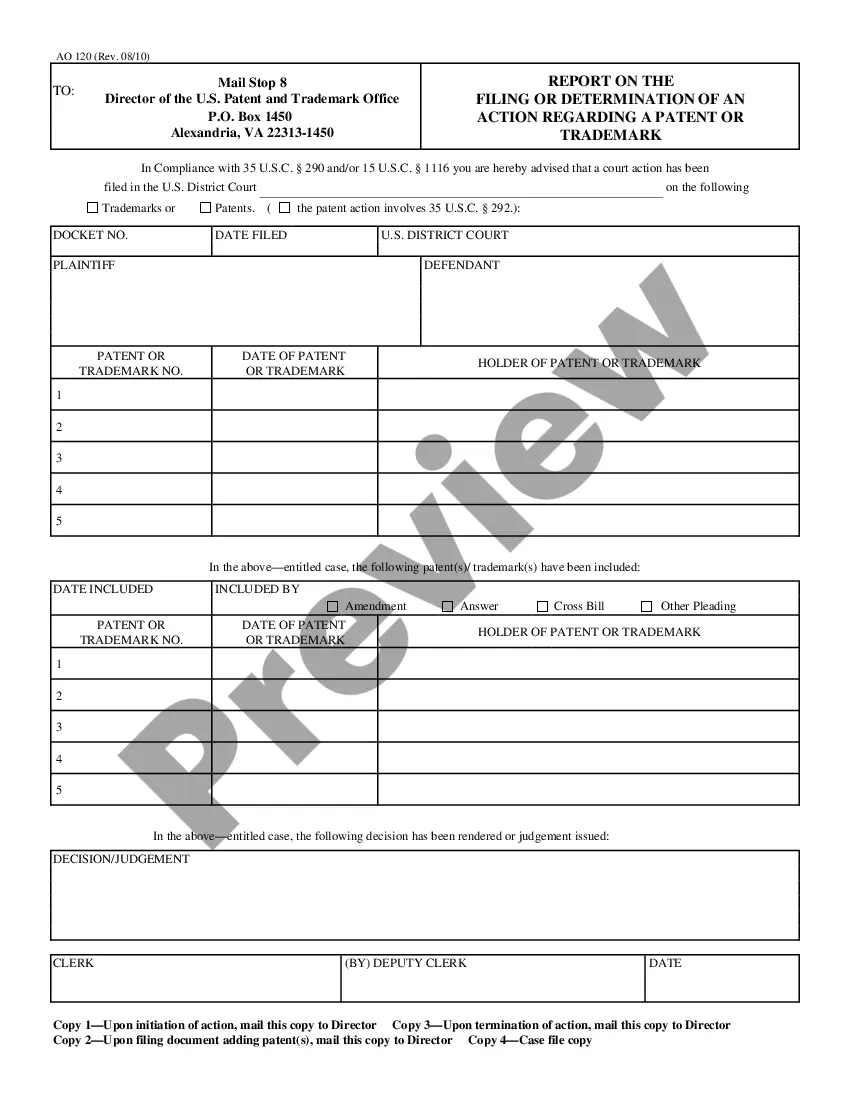
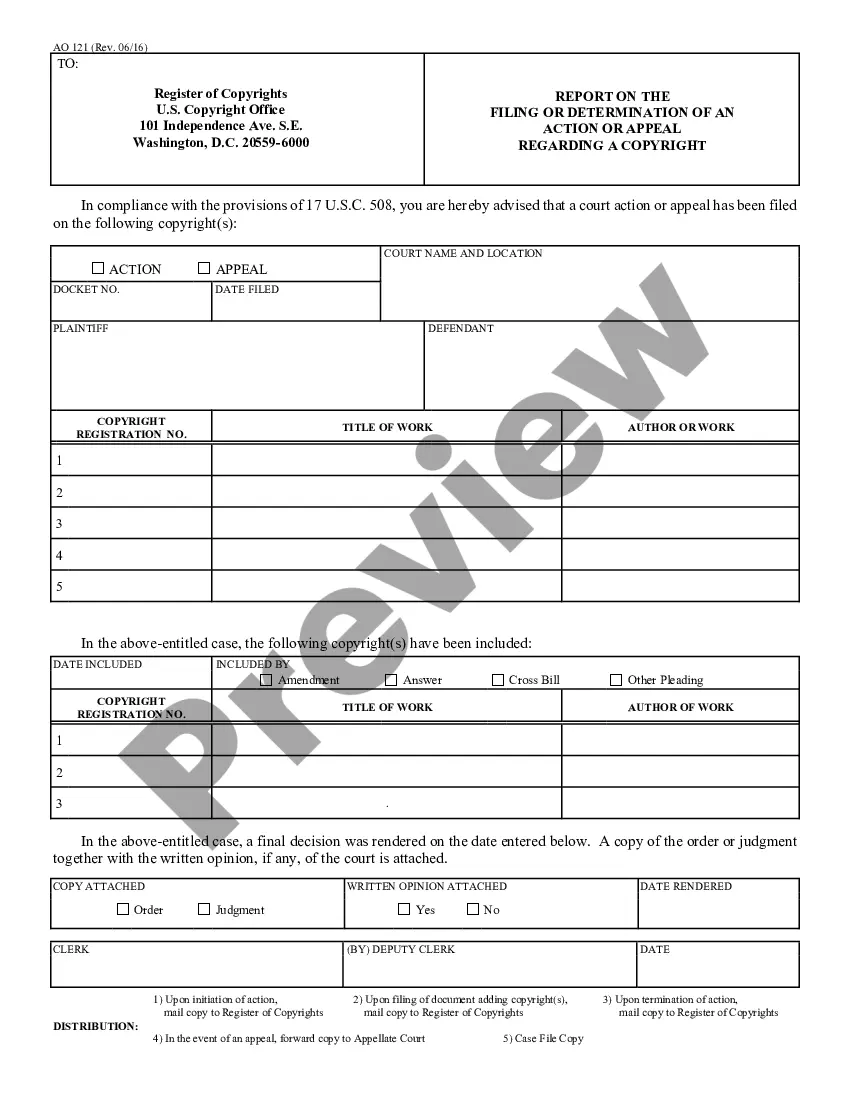
The Report on the Filing or Determination of an Action or Appeal Regarding a Copyright is a legal document required to notify the Register of Copyrights about the initiation of a copyright action, the addition of new copyrights, or the termination of an action. This form serves a crucial role in copyright litigation, ensuring that relevant authorities are aware of ongoing legal matters affecting copyrights.
Key parts of this document
- Identification of the copyright(s) involved in the action.
- It requires the name of the court where the action is filed.
- Details related to the case, including the case number.
- Instructions for forwarding copies to appellate courts in case of an appeal.
- A signature line for the attorney or representative submitting the form.
Situations where this form applies
You should use this form when you are involved in a copyright action or appeal. This includes instances when you are starting a legal process to enforce your copyright, adding new copyrights to existing claims, or notifying the Register of Copyrights of a case termination. Filing this form timely is crucial to maintaining proper legal protocols surrounding copyright issues.
Who should use this form
This form is designed for:
- Copyright holders who are initiating legal actions.
- Attorneys representing clients in copyright litigation.
- Individuals or organizations involved in appeals regarding copyright cases.
- Entities adding copyrights to existing claims.
How to complete this form
- Identify the copyright(s) relevant to the action.
- Provide the name of the court handling the case.
- Enter the case number assigned to the proceeding.
- Complete the attorney's signature section, confirming representation.
- Send the completed form to the Register of Copyrights by mail.
Does this form need to be notarized?
This form does not typically require notarization to be legally valid. However, some jurisdictions or document types may still require it. US Legal Forms provides secure online notarization powered by Notarize, available 24/7 for added convenience.
Get your form ready online
Our built-in tools help you complete, sign, share, and store your documents in one place.
Make edits, fill in missing information, and update formatting in US Legal Forms—just like you would in MS Word.
Download a copy, print it, send it by email, or mail it via USPS—whatever works best for your next step.
Sign and collect signatures with our SignNow integration. Send to multiple recipients, set reminders, and more. Go Premium to unlock E-Sign.
If this form requires notarization, complete it online through a secure video call—no need to meet a notary in person or wait for an appointment.
We protect your documents and personal data by following strict security and privacy standards.
Make edits, fill in missing information, and update formatting in US Legal Forms—just like you would in MS Word.
Download a copy, print it, send it by email, or mail it via USPS—whatever works best for your next step.
Sign and collect signatures with our SignNow integration. Send to multiple recipients, set reminders, and more. Go Premium to unlock E-Sign.

If this form requires notarization, complete it online through a secure video call—no need to meet a notary in person or wait for an appointment.
We protect your documents and personal data by following strict security and privacy standards.
Common mistakes to avoid
- Failing to include the case number or court name.
- Not signing the form or including the wrong representative's signature.
- Sending the form to the incorrect address or missing mailing deadlines.
- Neglecting to retain copies for personal records.
Why use this form online
- Convenience of downloading the form at any time.
- Editability allows you to fill out the form to match your specific situation.
- Access to professionally drafted templates that ensure compliance with legal standards.
- Reduce time and effort spent on paperwork with an efficient online process.
Looking for another form?
Form popularity
FAQ
Find an experienced appeals attorney. File the Notice of Appeal (California Penal Code Section 1237.5) Reviewing the Record on Appeal. Preparing and Filing the Opening Brief in Your Case. Oral Argument. The Decision. An Appeals Attorneys Can Help You Win Your Criminal Appeal.
Sandweiss. An appeal is a request for a higher court to review a lower court's decision. An appeals lawyer handles cases on appeal when a party loses or is unhappy with some part of the decision made by the lower court. The appeals court reviews the record made in the trial court.
Appeals are decided by panels of three judges working together. The appellant presents legal arguments to the panel, in writing, in a document called a "brief." In the brief, the appellant tries to persuade the judges that the trial court made an error, and that its decision should be reversed.
The judge made an error of law. The facts of the case and/or the evidence introduced in the trial court do not support the judge's decision. The judge abused his/her discretion
Filing the Notice of Appeal. Abandonment or Settlement. Waiver of Fees. Designating the Record. Civil Case Information Sheet. Briefs. Oral Argument. The Court's Decision.
Appeals in either civil or criminal cases are usually based on arguments that there were errors in the trial's procedure or errors in the judge's interpretation of the law. The party appealing is called the appellant, or sometimes the petitioner. The other party is the appellee or the respondent.
Potential grounds for appeal in a criminal case include legal error, juror misconduct and ineffective assistance of counsel. Legal errors may result from improperly admitted evidence, incorrect jury instructions, or lack of sufficient evidence to support a guilty verdict.
Step 1: Hiring an Appellate Attorney (Before Your Appeal) One of the biggest mistakes litigants make is filing their appeal before hiring an appellate attorney. Step 2: Filing the Notice of Appeal. Step 3: Preparing the Record on Appeal. Step 4: Researching and Writing Your Appeal. Step 5: Oral Argument.