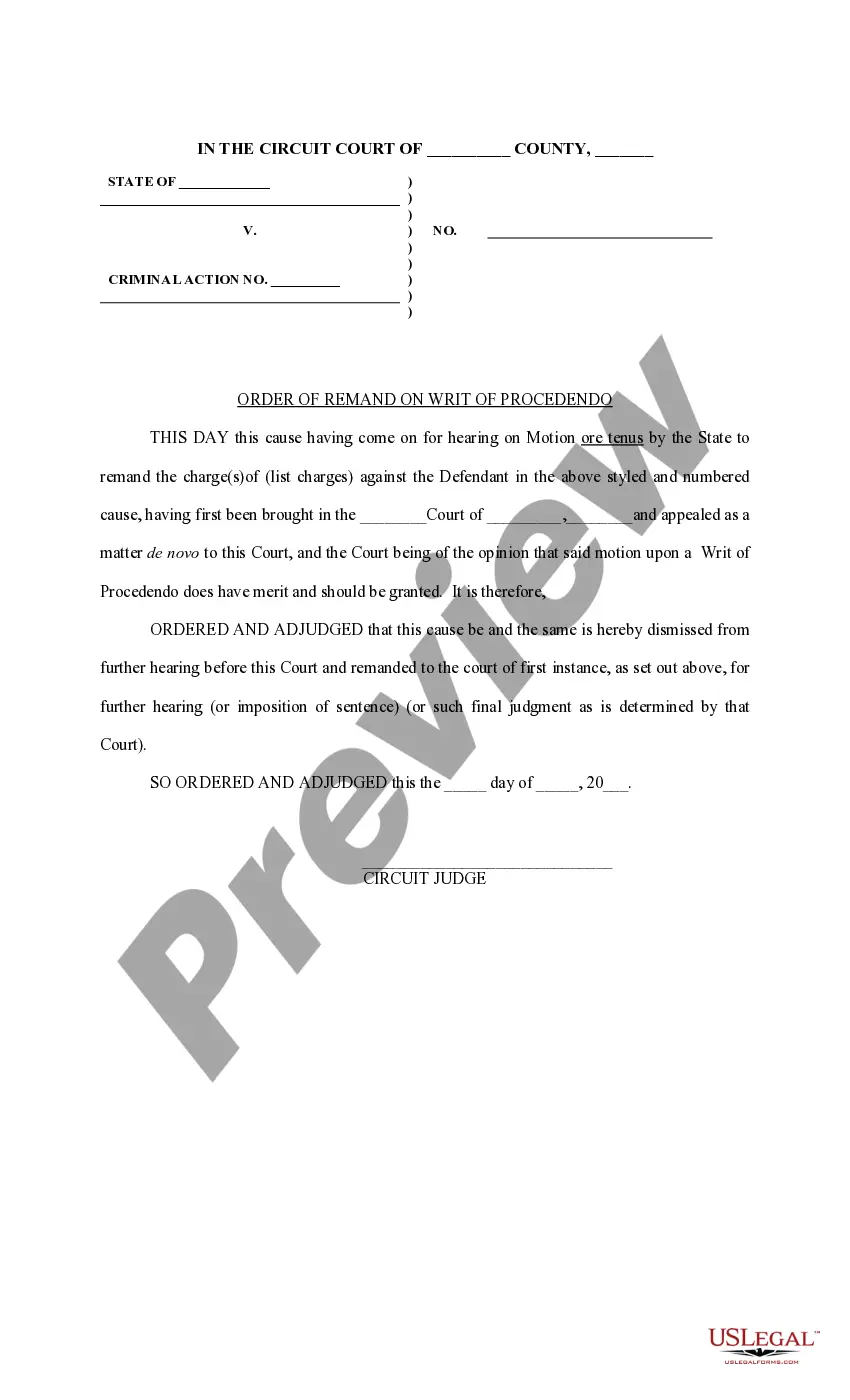
Order of Remand on Writ of Procedendo
Overview of this form
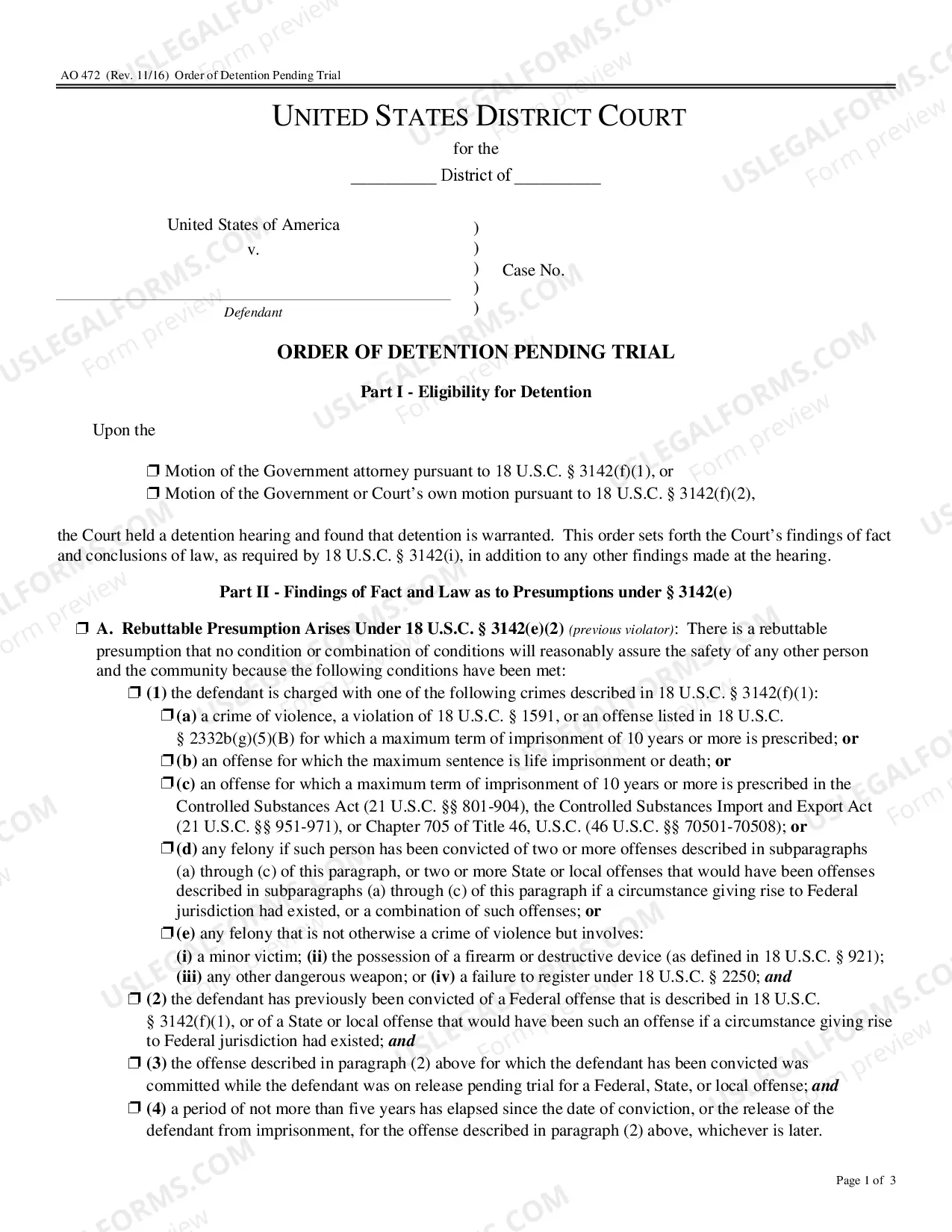
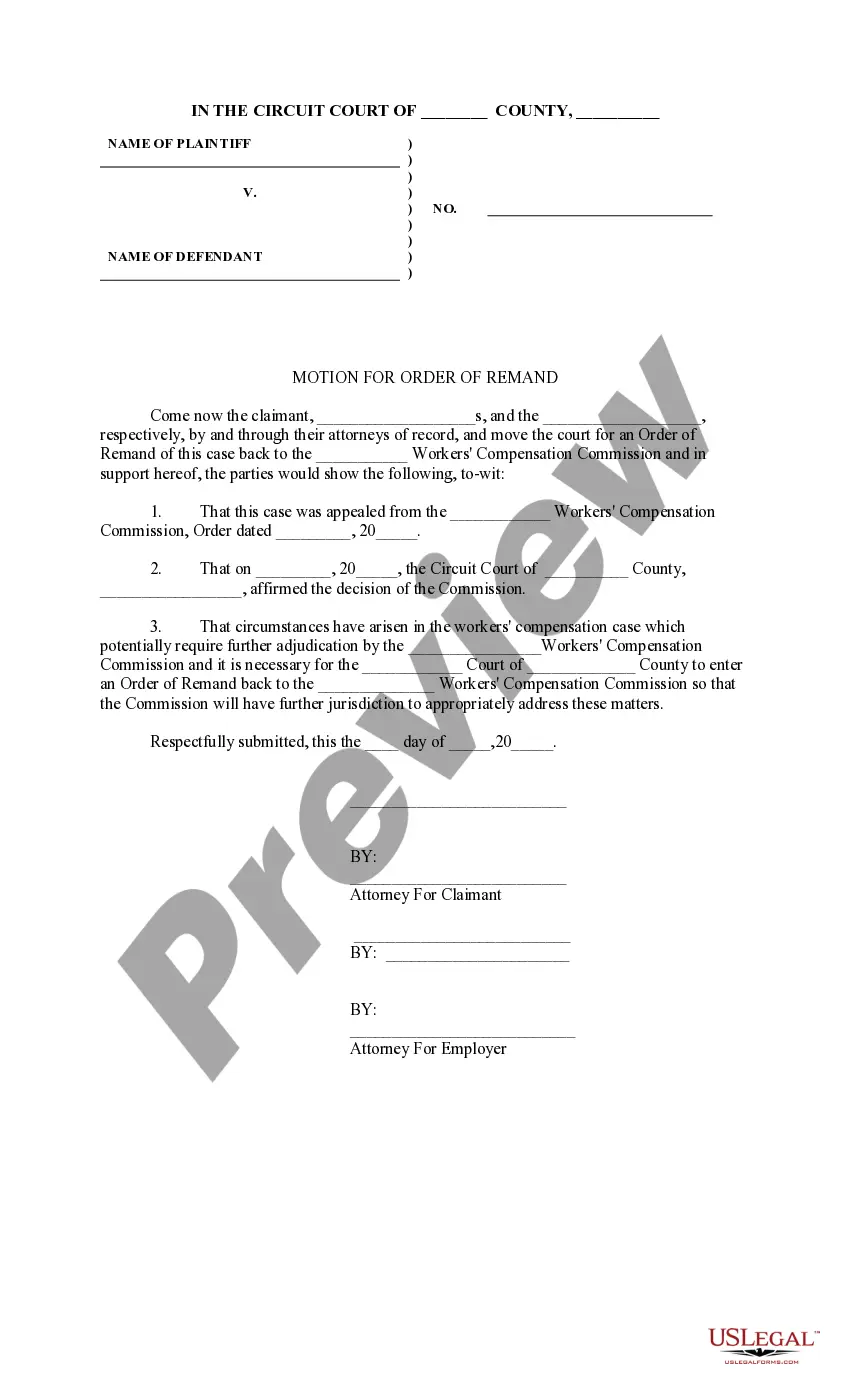
The Order of Remand on Writ of Procedendo is a legal document used to return a case to its original court after it has been erroneously moved to a higher court. This order indicates that the motion to remand, based on procedural grounds, is valid. It differs from other court orders by specifically addressing situations where jurisdictional issues or procedural errors warrant sending the case back for further hearings or sentencing by the initial court.
Key components of this form
- The date of the court order.
- Identification of the defendant and the charges being remanded.
- Description of the original court where the case was filed.
- Statement from the court regarding the merit of the remand motion.
- Signature line for the presiding judge.
Common use cases
This form should be utilized when a case has been moved from a lower court to a higher court but is determined to be improperly appealed or remanded. If the higher court finds that the original court has jurisdiction and should handle the case, this order facilitates the return to the lower court for further proceedings, such as hearings or sentencing.
Who needs this form
- Legal professionals representing defendants in criminal cases.
- Defendants who need to initiate a remand process after a wrongful appeal.
- State attorneys managing procedural issues concerning court jurisdictions.
How to complete this form
- Enter the date of the order in the designated field.
- List the charges against the defendant clearly.
- Specify the original court's name and location.
- Include a statement indicating the court's opinion on the motion.
- Sign the document in the provided space.
Notarization requirements for this form
This form usually doesn’t need to be notarized. However, local laws or specific transactions may require it. Our online notarization service, powered by Notarize, lets you complete it remotely through a secure video session, available 24/7.
Get your form ready online
Our built-in tools help you complete, sign, share, and store your documents in one place.
Make edits, fill in missing information, and update formatting in US Legal Forms—just like you would in MS Word.
Download a copy, print it, send it by email, or mail it via USPS—whatever works best for your next step.
Sign and collect signatures with our SignNow integration. Send to multiple recipients, set reminders, and more. Go Premium to unlock E-Sign.
If this form requires notarization, complete it online through a secure video call—no need to meet a notary in person or wait for an appointment.
We protect your documents and personal data by following strict security and privacy standards.

Make edits, fill in missing information, and update formatting in US Legal Forms—just like you would in MS Word.

Download a copy, print it, send it by email, or mail it via USPS—whatever works best for your next step.

Sign and collect signatures with our SignNow integration. Send to multiple recipients, set reminders, and more. Go Premium to unlock E-Sign.

If this form requires notarization, complete it online through a secure video call—no need to meet a notary in person or wait for an appointment.

We protect your documents and personal data by following strict security and privacy standards.
Avoid these common issues
- Failing to accurately list all charges against the defendant.
- Leaving out the original court's name and location.
- Not signing the order before submission.
Benefits of completing this form online
- Convenient access to a professionally drafted legal document.
- Editable format allows for easy customization to fit specific needs.
- Reliable and timely updates to legal standards and practices.
Looking for another form?






Form popularity
FAQ
A writ of procedendo is an order from an appellate court to a lower court to proceed with judgment. This writ is used in cases where a delay in rendering judgment constitutes a neglect or denial of justice.
The term writ refers to a formal, legal document that orders a person or entity to perform or to cease performing a specific action or deed. Writs are drafted by judges, courts, or other entities that have administrative or judicial jurisdiction.
A writ emanating from an appellate court, demanding that a lower court convey the record of a case to the appellate court so that the record may be reviewed for alleged errors of law committed during a juridical proceeding.
In common law, a writ (Anglo-Saxon gewrit, Latin breve) is a formal written order issued by a body with administrative or judicial jurisdiction; in modern usage, this body is generally a court. Warrants, prerogative writs, and subpoenas are common types of writ, but many forms exist and have existed.
Writs of Certiorari The primary means to petition the court for review is to ask it to grant a writ of certiorari. This is a request that the Supreme Court order a lower court to send up the record of the case for review.
A writ of prohibition is a writ directing a subordinate to stop doing something the law prohibits. This writ is often issued by a superior court to the lower court directing it not to proceed with a case which does not fall under its jurisdiction.
A writ is defined as a formal written order issued by a higher court which requests a lower court or a government entity to take action. Warrants, orders, directions, and subpoenas are all considered writs. When it comes to criminal cases, a defendant may file one or more writs in one trial.
The Writ of prohibition means to forbid or to stop and it is popularly known as 'Stay Order'. This writ is issued when a lower court or a body tries to transgress the limits or powers vested in it.
A writ is defined as a formal written order issued by a higher court which requests a lower court or a government entity to take action. Warrants, orders, directions, and subpoenas are all considered writs. When it comes to criminal cases, a defendant may file one or more writs in one trial.