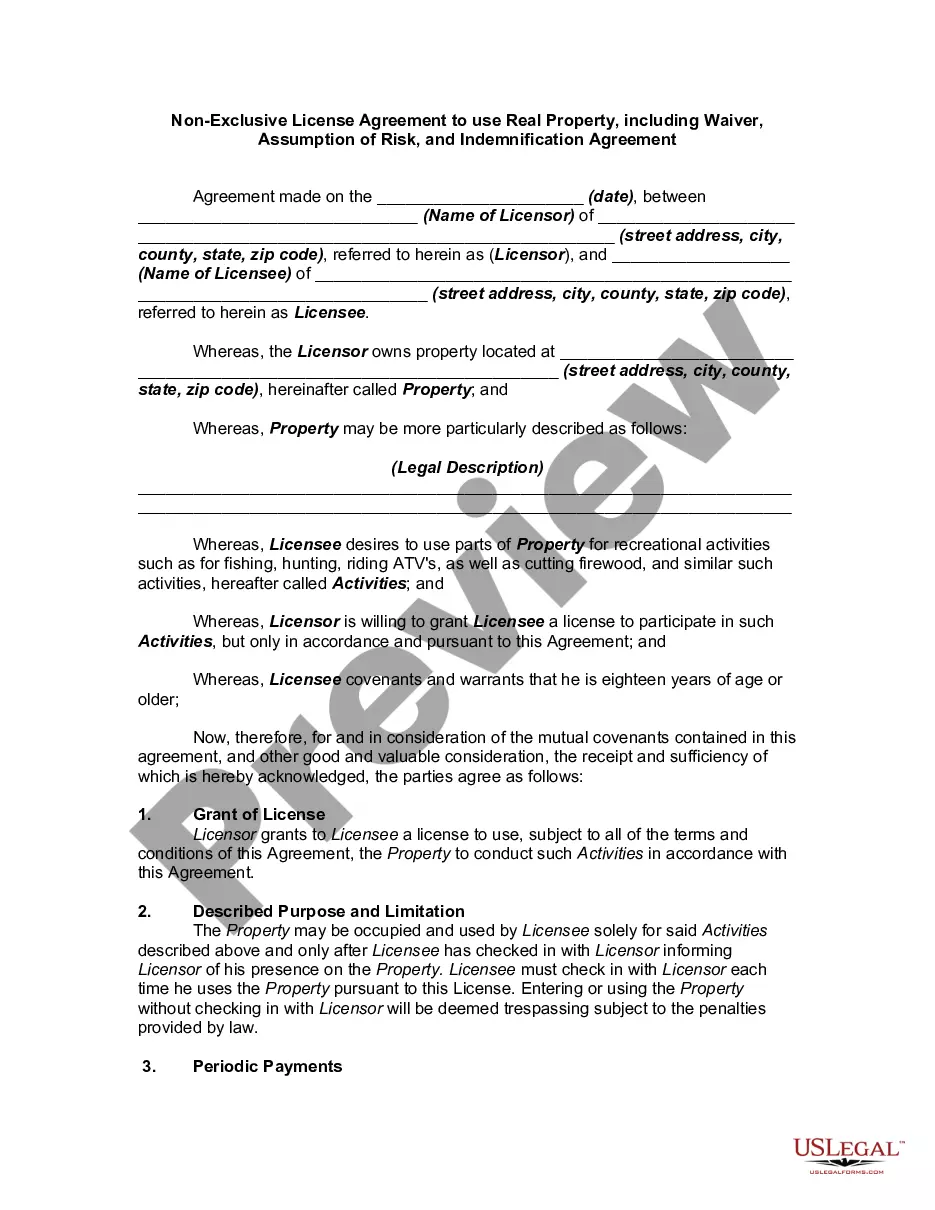
Non-Exclusive License Agreement to use Real Property, including Waiver, Assumption of Risk, and Indemnification Agreement
What is this form?
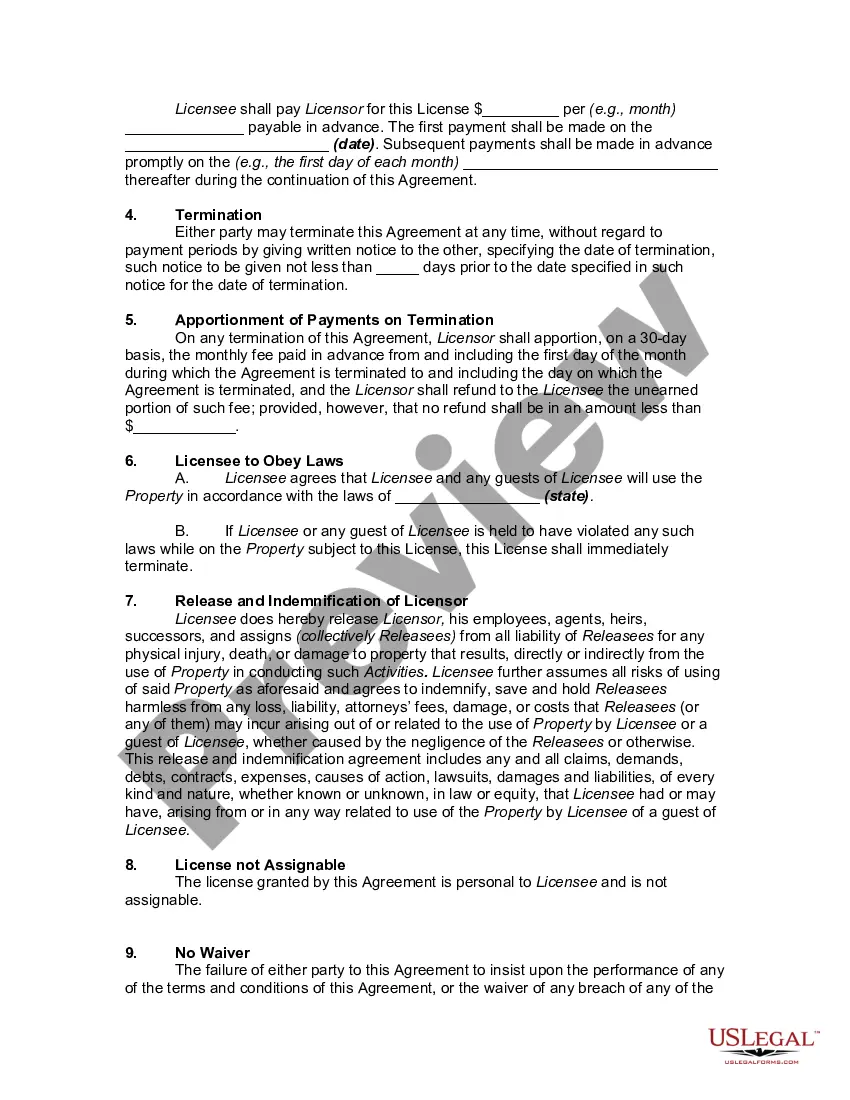
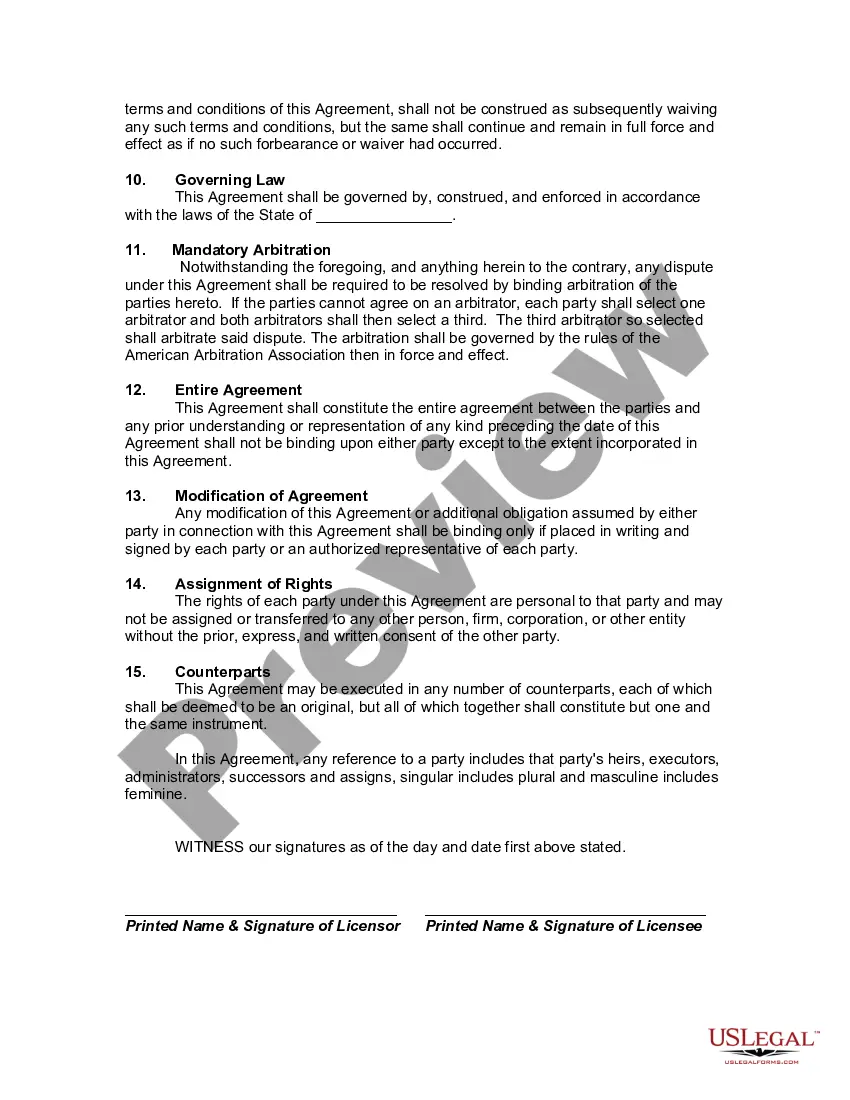
The Non-Exclusive License Agreement to use Real Property is a legal document that grants permission to an individual (the Licensee) to use another person's property (the Licensor) for specified recreational activities. Unlike an easement, which is a permanent right attached to the land, a license is a temporary and revocable privilege. This form includes essential clauses such as waiver, assumption of risk, and indemnification, which help protect the Licensor from liability while allowing the Licensee to engage in agreed-upon activities on the property.
Key components of this form
- Identification of parties involved: Licensor and Licensee, including their addresses.
- Description of the property being licensed, including its legal description.
- Specified recreational activities for which the Licensee can use the property.
- Payment terms, including the amount and frequency of license fees.
- Conditions under which the agreement can be terminated.
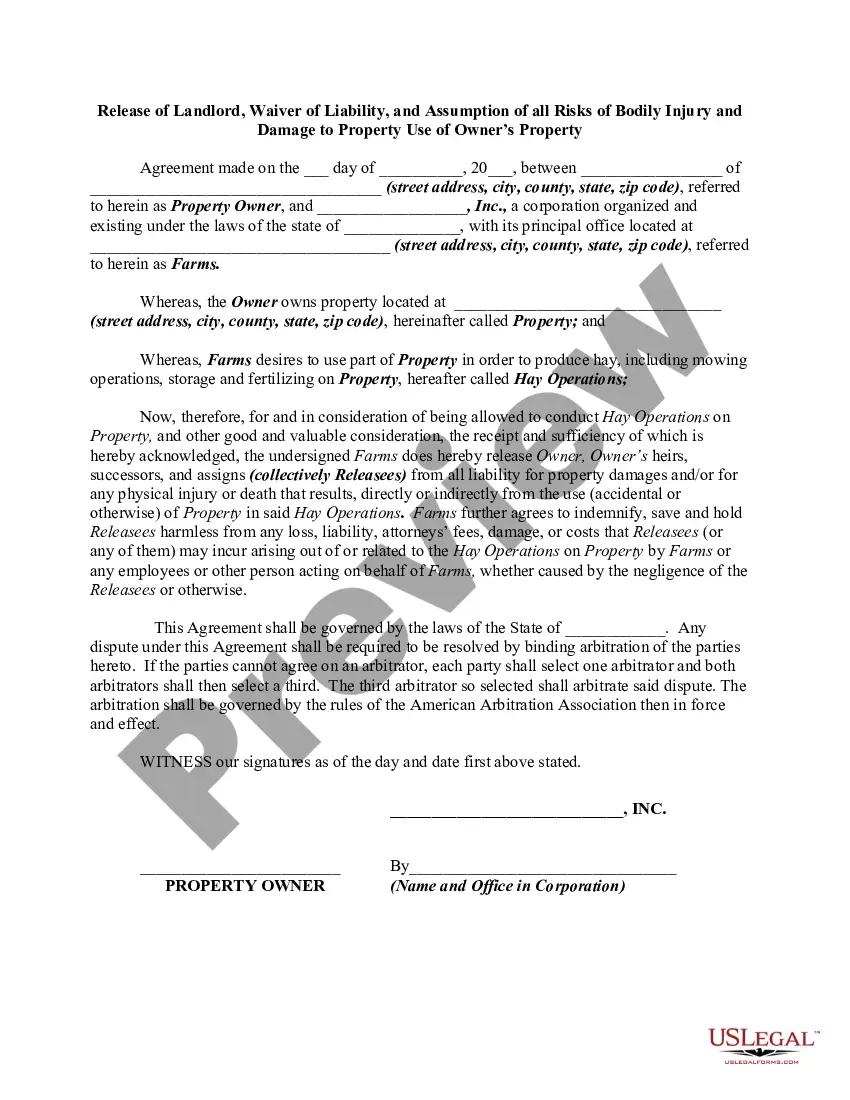
- Release and indemnification clauses that protect the Licensor from liability.


When to use this form
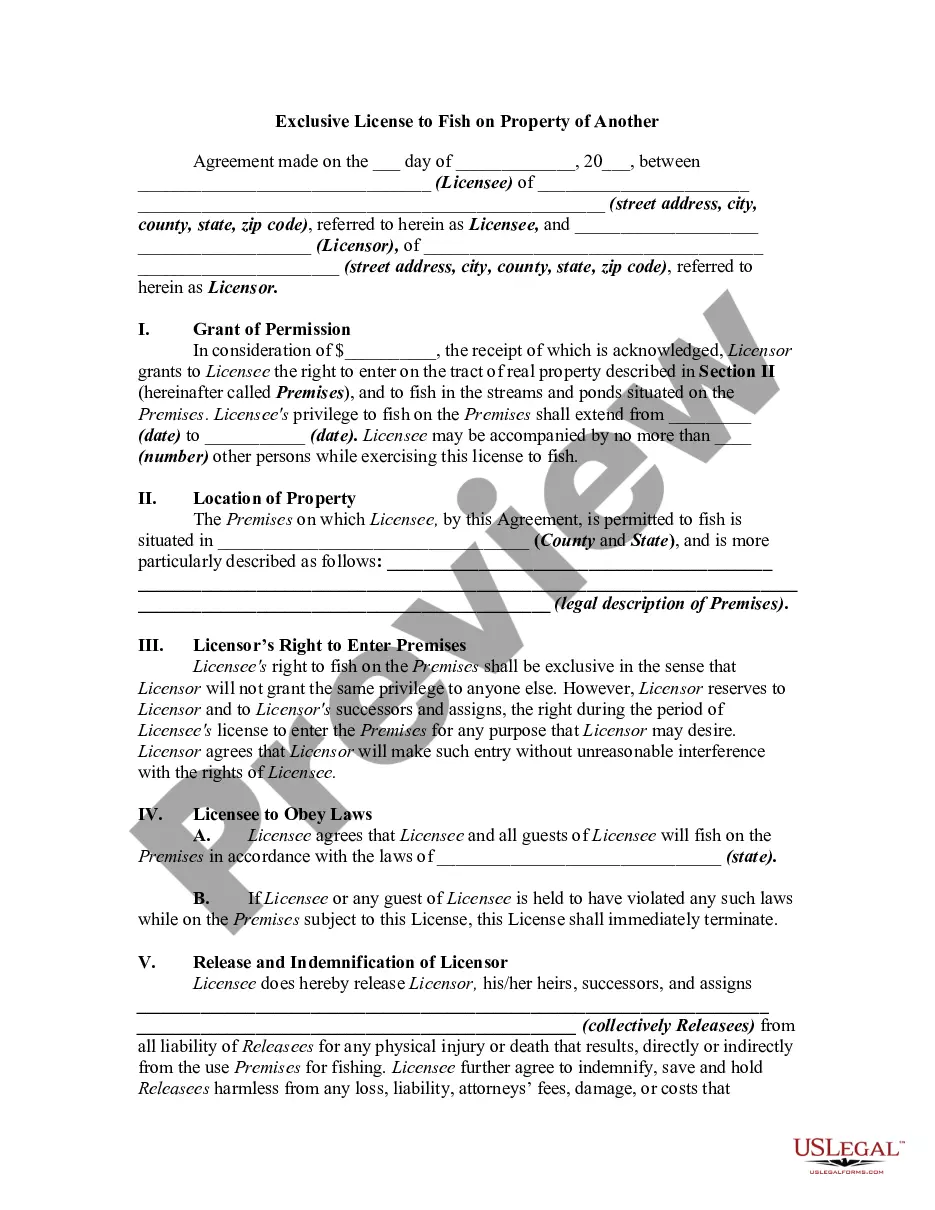
This form is ideal for situations where a property owner wishes to allow others to use their land for specific purposes such as hunting, fishing, or recreational activities, but wants to maintain control over the property and limit liability. It is particularly useful for landowners who want to formalize agreements with individuals who will engage in activities that may involve risk.
Intended users of this form
This form is intended for:
- Property owners (Licensors) who want to allow others to use their land while protecting themselves from legal liabilities.
- Individuals (Licensees) seeking permission to use someone elseâs property for recreational purposes.
- Attorneys drafting agreements on behalf of clients engaged in property usage arrangements.
How to complete this form
- Identify and enter the names and addresses of both the Licensor and Licensee.
- Provide the specific address and legal description of the property being licensed.
- List the recreational activities that the Licensee is permitted to engage in on the property.
- Specify the payment amount and frequency for the license fee.
- Include any necessary state laws related to property usage and liabilities.
- Ensure both parties sign and date the agreement to finalize it.
Notarization guidance
This form does not typically require notarization unless specified by local law. However, it is advisable to have the signatures witnessed to enhance the validity of the agreement in case it is ever contested.
Get your form ready online
Our built-in tools help you complete, sign, share, and store your documents in one place.
Make edits, fill in missing information, and update formatting in US Legal Forms—just like you would in MS Word.
Download a copy, print it, send it by email, or mail it via USPS—whatever works best for your next step.
Sign and collect signatures with our SignNow integration. Send to multiple recipients, set reminders, and more. Go Premium to unlock E-Sign.
If this form requires notarization, complete it online through a secure video call—no need to meet a notary in person or wait for an appointment.
We protect your documents and personal data by following strict security and privacy standards.

Make edits, fill in missing information, and update formatting in US Legal Forms—just like you would in MS Word.

Download a copy, print it, send it by email, or mail it via USPS—whatever works best for your next step.

Sign and collect signatures with our SignNow integration. Send to multiple recipients, set reminders, and more. Go Premium to unlock E-Sign.

If this form requires notarization, complete it online through a secure video call—no need to meet a notary in person or wait for an appointment.

We protect your documents and personal data by following strict security and privacy standards.
Avoid these common issues
- Not clearly identifying the property or outlining the activities allowed.
- Failing to specify payment details, which can lead to disputes.
- Neglecting to include terms for termination of the agreement.
- Not having both parties review the agreement before signing.
Benefits of using this form online
- Easy downloading and editing options to suit specific needs.
- Access to attorney-drafted templates ensures reliability and compliance.
- Conveniently complete the form at your pace without needing legal representation.
Legal use & context
- The Non-Exclusive License Agreement helps define the scope of the rights granted to the Licensee while protecting the Licensor's legal interests.
- This agreement may be enforced in court, provided it meets all legal standards within the relevant jurisdiction.
- Users should be aware of their local laws regarding property use to ensure compliance with the terms of the agreement.
Quick recap
- The Non-Exclusive License Agreement is a personal privilege rather than a property interest.
- Itâs essential to clearly define the property and allowed activities.
- Both parties should understand their rights and responsibilities, including liability releases.
- Ensure all terms, including payments and termination procedures, are explicitly stated to avoid misunderstandings.
Looking for another form?
Form popularity
FAQ
The Non-Exclusive License Agreement to Use Real Property is a legal document that allows a Licensee to use another person’s land for defined recreational activities. It creates a temporary, revocable privilege (not a permanent easement) and includes waiver, assumption of risk, and indemnification provisions to protect the Licensor, plus basic terms such as parties, property description, activities, fees, and termination.
Exclusive licenses give the Licensee sole, non-revocable rights to use the property during the term. This Non-Exclusive License Agreement to Use Real Property does not grant exclusivity—it allows the Licensor to grant similar rights to others and can be terminated or adjusted under the agreement’s terms.
It means the Licensor can grant similar rights to other people and that no single license is guaranteed exclusive access to the property. Under this form, the license is a temporary, revocable privilege and may be terminated under the specified conditions.
A non-exclusive licensing agreement grants permission to use property or rights without restricting the Licensor from granting similar rights to others. It outlines terms like permitted activities, payment, termination, and protection for the Licensor through waiver, assumption of risk, and indemnification provisions.
The agreement can be terminated under the conditions described in the contract, such as expiration of the term, breach of terms, failure to meet payment obligations, or other termination provisions specified by the parties.
This form does not grant exclusive rights to the Licensee; the Licensor may license the property to others and can revoke or modify the permission under the terms. An exclusive license would typically grant sole rights and limit or prevent parallel licensing during the term.