License Agreement for Use of Land for Sports Playing Field
Overview of this form
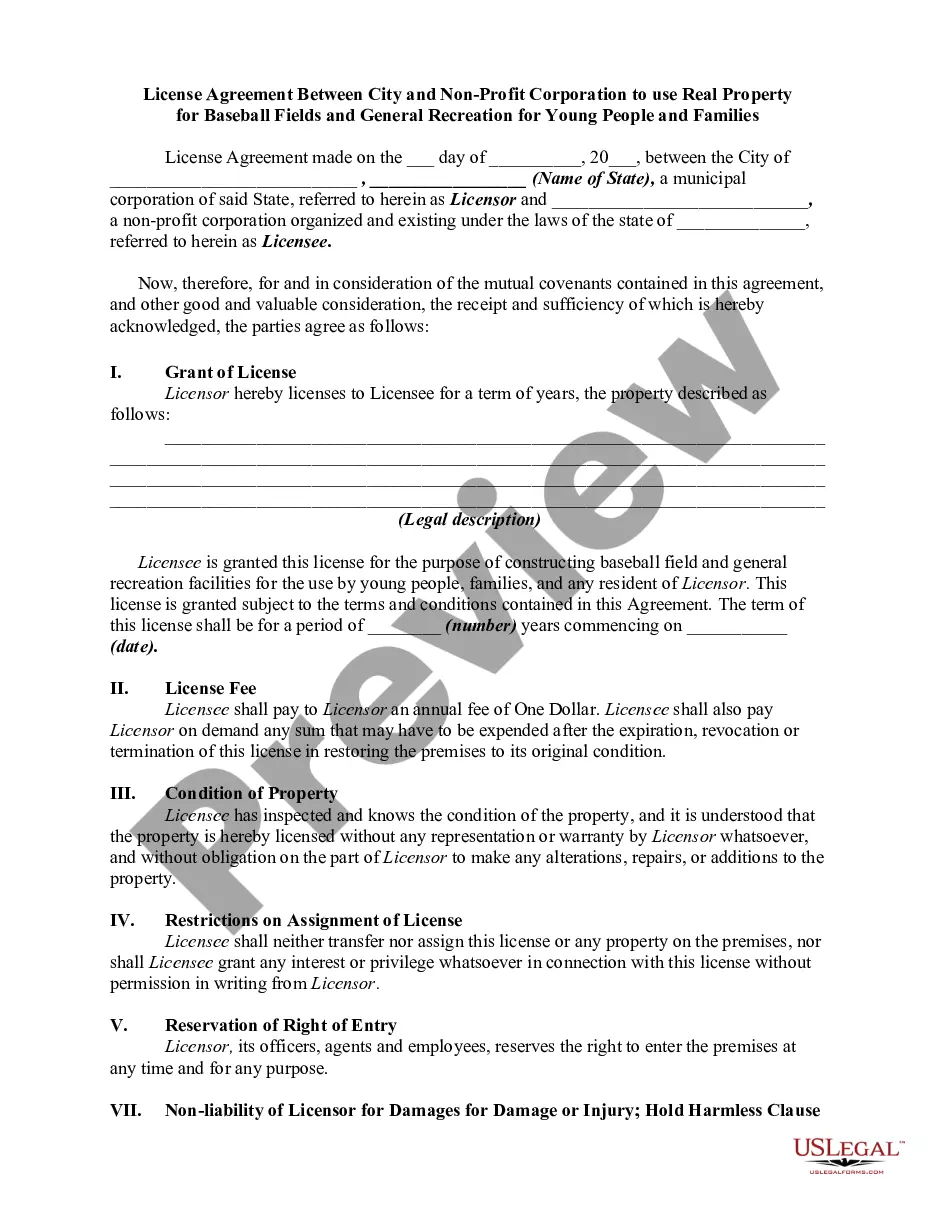
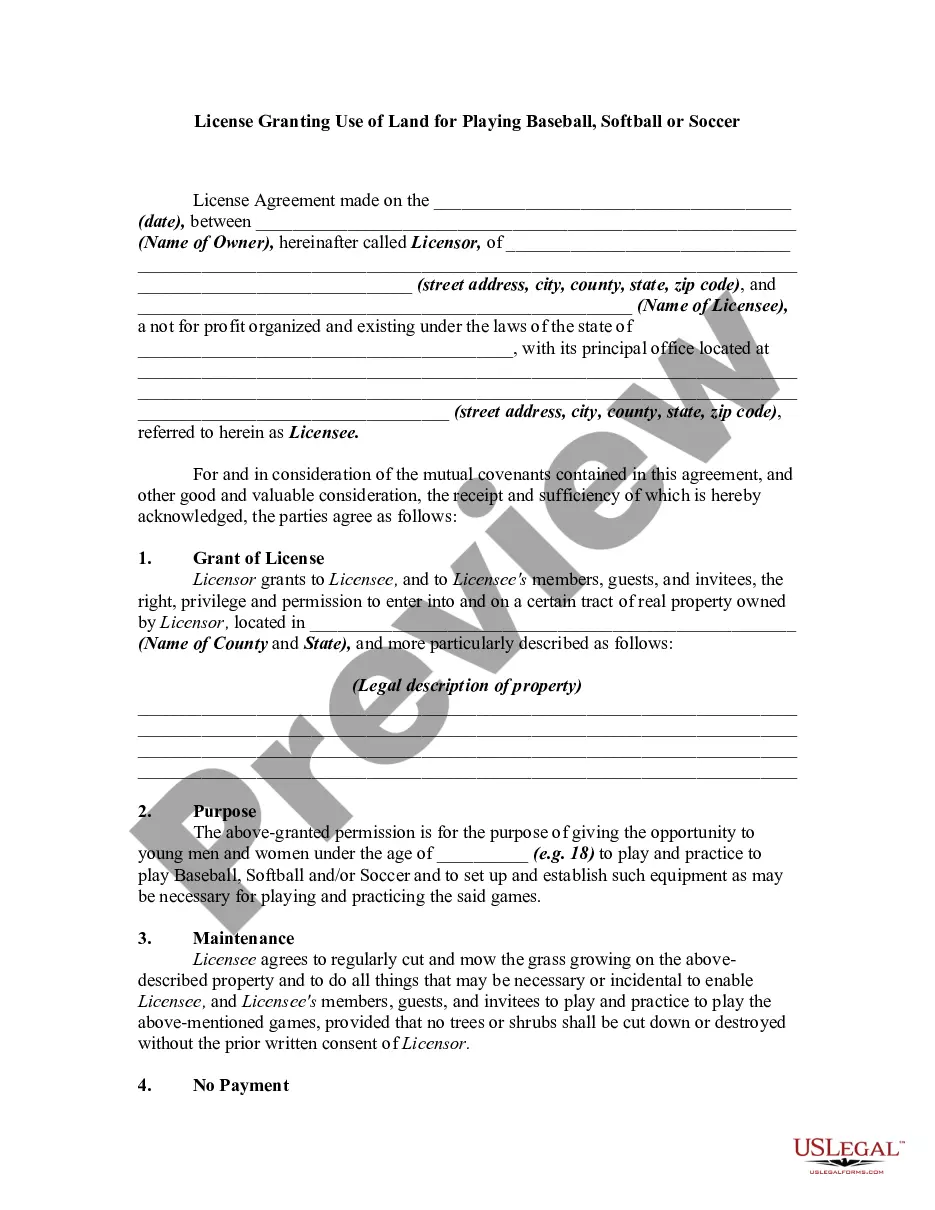
The License Agreement for Use of Land for Sports Playing Field is a legal document that grants permission from a landowner (Licensor) to another party (Licensee) to use their property specifically for sports activities. Unlike a lease, this form does not convey an interest in the property but rather a temporary privilege to use the land. It clearly states the terms, conditions, and limitations of that privilege, making it essential for organizing sporting events while protecting the rights of both parties involved.
Form components explained
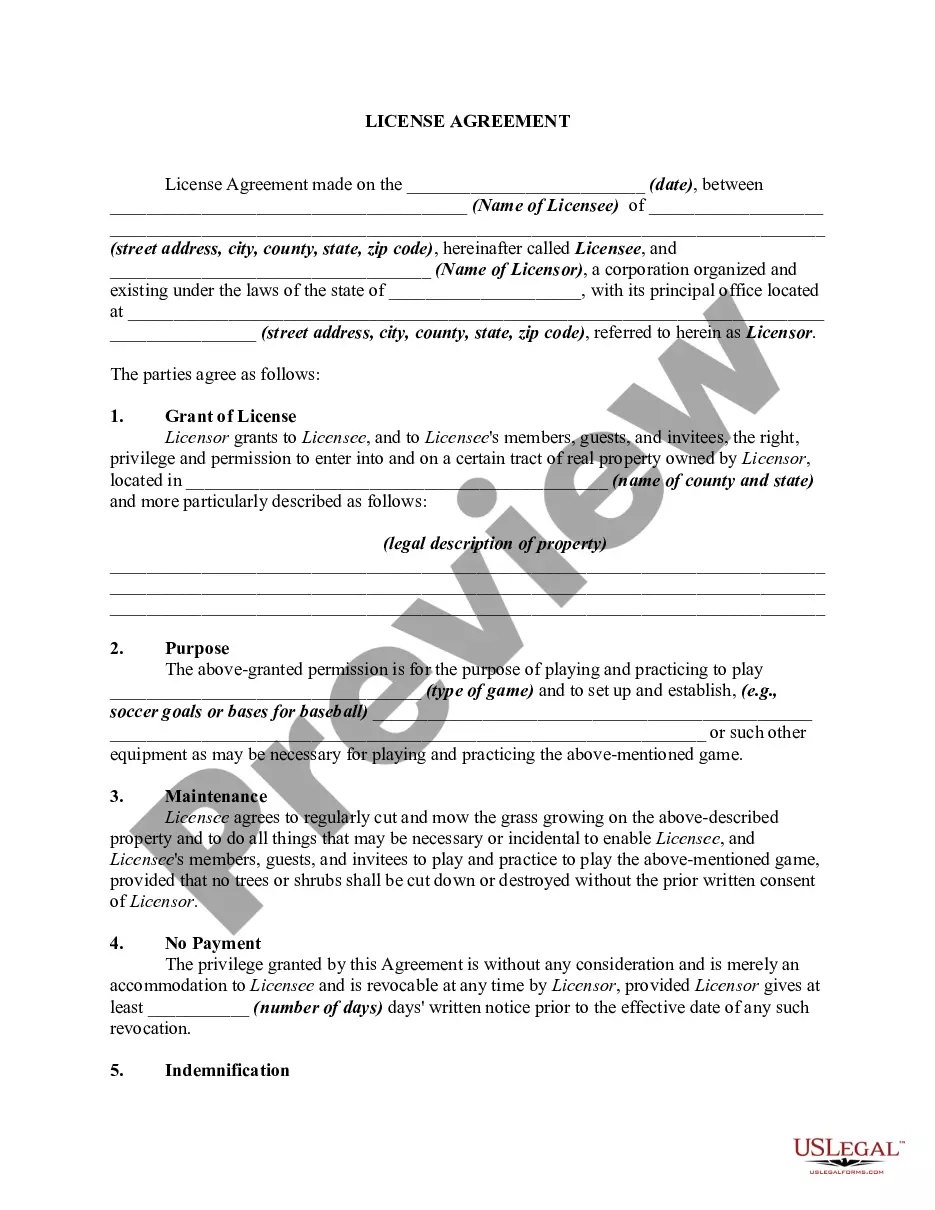
- Grant of License: Defines the permission granted to the Licensee to use the specific property for sports.
- Purpose: Details the intended use of the land for playing and practicing sports, including any necessary equipment.
- Maintenance: Outlines the Licensee's responsibilities for property upkeep, such as mowing grass.
- No Payment: Indicates that the license is granted without financial consideration and can be revoked by the Licensor.
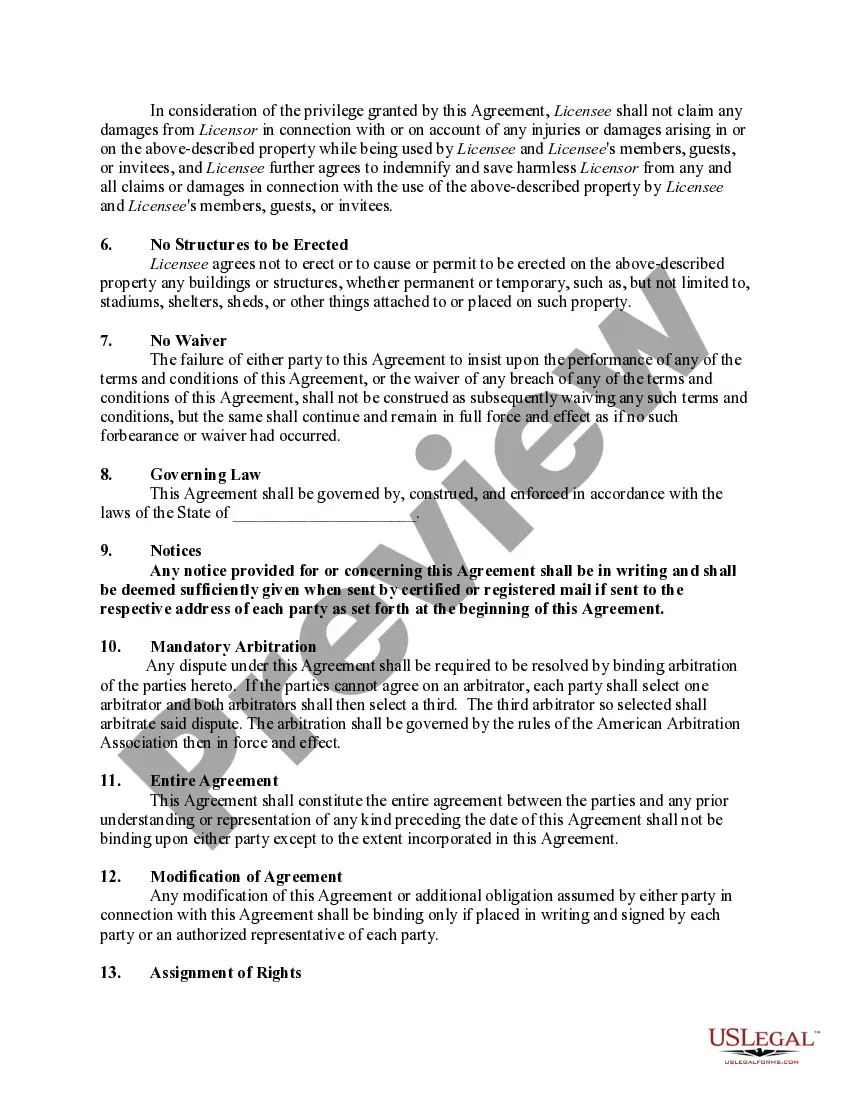
- Indemnification: States that the Licensee agrees not to hold the Licensor liable for injuries or damages during use of the property.
- No Structures to be Erected: Prohibits the Licensee from building any permanent or temporary structures on the property.
When this form is needed
This License Agreement should be used when a landowner wishes to allow others to use their land for sports activities without establishing a formal lease. It is suitable for community sports groups, schools, or informal gatherings that require a space to play and practice various sports, such as soccer, baseball, or football. The agreement ensures all parties understand their rights and responsibilities regarding the use of the land.
Who this form is for
This form is appropriate for:
- Landowners (Licensors) who want to permit others to use their land for sports.
- Individuals or organizations (Licensees) seeking temporary access to land for recreational purposes.
- Community groups, schools, or sports teams coordinating events that require a space for playing sports.
How to complete this form
- Identify the parties involved by entering the names of the Licensee and Licensor, along with their addresses.
- Specify the date on which the agreement is made.
- Detail the property location and provide a legal description of the land.
- State the type of sports to be played and any equipment to be used on the property.
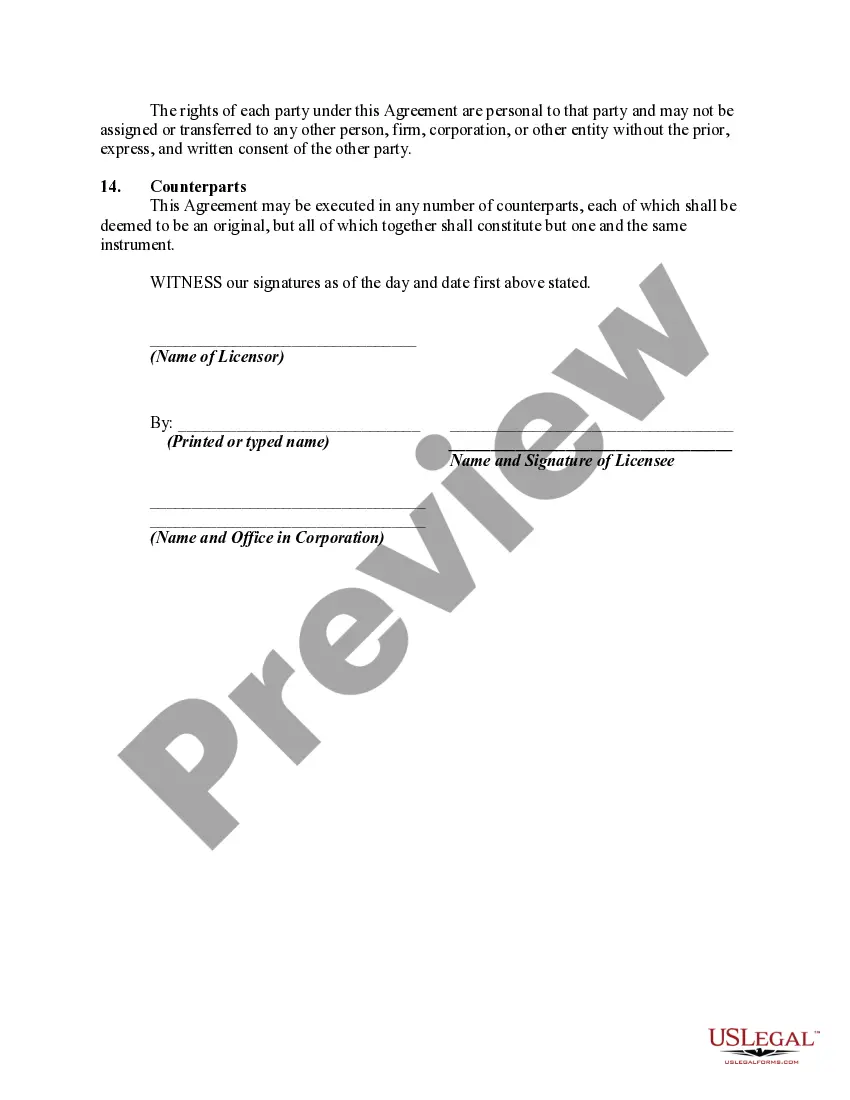
- Sign the agreement to validate the terms, ensuring both parties agree to the conditions outlined.
Does this form need to be notarized?
This form does not typically require notarization unless specified by local law. It is advisable to check local requirements to ensure compliance, but generally, both parties should sign the agreement to validate it.
Get your form ready online
Our built-in tools help you complete, sign, share, and store your documents in one place.
Make edits, fill in missing information, and update formatting in US Legal Forms—just like you would in MS Word.
Download a copy, print it, send it by email, or mail it via USPS—whatever works best for your next step.
Sign and collect signatures with our SignNow integration. Send to multiple recipients, set reminders, and more. Go Premium to unlock E-Sign.
If this form requires notarization, complete it online through a secure video call—no need to meet a notary in person or wait for an appointment.
We protect your documents and personal data by following strict security and privacy standards.

Make edits, fill in missing information, and update formatting in US Legal Forms—just like you would in MS Word.

Download a copy, print it, send it by email, or mail it via USPS—whatever works best for your next step.

Sign and collect signatures with our SignNow integration. Send to multiple recipients, set reminders, and more. Go Premium to unlock E-Sign.

If this form requires notarization, complete it online through a secure video call—no need to meet a notary in person or wait for an appointment.

We protect your documents and personal data by following strict security and privacy standards.
Common mistakes to avoid
- Failing to include a specific legal description of the property.
- Not clarifying the exact sports and activities allowed on the property.
- Omitting to cover the maintenance responsibilities of the Licensee.
- Not discussing or forgetting to add the notice period for revocation of the license.
Why complete this form online
- Convenient access: Download the form anytime without needing to visit a lawyer.
- Editability: Customize the form to fit specific circumstances before finalizing.
- Reliability: Ensure your agreement follows current legal standards drafted by licensed professionals.
Legal use & context
- This agreement is legally binding as long as both parties sign it and adhere to its terms.
- It's important to clarify the terms to enhance enforceability and reduce potential conflicts.
- Retaining a copy for both parties is essential to ensure clarity in future interactions related to the property use.
Summary of main points
- This form allows the temporary use of land for sports without creating a lease.
- Both Licensor and Licensee must understand their rights and responsibilities.
- Important terms include maintenance, revocation of the license, and indemnification.
Looking for another form?
Form popularity
FAQ
A license agreement is a business contract between two parties. The licensor (the seller of the license) owns the asset being licensed and the licensee (the buyer) pays for the right to use the license. The licensee pays royalties to the owner in exchange for the right to sell the product or use the technology.
A licensing agreement is a legal contract between two parties, known as the licensor and the licensee. In a typical licensing agreement, the licensor grants the licensee the right to produce and sell goods, apply a brand name or trademark, or use patented technology owned by the licensor.
The 3 P's of collegiate licensing are protection, promotion, and profit.
Exclusive or non-exclusive. In an exclusive license, the intellectual property holder is licensing the work only to one person, for that particular use/territory. Territory. Use. Attribution. Derivative works. Confidentiality. Time frame. Termination.
Download a template for a licensing agreement. Choose your role as the licensor or licensee. Define the license(s) in the agreement. Decide whether the license is exclusive or not. Settle the matter of fees and payment schedule. Add a renewal date and rules.
An example of a licensing agreement is a contract between the copyright holders of software and another company, allowing the latter to use the computer software for their daily business operations.
Do your homework. Before you begin negotiating, you need to understand your licensee's business. Start with a term sheet. Manage your expectations. Be patient. Have a win-win attitude. Don't lose your sense of humor. Remember to hold something back. Put yourself in their shoes.
An example of a licensing agreement is a contract between the copyright holders of software and another company, allowing the latter to use the computer software for their daily business operations.