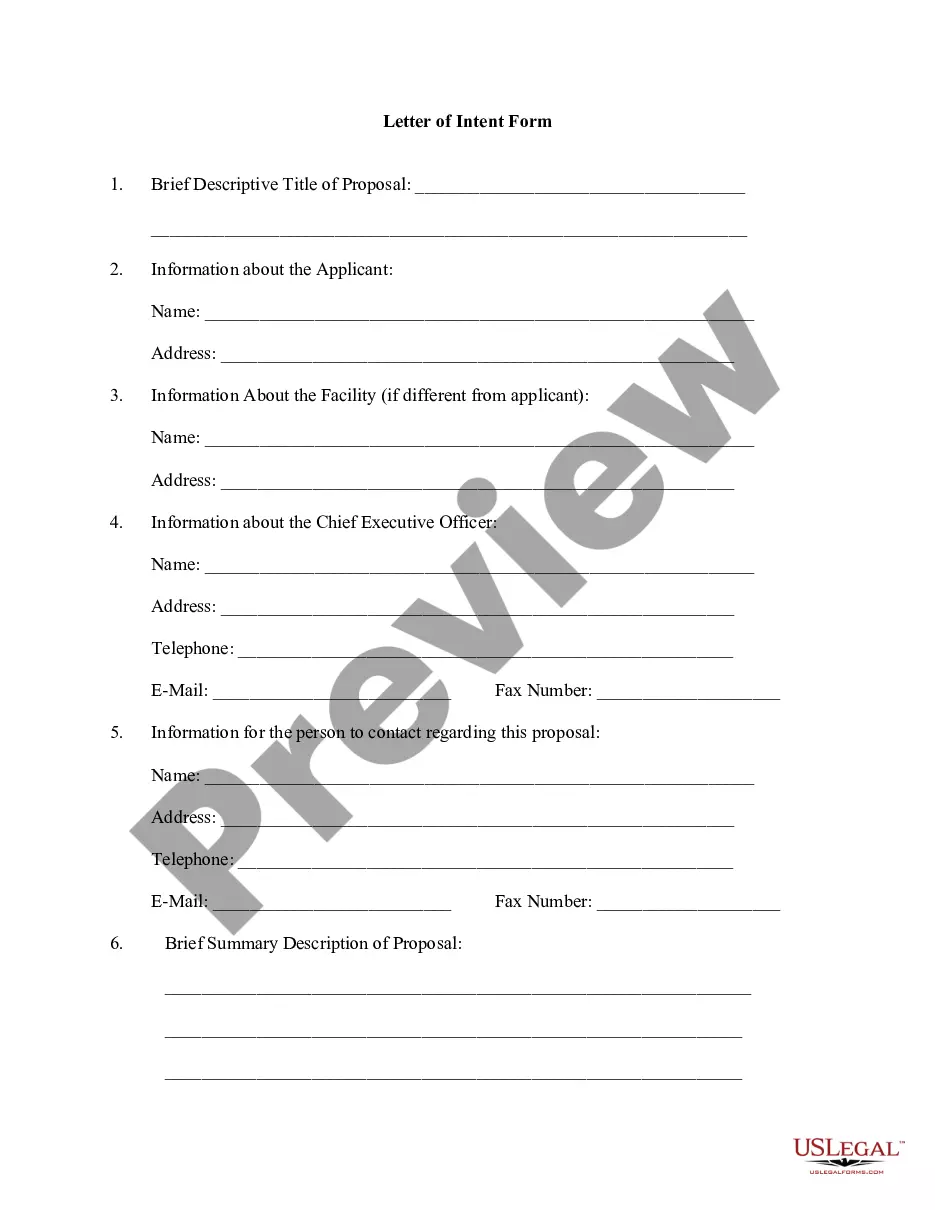
Letter of Intent in Connection with Obtaining a Certificate of Need for a New Health Care Facility or Major Capital Expenditure in the Health Care Industry
Overview of this form
The Letter of Intent in Connection with Obtaining a Certificate of Need for a New Health Care Facility or Major Capital Expenditure is a formal document that initiates the process of securing a Certificate of Need (CON) from regulatory authorities. This letter is often required in many states as the first step in a two-step application process designed to prevent the unnecessary duplication of health care services and equipment, thereby ensuring that expansions or new facilities are justified and beneficial to the community.
Form components explained
- Brief descriptive title of the proposal.
- Information about the applicant, including name and address.
- Details about the facility and Chief Executive Officer.
- Summary description of the proposed project.
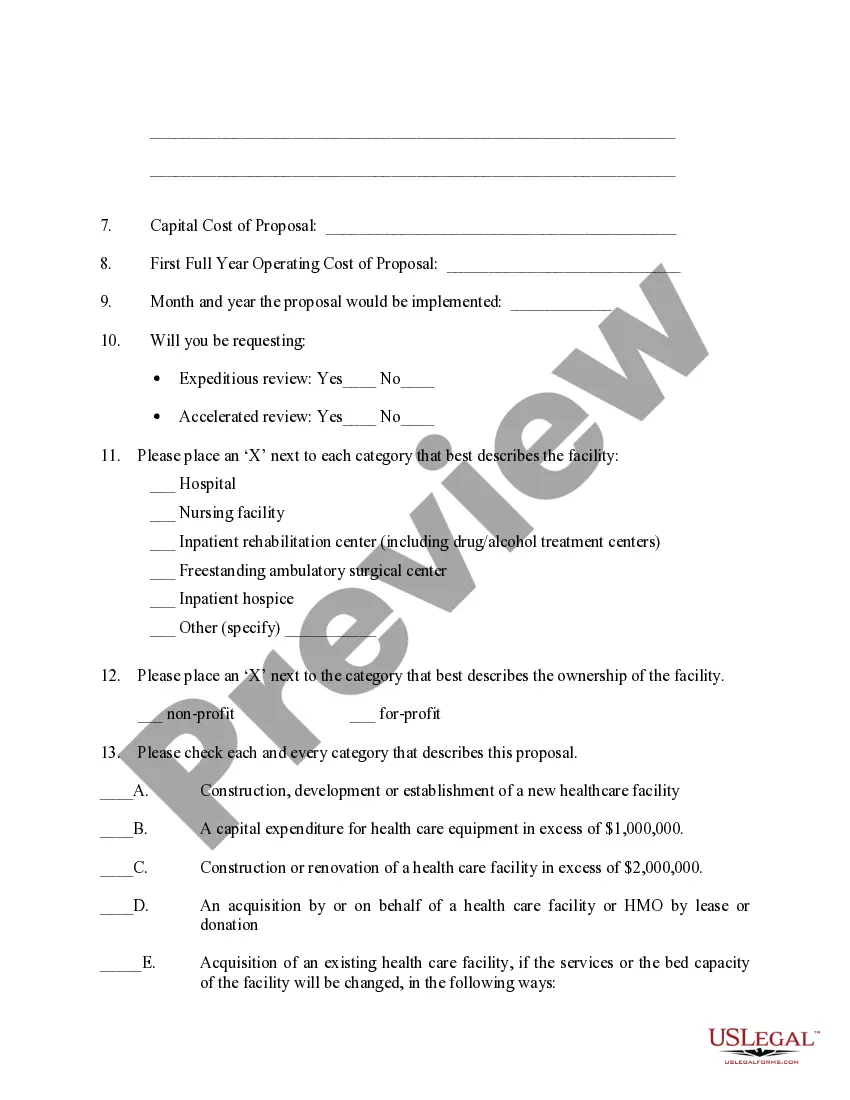
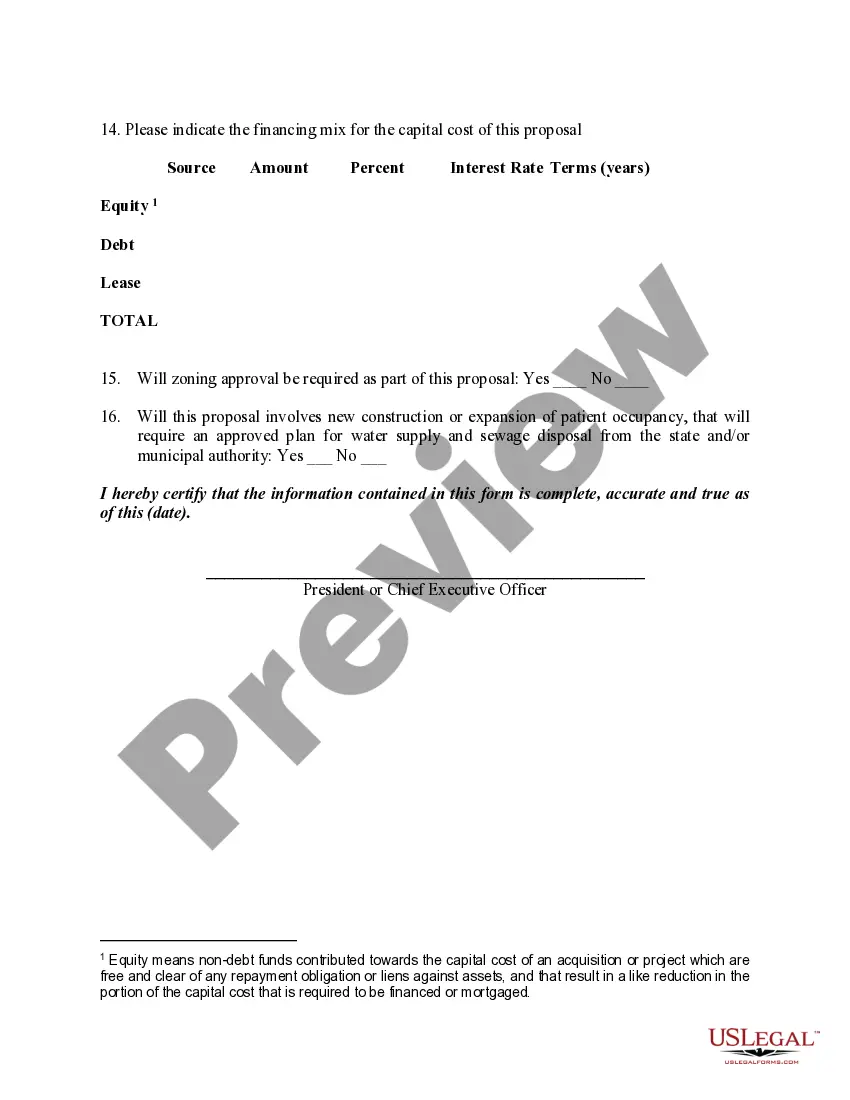
- Estimated capital and operational costs.
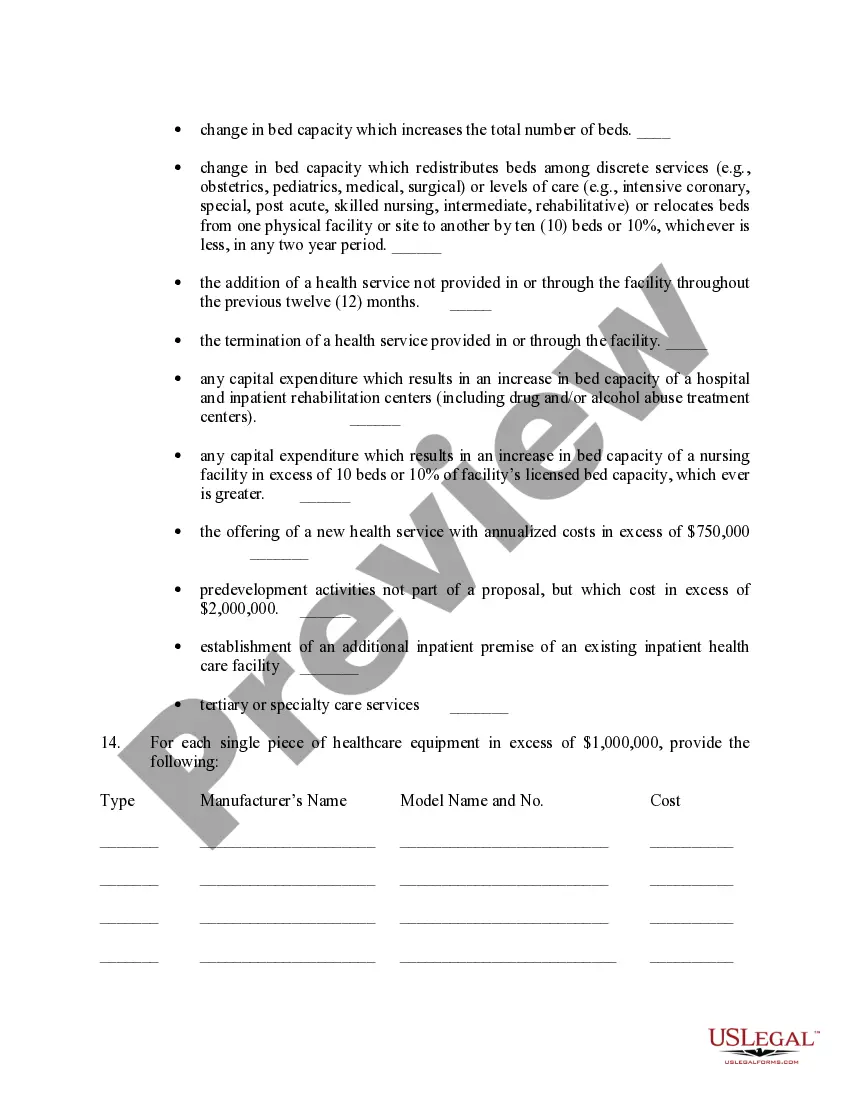
- Categories describing the type of facility and nature of the proposal.
When to use this document
This form should be used when an individual or organization plans to establish a new health care facility or undertake a significant capital expenditure in the health care industry. It is particularly relevant when the project requires state approval to ensure that the services provided do not duplicate existing facilities and are aligned with community needs.
Who can use this document
- Health care providers looking to establish new facilities.
- Organizations planning major capital expenditures in the health care sector.
- Administrators and executives in charge of health care projects.
- Investors interested in health care facility developments.
Completing this form step by step
- Identify and enter the brief descriptive title of your proposal.
- Provide the name and address of the applicant seeking the Certificate of Need.
- Fill out details regarding the health care facility and chief executive officer.
- Summarize the proposed project concisely, outlining key objectives and goals.
- Complete the capital cost estimations and projected operating costs for the first full year.
- Indicate whether an expedited or accelerated review of the proposal is needed.
Is notarization required?
This form does not typically require notarization unless specified by local law. Always check state-specific requirements to ensure compliance.
Get your form ready online
Our built-in tools help you complete, sign, share, and store your documents in one place.
Make edits, fill in missing information, and update formatting in US Legal Forms—just like you would in MS Word.
Download a copy, print it, send it by email, or mail it via USPS—whatever works best for your next step.
Sign and collect signatures with our SignNow integration. Send to multiple recipients, set reminders, and more. Go Premium to unlock E-Sign.
If this form requires notarization, complete it online through a secure video call—no need to meet a notary in person or wait for an appointment.
We protect your documents and personal data by following strict security and privacy standards.

Make edits, fill in missing information, and update formatting in US Legal Forms—just like you would in MS Word.

Download a copy, print it, send it by email, or mail it via USPS—whatever works best for your next step.

Sign and collect signatures with our SignNow integration. Send to multiple recipients, set reminders, and more. Go Premium to unlock E-Sign.

If this form requires notarization, complete it online through a secure video call—no need to meet a notary in person or wait for an appointment.

We protect your documents and personal data by following strict security and privacy standards.
Mistakes to watch out for
- Failing to provide complete and accurate contact information for all parties involved.
- Omitting essential details in the summary description of the proposal.
- Not specifying the correct category that describes the facilityâs ownership.
Advantages of online completion
- Convenience of filling out the form at your own pace and reviewing details easily.
- Editable fields allow for adjustments without needing to start from scratch.
- Access to reliable content drafted by licensed attorneys ensures legal compliance.
What to keep in mind
- The Letter of Intent is crucial for obtaining a Certificate of Need in many states.
- Completeness and accuracy in the proposed details are vital for state review.
- Consult your stateâs requirements before completing and submitting the form.
Looking for another form?
Form popularity
FAQ
A certificate of need (CON) is a legal document that is required in order to construct a new healthcare facility.
Regulating 28 services, Hawaii has the highest number of CON requirements of any state.Eleven states have no CON laws or caps: California, Colorado, Idaho, Kansas, New Hampshire, North Dakota, Pennsylvania, South Dakota, Texas, Utah, and Wyoming (see the accompanying chart).
As figure 1 shows, Missouri's certificate-of-need program ranks the 21st most restrictive in the United States. Note: Fourteen states either have no certificate-of-need laws or they are not in effect.
THE SOLUTION: Repeal the Certificate of Need law.WHO ELSE DOES IT? California, Colorado, Idaho, Indiana, Kansas, New Hampshire, New Mexico, North Dakota, Pennsylvania, South Dakota, Texas, Utah, and Wyoming have no CON law.
At least 10 statesFlorida, Georgia, Illinois, Maryland, Ohio, Rhode Island, Tennessee, Vermont, Virginia and Washingtonenacted legislation in 2019 to modify CON oversight for certain health facilities and services.
Kentucky remains among the 36 states, along with the District of Columbia, that continue to limit entry and expansion within their respective health care markets through certificates of need. On average, states with CON programs regulate 14 different services, devices, and procedures.
The State of Oklahoma requires facilities to obtain a certificate of need before developing or changing long-term care and psychiatric/chemical dependency services.
The program stopped providing funds in 1997, but about 140 health care facilities nationwide are still obligated to provide free or reduced-cost care.Since 1980, more than $6 billion in uncompensated services have been provided to eligible patients through Hill-Burton.
At least 10 statesFlorida, Georgia, Illinois, Maryland, Ohio, Rhode Island, Tennessee, Vermont, Virginia and Washingtonenacted legislation in 2019 to modify CON oversight for certain health facilities and services.