General Assignment of Contract Rights with Guaranty
Overview of this form
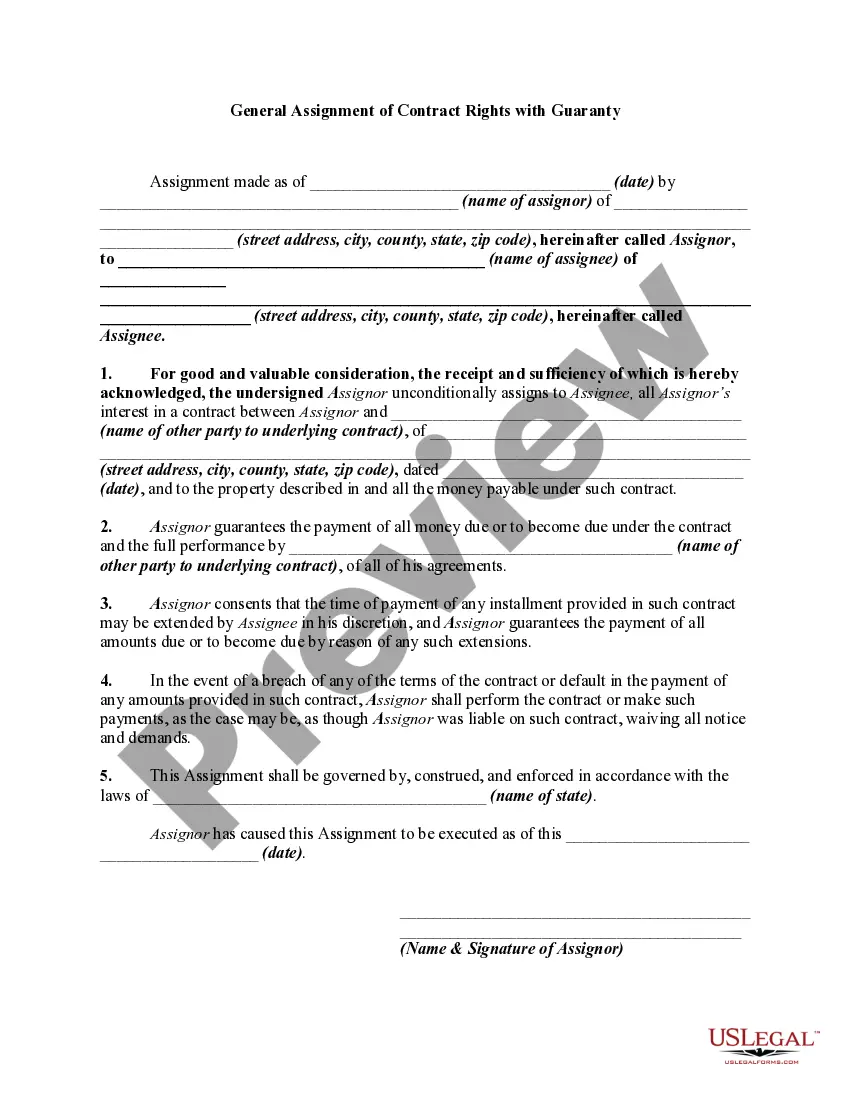
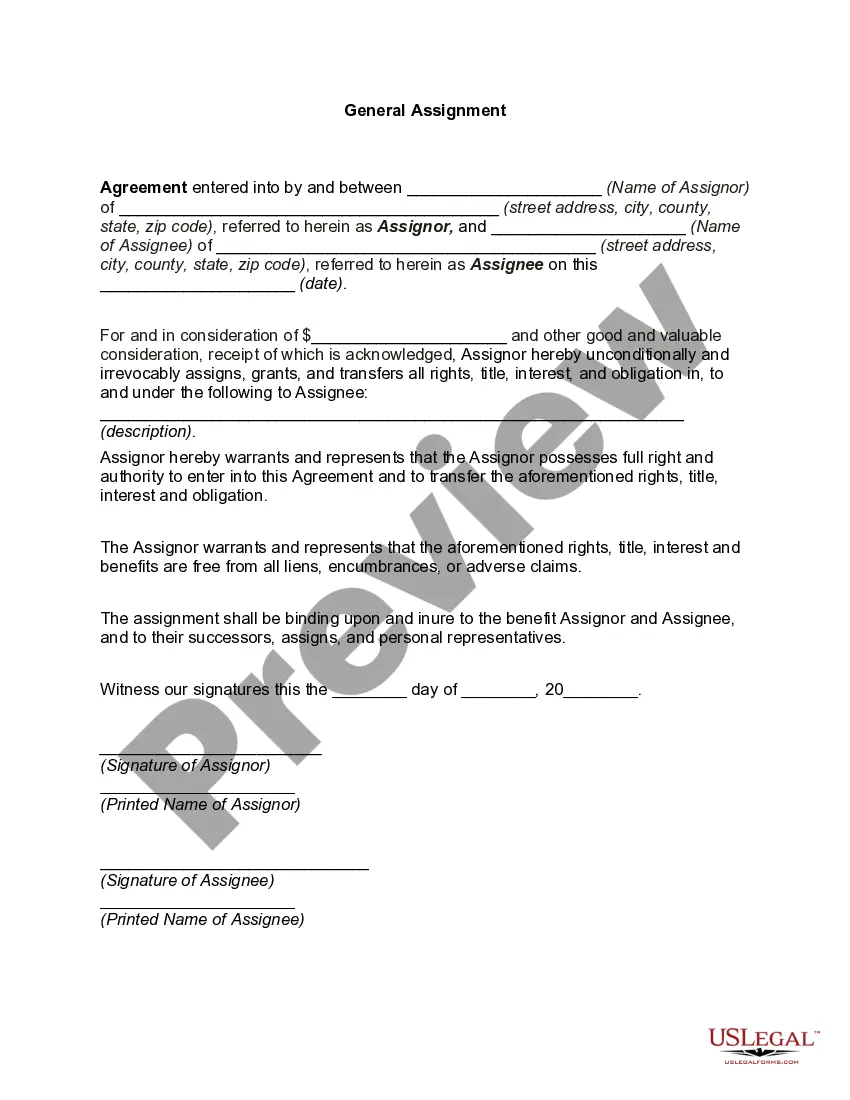
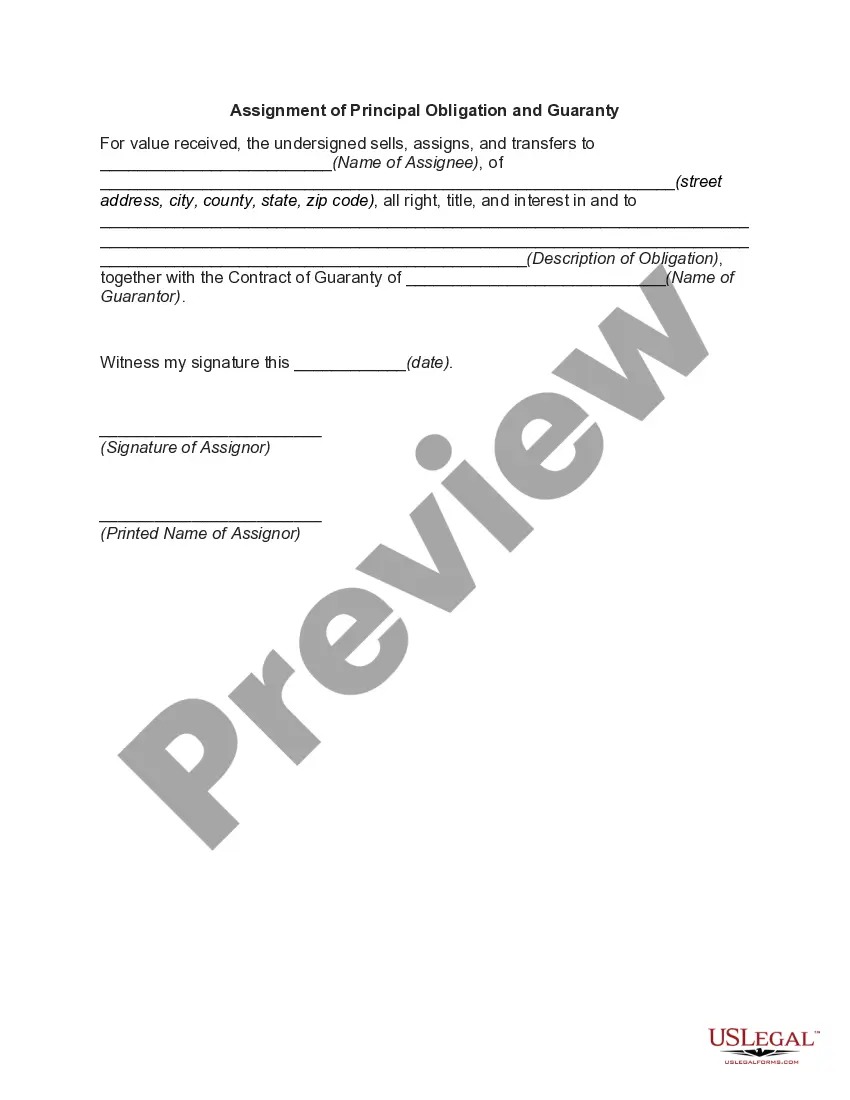
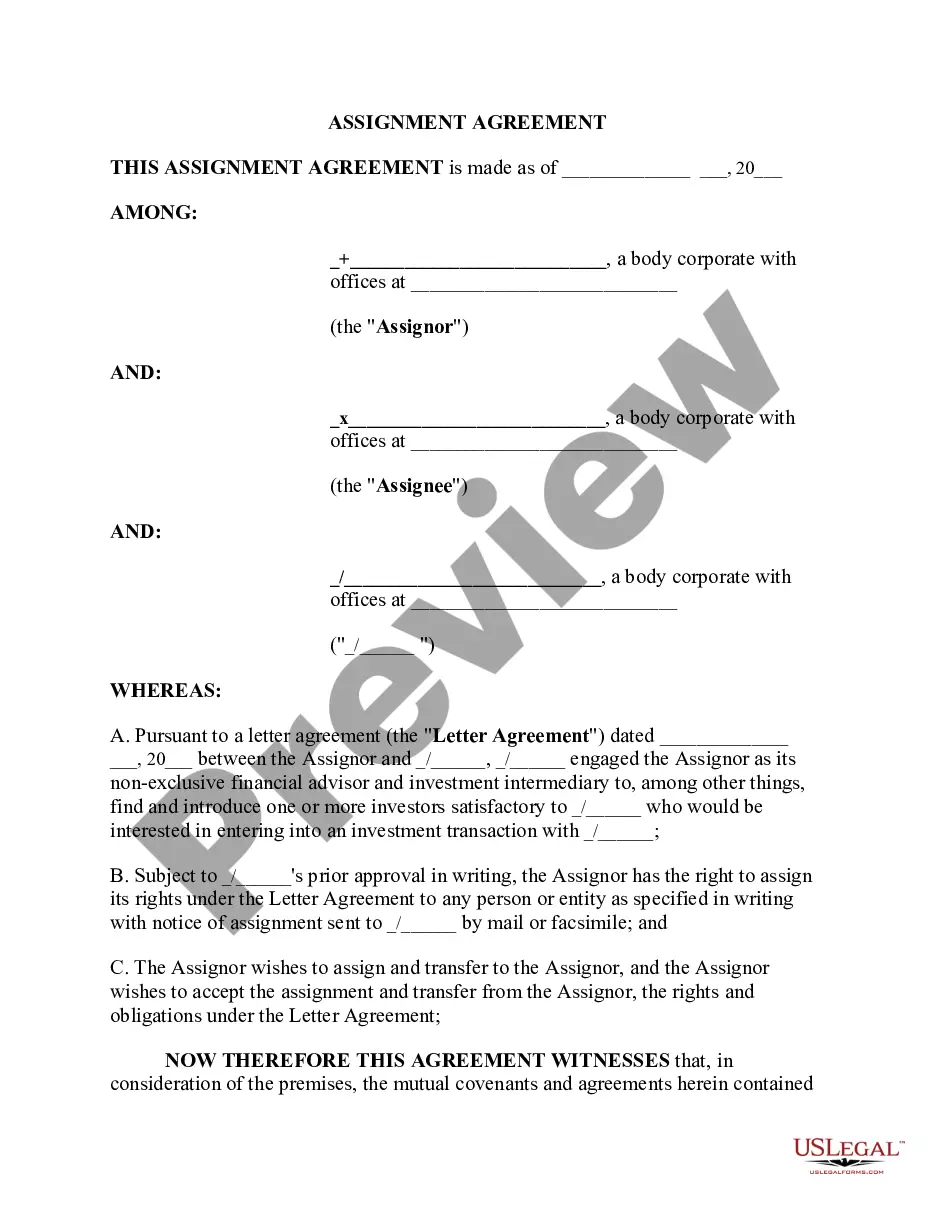
The General Assignment of Contract Rights with Guaranty is a legal document that facilitates the transfer of contractual rights from one party (the Assignor) to another (the Assignee). This form is crucial in various business dealings and financial agreements, as it ensures that the Assignee can claim benefits and obligations outlined in the contract. Unlike other assignment forms, this one includes a guaranty, which means the Assignor also guarantees that the obligations of the contract will be fulfilled.
Key components of this form
- Assignment date: Date on which the assignment takes effect.
- Details of the Assignor: Name and address of the person transferring rights.
- Details of the Assignee: Name and address of the person receiving rights.
- Description of the contract: Name of the other party and specifics of the underlying contract.
- Guaranty clause: Assignor agrees to guarantee payment and performance under the contract.
- Governing law: Specifies which stateâs laws will govern the assignment.

When this form is needed
This form should be used when an individual or entity wishes to transfer their rights under a specific contract to another party. Common scenarios include business sales, partnership changes, or situations where one party can no longer fulfill their contractual obligations. Using this form ensures that the Assignee has a clear claim to the rights and guarantees performance from the Assignor.
Who should use this form
- Business owners looking to transfer contractual rights to another party.
- Individuals entering into agreements who need to ensure their obligations are fulfilled.
- Investors acquiring rights to contracts from other parties.
- Parties involved in mergers or acquisitions.
How to prepare this document
- Identify the parties: Enter the names and addresses of both the Assignor and Assignee.
- Specify the contract: Clearly describe the contract being assigned, including details about the other party involved.
- Enter the effective date: Fill in the date when the assignment takes effect.
- Review the guaranty clause: Ensure the Assignor's obligations and guarantees are understood.
- Obtain signatures: Make sure both parties sign and date the form to validate the assignment.
Does this form need to be notarized?
This form does not typically require notarization unless specified by local law. However, it is always a good practice to consult with a legal professional if you have questions about the implications of your assignment.
Get your form ready online
Our built-in tools help you complete, sign, share, and store your documents in one place.
Make edits, fill in missing information, and update formatting in US Legal Forms—just like you would in MS Word.
Download a copy, print it, send it by email, or mail it via USPS—whatever works best for your next step.
Sign and collect signatures with our SignNow integration. Send to multiple recipients, set reminders, and more. Go Premium to unlock E-Sign.
If this form requires notarization, complete it online through a secure video call—no need to meet a notary in person or wait for an appointment.
We protect your documents and personal data by following strict security and privacy standards.

Make edits, fill in missing information, and update formatting in US Legal Forms—just like you would in MS Word.

Download a copy, print it, send it by email, or mail it via USPS—whatever works best for your next step.

Sign and collect signatures with our SignNow integration. Send to multiple recipients, set reminders, and more. Go Premium to unlock E-Sign.

If this form requires notarization, complete it online through a secure video call—no need to meet a notary in person or wait for an appointment.

We protect your documents and personal data by following strict security and privacy standards.
Common mistakes
- Failing to include the date of the assignment.
- Not clearly identifying the contract being assigned.
- Omitting signatures from either party.
- Not reviewing specific state requirements before completing the form.
Advantages of online completion
- Convenience: Easily download and complete the form at your own pace.
- Editability: Customize the document to fit your specific situation accurately.
- Reliability: Access forms drafted by licensed attorneys to ensure legal compliance.
Key takeaways
- The General Assignment of Contract Rights with Guaranty allows for secure transfer of contractual rights while maintaining assignor liability.
- Key components include assignor and assignee information, contract details, and a guaranty clause.
- Ensure all parties sign and complete the form accurately to avoid future disputes.
Looking for another form?

Form popularity
FAQ
An assignment of rights agreement refers to a situation in which one party, known as the assignor, shifts contract rights to another party. The party taking on the rights is known as the assignee.
An assignment of contract occurs when one party to an existing contract (the "assignor") hands off the contract's obligations and benefits to another party (the "assignee"). Ideally, the assignor wants the assignee to step into his shoes and assume all of his contractual obligations and rights.
Contractual rights are the set of rights guaranteed whenever people enter into a valid contract with one another. Contract rights usually involve business matters, including the provision of products and services.Rights to purchase a particular product or service. Rights to be sell a product or service.
A right cannot be assigned if the assignment will significantly increase or alter the risks to or the duties of the obligor (the party owing performance under the contract).
The right or benefit being assigned may be a gift (such as a waiver) or it may be paid for with a contractual consideration such as money. The rights may be vested or contingent, and may include an equitable interest. Mortgages and loans are relatively straightforward and amenable to assignment.
Generally speaking, contracts can be freely assigned to third parties.This contract cannot be assigned to anyone without the written consent of both parties.
An assignment of rights agreement refers to a situation in which one party, known as the assignor, shifts contract rights to another party. The party taking on the rights is known as the assignee.
Guaranty Agreement a two-party contract in which the first party agrees to perform in the event that a second party fails to perform. Unlike a surety, a guarantor is only required to perform after the obligee has made every reasonable and legal effort to force the principal's performance.
Contracts can usually be "assigned" to another party, so long as that party agrees to uphold your end of the bargain. However, some contracts prohibit assignment. When you draft a contract, consider whether you would like the right to assign it to someone else.