Conditional Guaranty of Payment of Obligation
Overview of this form
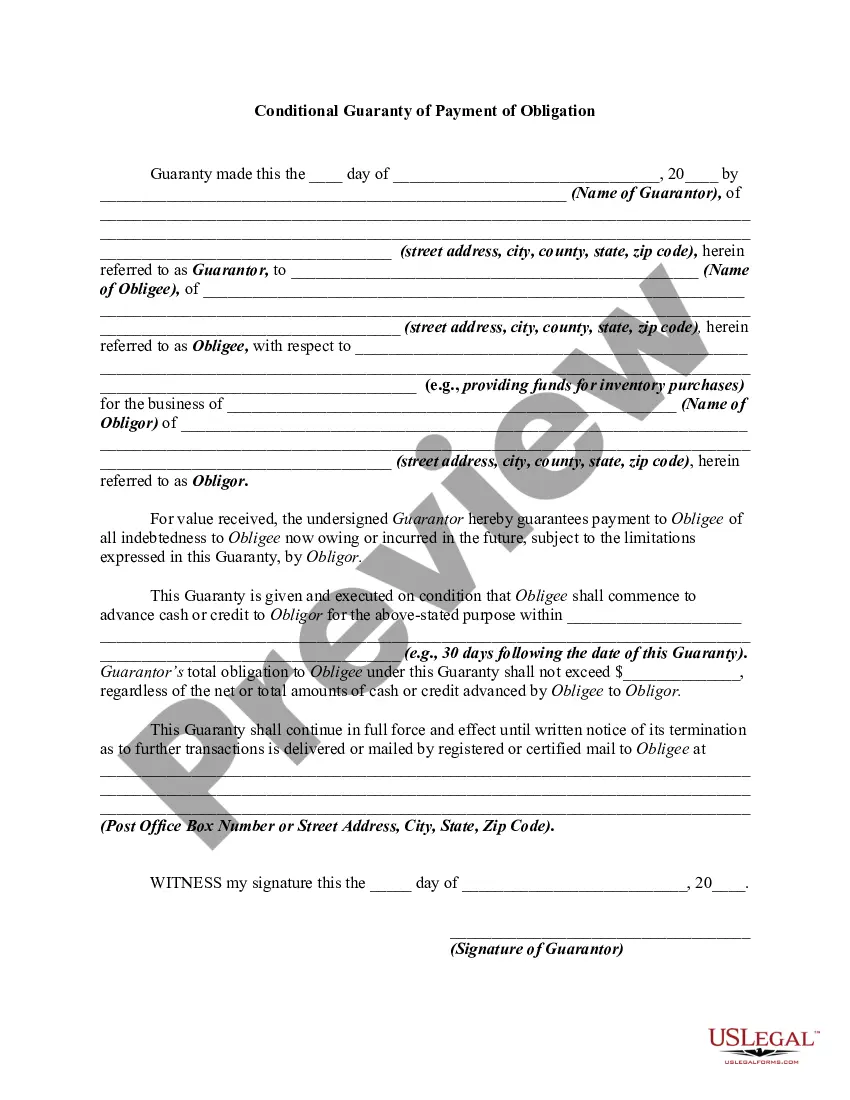
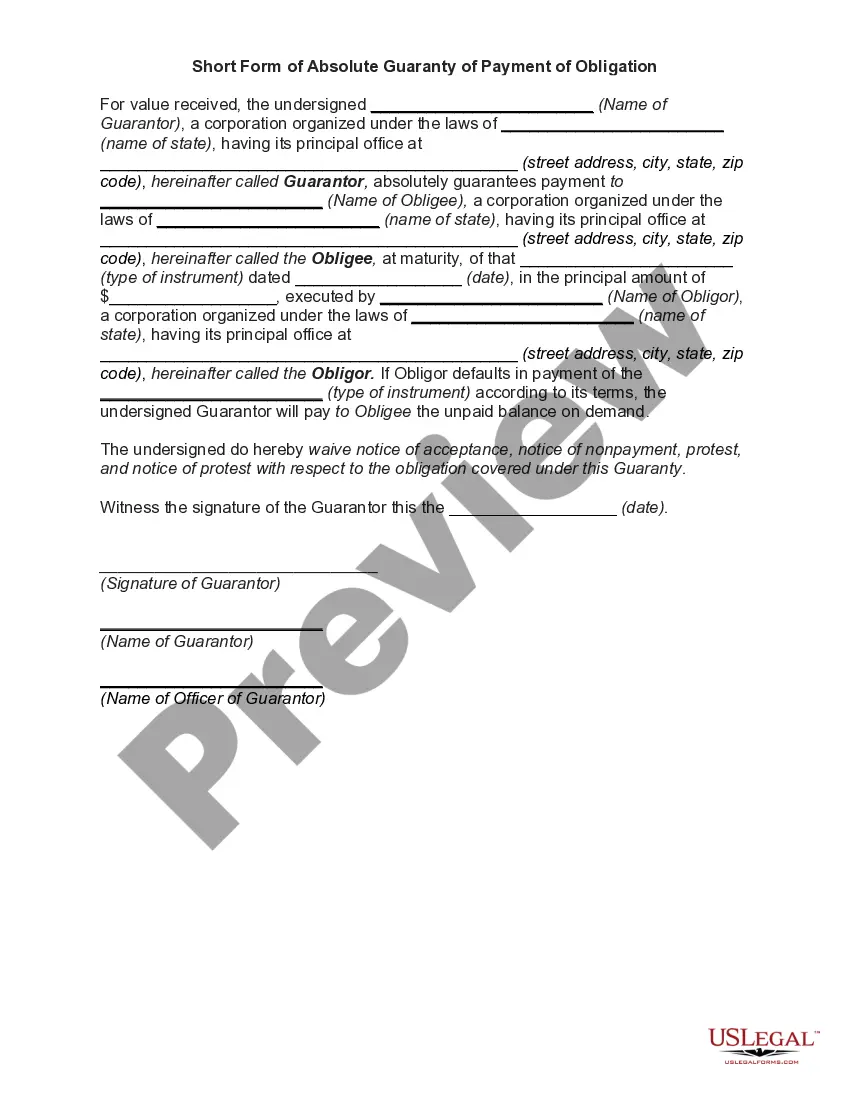
A Conditional Guaranty of Payment of Obligation is a legal document in which one party, known as the guarantor, agrees to pay a debt or fulfill a responsibility if the primary debtor, known as the obligor, fails to do so. This type of guaranty imposes a condition on the guarantor's liability, making it different from an absolute guaranty. The conditional element typically relates to specific triggers, such as the obligor not meeting their obligations.
Key components of this form
- Identification of the guarantor, obligee, and obligor.
- Specification of the debt or obligation being guaranteed.
- Conditions under which the guarantor is liable for the debt.
- Limitations on the guarantor's obligation, specifying a maximum amount.
- Notification procedure for terminating the guaranty.

When this form is needed
This form is typically used when a business or individual is seeking a financial guarantee for loans, credit, or other obligations, and wants a conditional guarantee. It is useful when the lender wants assurance that they will receive payment, and it allows the guarantor to know the terms under which they must fulfill the obligation.
Who this form is for
- Businesses seeking to secure loans or lines of credit.
- Individuals acting as guarantors on behalf of a business.
- Lenders looking for guarantees to protect their financial interests.
How to complete this form
- Identify all parties involved: the guarantor, obligee, and obligor.
- Clearly specify the purpose of the guarantee.
- Enter the date and effective timeframe for the guaranty.
- Limit the total obligation of the guarantor as needed.
- Sign and date the form in the presence of witnesses if required.
Notarization guidance
Notarization is generally not required for this form. However, certain states or situations might demand it. You can complete notarization online through US Legal Forms, powered by Notarize, using a verified video call available anytime.
Get your form ready online
Our built-in tools help you complete, sign, share, and store your documents in one place.
Make edits, fill in missing information, and update formatting in US Legal Forms—just like you would in MS Word.
Download a copy, print it, send it by email, or mail it via USPS—whatever works best for your next step.
Sign and collect signatures with our SignNow integration. Send to multiple recipients, set reminders, and more. Go Premium to unlock E-Sign.
If this form requires notarization, complete it online through a secure video call—no need to meet a notary in person or wait for an appointment.
We protect your documents and personal data by following strict security and privacy standards.

Make edits, fill in missing information, and update formatting in US Legal Forms—just like you would in MS Word.

Download a copy, print it, send it by email, or mail it via USPS—whatever works best for your next step.

Sign and collect signatures with our SignNow integration. Send to multiple recipients, set reminders, and more. Go Premium to unlock E-Sign.

If this form requires notarization, complete it online through a secure video call—no need to meet a notary in person or wait for an appointment.

We protect your documents and personal data by following strict security and privacy standards.
Mistakes to watch out for
- Failing to specify conditions that trigger the guarantor's obligations.
- Not clearly identifying all parties and their roles.
- Overlooking to set a maximum limit on the guarantor's obligation.
- Neglecting to sign and date the document properly.
Advantages of online completion
- Convenient access and ability to download immediately.
- Edit the form to meet specific needs with ease.
- Reliability with templates drafted by licensed attorneys.
Legal use & context
- The conditional guaranty is enforceable under contract law principles.
- It is vital to clearly define the conditions and limits of the guaranty to avoid future disputes.
- The form should be used in accordance with applicable state laws to ensure legal compliance.
Key takeaways
- The Conditional Guaranty of Payment of Obligation offers conditional assurance of payment for defined debts.
- Proper completion of this form is crucial for ensuring enforceability and clarity of terms.
- It is adaptable to varying state requirements, making it useful for multiple jurisdictions.
Looking for another form?
Form popularity
FAQ
A guarantor is a third party who 'guarantees' a loan, mortgage or rental agreement. This means they agree to repay the total amount owed if the borrower or renter can't pay what they owe. By guaranteeing the agreement, you become responsible for any arrears that occur.
A Guarantor's obligations A guarantor may be bound to maintain repayments on a borrower's loan in circumstances where the borrower defaults on repayments. Alternatively they may be called upon to repay the loan in full.
No, if you have signed an agreement and are acting as the guarantor for a guarantor loan, you cannot stop being this until the loan term has ended.
A guaranty of the payment of an obligation, without words of limitation or condition, is construed as an absolute or unconditional guaranty.
Lenders often insert continuing and unconditional guaranty language. This type of guaranty renders a guarantor liable for all past, present and future obligations of the business. The exposure is almost unlimited. The business may incur a mountain of debt and in the event of default the guarantor is ultimately liable.
Most landlords and letting agents require tenants to have a Guarantor in order to qualify as a suitable tenant. Some tenants for one reason or another can't arrange a Guarantor.The reality is, a guarantor is a prerequisite for every sensible landlord, and rightly so.
Guarantors are asked to sign a guarantee agreement this is a legally binding document and once you sign it you become responsible for the loan repayments if the person you are acting as guarantor for cannot pay.
A guaranty of payment is an independent agreement by a person or an entity to pay the loan when it goes into default. Even if the borrower is unable or unwilling to pay back the loan, the Bank can require the guarantor to pay it back.
The guarantor promises to pay an amount owed by the borrower, if the borrower fails to pay it. This means that the guarantor is only under an obligation to pay, if the borrower breaches its obligation.