Waiver of Moral Rights
What is this form?
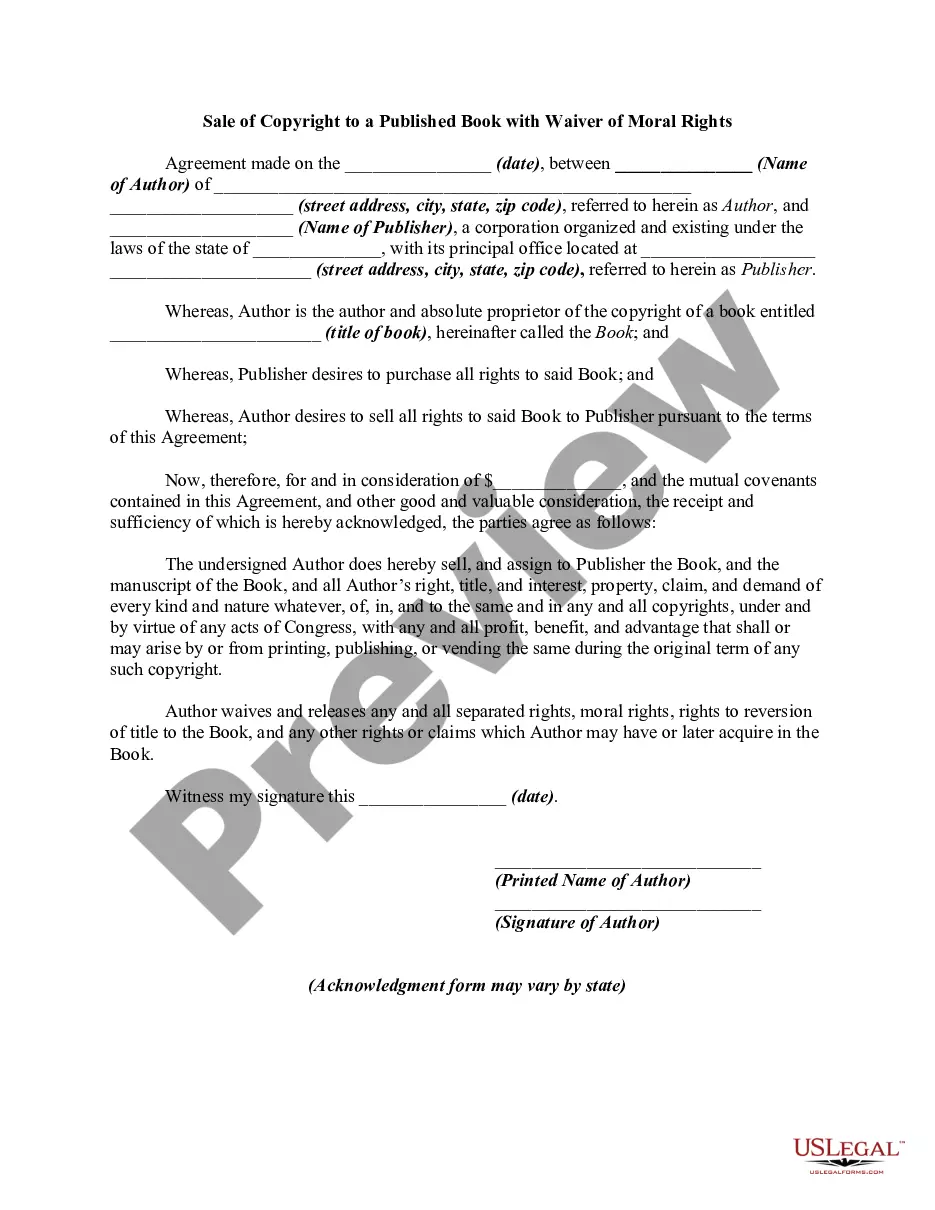
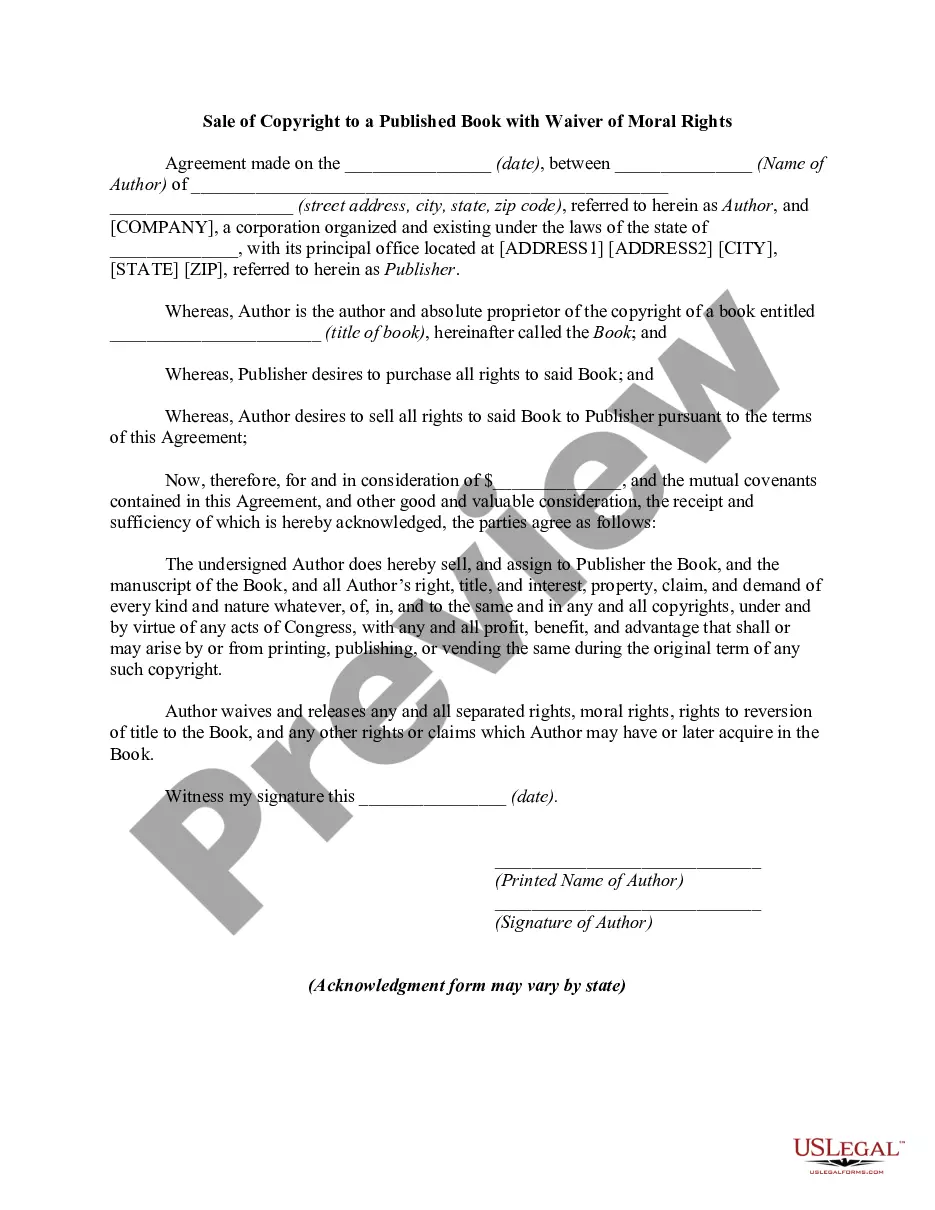
The Waiver of Moral Rights is a legal document that allows an author to relinquish certain moral rights associated with their copyrighted work. Moral rights typically include rights to attribution, integrity, and anonymity. By signing this form, the author relinquishes these rights to a publisher, enabling them to utilize the work without restrictions tied to the authorâs moral rights. This is distinct from economic rights of copyright, which involve the financial gains from the work.
Key parts of this document
- Date of agreement establishment.
- Identification of the Author and Publisher, including addresses.
- Title and description of the copyrighted work, referred to as the Book.
- Terms of the sale and assignment of rights from the Author to the Publisher.
- Waiver of all moral rights and associated claims by the Author.
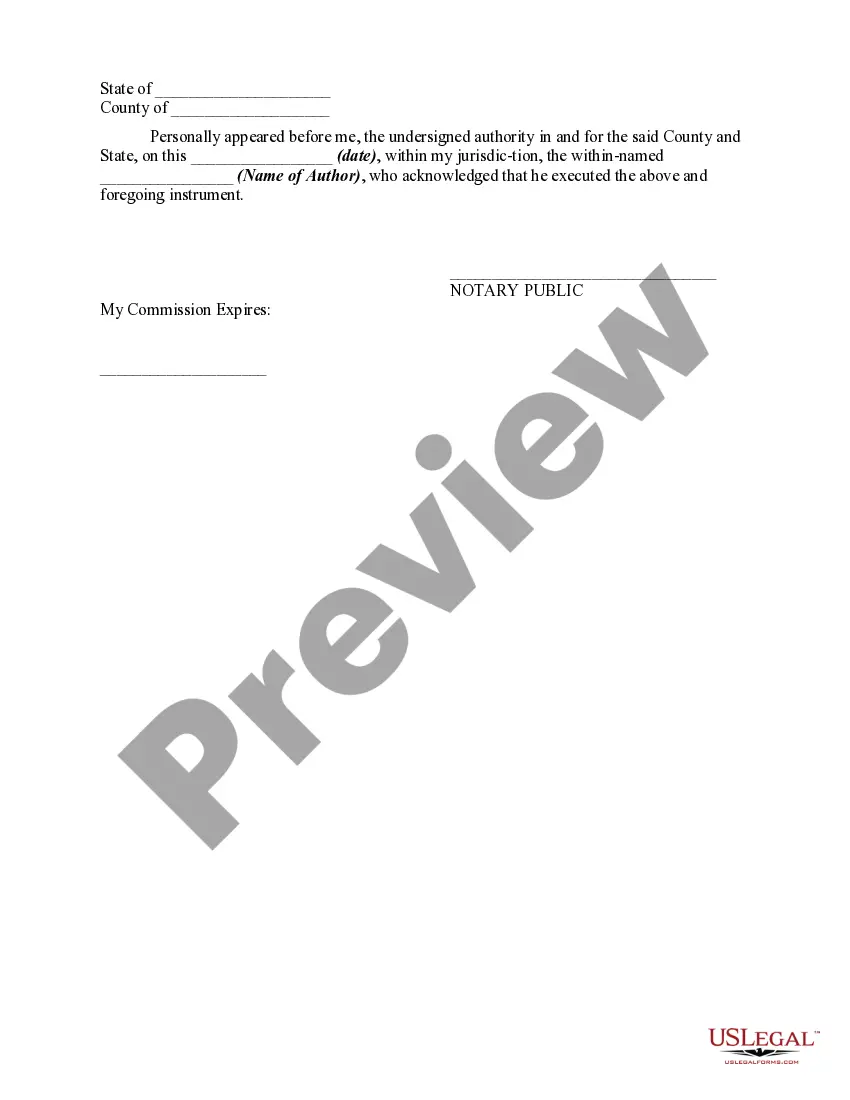
- Signature fields for both Author and notary public acknowledgment.
Common use cases
This form is used when an author wishes to transfer all rights to their copyrighted work to a publisher while waiving any moral rights. It is essential in situations where the publisher needs to modify, adapt, or otherwise use the work without restrictions typically granted to the original creator. It is common in publishing agreements where the publisher intends to produce a commercial version of the work.
Who needs this form
- Authors who are ready to sell their copyright to a publisher.
- Publishers who wish to acquire full rights to a work.
- Legal representatives facilitating copyright transfers for clients.
How to prepare this document
- Identify and enter the date of the agreement.
- Fill in the names and addresses of both the Author and the Publisher.
- Specify the title of the copyrighted work (the Book).
- Outline the terms of the sale, including the compensation, if applicable.
- Have the Author sign and date the agreement in the provided fields.
- Ensure notarization if required by state law.
Is notarization required?
This form must be notarized to be legally valid. Ensuring notarization verifies the authenticity of the signatures and the date of execution. US Legal Forms offers integrated online notarization services that are available 24/7 via secure video call, providing legal equivalence without the need for travel.
Get your form ready online
Our built-in tools help you complete, sign, share, and store your documents in one place.
Make edits, fill in missing information, and update formatting in US Legal Forms—just like you would in MS Word.
Download a copy, print it, send it by email, or mail it via USPS—whatever works best for your next step.
Sign and collect signatures with our SignNow integration. Send to multiple recipients, set reminders, and more. Go Premium to unlock E-Sign.
If this form requires notarization, complete it online through a secure video call—no need to meet a notary in person or wait for an appointment.
We protect your documents and personal data by following strict security and privacy standards.

Make edits, fill in missing information, and update formatting in US Legal Forms—just like you would in MS Word.

Download a copy, print it, send it by email, or mail it via USPS—whatever works best for your next step.

Sign and collect signatures with our SignNow integration. Send to multiple recipients, set reminders, and more. Go Premium to unlock E-Sign.

If this form requires notarization, complete it online through a secure video call—no need to meet a notary in person or wait for an appointment.

We protect your documents and personal data by following strict security and privacy standards.
Avoid these common issues
- Failing to accurately identify the parties involved.
- Neglecting to specify the title of the copyrighted work.
- Leaving out the signatures or dates required on the document.
- Not consulting state-specific legal requirements before usage.
Why complete this form online
- Convenience of instantly accessing and downloading the form.
- Editability allows for customization specific to your needs.
- Reliable guidance through all necessary sections for completion.
- Secure storage and easy retrieval of completed documents.
Looking for another form?



Form popularity
FAQ
Moral rights are rights of creators of copyrighted works generally recognized in civil law jurisdictions and, to a lesser extent, in some common law jurisdictions.Even if an artist has assigned his or her copyright rights to a work to a third party, he or she still maintains the moral rights to the work.
A specimen form of waiver by which the author of a copyright literary, dramatic, musical or artistic work, or the director of a copyright film, waives their rights to be identified as the author or director of the work in question and/or their right to object to derogatory treatment of the work.
In Australia, there is no need to "assert" your moral rights.The Copyright Act does not specifically allow for the "waiver" of moral rights. However, it does contemplate that artists can consent in writing to the future infringement of their moral rights.
Be careful not to waive your moral rights Unlike copyright, it is not possible to 'assign' or sell your moral rights.You should look out for any clause that mentions waiving moral rights.
Can moral rights be transferred or waived?It is not legally possible to waiver moral rights nor is it possible to include a clause in the agreement stating that the publisher will not sue or take any action against the author (as it will be hit by certain sections of the Indian Contract Act).
The Delhi High Court's verdict in Amar Nath Sehgal v Union of India (1987) is perhaps the most prominent judgment to deal with the issue of an author exercising their moral rights after assigning copyright.These rights cannot be negated or waived by the terms of a contract for assignment.
The right to life. The right to liberty. The right to pursue happiness. The right to a jury trial. The right to a lawyer. The right to freely practice a religion of choice. The right to express ideas or opinions with freedom as an individual.