Petition to Enter Plea of Guilty
What this document covers
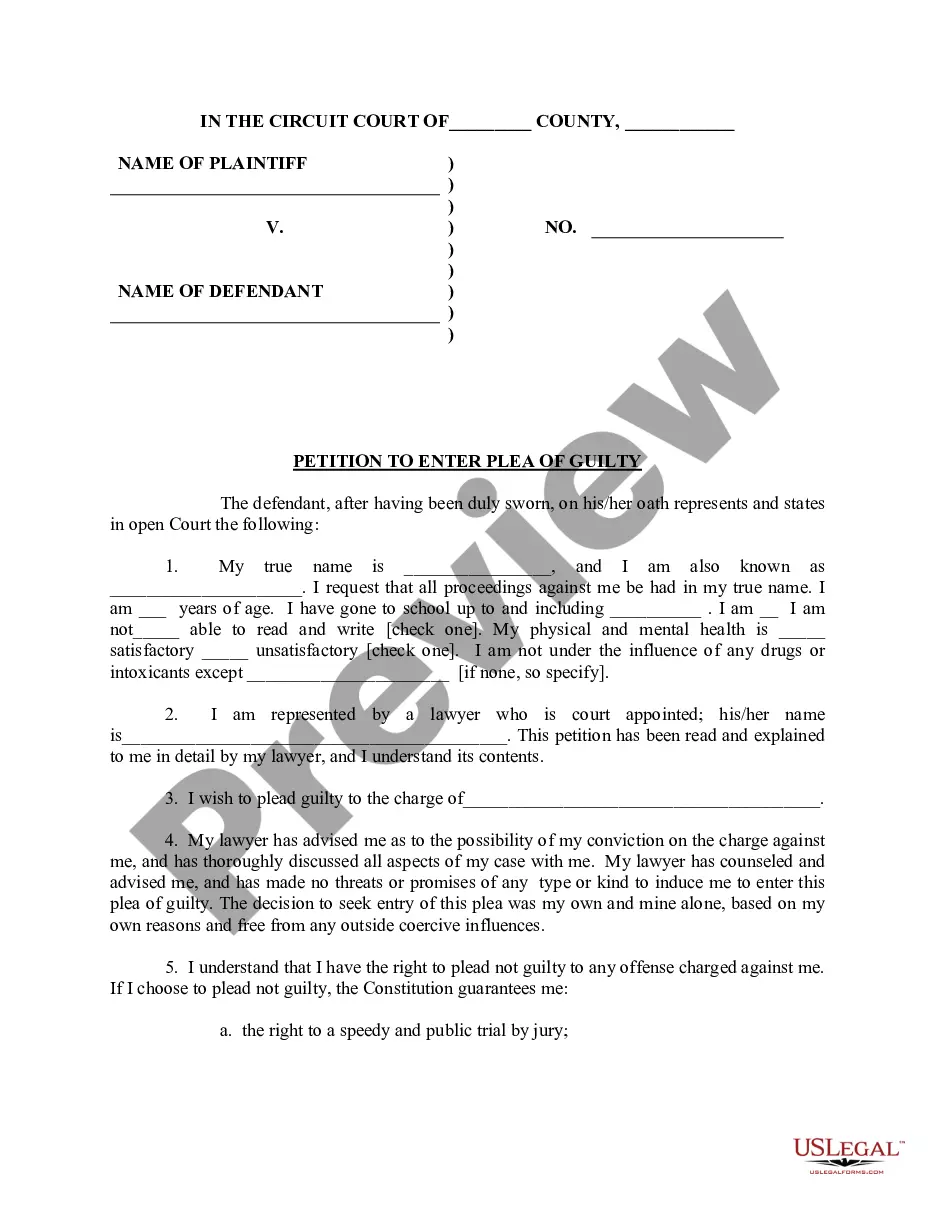
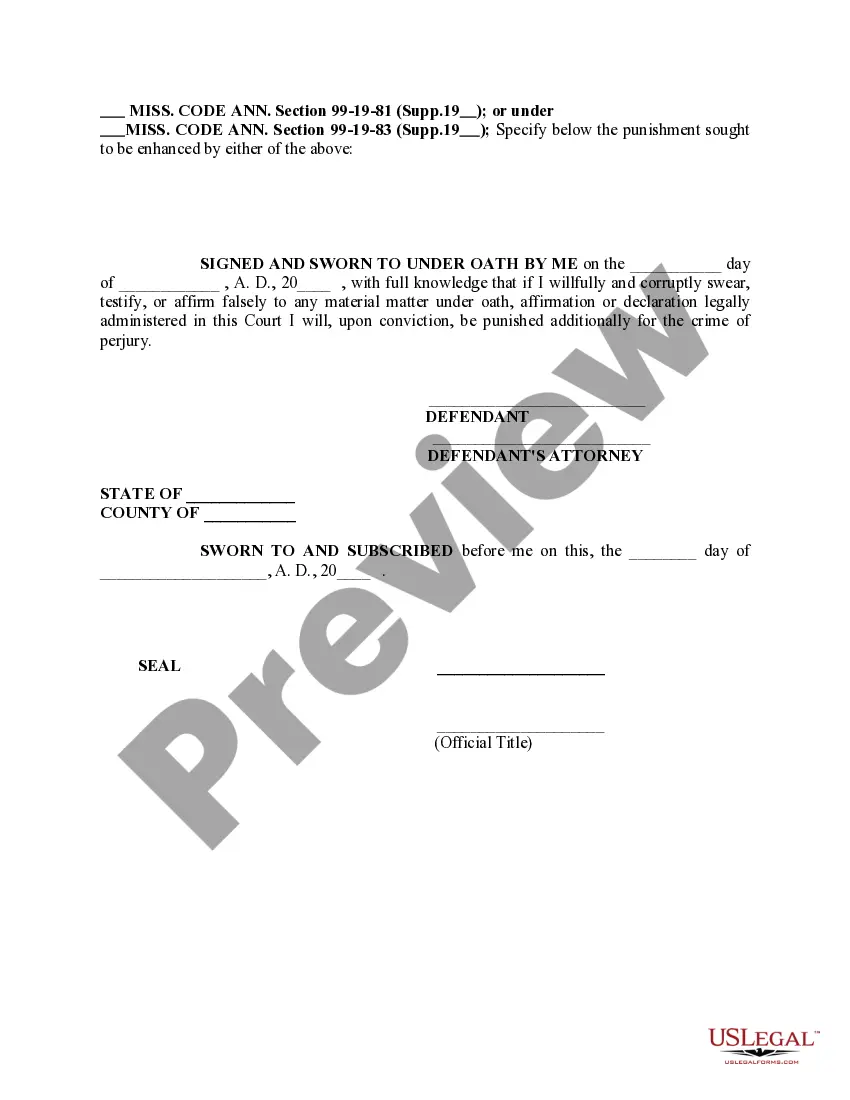
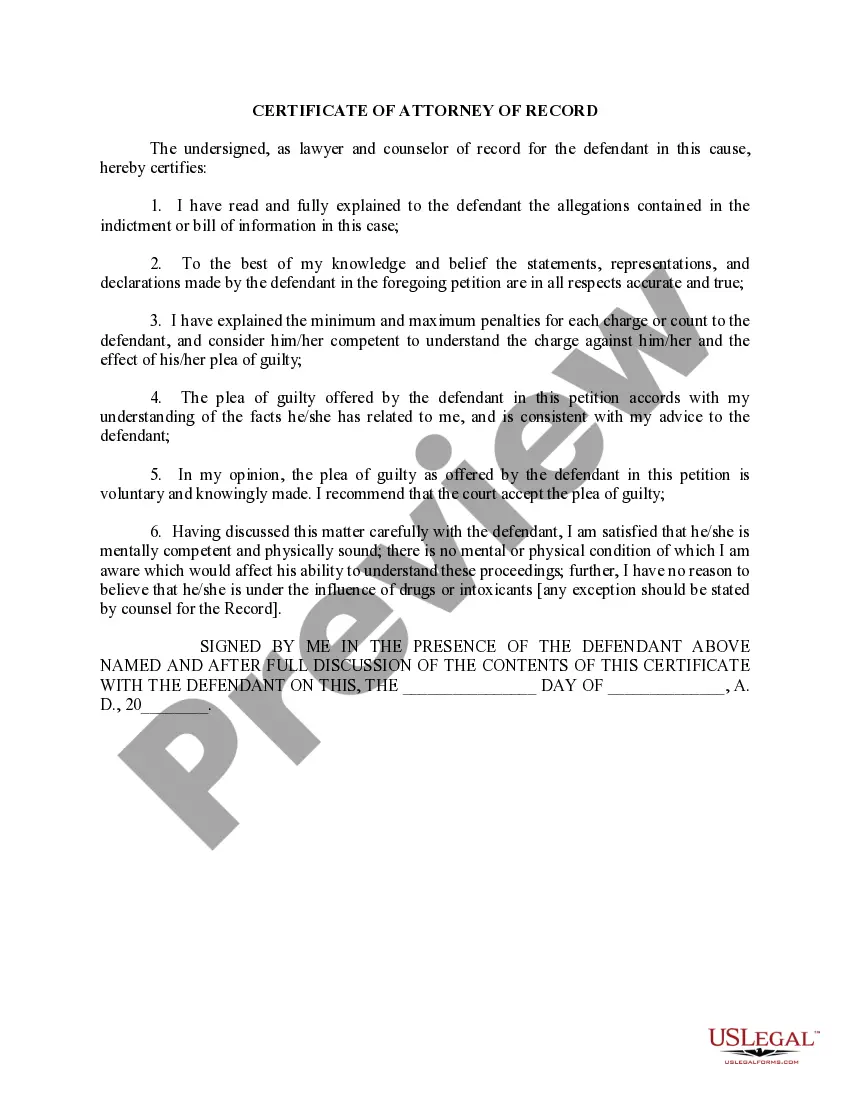
The Petition to Enter Plea of Guilty is a legal document used by individuals who wish to formally admit guilt in a criminal case. This form outlines the defendant's rights and the implications of pleading guilty, distinguishing it from other plea forms. Although designed for use in Mississippi, it can be adapted for other jurisdictions as necessary.
Main sections of this form
- Defendant's personal information, including names and age.
- Representation by a lawyer and understanding of the petition's content.
- Details of the charge the defendant wishes to plead guilty to.
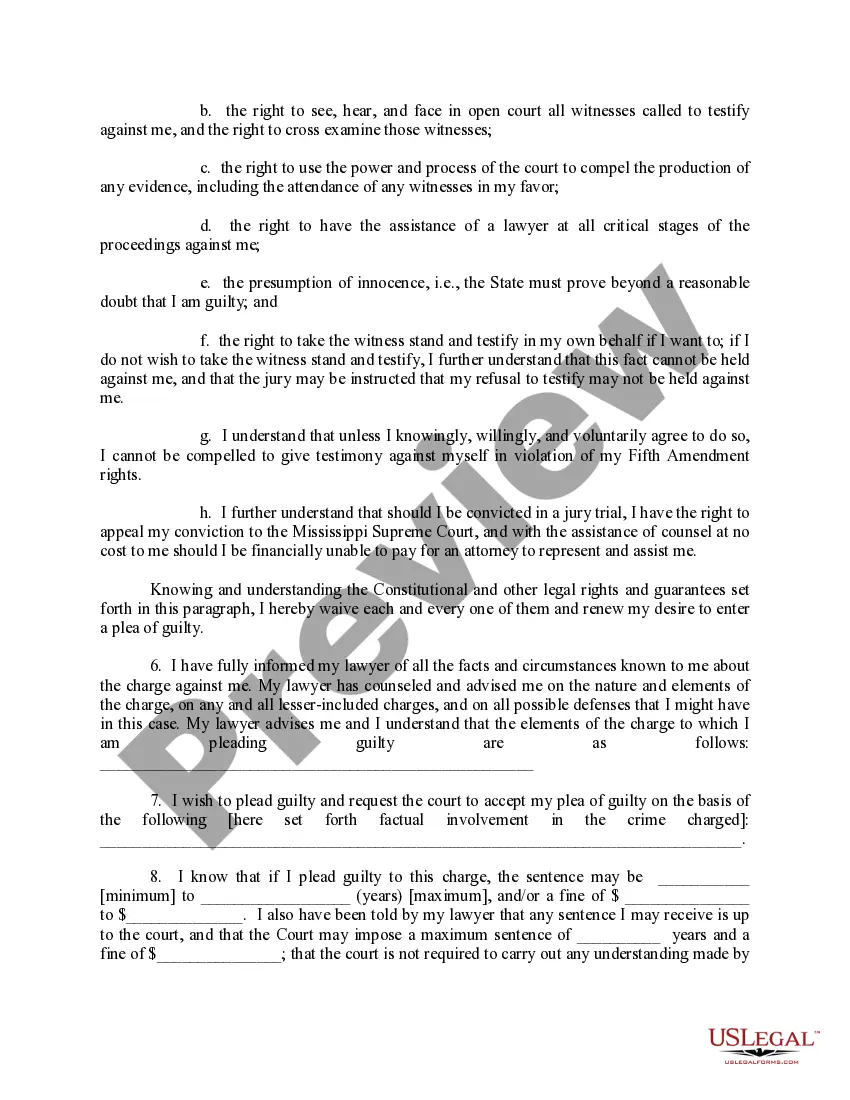
- Explanation of the legal rights being waived by entering a plea of guilty.
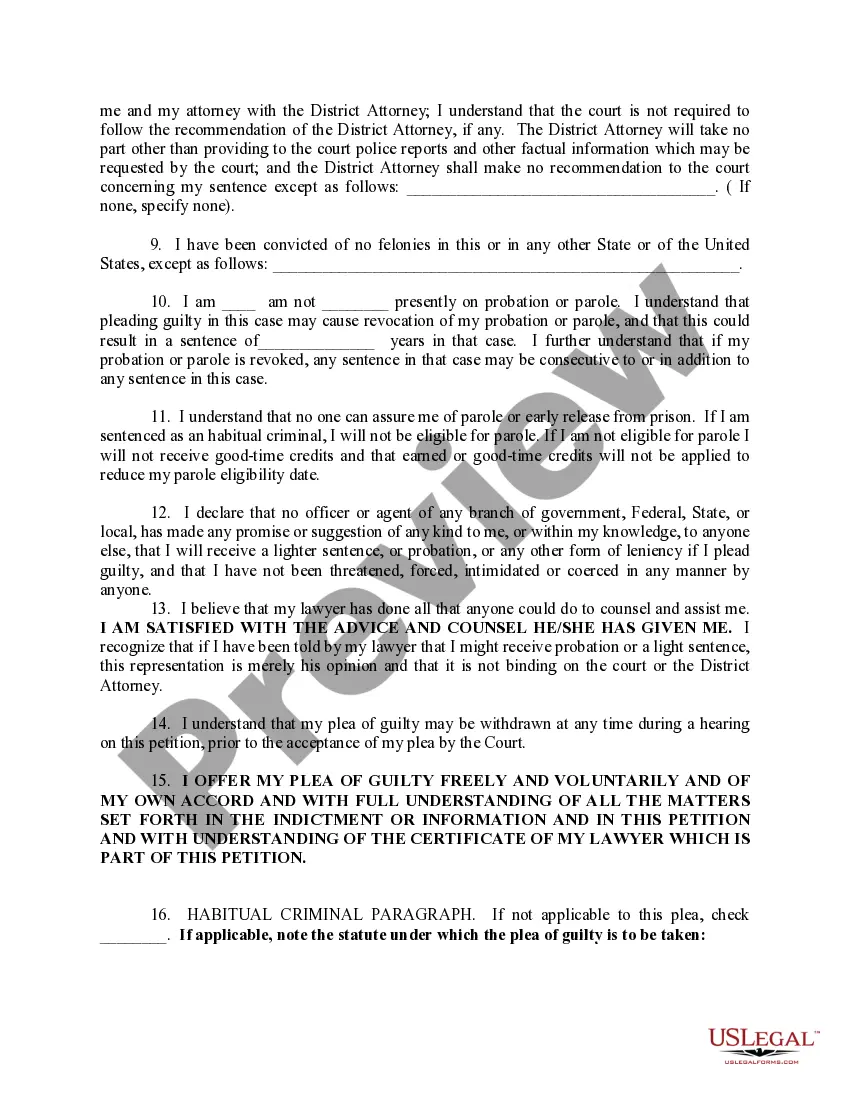
- Disclosure of any prior convictions and current probation or parole status.
- Confirmation that the plea is made voluntarily and without coercion.
Common use cases
This form is appropriate when a defendant has decided to plead guilty to a criminal charge and needs to formally submit that plea to the court. It may be used in cases where the defendant wishes to accept responsibility for the offense and is aware of their legal rights and the potential consequences of a guilty plea.
Intended users of this form
- Defendants in criminal cases wishing to plead guilty.
- Individuals who have received legal counsel regarding their plea.
- Those who understand the implications of pleading guilty and the rights being waived.
- Persons with no prior felony convictions or those aware of their status regarding probation or parole.
How to prepare this document
- Provide your full legal name and any aliases.
- Indicate your age and education level, and check the appropriate boxes regarding your ability to read and write.
- Fill in details regarding your lawyer and confirm that you understand the petition.
- State the charge to which you are pleading guilty and summarize your involvement in the crime.
- Sign and date the petition at the end, confirming your plea is voluntary.
Does this document require notarization?
This form needs to be notarized to ensure legal validity. US Legal Forms provides secure online notarization powered by Notarize, allowing you to complete the process through a verified video call, available anytime.
Get your form ready online
Our built-in tools help you complete, sign, share, and store your documents in one place.
Make edits, fill in missing information, and update formatting in US Legal Forms—just like you would in MS Word.
Download a copy, print it, send it by email, or mail it via USPS—whatever works best for your next step.
Sign and collect signatures with our SignNow integration. Send to multiple recipients, set reminders, and more. Go Premium to unlock E-Sign.
If this form requires notarization, complete it online through a secure video call—no need to meet a notary in person or wait for an appointment.
We protect your documents and personal data by following strict security and privacy standards.

Make edits, fill in missing information, and update formatting in US Legal Forms—just like you would in MS Word.

Download a copy, print it, send it by email, or mail it via USPS—whatever works best for your next step.

Sign and collect signatures with our SignNow integration. Send to multiple recipients, set reminders, and more. Go Premium to unlock E-Sign.

If this form requires notarization, complete it online through a secure video call—no need to meet a notary in person or wait for an appointment.

We protect your documents and personal data by following strict security and privacy standards.
Mistakes to watch out for
- Failing to fully read and understand the petition before signing.
- Not disclosing prior convictions that may affect the plea.
- Rushing to plead guilty without consulting a legal professional.
- Overlooking the implications of waiving certain legal rights.
Benefits of using this form online
- Ease of access: Download the form anytime, from anywhere.
- Time-saving: Complete the form at your convenience without waiting for in-person meetings.
- Editable: Directly customize the form to suit your specific situation.
- Reliability: Access forms created by licensed attorneys, ensuring legal validity.
Legal use & context
- The form should be filled out accurately to reflect the defendant's true circumstances.
- Pleading guilty entails serious consequences and should only be done with a clear understanding of the charges.
- The court has discretion in sentencing, and this form does not guarantee any particular outcome.
What to keep in mind
- This form is essential for defendants wishing to admit guilt formally.
- Understanding your rights and consequences is critical before submitting the petition.
- Ensure the form is properly completed and reviewed by legal counsel.
Looking for another form?







Form popularity
FAQ
Sentencing can mean years in prison. Even if a long sentence is not in the cards for the criminal defendant, a conviction may change the person's life.Therefore, pleading guilty could wind up causing a criminal defendant to lose a potential plea bargain that would offer better terms than a simple guilty plea.
Waiver. By submitting a guilty plea, a defendant waives a number of constitutional protections. A guilty plea results in the waiver of the right to a jury trial, the right against self-incrimination, and the right to confront witnesses.
A plea of guilty in a criminal case consists of three elements.4 Third, it is an admission of actual guilt. 5 A recent Supreme Court decision, North Carolina v. Alford,6 has highlighted the first two elements of the plea, but has cast some doubt on the continued validity of the plea as an admission of guilt.
A Plea of Guilty If you plead guilty, you are admitting to the Judge that you have committed acts which violate a valid City law. The judge will then decide what penalty will be assessed.You cannot plead guilty and then in your explanation to the Judge say that you did not violate the law.
Having a guilty plea or a no contest plea on the record will look better than having a conviction after a trial. This is partly because the defendant likely will plead guilty or no contest to a lesser level of offense or to fewer offenses.Often, a plea bargain involves reducing a felony to a misdemeanor.
For a knowing and intelligent guilty plea to be made, defendants have to: admit the conduct made punishable by the law. admit and understand the charges against them. know the consequences of the plea (both the sentence as it stands and the possible sentences that could be given were the defendant to have a trial),
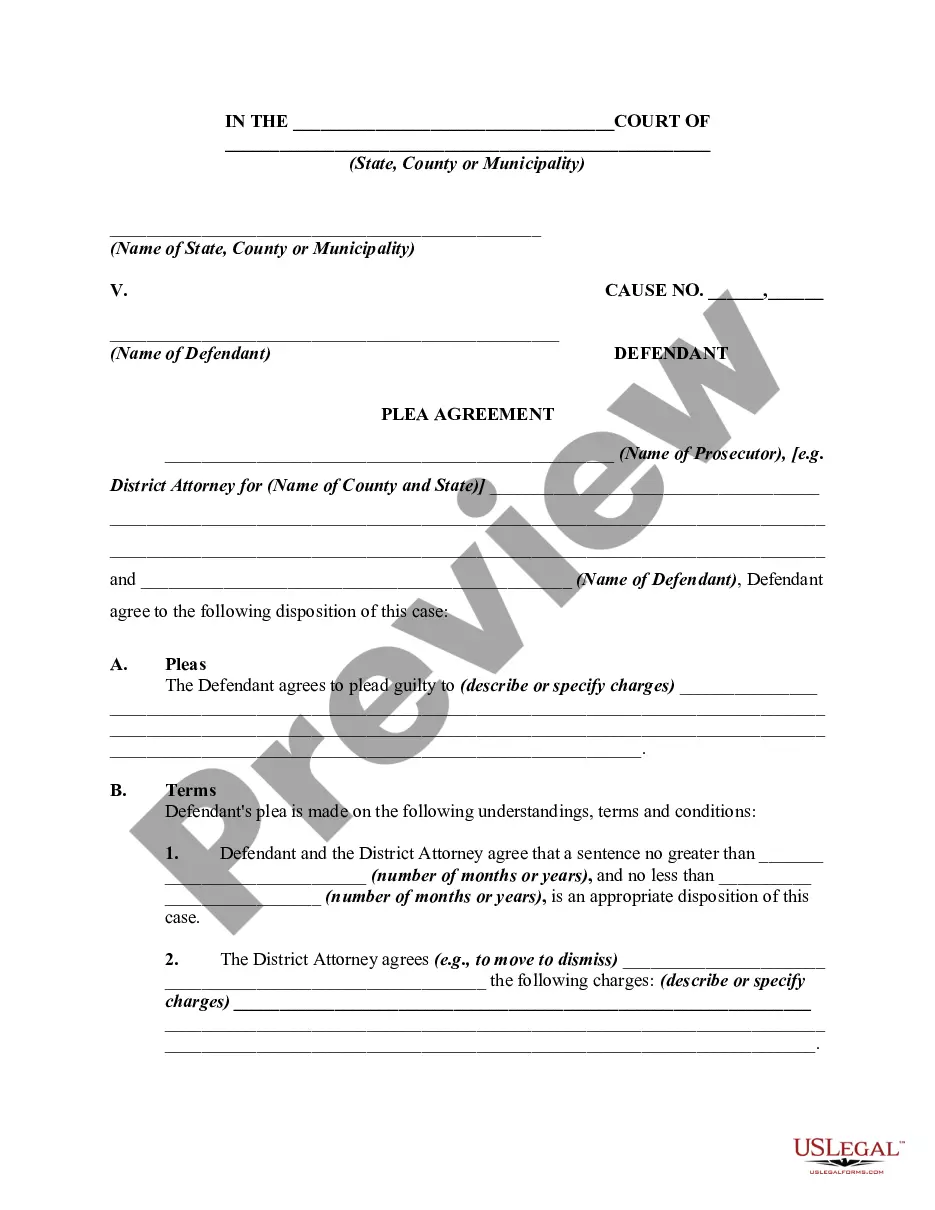
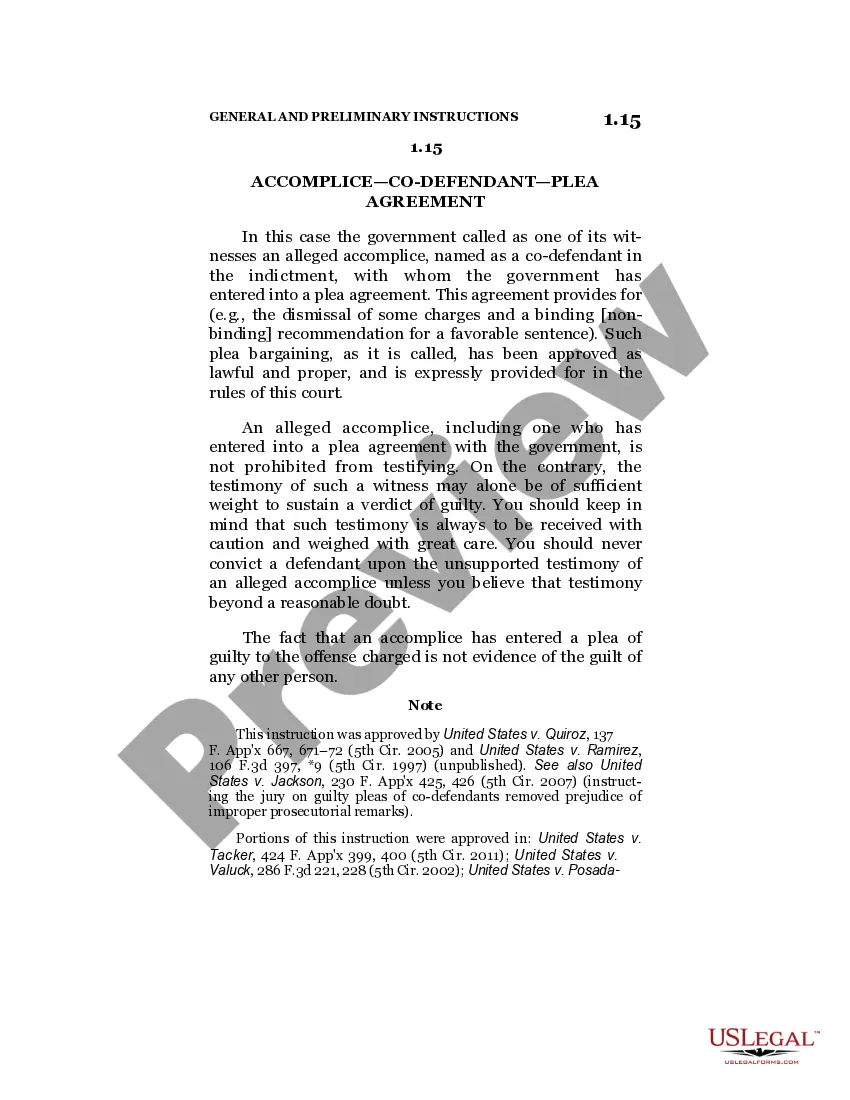
By pleading guilty, defendants waive those rights in exchange for a commitment from the prosecutor, such as a reduced charge or more favorable sentence.The prosecutor secures a conviction while avoiding the need to commit time and resources to trial preparation and a possible trial.
If the defendant pleads guilty it means they admit to committing the offence they were charged with. The court will then decide what punishment (sentence) the offender will be given.