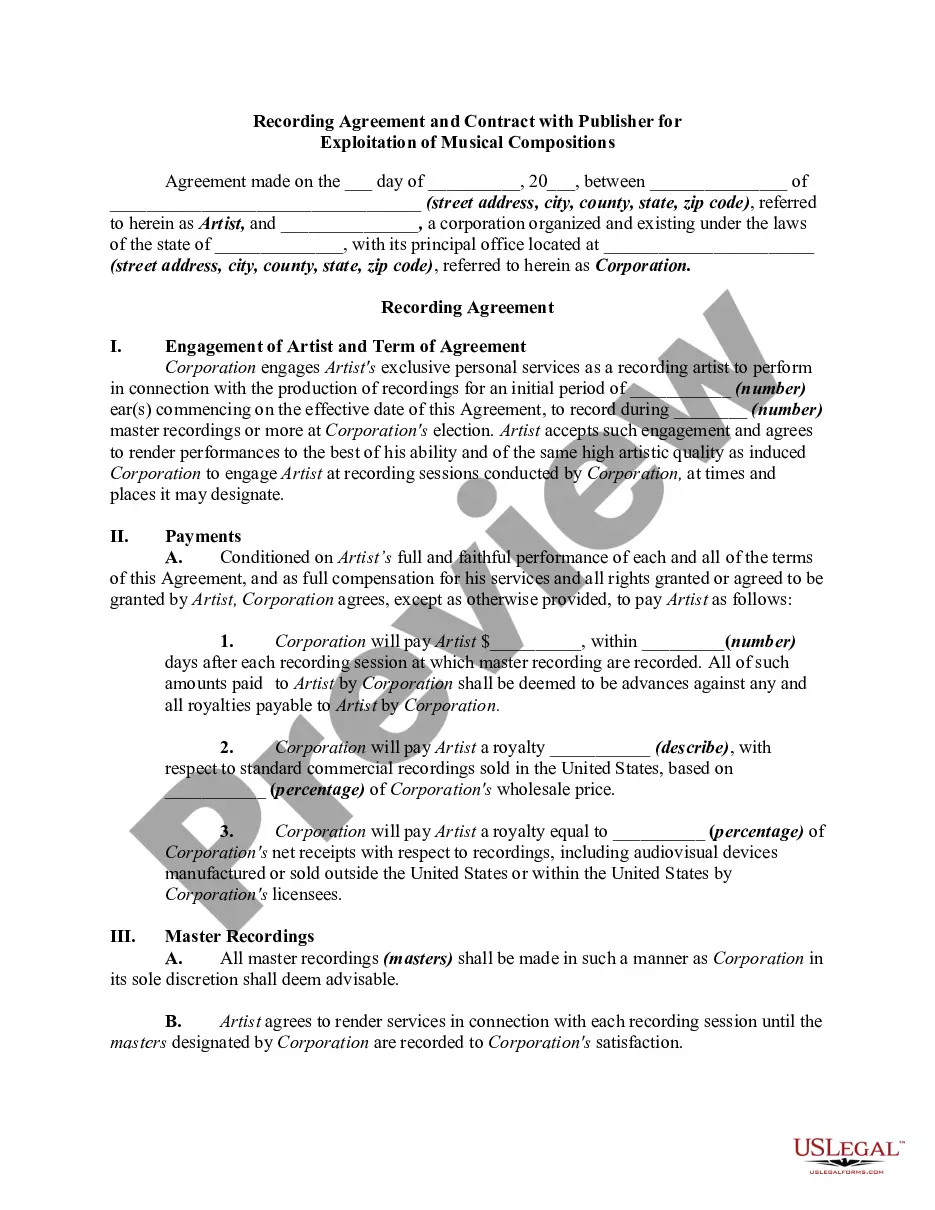
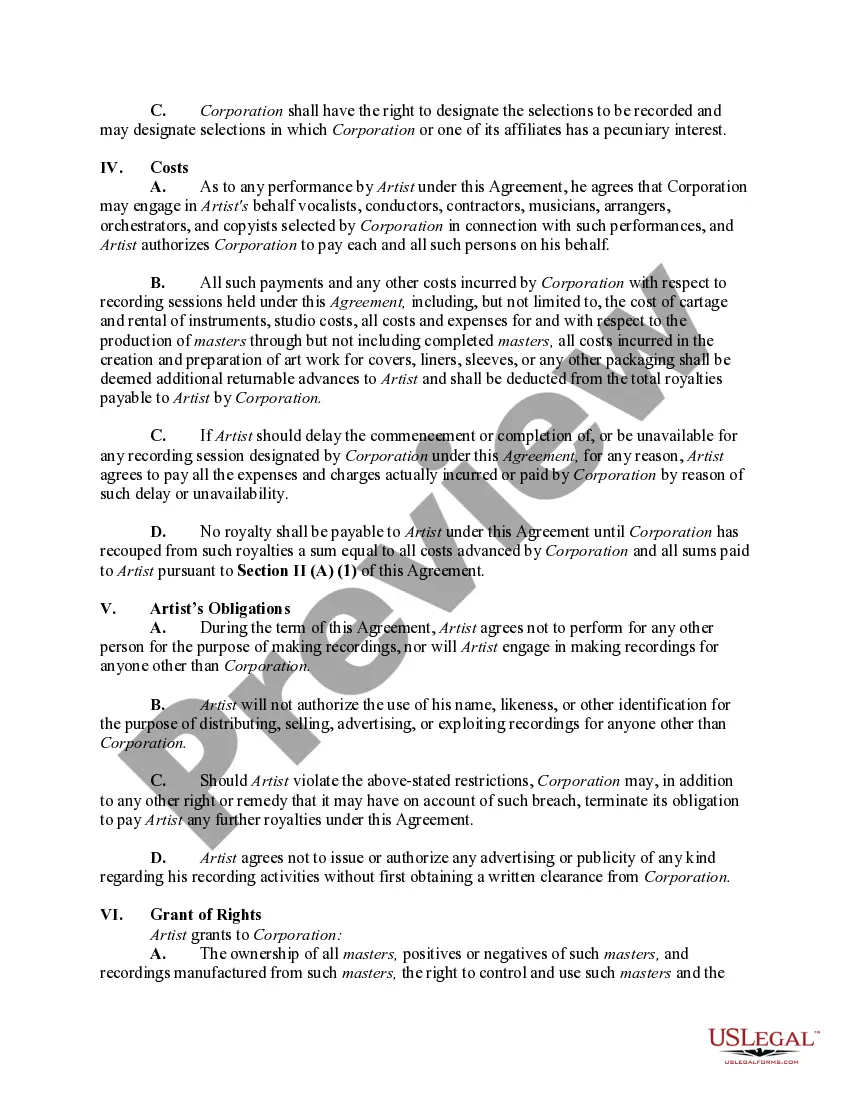
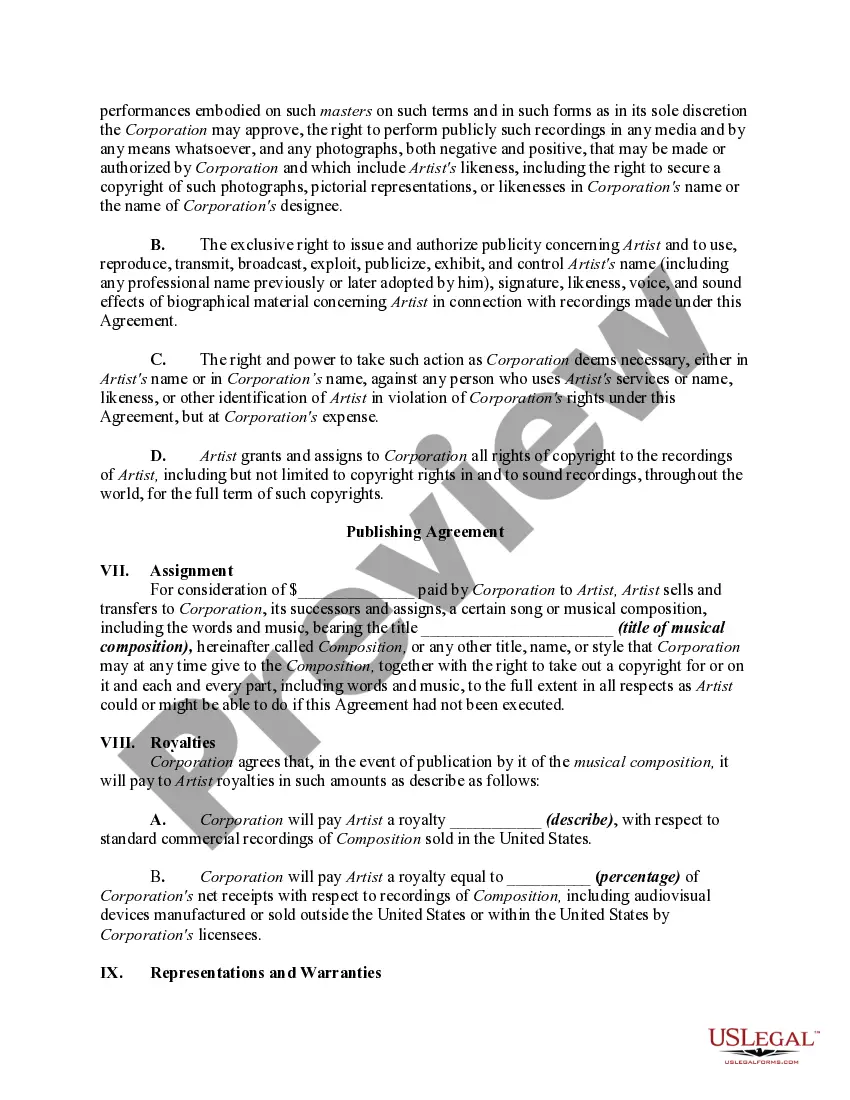
Recording Agreement and Contract with Publisher for Exploitation of Musical Compositions
About this form
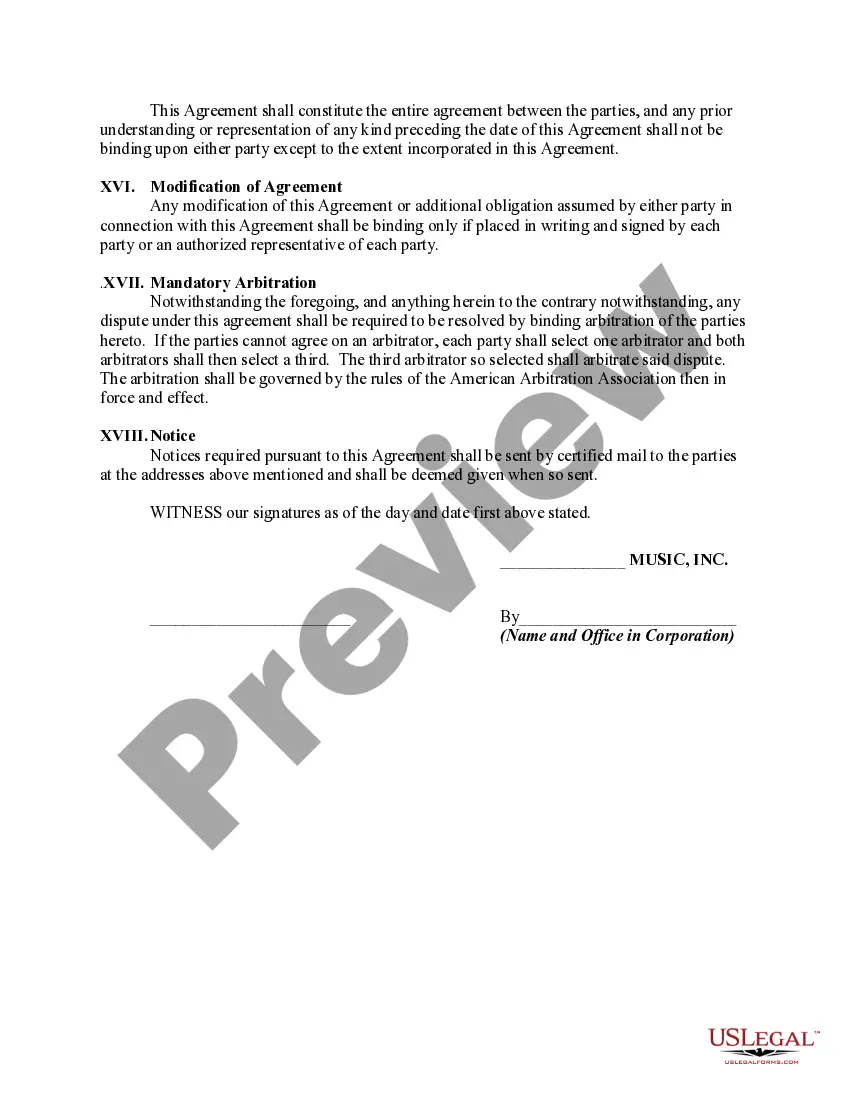
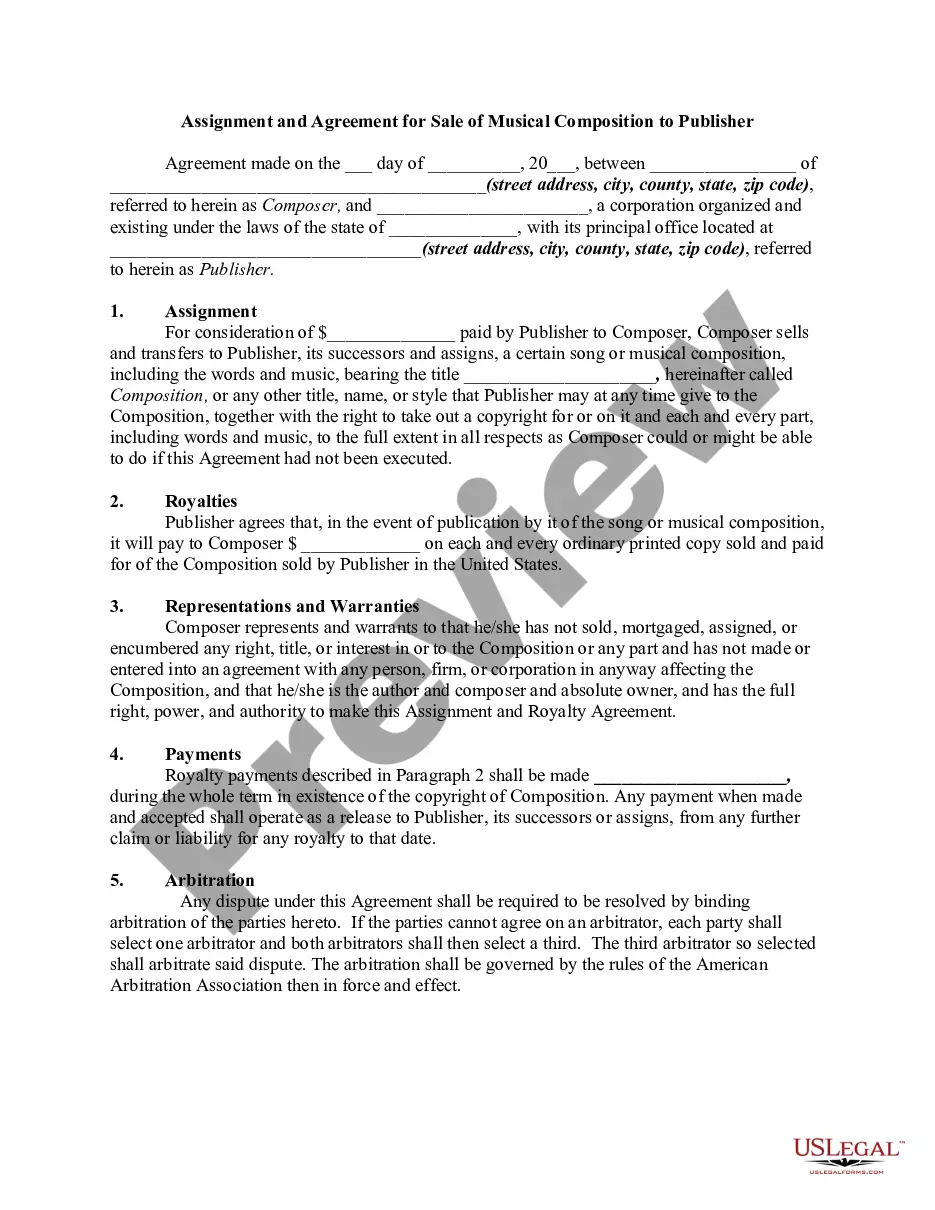
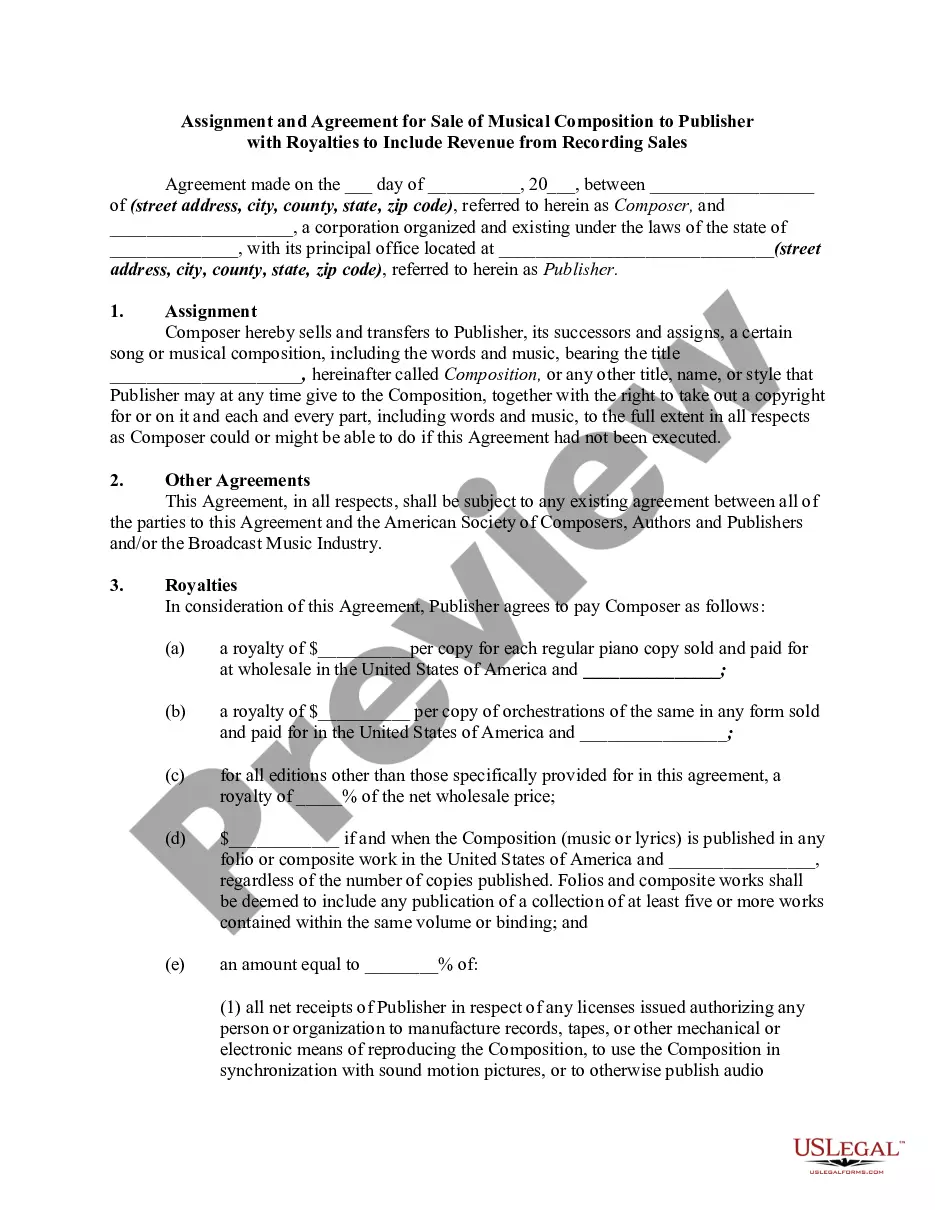
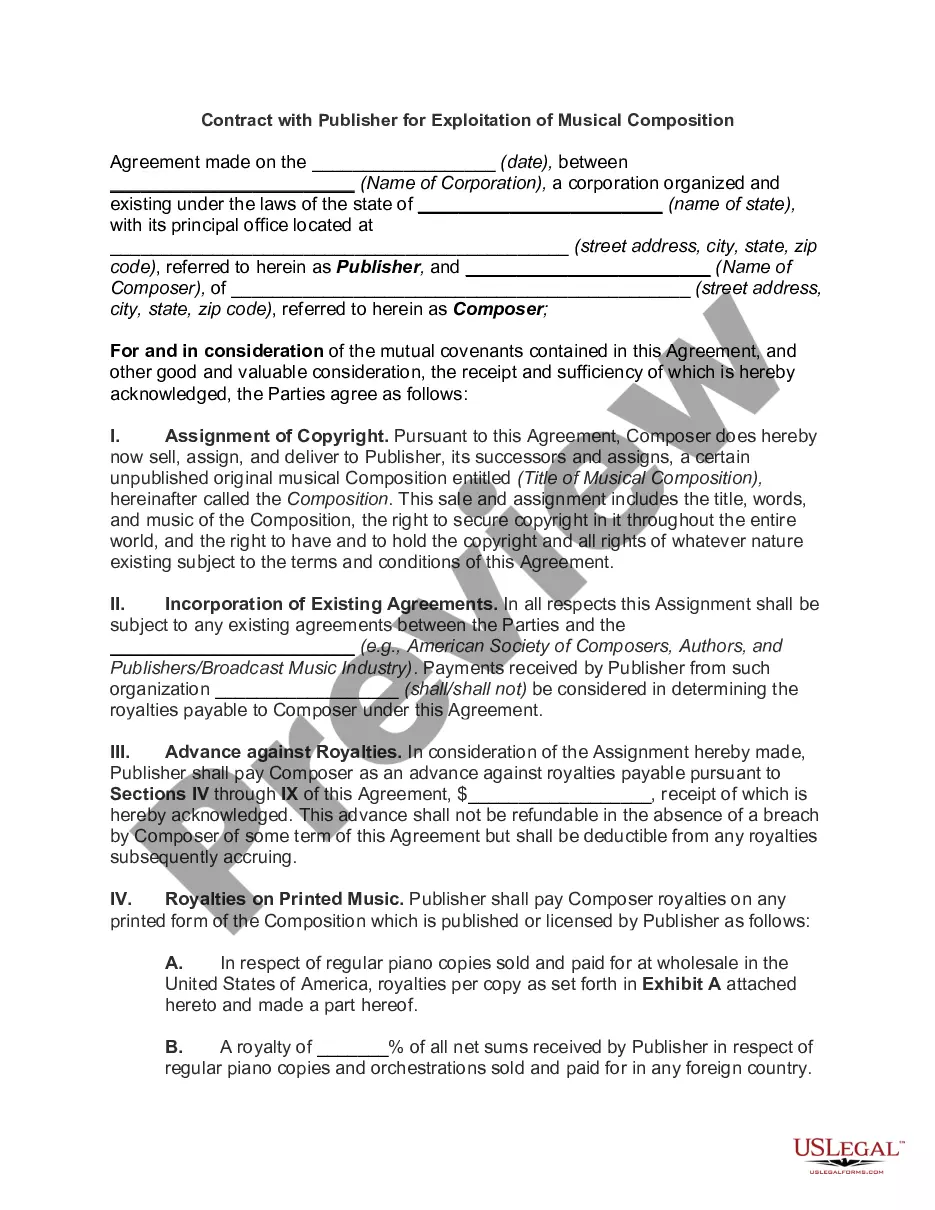
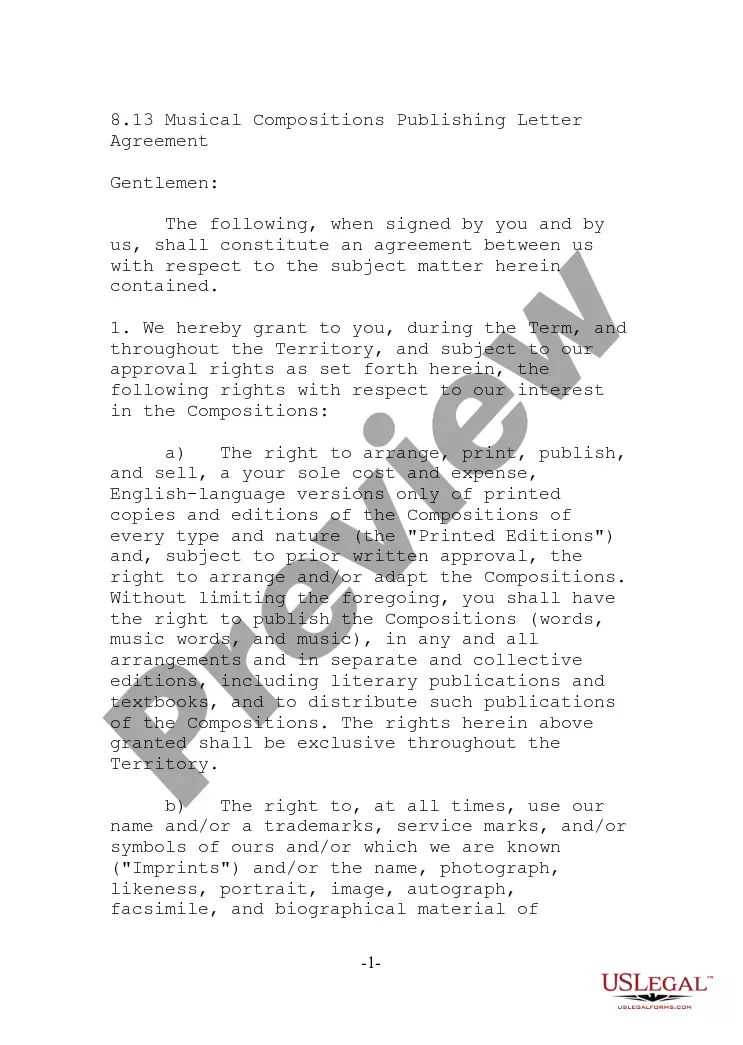
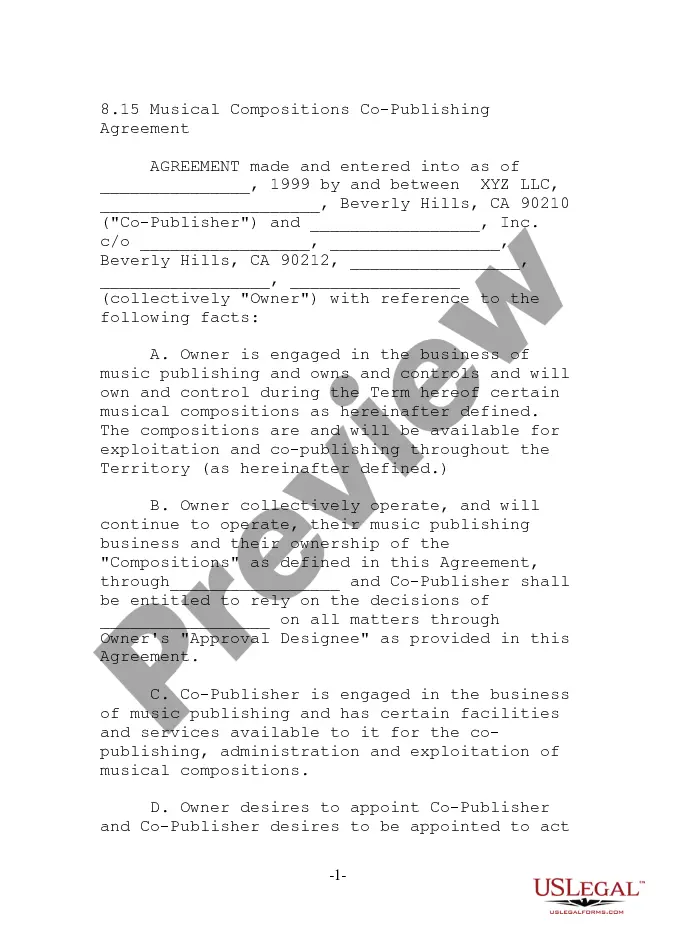
The Recording Agreement and Contract with Publisher for Exploitation of Musical Compositions is a legal document that establishes the terms between an artist and a publisher regarding the recording and exploitation of the artist's musical works. This form is particularly important for artists who perform and compose music, as it ensures that both their performance rights and composition rights are addressed. Unlike simpler contracts, this comprehensive agreement covers various aspects such as engagement, payment terms, responsibilities, and royalty distributions, ensuring both parties are protected and clear on their obligations.
Form components explained
- Engagement of Artist: Details the duration and scope of the artist's exclusive services.
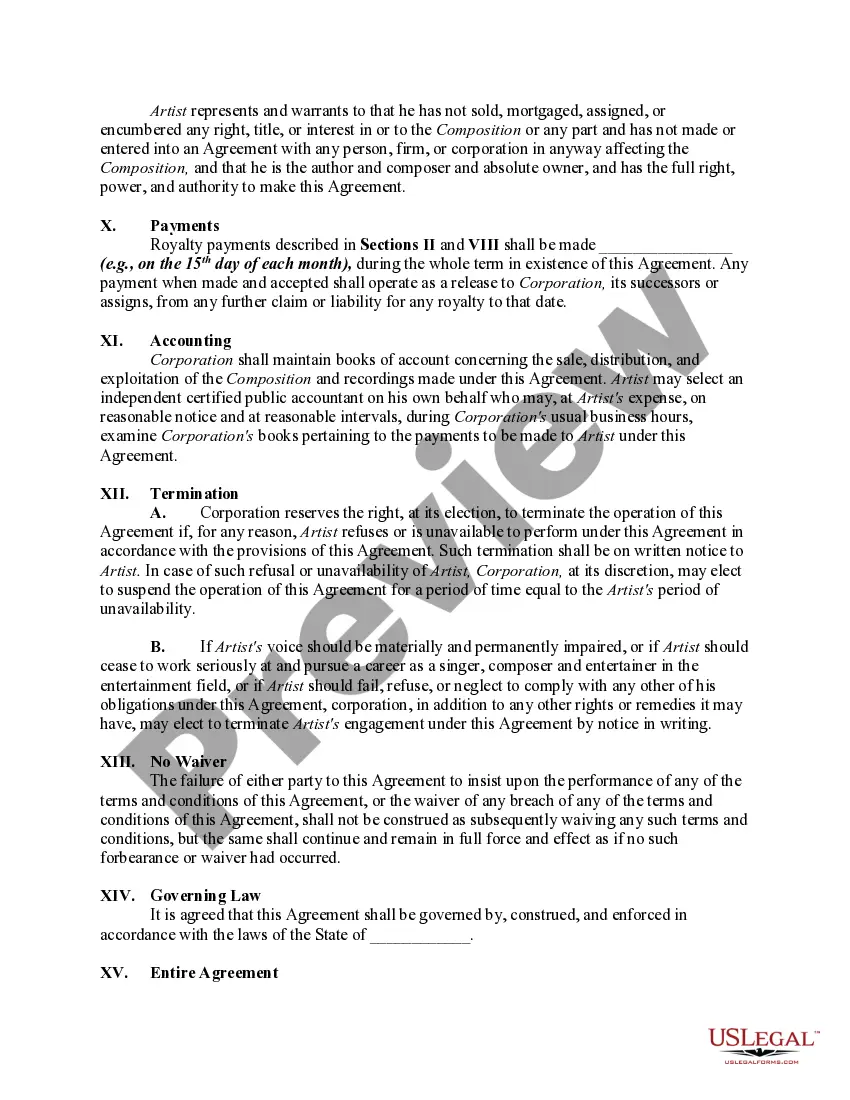
- Payments: Outlines compensation terms, including advances and royalties based on the artist's recordings.
- Master Recordings: Specifies the rights regarding the creation and control of master recordings.
- Artist's Obligations: Lists the artist's commitments during the contract term, including exclusivity clauses.
- Grant of Rights: Defines the rights being transferred to the corporation, including copyright ownership.
- Termination: Explains the conditions under which the agreement may be terminated by the corporation.
Situations where this form applies
This form should be used when an artist (who is both a performer and composer) engages with a corporation to record their musical work. It is ideal in scenarios where an artist is seeking to establish a formal agreement that clarifies their responsibilities, rights to performances, and how royalties are handled. It can be especially crucial when entering the music industry or when expanding an artist's catalog with a new publisher.
Intended users of this form
- Musical artists who perform and compose their own music.
- Publishers or record labels seeking to formalize agreements with artists.
- Companies involved in music production and distribution.
- Entertainment attorneys drafting contracts for clients in the music industry.
Instructions for completing this form
- Identify the parties involved: Fill in the names and addresses of the artist and the corporation.
- Specify the term of the agreement: Indicate the duration of the engagement and the number of master recordings.
- Detail payment terms: Clearly state the advance payment amounts, royalties, and payment schedule.
- Outline the rights granted: Define the ownership and rights related to the musical compositions.
- Include any necessary signatures: Ensure the form is signed by both parties to validate the agreement.
Notarization guidance
This form does not typically require notarization unless specified by local law. However, it is recommended to have it reviewed by a legal professional for proper execution.
Get your form ready online
Our built-in tools help you complete, sign, share, and store your documents in one place.
Make edits, fill in missing information, and update formatting in US Legal Forms—just like you would in MS Word.
Download a copy, print it, send it by email, or mail it via USPS—whatever works best for your next step.
Sign and collect signatures with our SignNow integration. Send to multiple recipients, set reminders, and more. Go Premium to unlock E-Sign.
If this form requires notarization, complete it online through a secure video call—no need to meet a notary in person or wait for an appointment.
We protect your documents and personal data by following strict security and privacy standards.

Make edits, fill in missing information, and update formatting in US Legal Forms—just like you would in MS Word.

Download a copy, print it, send it by email, or mail it via USPS—whatever works best for your next step.

Sign and collect signatures with our SignNow integration. Send to multiple recipients, set reminders, and more. Go Premium to unlock E-Sign.

If this form requires notarization, complete it online through a secure video call—no need to meet a notary in person or wait for an appointment.

We protect your documents and personal data by following strict security and privacy standards.
Common mistakes to avoid
- Failing to specify all payment terms, leading to misunderstandings about compensation.
- Not clearly defining the rights granted to the publisher, which can result in disputes later.
- Leaving out signature requirements, which can invalidate the contract.
- Not addressing termination clauses, which can lead to complications if the agreement needs to end prematurely.
Benefits of completing this form online
- Convenience: Easily download and fill out the form from anywhere.
- Editability: Customize the form to meet specific needs before finalizing.
- Reliability: Ensure the form is drafted with legal precision and updates reflecting current laws.
Legal use & context
- This agreement is legally binding once signed by both parties.
- The terms must comply with state laws regarding contract enforceability.
- Artists should ensure they fully understand their obligations and rights before signing.
Main things to remember
- The form creates a formal agreement between artists and publishers.
- Clear payment terms and copyright ownership are critical for both parties.
- Using a legal template streamlines the process and ensures compliance.
Looking for another form?
Form popularity
FAQ
Recording contract. Call it what you want, but it all equates to a legally binding agreement between the artist and label. Under the deal, a label generally pays for making, distributing and marketing the recordings.The label also agrees to pay you a set share of money from recording sales known as the royalty rate.
Affiliate your company with ASCAP or BMI. Create a Business Entity or File a Fictitious Name Statement. Register Songs with the Copyright Office. Register Songs with the Performing Rights Society. Congratulations!
Recording company details (name, contact info) Artist details (group name, names of each artist, contact info) Production details, e.g. studio address, recording session dates, control over song selections on the recording, and control over album title.
How Long is the Term? This is a good starting point: how long will you be tied to this record deal? What is the Territory? What is Your Royalty? How Much Will The Label Invest in You? Does the Label Participate in Non-Record Revenues?
Music publishing contracts are used by publishing companies and songwriters to address rights to songs (lyrics and music). Publishing companies use music publishing co-publishing and songwriter agreements to contract with a songwriter to obtain the rights to their songs.
Get it in writing. Keep it simple. Deal with the right person. Identify each party correctly. Spell out all of the details. Specify payment obligations. Agree on circumstances that terminate the contract. Agree on a way to resolve disputes.
Efficient Collection Network. Strong Creative Team. Account Management. Other Services.
The path to publication generally requires authors to sign a publishing contract that covers such topics as: manuscript delivery and acceptance, copyright ownership and grants; royalty advances, rates and payment; author warranties and indemnities; contract duration and rights reversion (out-of-print); options on new
The agreement or contract is the legal document between an artist or owner of an artwork and a borrowing institution, or between an exhibition organiser and the host venue.They are written to specify details about work to be undertaken and the expected outcomes.