Release from Liability by Member of the State Defense Force from Liability Regarding Training Activities with the National Guard
What is this form?
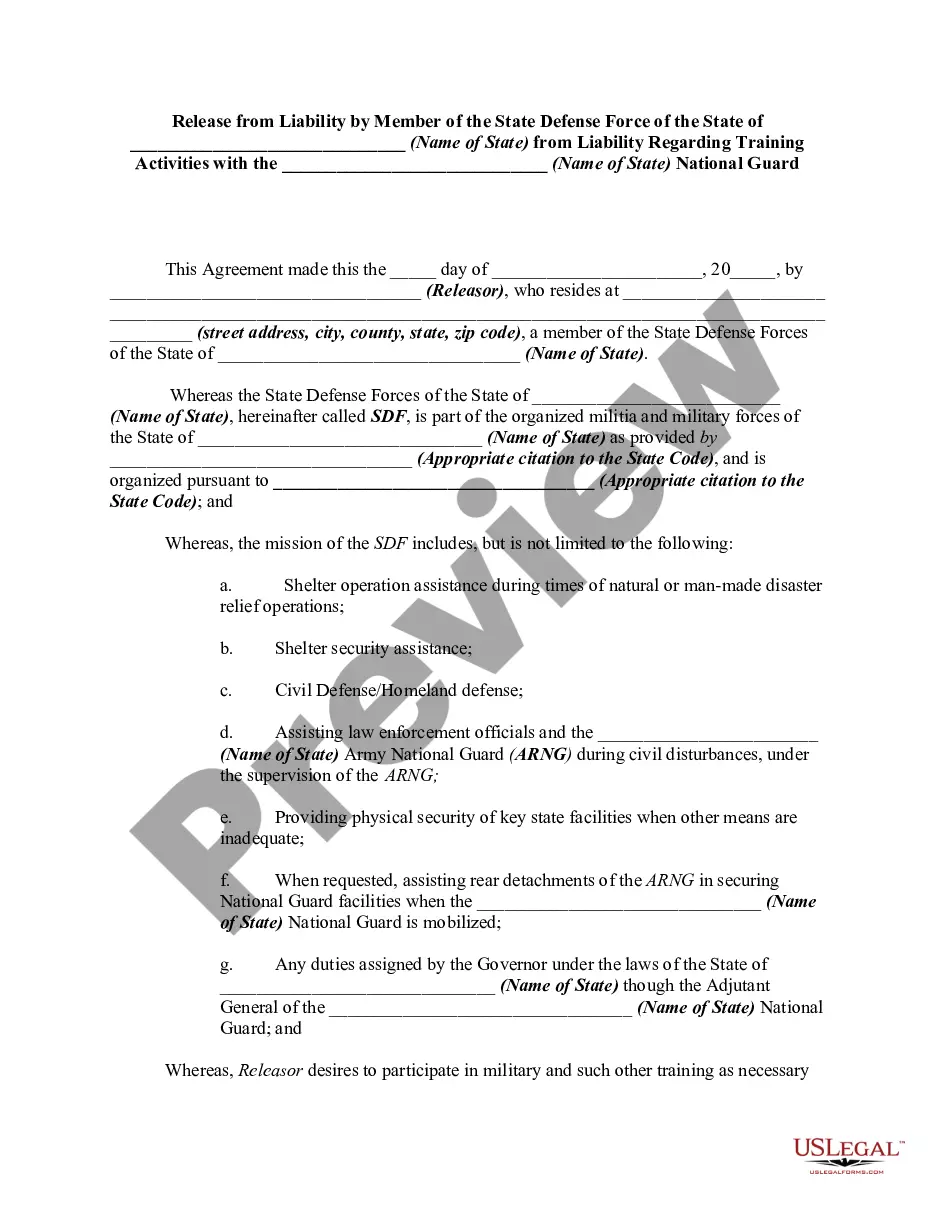
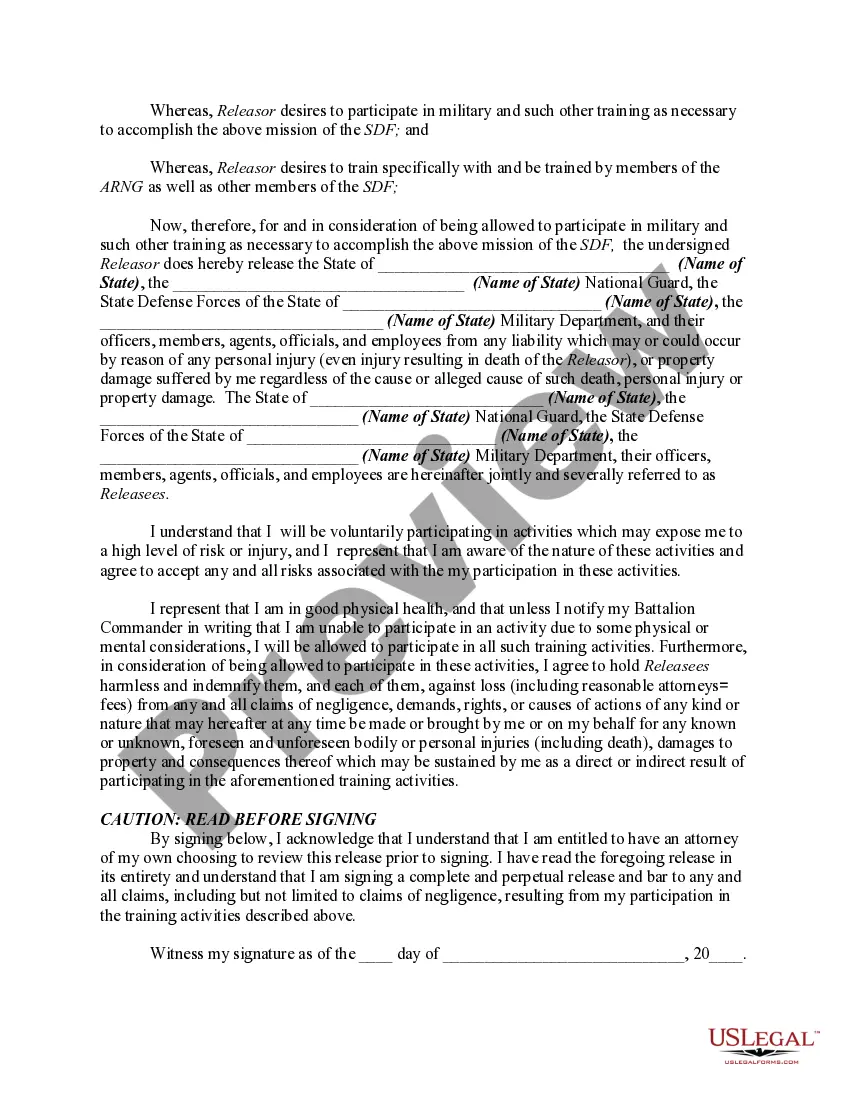
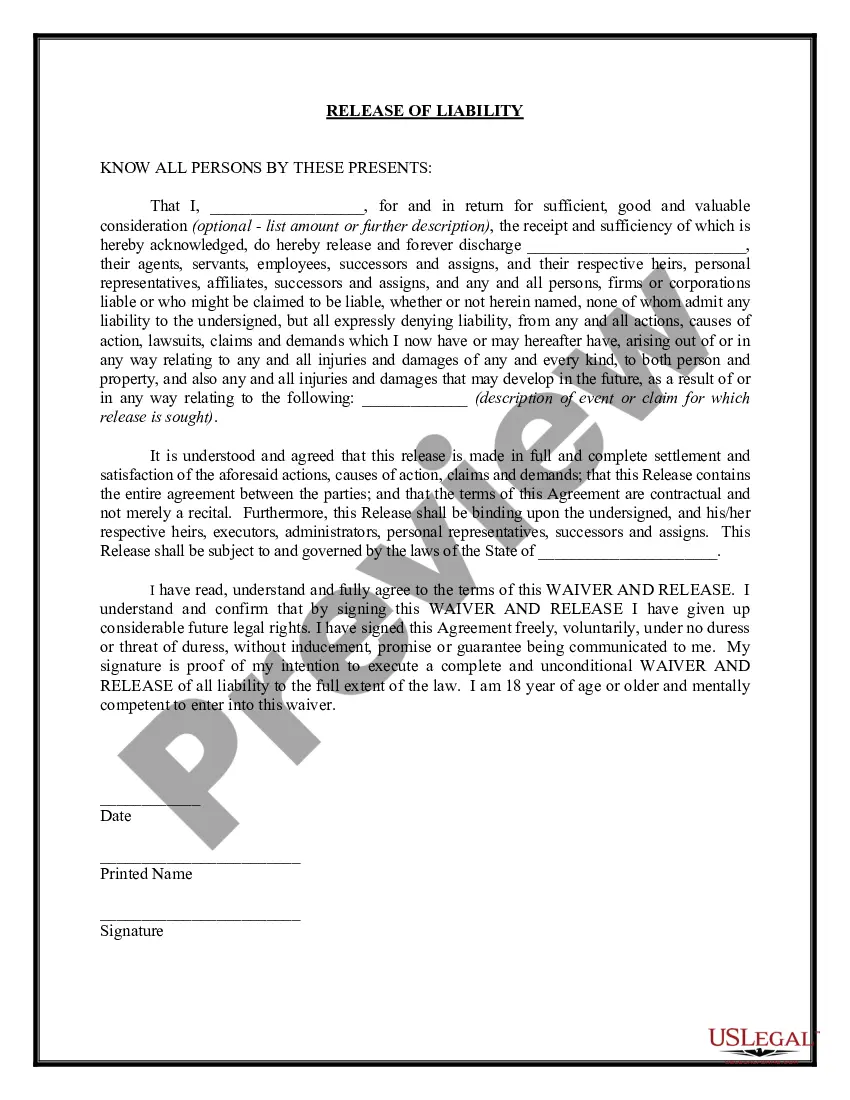
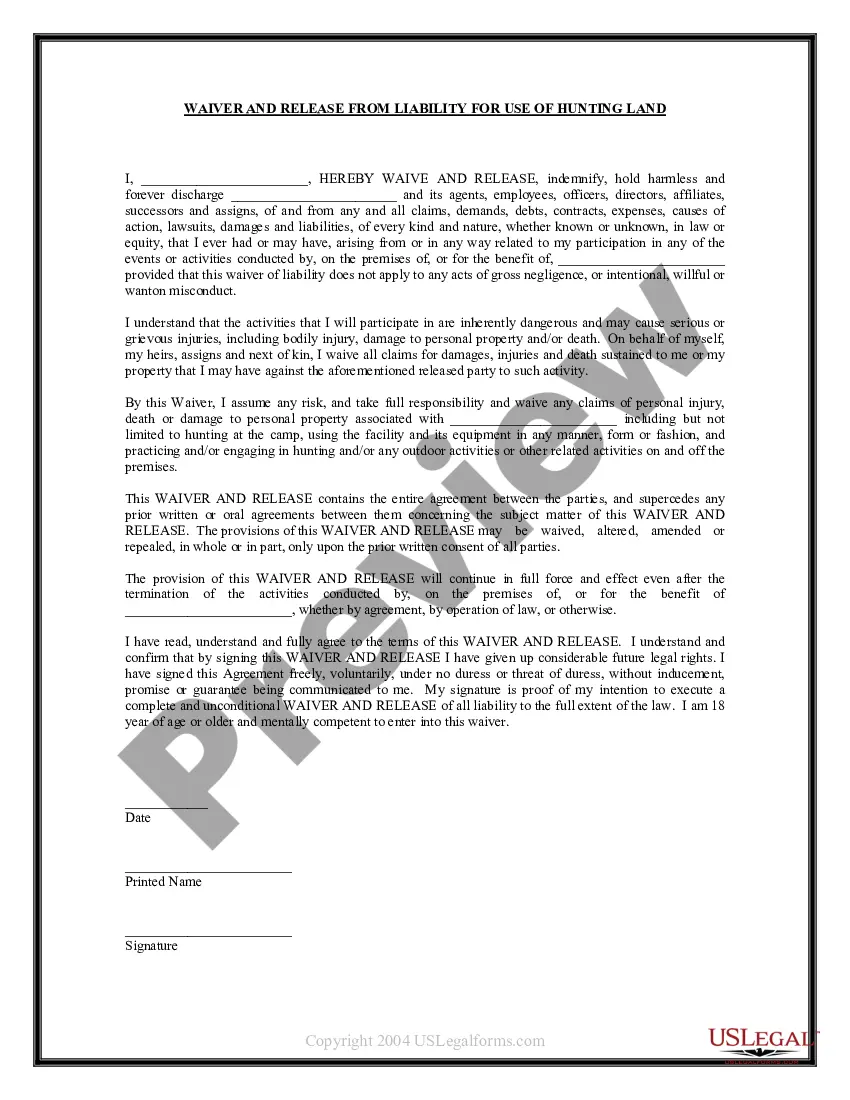
This form is a Release from Liability by Member of the State Defense Force from Liability Regarding Training Activities with the National Guard. Its primary purpose is to legally waive the right to sue for any injuries or damages that may occur while participating in specific training activities with the National Guard and State Defense Force. Unlike a general waiver, this form is tailored specifically for members engaged in military training, ensuring they acknowledge the risks involved. The release covers both personal injuries and property damage that might arise during these activities.
Form components explained
- Identification of the Releasor (the person signing the form) and their address.
- Descriptions of the mission and duties of the State Defense Force.
- A clear statement releasing the State, National Guard, and associated parties from liability for injuries or damages.
- Acknowledgment of the inherent risks associated with training activities.
- Statement of good physical health and ability to participate in training activities.
- Signature lines for the Releasor and witnesses.

When to use this document
This form should be used when a member of the State Defense Force wishes to participate in training activities with the National Guard. It is essential whenever there is a potential for personal injury or property damage during military training exercises. Members should complete this form before engaging in any activities that pose risks to their safety or well-being.
Who needs this form
- Members of the State Defense Forces who are engaging in training activities.
- Participants in joint exercises with the National Guard.
- Individuals who wish to formally acknowledge and accept the risks associated with military training.
Instructions for completing this form
- Enter the date the agreement is made.
- Provide the name and address of the Releasor.
- Fill in the relevant state name and citations detailing the organization of the State Defense Force.
- Clearly outline the mission and functions of the State Defense Force as described.
- Sign the form and have it witnessed as required.
Does this document require notarization?
This form does not typically require notarization to be legally valid. However, some jurisdictions or document types may still require it. US Legal Forms provides secure online notarization powered by Notarize, available 24/7 for added convenience.
Get your form ready online
Our built-in tools help you complete, sign, share, and store your documents in one place.
Make edits, fill in missing information, and update formatting in US Legal Forms—just like you would in MS Word.
Download a copy, print it, send it by email, or mail it via USPS—whatever works best for your next step.
Sign and collect signatures with our SignNow integration. Send to multiple recipients, set reminders, and more. Go Premium to unlock E-Sign.
If this form requires notarization, complete it online through a secure video call—no need to meet a notary in person or wait for an appointment.
We protect your documents and personal data by following strict security and privacy standards.

Make edits, fill in missing information, and update formatting in US Legal Forms—just like you would in MS Word.

Download a copy, print it, send it by email, or mail it via USPS—whatever works best for your next step.

Sign and collect signatures with our SignNow integration. Send to multiple recipients, set reminders, and more. Go Premium to unlock E-Sign.

If this form requires notarization, complete it online through a secure video call—no need to meet a notary in person or wait for an appointment.

We protect your documents and personal data by following strict security and privacy standards.
Typical mistakes to avoid
- Failing to fully understand the risks involved before signing the form.
- Not providing complete identification details for the Releasor.
- Signing without witnesses, if required by state law.
- Leaving sections blank which could lead to misunderstandings about the liability release.
Benefits of using this form online
- Convenient access to the form ensures timely participation in training.
- Easy to edit and customize based on specific training activities.
- Reliability of templates drafted by licensed attorneys to ensure legal validity.
- Immediate download allows for quick completion and submission.
Legal use & context
- The waiver protects state entities from liability arising from injuries sustained during training.
- Courts may enforce the release as long as it is clear and voluntary, though they can invalidate releases under certain circumstances, such as for minors or in cases of gross negligence.
- Understanding the limitations of liability and the nature of the risks involved is essential for both parties.
Main things to remember
- This form is essential for members of the State Defense Force participating in training with the National Guard.
- Participants must understand and accept the inherent risks of participating in military training activities.
- Accurate completion and proper witnessing of the form are crucial for its validity.
Looking for another form?







Form popularity
FAQ
A defense of waiver is defined as an intentional relinquishment of a known right. Such a defense requires proof that plaintiff had knowledge of the facts basic to the exercise of the right and the intent to relinquish that right.
Understanding Waivers Essentially, a waiver removes a real or potential liability for the other party in the agreement. For example, in a settlement between two parties, one party might, by means of a waiver, relinquish its right to pursue any further legal action once the settlement is finalized.
Accord and Satisfaction, Arbitration and Award, Assumption of the Risk, Contributory Negligence, Discharge in Bankruptcy, Duress, Estoppel, Failure of Consideration,
An affirmative defense to a civil lawsuit or criminal charge is a fact or set of facts other than those alleged by the plaintiff or prosecutor which, if proven by the defendant, defeats or mitigates the legal consequences of the defendant's otherwise unlawful conduct.
An affirmative defense operates to prevent conviction even when the prosecutor has proof beyond a reasonable doubt as to every element of the crime. Some jurisdictions place the burden on the defendant to prove the defense, while others require that the prosecution disprove the defense beyond a reasonable doubt.
The waiver and release are affirmative defenses which a person bears the burden of raising. The failure to raise a release as an affirmative defense will result in a waiver of the defensex. It is to be noted that, a party asserting the affirmative defense of a release has the burden of proof.
(A) Department of Real Estate Hint: The Department of Real Estate (DRE) is the state agency that administers the Real Estate Law in California. What is one of the best defenses in a lawsuit? (B) Documentation Hint: One of the best defenses in a lawsuit is good documentation.
Equitable theories, such as estoppel, waiver, and ratification, are subject to traditional equitable defenses.