Notice of Copyrighted Material on Website and Waiver of Liability
What this document covers
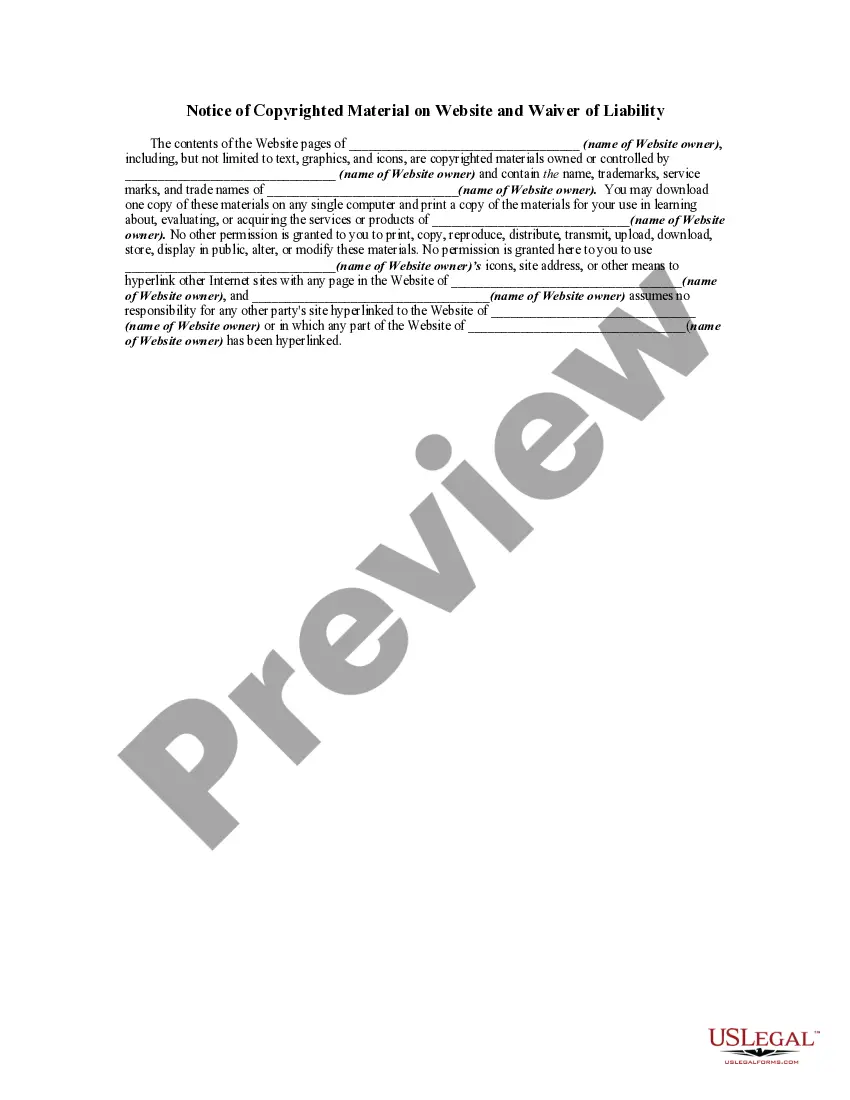
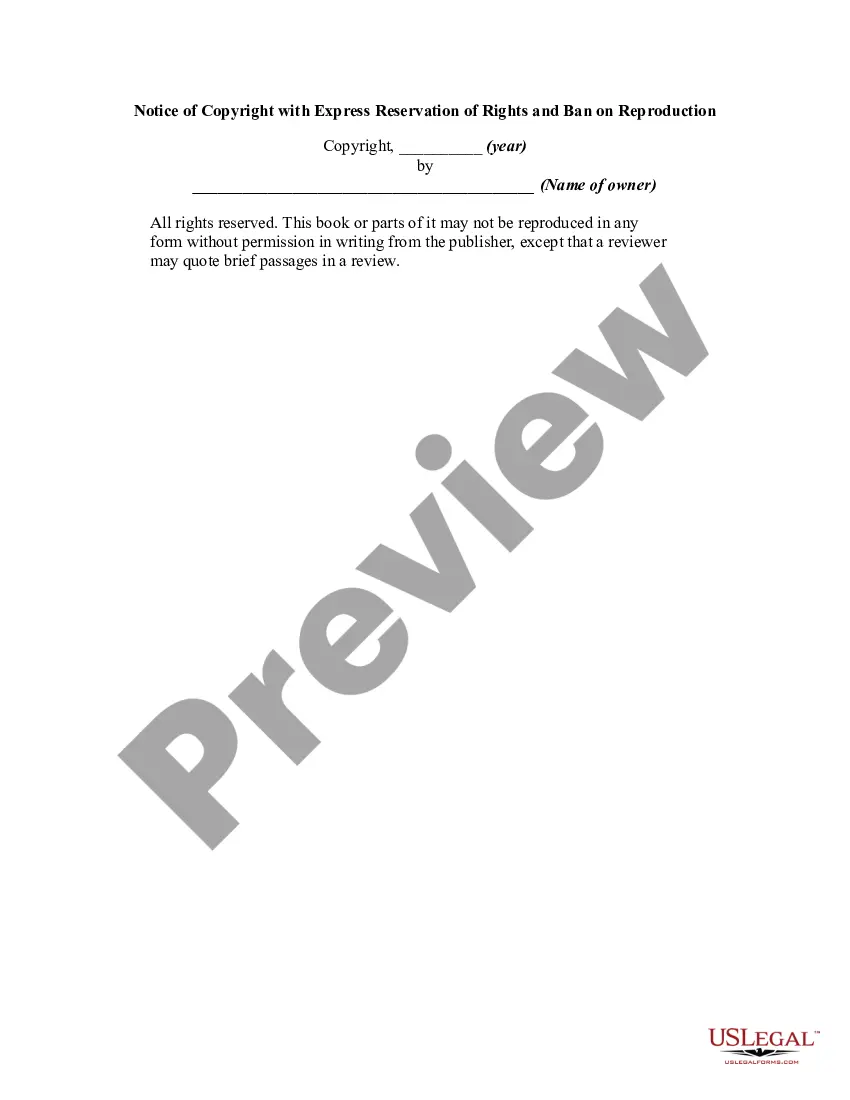
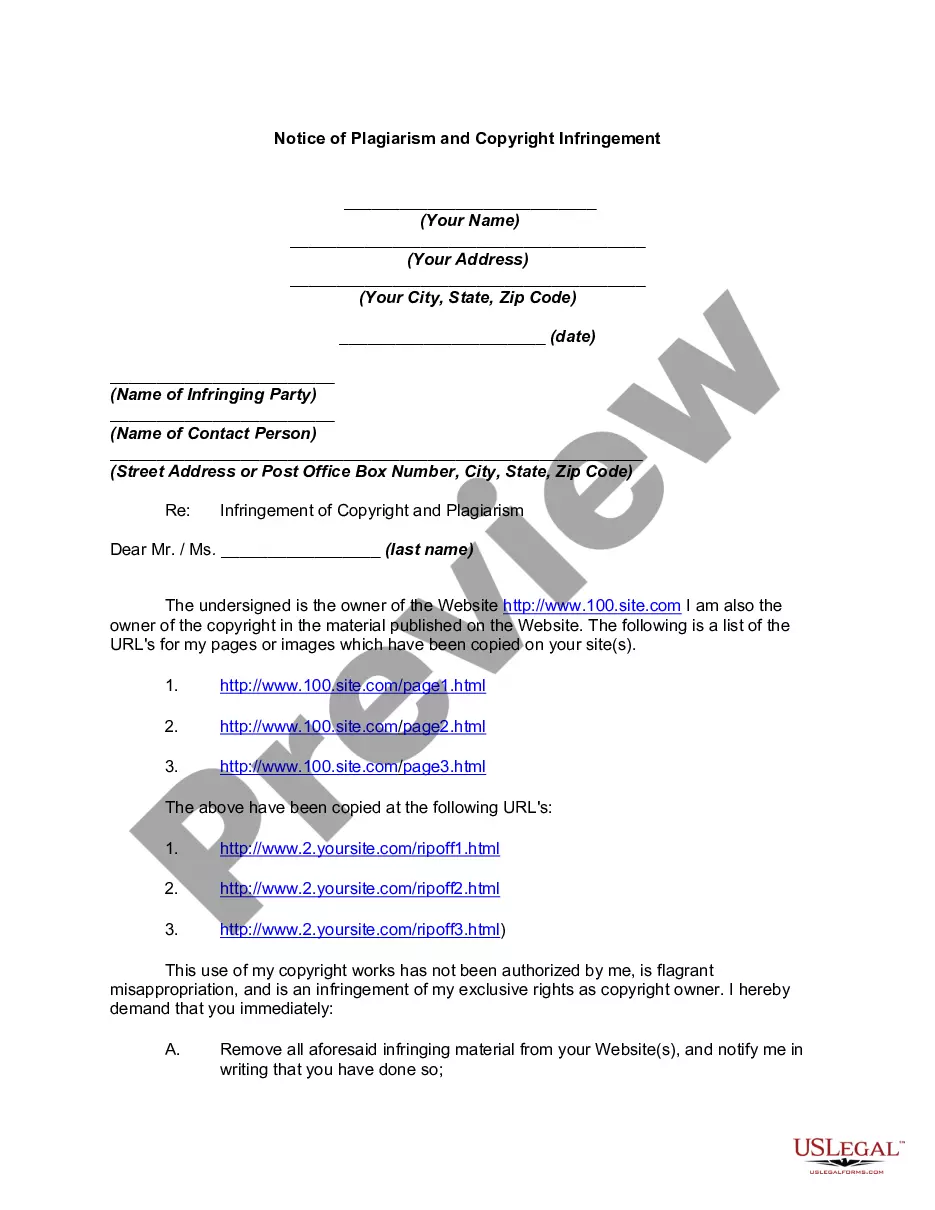
The Notice of Copyrighted Material on Website and Waiver of Liability is a legal document designed to protect a website owner's copyrighted materials from unauthorized use. This form clarifies the ownership of content on the website and restricts how that content can be utilized by others. It serves to inform users of the rights associated with the websiteâs materials, differentiating it from other copyright-related forms by emphasizing both the notice and liability waiver aspects.
What’s included in this form
- The name of the website owner, specifying ownership of the copyrighted materials.
- Details about the types of materials that are copyrighted, such as text, graphics, and icons.
- Clear restrictions on the use of website materials, outlining what users may and may not do.
- A disclaimer regarding hyperlinking to the website and the ownerâs liabilities related to other sites.
When to use this document
This form should be used when a website owner wishes to assert copyright over the content on their site. It is particularly important for businesses, artists, or anyone who has created original materials and wants to prevent unauthorized reproduction, distribution, or display of their work. Additionally, it can be utilized to inform users about the legal status of the websiteâs content and limit the owner's liability regarding external links.
Who needs this form
- Website owners who have original content they want to protect.
- Businesses that need to clarify copyright issues related to their online presence.
- Creators, including artists and writers, who want to notify others of their copyright claims.
- Organizations looking to limit their liability concerning third-party hyperlinks on their websites.
Steps to complete this form
- Identify and provide the name of the website owner in the designated field.
- List all types of copyrighted materials featured on the website.
- Clearly outline restrictions on how users may use, reproduce, or share the content.
- Include a disclaimer about hyperlinking and the website owner's liability regarding third-party sites.
- Review the form for accuracy and completeness before finalizing it.
Notarization requirements for this form
This form does not typically require notarization unless specified by local law.
Get your form ready online
Our built-in tools help you complete, sign, share, and store your documents in one place.
Make edits, fill in missing information, and update formatting in US Legal Forms—just like you would in MS Word.
Download a copy, print it, send it by email, or mail it via USPS—whatever works best for your next step.
Sign and collect signatures with our SignNow integration. Send to multiple recipients, set reminders, and more. Go Premium to unlock E-Sign.
If this form requires notarization, complete it online through a secure video call—no need to meet a notary in person or wait for an appointment.
We protect your documents and personal data by following strict security and privacy standards.

Make edits, fill in missing information, and update formatting in US Legal Forms—just like you would in MS Word.

Download a copy, print it, send it by email, or mail it via USPS—whatever works best for your next step.

Sign and collect signatures with our SignNow integration. Send to multiple recipients, set reminders, and more. Go Premium to unlock E-Sign.

If this form requires notarization, complete it online through a secure video call—no need to meet a notary in person or wait for an appointment.

We protect your documents and personal data by following strict security and privacy standards.
Avoid these common issues
- Failing to include the correct name of the website owner.
- Omitting important details about the types of copyrighted materials.
- Using vague language in restrictions that may lead to misunderstandings.
Why complete this form online
- Convenient access to legal templates that are easy to fill out.
- Editability allows for quick updates to the form as needed.
- Reliability comes from professional legal drafting by licensed attorneys.
Legal use & context
- This form clearly establishes copyright ownership and usage limitations.
- It serves as a legal safeguard against unauthorized use of a website's materials.
- Users are informed of their rights and responsibilities when interacting with the website's content.
Main things to remember
- The form protects a website owner's copyright and limits liability.
- It is important for anyone with original content online.
- Ensure all information is accurate to avoid legal complications.
Looking for another form?

Form popularity
FAQ
If you have located a website that is illegally publishing content you know to be copyright you can submit the website name to DMCA.com. Simply click on the link below and complete the form.
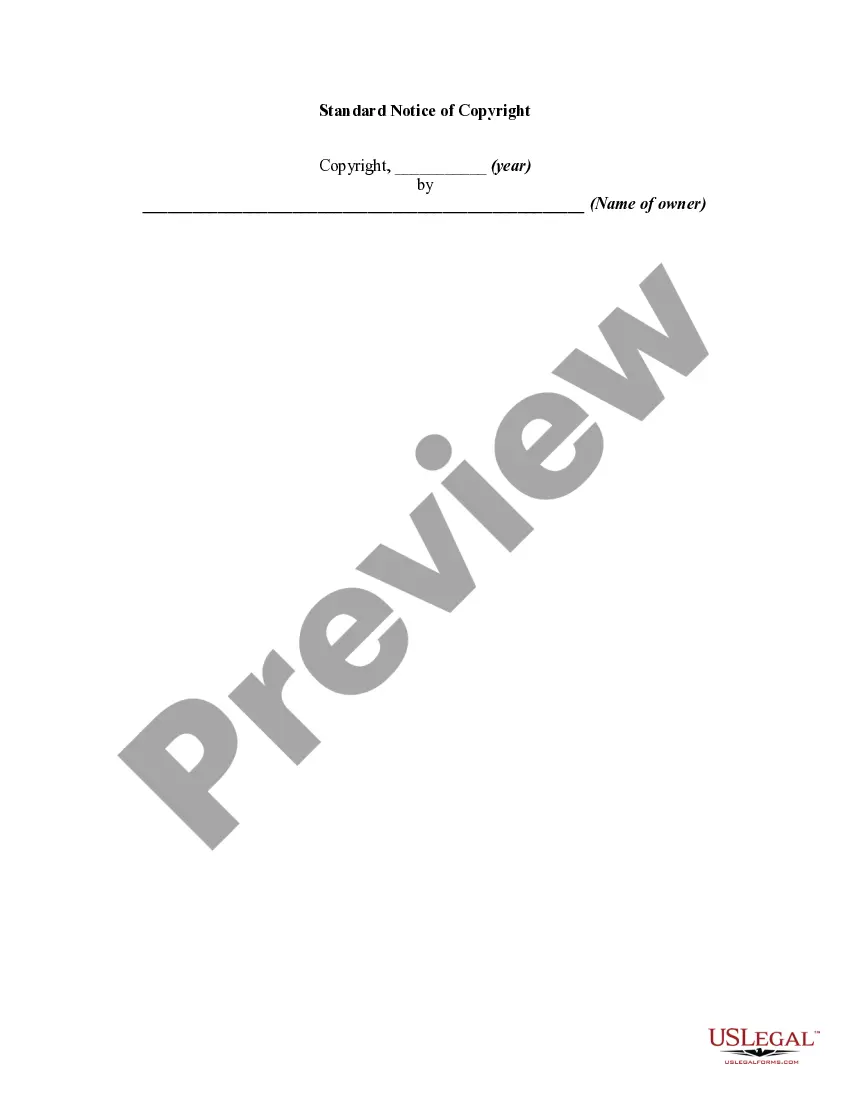
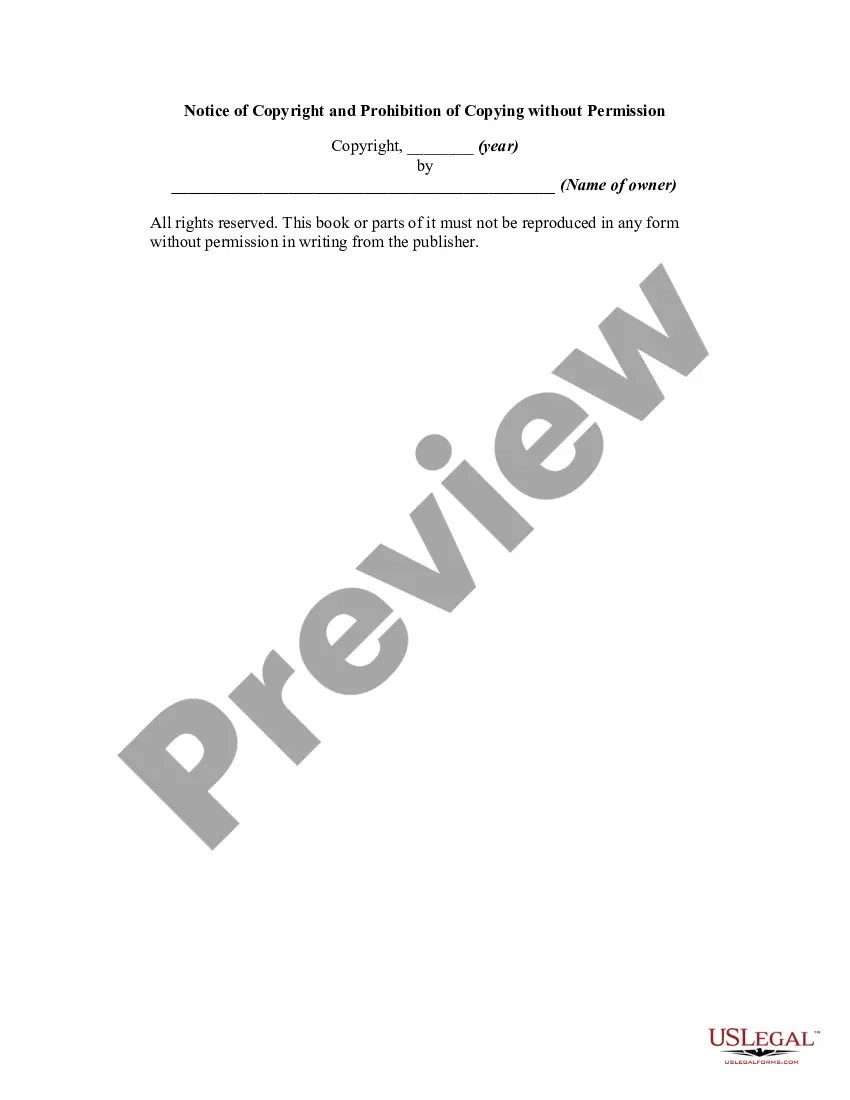
The symbol © (the letter C in a circle), or the word "Copyright" or the abbreviation "Copr."; The year of first publication of the work; and. The name of the owner of copyright in the work.
200bStart the letter off with a clear explanation regarding your request. For instance, explain that you're requesting certain fees or charges to be waived or to be released from a previous engagement. Communicate any supporting or relative dates, names of parties, monetary figures, or venues as facts.
While many users panic when receiving infringement notices from their ISP, in the majority of cases there is no need to worry. Stopping sharing the content in question usually solves the problem and if no additional sharing takes place, no further warnings should be received, for that content at least.
In California, a liability waiver must be clear, unambiguous, and explicit. In other words, waivers cannot be printed in faded ink, in small font, on the back of a paper, or in an otherwise ambiguous form. If the waiver that you sign is not represented clearly, it may not hold up in the event of a lawsuit.
What is copyright infringement? Don't ignore the Copyright Infringement Notice. Don't immediately call the copyright holder and/or the copyright holder's lawyer. Investigate the claims made against you or your company. Write and send a response to the cease and desist letter.
Get help. Writing a waiver should not be complicated. Use the correct structure. Proper formatting. Include a subject line. Include a caution! Talk about the activity risks. Do not forget an assumption of risk. Hold harmless.
Don't ignore it As we mentioned above, copyright infringement notices are usually harmless. In most cases, the copyright holder will simply ask your business to cease and desist. If you're guilty, remove the copyrighted material from whatever platform it's on.
The General Release is a broad release from all possible civil claims resulting from a dispute. Since the Releasing Party is giving up all known and unknown claims against the other party, care should be taken to ensure that the Releasor is fully aware of their rights.