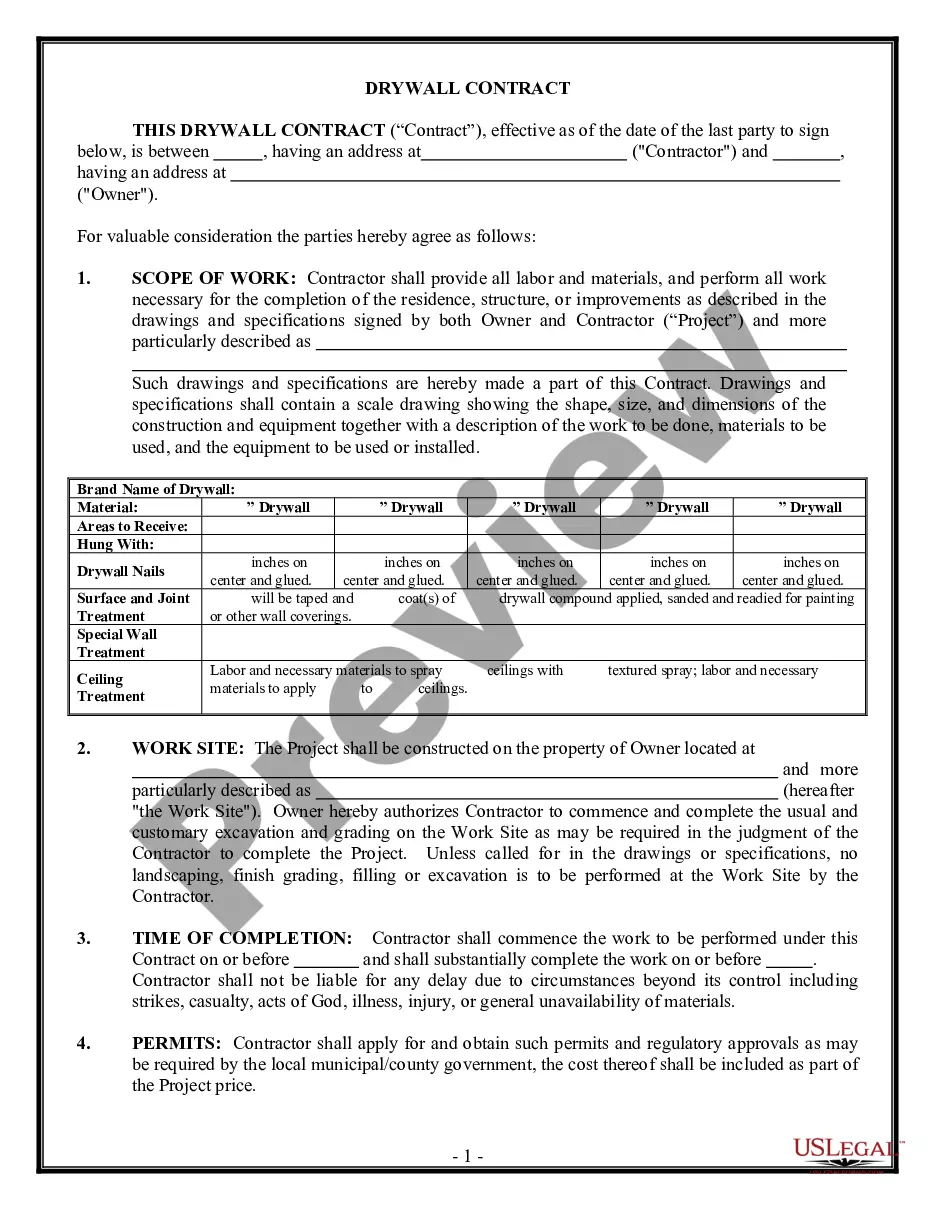
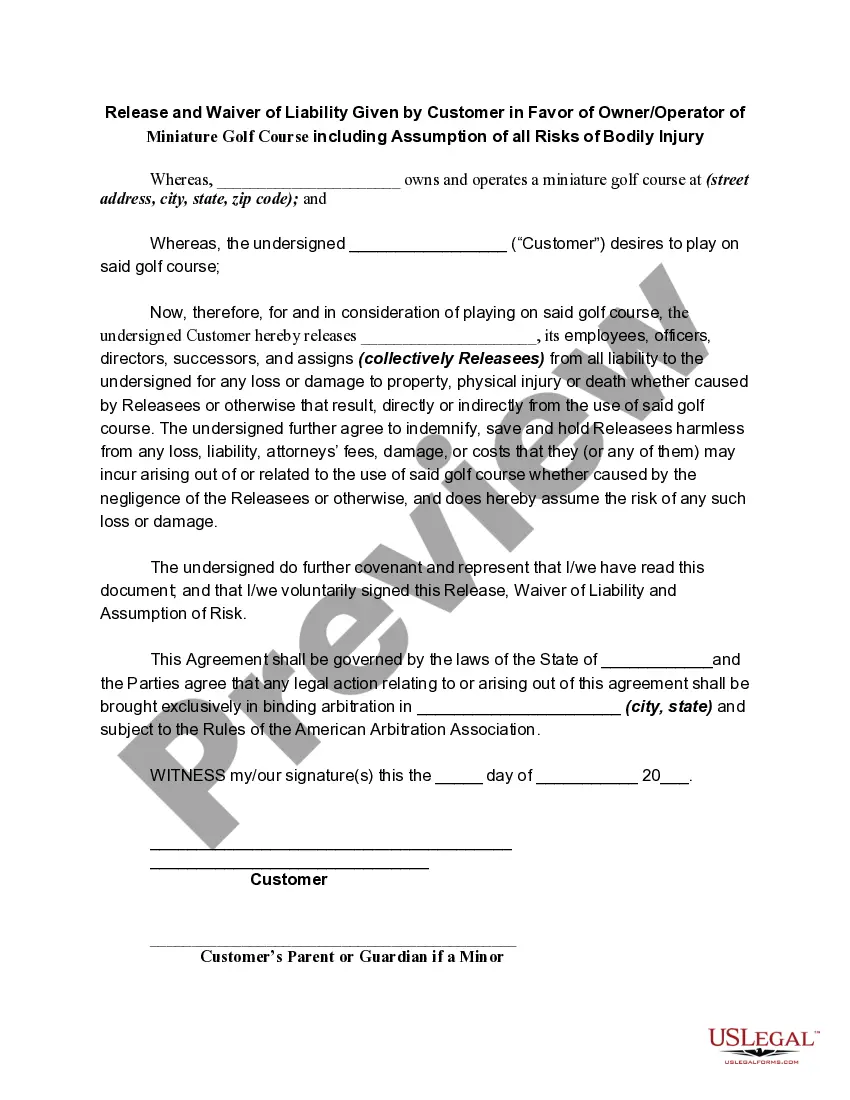
Release and Waiver of Liability Given by Customer in Favor of Owner / Operator of Miniature Golf Course including Assumption of all Risks of Personal Bodily Injury
What is this form?
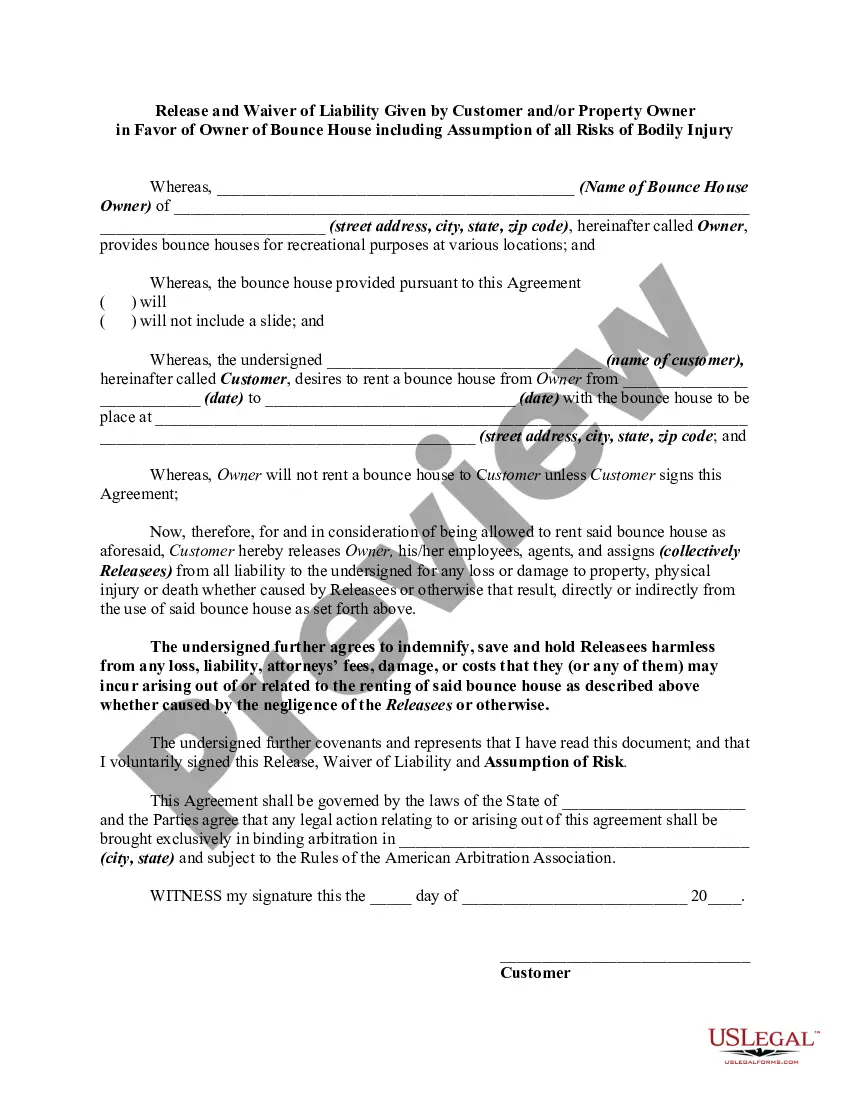
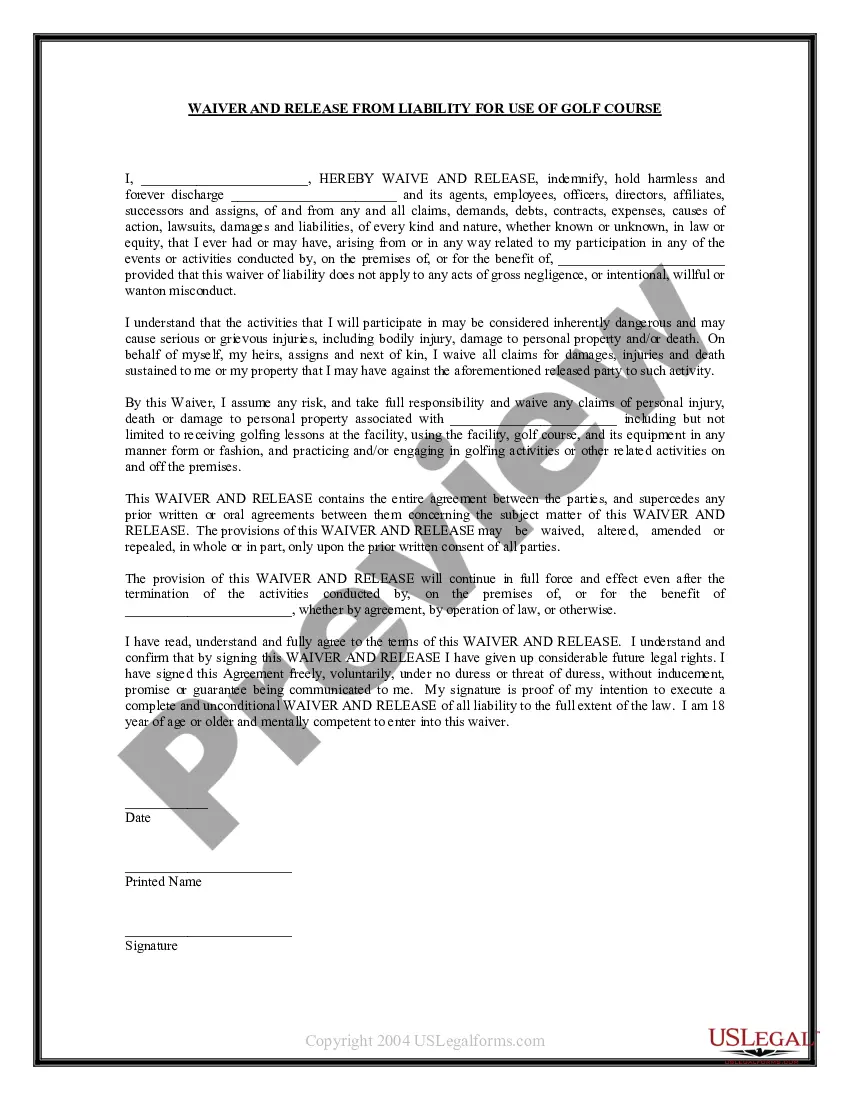
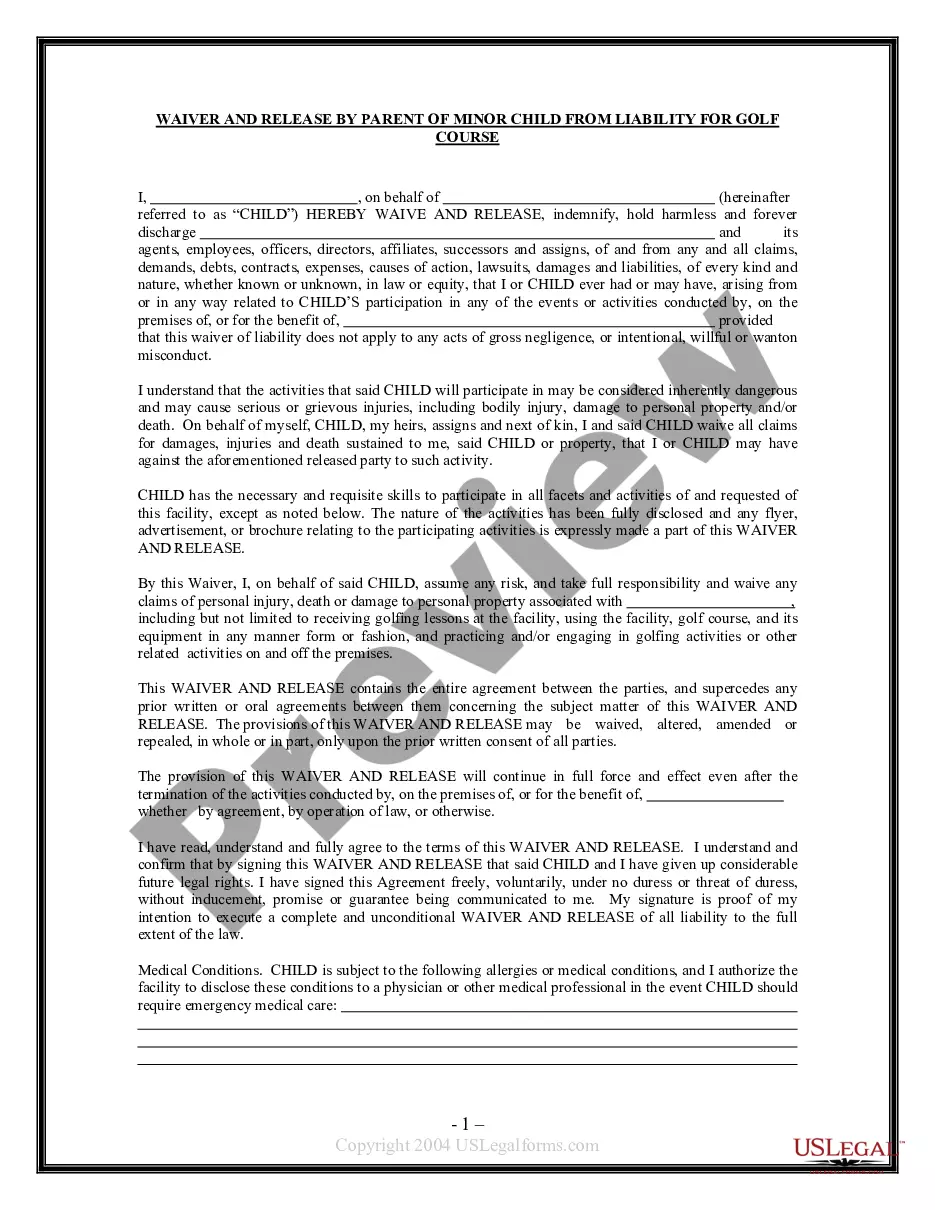
This form is a Release and Waiver of Liability given by a customer in favor of the owner/operator of a miniature golf course. It serves to protect the course owner from legal claims related to personal injuries or damages that may arise during the customer's use of the course. Unlike standard waivers, this form includes specific clauses about the assumption of risk, ensuring that the customer understands and accepts the potential dangers of participating in the activity.
Main sections of this form
- Identification of the golf course owner/operator and customer.
- A statement of release from liability for any injuries or damages.
- Indemnification clause holds Releasees harmless for losses incurred.
- Assumption of risk clause acknowledging the inherent dangers of mini-golf.
- Governing law clause specifying the applicable state laws.
- Signature lines for the customer and, if applicable, a guardian for minors.
When to use this form
This form should be used whenever a customer wishes to participate in activities at a miniature golf course. It is particularly important for businesses that want to limit their liability during activities that may involve physical risks, such as playing on the course. This form protects the owner/operator from legal claims arising from accidents that may occur while customers are using the facilities.
Who needs this form
Individuals who should consider using this form include:
- Owners or operators of a miniature golf course looking to minimize liability.
- Customers who plan to use the golf course and wish to acknowledge the associated risks.
- Parents or guardians signing on behalf of minors participating in the activity.
Instructions for completing this form
- Identify the full legal names of the golf course owner/operator and the customer in the designated fields.
- Provide the street address, city, state, and zip code of the golf course.
- Sign the form, ensuring that all signatures are from the correct parties, including parents or guardians for minors.
- Fill in the date of signing to validate the document.
- Review the completed form for accuracy before submitting it to the owner/operator.
Does this form need to be notarized?
In most cases, this form does not require notarization. However, some jurisdictions or signing circumstances might. US Legal Forms offers online notarization powered by Notarize, accessible 24/7 for a quick, remote process.
Get your form ready online
Our built-in tools help you complete, sign, share, and store your documents in one place.
Make edits, fill in missing information, and update formatting in US Legal Forms—just like you would in MS Word.
Download a copy, print it, send it by email, or mail it via USPS—whatever works best for your next step.
Sign and collect signatures with our SignNow integration. Send to multiple recipients, set reminders, and more. Go Premium to unlock E-Sign.
If this form requires notarization, complete it online through a secure video call—no need to meet a notary in person or wait for an appointment.
We protect your documents and personal data by following strict security and privacy standards.

Make edits, fill in missing information, and update formatting in US Legal Forms—just like you would in MS Word.

Download a copy, print it, send it by email, or mail it via USPS—whatever works best for your next step.

Sign and collect signatures with our SignNow integration. Send to multiple recipients, set reminders, and more. Go Premium to unlock E-Sign.

If this form requires notarization, complete it online through a secure video call—no need to meet a notary in person or wait for an appointment.

We protect your documents and personal data by following strict security and privacy standards.
Typical mistakes to avoid
- Failing to read the entire document before signing.
- Not including the full names or addresses required in the form.
- Neglecting to have the form signed by a parent or guardian when a minor is involved.
- Not dating the form at the time of signature.
Why use this form online
- Convenience of completing and downloading the form at any time.
- Editability allows for easy customization to fit specific needs.
- Access to forms drafted by licensed attorneys ensuring reliability and legal compliance.
Legal use & context
- The form serves to protect owners from claims related to negligence during provided services.
- Adhering to the conditions outlined within the form can help ensure its enforceability in court.
- Proper execution, including the signatures of all required parties, is crucial for legal acceptance.
Key takeaways
- The Release and Waiver of Liability is essential for miniature golf course operations to limit liability.
- Customers must acknowledge and assume the risks involved in golfing activities.
- Careful completion and understanding of the form enhance legal protection for both parties.
Looking for another form?
Form popularity
FAQ
Owners have unlimited liability; may have to cover debts of other, less financially sound partners. Double taxation because both corporate profits and dividends paid to owners are taxed, although the dividends are taxed at a reduced rate.
Just as with corporations, an LLC's money or property cannot be taken by personal creditors of the LLC's owners to satisfy personal debts against the owner.
Bank debt. Mortgage debt. Money owed to suppliers (accounts payable) Wages owed. Taxes owed.
Like shareholders of a corporation, all LLC owners are protected from personal liability for business debts and claims.Because only LLC assets are used to pay off business debts, LLC owners stand to lose only the money that they've invested in the LLC. This feature is often called "limited liability."
The general guidelines are: Individuals or a business owned by an individual (sole proprietorship) can sue up to $10,000. Corporations, LLCs, and other business entities are capped at $5,000. If a bodily injury or other specific actions are part of the suit, the limit is $7,500.
If you form an LLC, you will remain personally liable for any wrongdoing you commit during the course of your LLC business. For example, LLC owners can be held personally liable if they: personally and directly injure someone during the course of business due to their negligence.
A limited liability company (LLC) offers protection from personal liability for business debts, just like a corporation. While setting up an LLC is more difficult than creating a partnership or sole proprietorship, running one is significantly easier than running a corporation.
A liability is any financial obligation of your business. Some of the most common business liabilities for which an owner can find him or herself personally responsible include: Loans, mortgages, and other types of debt. Income tax and other taxes payable.
Limits of Personal Liability Protection Suing an LLC for personal injury sometimes involves also suing individual members. Any LLC owner who personally guarantees an LLC debt, such as a bank loan, will be personally liable to repay the debt if the LLC defaults on its payment.