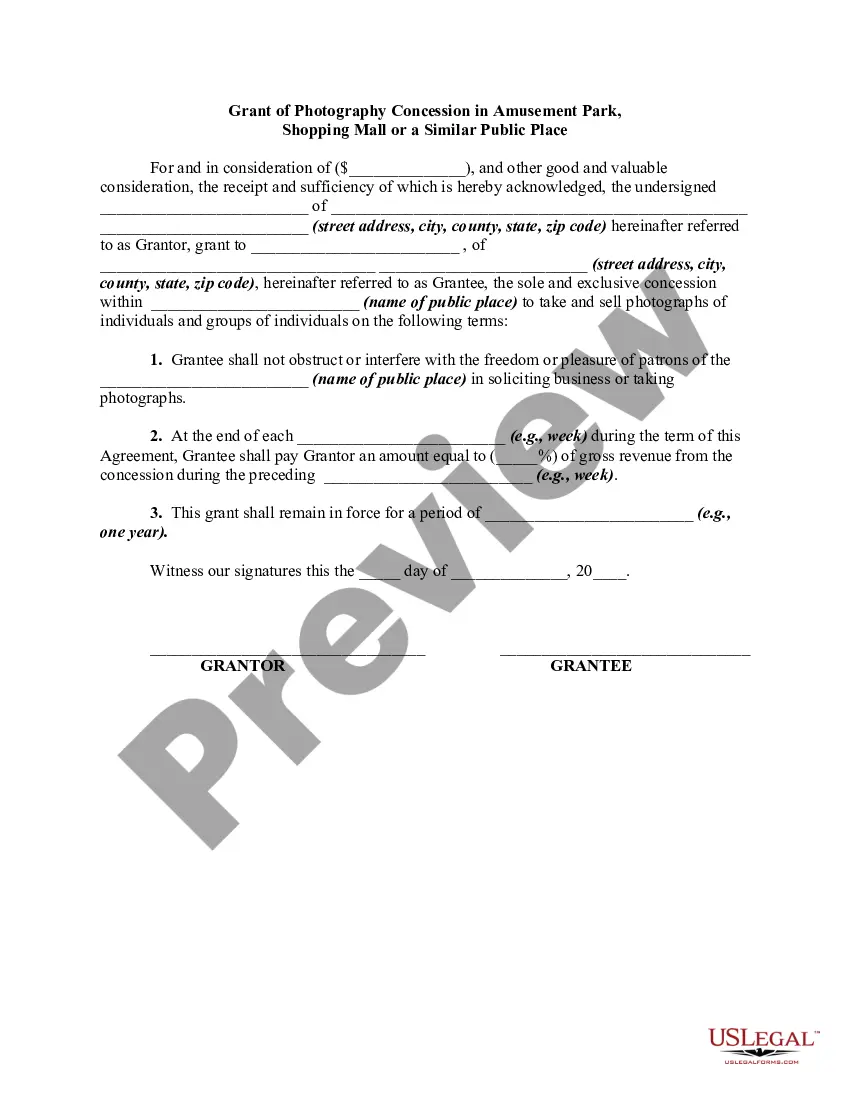
Grant of Photography Concession in Amusement Park, Shopping Mall or a Similar Public Place
What is this form?
The Grant of Photography Concession in Amusement Park, Shopping Mall or a Similar Public Place is a legal agreement that allows a photographer or photography company (the Grantee) to take and sell photographs of individuals and groups within a designated public space. This form is specifically designed for amusement parks, shopping malls, or similar venues, establishing the parameters and rights related to the concession of photographing patrons. It differs from standard photography agreements by focusing on public spaces and the sale of photos taken therein.
Main sections of this form
- Names and addresses of both the Grantor and Grantee involved in the agreement.
- Description of the public place where photography will take place.
- Terms regarding the Grantee's obligation to not obstruct patrons while soliciting business.
- Payment structure based on gross revenue from photography sales.
- Duration of the concession agreement.
- Signatures of both parties to formalize the agreement.
When this form is needed
This form is needed when an individual or business wants to secure the rights to photograph and sell images of patrons in a public place like an amusement park or shopping mall. It is particularly useful for photographers who want to ensure compliance with local regulations while protecting their right to conduct business in such venues. Examples include new photography businesses entering agreements with public space managers or existing businesses renewing or altering their concession agreements.
Who should use this form
This form is suitable for:
- Photographers or photography companies seeking to sell photographs in public places.
- Owners or managers of amusement parks, shopping malls, or similar establishments.
- Event organizers who may need to photograph attendees in a public venue.
- Anyone involved in managing public spaces where photography is permitted.
How to prepare this document
- Identify the parties: Fill in the names and addresses of the Grantor and Grantee.
- Specify the public place: Clearly state the name and location of the amusement park or shopping mall.
- Detail the payment terms: Enter the agreed percentage of gross revenue the Grantee will pay to the Grantor.
- Set the duration: Indicate the length of time the concession agreement will be effective.
- Sign the agreement: Ensure that both the Grantor and Grantee sign and date the document to make it legally binding.
Is notarization required?
This form does not typically require notarization unless specified by local law. However, it is recommended to have the signatures witnessed for added validation, especially in formal agreements related to business concessions.
Get your form ready online
Our built-in tools help you complete, sign, share, and store your documents in one place.
Make edits, fill in missing information, and update formatting in US Legal Forms—just like you would in MS Word.
Download a copy, print it, send it by email, or mail it via USPS—whatever works best for your next step.
Sign and collect signatures with our SignNow integration. Send to multiple recipients, set reminders, and more. Go Premium to unlock E-Sign.
If this form requires notarization, complete it online through a secure video call—no need to meet a notary in person or wait for an appointment.
We protect your documents and personal data by following strict security and privacy standards.

Make edits, fill in missing information, and update formatting in US Legal Forms—just like you would in MS Word.

Download a copy, print it, send it by email, or mail it via USPS—whatever works best for your next step.

Sign and collect signatures with our SignNow integration. Send to multiple recipients, set reminders, and more. Go Premium to unlock E-Sign.

If this form requires notarization, complete it online through a secure video call—no need to meet a notary in person or wait for an appointment.

We protect your documents and personal data by following strict security and privacy standards.
Common mistakes
- Failing to include complete addresses for both parties.
- Not specifying the exact terms or conditions of the concession.
- Omitting the payment structure or incorrect calculation of gross revenue percentages.
- Not having both parties sign the form, which can render it unenforceable.
Why complete this form online
- Convenience of downloading the form from anywhere at any time.
- Editability allows customization to meet specific needs.
- Access to reliable legal templates drafted by licensed attorneys.
- Speeding up the process of securing photography concessions without need for legal consultations.
- This form serves as a legal agreement outlining the rights and responsibilities of both parties regarding photography in public spaces.
- The terms must be clear to ensure enforceability and to prevent misunderstandings.
- Consulting with a legal professional is advisable to adapt the form if necessary based on specific local laws.
What to keep in mind
- The Grant of Photography Concession form is essential for securing exclusive photography rights in public venues.
- Clear terms and signatures from both parties are necessary to make the agreement valid and enforceable.
- Using this form addresses potential legal and operational issues related to photography in public places.
Looking for another form?
Form popularity
FAQ
Shopping centres are private property and therefore the owners can impose restrictions and bans on taking photographs whilst on their property. you can however take photos of private property, ie shopping centre, if you are standing on the public highway.
Public place includes any highway and any other premises or place to which at the material time the public have or are permitted to have access, whether on payment or otherwise .
The less develop areas of coasts and foreshores can be considered spaces rather than places. There is an argument that these places can be considered examples of neighbourhood parks (local beaches) and Town Squares (regional beaches).
Privately owned restaurants and bars, however, are also considered public places in most legal definitions because the public is invited into the establishment.In other words, if you are allowed to walk into a place without an invitation, it's probably public.
Public place includes any highway and any other premises or place to which at the material time the public have or are permitted to have access, whether on payment or otherwise .
For this purpose a public place shall mean any place intendedaccessible to the public and shall include any public conveyance. 24. The same definition of public place was contained. Supreme Court of India.
A person's garden cannot be a public place, notwithstanding the possibility that from there he might be able to inflict injury with a weapon on a passer-by on adjacent land to which the public has access.
A public space is a place that is generally open and accessible to people. Roads (including the pavement), public squares, parks and beaches are typically considered public space.