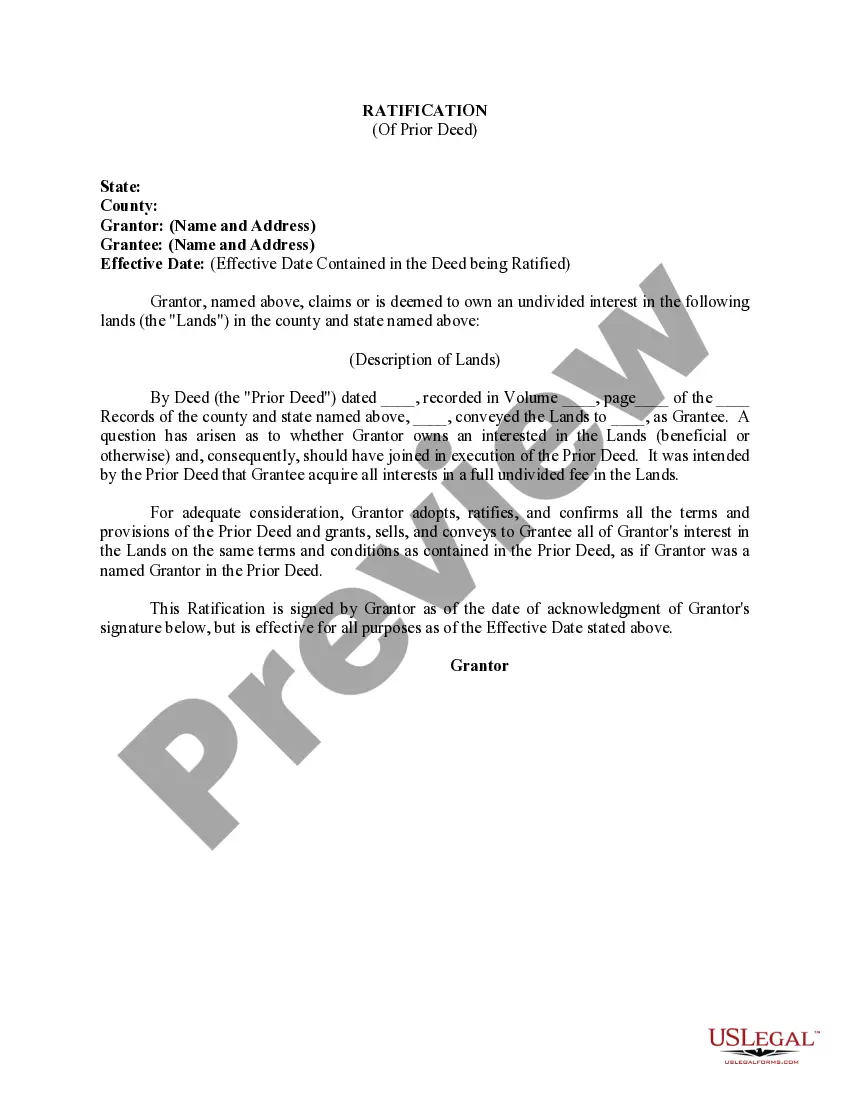
Proposal and Acceptance of the Installation of a Sprinkler System
What this document covers
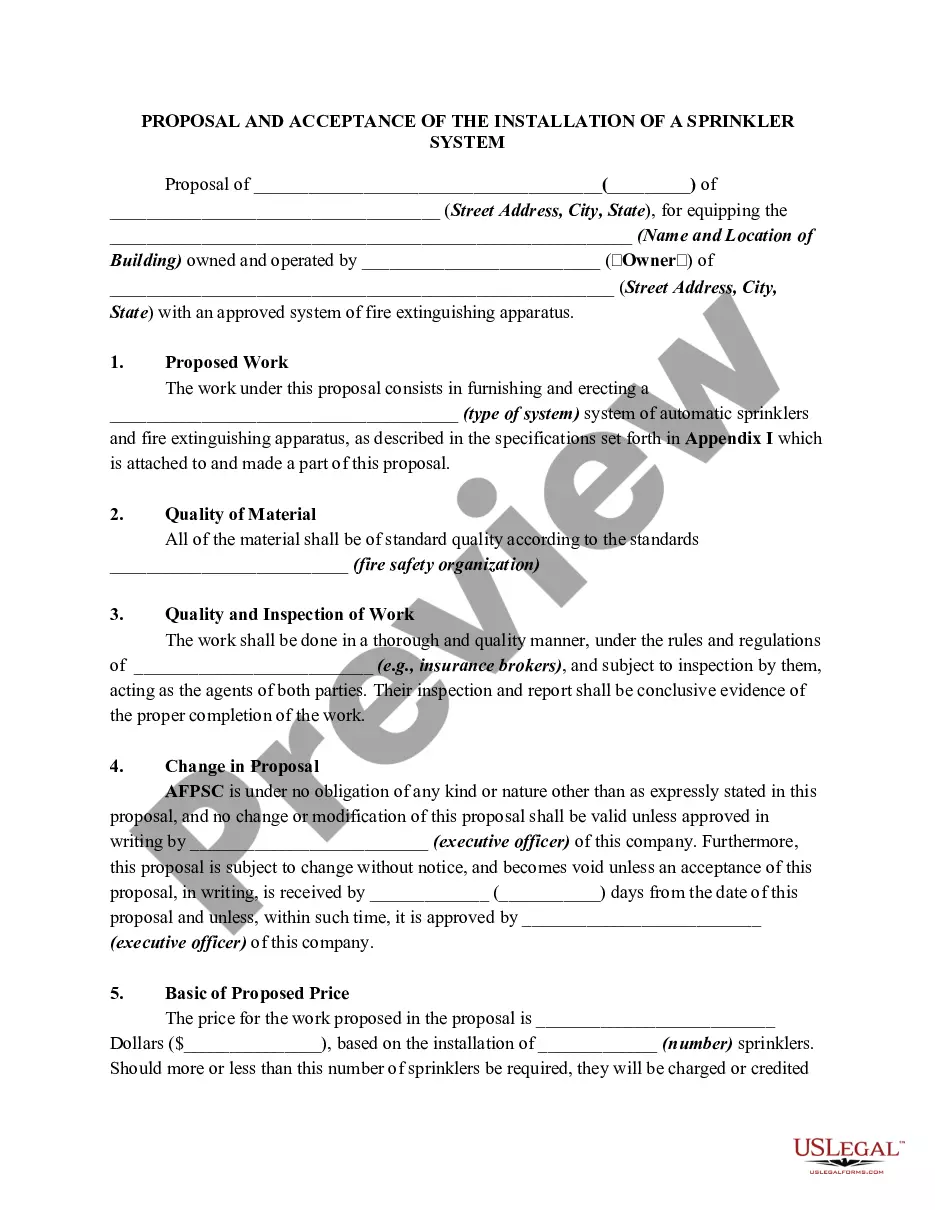
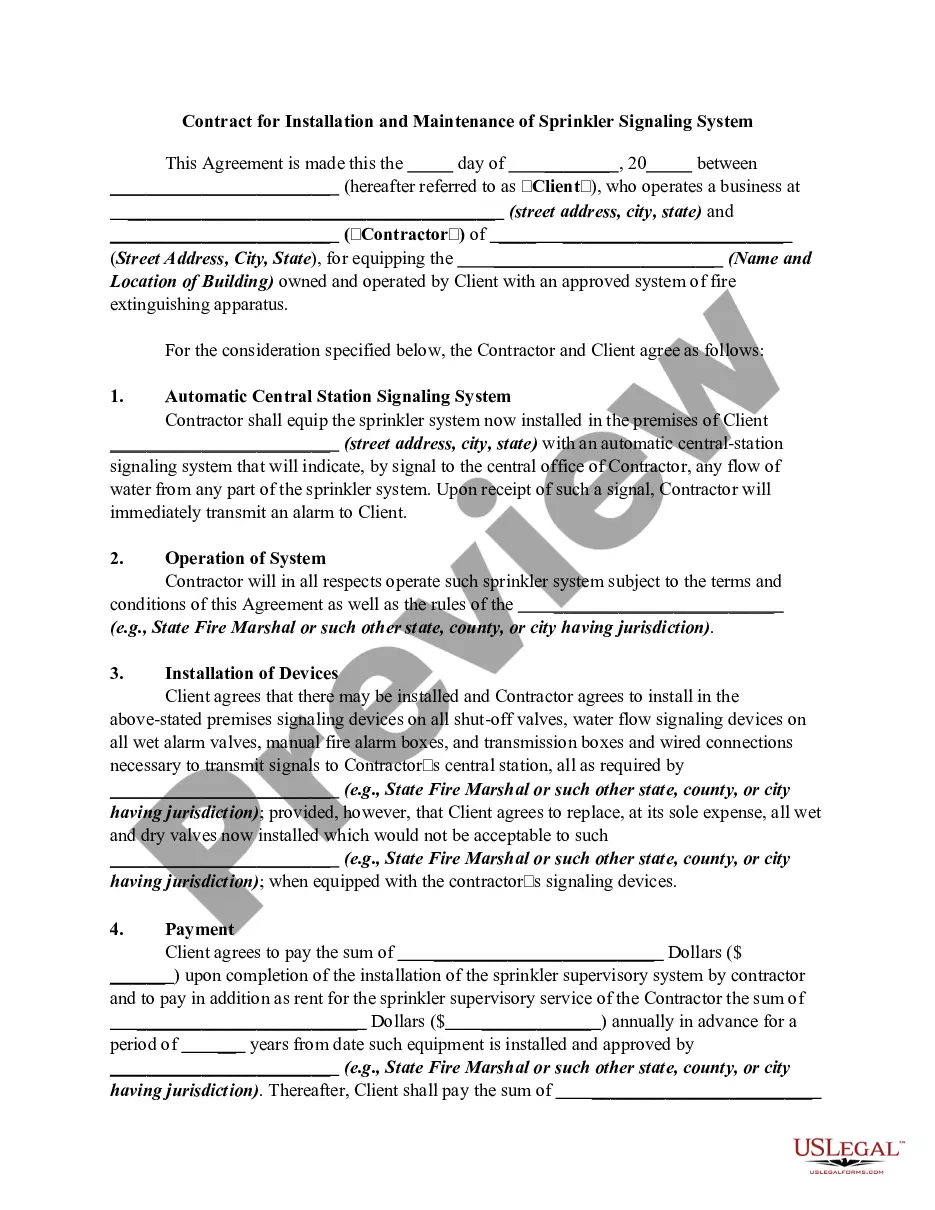
The Proposal and Acceptance of the Installation of a Sprinkler System is a legal document that outlines the terms for installing a sprinkler system, including price and specifications for labor and materials. This form serves as a formal agreement between the property owner and the contractor, ensuring both parties have a clear understanding of the scope and cost of the fire protection system. It differs from other installation agreements by focusing specifically on sprinkler systems and their related components.
Key parts of this document
- Proposal details, including the quoted price and installation specifics.
- Quality standards of materials to be used in the sprinkler system installation.
- Inspection clauses to ensure work meets established regulations.
- Terms for modifications or changes to the proposal.
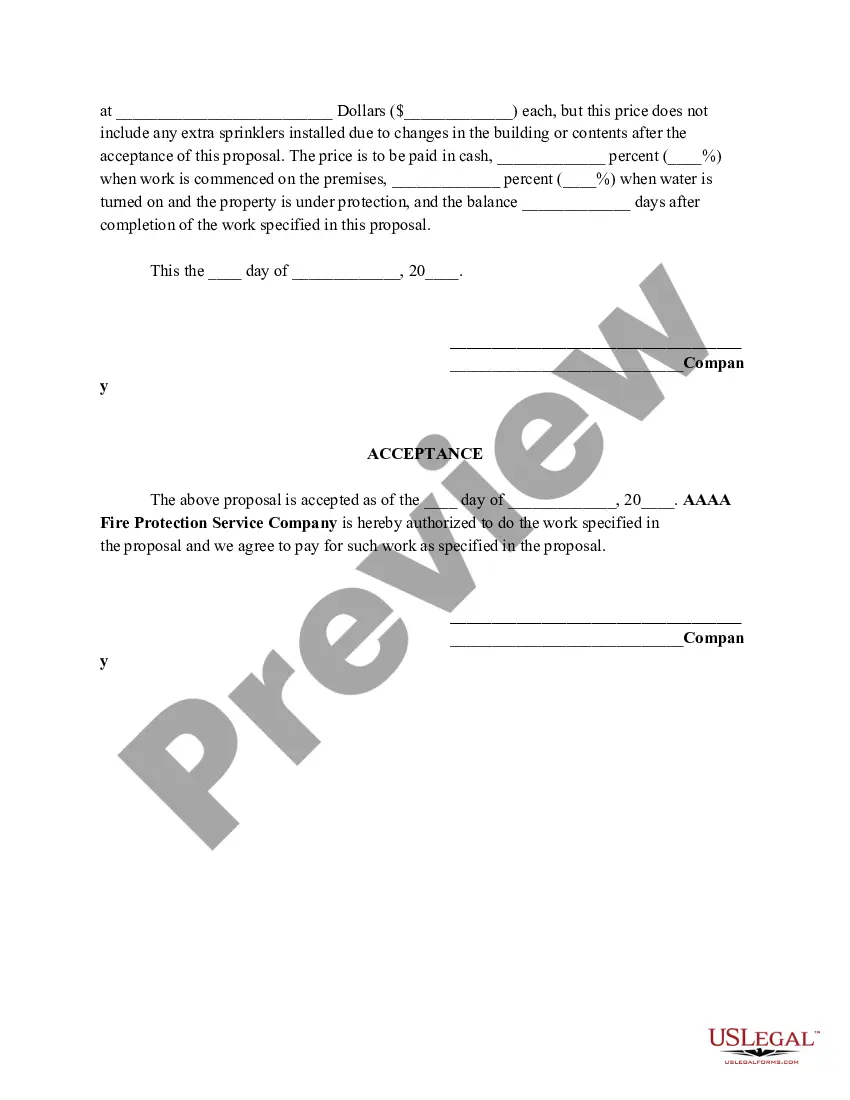
- Payment schedule outlining when and how payments will be made.
- Acceptance section for the property owner to sign, indicating agreement to the proposal.
When this form is needed
This form should be used when a property owner wishes to hire a contractor for the installation of a sprinkler system. It is particularly relevant in situations requiring compliance with fire safety regulations or when a property is under construction or renovation. Utilize this form to clearly set out the financial terms and specifications, ensuring that both parties agree to the work to be completed.
Who needs this form
- Property owners looking to install a new sprinkler system.
- Contractors seeking formal agreements for their installation services.
- Business owners needing compliance with local fire safety regulations.
How to prepare this document
- Identify the parties involved: property owner and contractor.
- Enter the property specifics, including the name and location of the building.
- Detail the proposed work, including the type of sprinkler system.
- Fill in the price for the installation and outline the payment terms.
- Have both parties sign and date the form for mutual acceptance.
Does this form need to be notarized?
Notarization is not commonly needed for this form. However, certain documents or local rules may make it necessary. Our notarization service, powered by Notarize, allows you to finalize it securely online anytime, day or night.
Get your form ready online
Our built-in tools help you complete, sign, share, and store your documents in one place.
Make edits, fill in missing information, and update formatting in US Legal Forms—just like you would in MS Word.
Download a copy, print it, send it by email, or mail it via USPS—whatever works best for your next step.
Sign and collect signatures with our SignNow integration. Send to multiple recipients, set reminders, and more. Go Premium to unlock E-Sign.
If this form requires notarization, complete it online through a secure video call—no need to meet a notary in person or wait for an appointment.
We protect your documents and personal data by following strict security and privacy standards.

Make edits, fill in missing information, and update formatting in US Legal Forms—just like you would in MS Word.

Download a copy, print it, send it by email, or mail it via USPS—whatever works best for your next step.

Sign and collect signatures with our SignNow integration. Send to multiple recipients, set reminders, and more. Go Premium to unlock E-Sign.

If this form requires notarization, complete it online through a secure video call—no need to meet a notary in person or wait for an appointment.

We protect your documents and personal data by following strict security and privacy standards.
Avoid these common issues
- Failing to specify all required details about the sprinkler system installation.
- Neglecting to include the correct payment schedule and terms.
- Not obtaining signatures from both parties before commencing work.
- Overlooking local fire safety regulations that may require additional provisions.
Benefits of completing this form online
- Convenient access allows you to complete the form anytime and from anywhere.
- Editability ensures you can customize sections according to your specific project requirements.
- Reliable templates drafted by licensed attorneys provide peace of mind regarding legal validity.
Legal use & context
Using this form ensures that both parties have a clear understanding of their responsibilities and obligations regarding the sprinkler system installation. It helps establish enforceability in case of disputes and serves as a record of the agreement made between the contractor and the property owner.
Main things to remember
- The form formalizes an agreement between property owners and contractors for sprinkler system installation.
- It includes critical details such as costs, materials, and payment terms.
- Proper completion and signatures are essential for the form's validity.
Looking for another form?








Form popularity
FAQ
Plot types and locations of sprinkler heads. Plan the System. install an anti siphon valve. Access the Water Line. dig the trench for system. attach one end of valve manifold assembly to water. attach risers using 90 degree connectors. level sprinkler heads with soil level. timer controls length and frequency of waterings.
Sprinkler heads should always be placed so that the sprays overlapthe distance one head throws should reach the head of the next sprinkler. This is called head-to-head coverage, and sprinklers should be placed equidistantly in each zone to achieve it.
The hardest part of installing a DIY sprinkler system is laying all the underground water-supply piping. That is, if you dig the trenches by hand.Just push the saddle down onto the pipe at each sprinkler head location, then twist the handle to puncture the piping, so water can flow to the sprinkler.
Sprinkler heads should always be placed so that the sprays overlapthe distance one head throws should reach the head of the next sprinkler. This is called head-to-head coverage, and sprinklers should be placed equidistantly in each zone to achieve it.
You'll also save money doing it yourself. A professionally installed system for a typical ¼-acre lot is $3,000 to $4,000. You can DIY it for under $1,500. The heart of an underground system is pop-up sprinkler heads.
Primary goal: life safety, Secondary goal: property protection. When sprinklers are present, the risk of dying in a home fire decreases by nearly 80%. Sprinklers reduce the average property loss by 71%. Sprinkler systems are designed to control a fire for a sufficient time to enable people to escape.
I still recommend that you keep at least 80% of the sprinklers at head-to-head spacing! Take the sprinkler head watering DIAMETER and multiply it by 0.6 to get the absolute maximum distance that should ever occur between any two adjacent sprinklers.
Run your sprinkler and see how long it takes to get a half inch of water in the can just like a rain gauge. Usually it's about 30 minutes. So 20 minutes, 3 times per week will get an inch of water on your lawn, and 30 minutes 3 times per week will get 1 ½ down.
By allowing each sprinkler head to overlap with one another you create a consistent layer of watering. Meaning each area of your yard will have nearly the same amount of water applied. On average rotor heads general spray 30 feet, therefore they should be placed 30 feet apart from one another.